Qatar’s strategic potable water storage has grown from about 2.5 days of supply to roughly 5.5 days, according to the Qatar General Electricity and Water Corporation (KAHRAMAA). The utility credits a program of 15 concrete reservoirs linked by more than 600 kilometers (km) of large-diameter pipeline.
The Water Mega Reservoirs Project, a finalist for POWER’s 2026 Water Award, is owned by KAHRAMAA. It is built around five sites, designated PRPS 1 through PRPS 5, at Umm Birka, Umm Slal, Rawdat Rashed, Abu Nakla, and Al Thumama. KAHRAMAA says the extra reserve strengthens the country’s resilience to emergencies, supply interruptions, and peak demand.
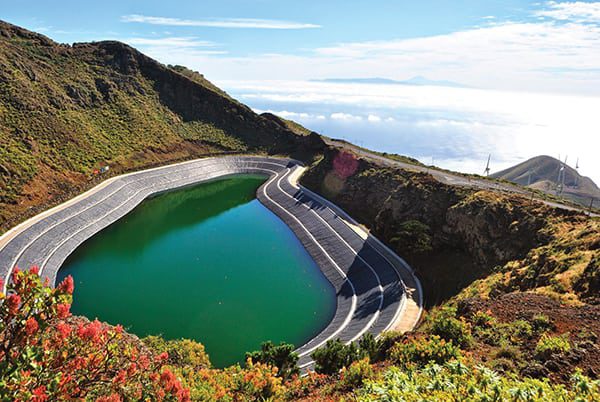
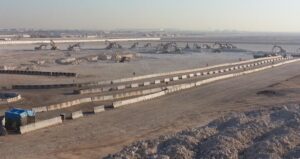
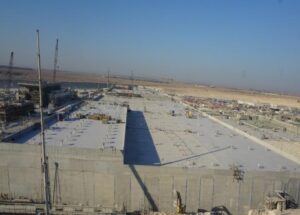
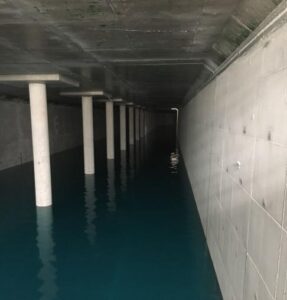
Scale is the headline. The sites hold a combined 1,421 million imperial gallons (MIG) across 15 reservoirs, each measuring roughly 300 meters (m) by 150 m by 12 m. PRPS 2 and PRPS 3 each hold four reservoirs totaling 386 MIG. PRPS 5 holds three, totaling 261 MIG, while PRPS 1 and PRPS 4 each hold two, totaling 194 MIG. Individual reservoirs range from 87 MIG to 97 MIG. KAHRAMAA describes the 97 MIG units as among the largest concrete potable water reservoirs in the world.
The pipeline network is the second half of the design. KAHRAMAA says the more than 600 km of pipe, in diameters from 900 millimeters (mm) to 1,600 mm, is arranged to supply water in both directions, north to south and south to north. Because the reservoirs are spread across the country rather than concentrated at one location, the utility says water can be rerouted through the interconnected network to keep supplying critical demand centers if a local disruption occurs.
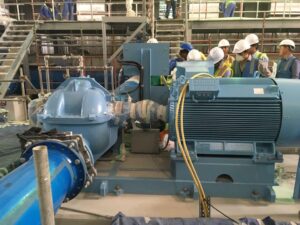
Pumping capacity determines how much of that storage is usable. Each PRPS site has a main pumping station with eight to 12 pumps, and KAHRAMAA says the largest are rated to deliver 2 m3/sec at 82 m of head. The utility argues that this lets it mobilize and move large volumes quickly, so the stored water is available in practice and not just on paper. By pairing 1,421 MIG of storage with a national pipeline network and high-capacity pumping at every site, KAHRAMAA has built a system meant to keep water moving, not just held in reserve.
—POWER