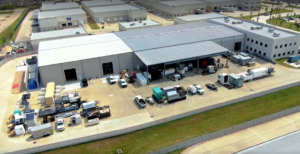
Late in construction of Total Hydrogen Solutions’ new hydrogen plant in Katy, Texas, someone cut and stole the incoming high-voltage cable. The theft forced a complete replacement of the affected run just as the team was preparing for utility energization.
“It was a frustrating hurdle, but the team coordinated the replacement and kept moving toward startup,” said Bobby Hunt, general manager of Total Hydrogen Solutions.
The setback is a fitting introduction to a project that has moved quickly and now awaits proof. Total Hydrogen Solutions, a division of Pneumatic and Hydraulic Co., built the Houston-area facility in 12 months. It is approaching initial energization and commissioning, Hunt said, so it is too early to share operating results or verified energy savings. What the plant can show today is its design, built around a bet that storing hydrogen will give the operator a say in when it draws power from the Electric Reliability Council of Texas (ERCOT) grid. The facility was a finalist for POWER‘s 2026 Hydrogen Award.
According to the company’s nomination, the plant combines electrolytic hydrogen production with compression, storage, and dispensing in a 5,500-square-foot footprint. The nomination puts capacity at 500 kilograms of hydrogen per day, enough to refuel up to eight Class 8 heavy-duty trucks or about 100 passenger vehicles such as the Toyota Mirai.
Assembling those pieces was the hardest part of the build. “The biggest challenge was bringing the individual systems together into a complete plant,” Hunt said. The electrolyzer is only one element, he explained, alongside electrical infrastructure, water treatment, cooling, purification, compression, storage, dispensing, and controls. Total Hydrogen Solutions manufactures its H-Drive compression equipment in-house, which Hunt said gave the company direct control over an important part of the project, and its team stayed closely involved in engineering, manufacturing, and installation.
The initial installation uses a 1-MW alkaline electrolyzer from HyperCellX. Hunt said Total Hydrogen Solutions chose it for two reasons: the company wanted to build around domestically manufactured equipment, and efficiency mattered because electricity is a major operating cost in hydrogen production.
That cost is where storage comes in. The nomination says the plant participates in ERCOT’s 4CP and demand-response programs. Hunt described that approach as planned rather than proven. “The idea is to use hydrogen storage to give us flexibility in when we produce,” he said. “Production and customer fueling do not necessarily have to happen at the same time.” By building inventory ahead of anticipated peak periods, Total Hydrogen Solutions intends to reduce production loads when it makes economic sense while serving customers from storage. Hunt cautioned that “actual savings and the right balance between production, inventory, and customer demand will need to be established through operation.”
Demand for the hydrogen is meant to come partly from Hyroad. The nomination says an offtake agreement with the company supports distribution to regional users, and Hunt called the relationship an important part of connecting supply with real demand. The nomination targets expansion to 2 MW by the end of 2026, with a modular design that could reach 5 MW. Hunt said timing will follow customer demand and the company’s experience commissioning the initial system. Total Hydrogen Solutions also hopes to apply what it learns at additional locations, adapting each to its customers, utilities, and site conditions.
For now, the measure of success is simpler. “The milestone we are working toward is straightforward: producing hydrogen on site and reliably putting it into a customer’s vehicle,” Hunt said.
—Aaron Larson is POWER’s executive editor.