If a number of technical, financial, and regulatory hurdles can be overcome, power generated by integrated gasification combined-cycle technology could become an important source for U.S. utilities. Our overview presents diverse perspectives from three industry experts about what it will take to move this technology off the design table and into the field.
In May, POWER interviewed representatives from two large consulting firms and a national electric energy research organization. From the challenges of adding carbon dioxide (CO2) capture technology to coal-fired plants to the impact of tax credits, the three experts shared their insights about integrated gasification combined-cycle (IGCC) technology. They discussed current and future IGCC technology developments and their predictions about when this technology might become commercially available in the U.S.
Increasingly viewed as having strong potential to provide abundant electricity in the U.S., IGCC technology still has to surmount a number of major challenges. As its name implies, the IGCC generation system integrates two different technologies: coal gasification from the chemical industry and combined-cycle power generation from the power industry. IGCC power plants can use synthetic gas (syngas) derived from a variety of sources such as coal, pet coke, and biomass as their fuel (Figure 1).
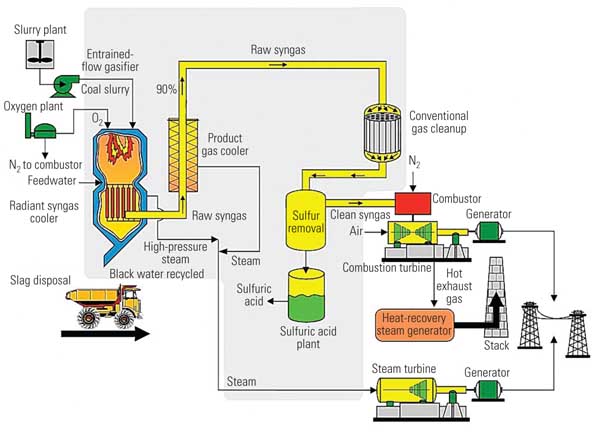
1. Dynamic duo. Integrated gasification combined-cycle (IGCC) plants integrate coal gasification with combined-cycle technology and can use synthetic gas derived from coal, pet coke, and other feedstocks. Source: Tampa Electric
Advantages of IGCC Plants
IGCC plants have a number of well-known advantages over traditional coal-fired power plants that use pulverized coal (PC), according to Steve Jenkins, the vice president of gasification services at CH2M HILL Inc., an international consulting, engineering, construction, and operations firm.
IGCC uses less water. IGCC uses about 33% less water for cooling purposes than a similar-size PC plant. This is because about two-thirds of the power generated in an IGCC plant is from the gas turbines and one-third is from a steam turbine-generator, which requires cooling water. Minimizing water needs can be a significant advantage in areas of the U.S. where water use is a major siting issue.
IGCC creates a usable by-product. When using high-temperature gasification technologies, the ash in the feedstock is removed in the form of a glassy, nonleachable slag that can be used in the manufacture of cement or roofing shingles, or as asphalt filler or aggregate. This slag is different from the bottom ash and fly ash produced by most PC units, which can be more leachable. Also, slag can be more easily handled, stored, and transported than fly ash.
IGCC has a carbon capture advantage. Although CO2 capture technologies are available for both IGCC plants (pre-combustion) and PC plants (post-combustion), IGCC plants may have an advantage because the technology required for pre-combustion CO2 capture has already been used successfully on coal gasification (but not IGCC) technology. Enhancements are being made to this technology for better performance in IGCC configuration. Furthermore, some of these capture technologies have the capability to produce the concentrated CO 2 stream at high enough pressures to match the needs of the compressors required to compress the CO2 for transport in pipelines for either sequestration or enhanced oil recovery. However, the costs and performance impacts for CO2 capture vary significantly between IGCC and PC plants.
IGCC Limitations
The advantages of IGCC must be balanced against its limitations, said David J. Stopek, PE, an engineer with Sargent & Lundy, a Chicago-based consulting firm.
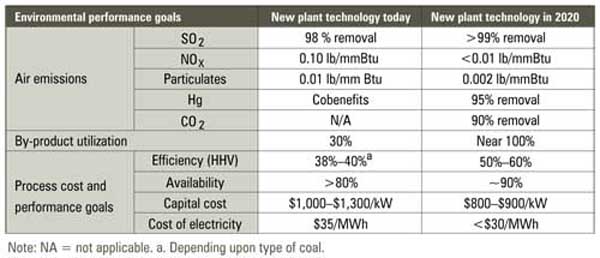
"IGCC can offer advantages compared to a conventional PC plant for the transition to a power generation fleet with a lower CO2 footprint based on coal," he commented. "Having said this, you must understand that IGCC is still an evolving technology compared to the level of commercial status of conventional PC technology [see table]. Because IGCC deployment has been limited, the costs for each plant require extensive engineering and development. Efforts by GE and others to develop a ‘standard’ plant are intended to help lower the cost for deployment. The projects first envisioned by Duke Energy and American Electric Power (AEP) were an effort in that direction. However, the fact that AEP was unable to gain approval by their state regulatory agencies to place their plants into rate-base has derailed these efforts to a degree."
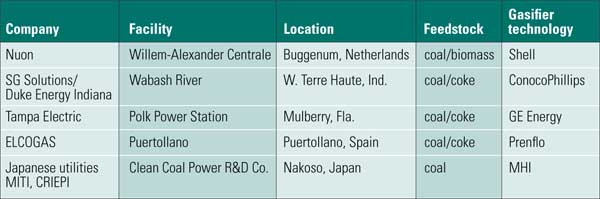
An exclusive club. As of 2009, there are five operating coal-based IGCC plants worldwide. Source: CH2M HILL
Major Roadblocks to Development
Jeffrey N. Phillips, the senior program manager of advanced generation at the Electric Power Research Institute (EPRI) pointed out some of the major implementation challenges that IGCC technology faces.
"For plants without CO2 capture, IGCCs are more expensive to build than PCs," he said. "Also, with natural gas prices currently in the $4/MMBtu range, it is difficult to choose an IGCC over a natural gas combined-cycle. IGCC suppliers need to improve their cost-competitiveness versus PCs."
EPRI believes that one way to make that happen is to focus on standardized designs that minimize up-front engineering costs. EPRI’s CoalFleet for Tomorrow has been encouraging such an approach with the development of its CoalFleet User Design Basis Specification (UDBS) for IGCCs that defines the capabilities that power plant owners would like to see in an IGCC.
Jenkins listed a number of other challenges that IGCC developers currently face:
-
Permit appeals. Appeals by environmental advocacy groups (even for IGCC plants) make it difficult for projects to proceed. For non-utility projects, developers may not be able to obtain the required funding from investors to move forward while permits are under appeal. Of course, this is a tactic well understood by those advocacy groups.
-
Cost issues and how they are addressed by public utility commissions. Because IGCC plants cost more than PC plants (for the same capacity), some public utility commissions have been reluctant to approve those additional costs, even when approving IGCC technology as the choice to meet the "need for power" requirements of a Certificate of Public Convenience and Necessity.
-
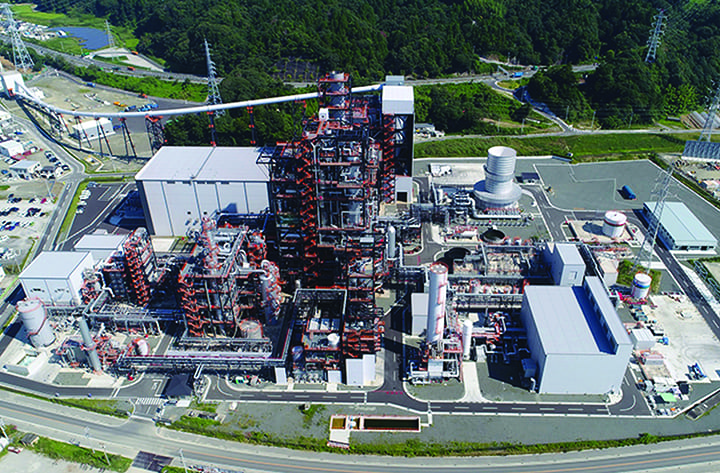
Obtaining meaningful guarantees at an affordable price. Because there are only two coal-based IGCC plants in the U.S. (Figure 2), IGCC technology suppliers do not have an extensive database of experience to work with, as they do for PC plants. Therefore, there is more potential risk to these suppliers with respect to performance and availability (and associated monetary liabilities), and they must translate the potential risk of nonperformance into additional cost.

2. A power pioneer. Operating since 1996, Tampa Electric’s 250-MW IGCC Polk Power Station is located in Mulberry, Fla. It was the first full-size commercial plant in the U.S. to use the advanced IGCC process. Courtesy: DOE
Stopek added two other roadblocks to the deployment of IGCC technology in the U.S.:
-
The downturn in the economy has pushed back the drive to add new baseload capacity. As baseload needs have eroded, the availability of natural gas has risen and its cost is lower. These factors are allowing companies to sit on the sidelines and wait for new greenhouse gas (GHG) regulations to become law and eliminate the uncertainties they now face in supplying customer electricity demands for the future.
-
Congress needs to step up and take action on climate and energy legislation that ends the speculation that is crippling new action on new plant construction. Distribution of incentives and/or penalties must be carefully weighed in the crafting of new laws to ensure that unintended consequences do not occur. New laws must reshape the energy landscape in a way that provides a reduction in GHG emissions while minimizing the impact to the energy consumer without disrupting the entire economy. This is a delicate balancing act that Congress faces in meeting this challenge.
IGCC’s Availability Challenges
"Historical data clearly shows that the existing coal-based IGCC plants have not been able to achieve 85% availability on a sustained basis," Jenkins said. "It typically takes several years of operation to achieve levels of even 80%, and some have not yet reached 70%. However, these are one-gasifier-train systems." (See "Polk Power Station, Unit 1," POWER, Oct. 2007.)
Using that operational data and lessons learned, IGCC technology suppliers have implemented enhanced design concepts (discussed above) to increase availability, including the use of multiple gasifier trains, he said. Data submitted by IGCC developers to state and federal agencies show that the two-train reference plant designs are expected to achieve about 85% availability. Adding a spare (third) train may increase overall IGCC availability to about 90%, although at considerable additional cost.
Phillips had an optimistic view of efforts to overcome this problem. "Overall, the availability of coal- and oil-based IGCCs has been improving over time," he said. "The availability of the first generation of IGCCs is similar to that of the first generation of supercritical PCs and nuclear plants. Both those technologies now enjoy availabilities in the mid-80% to 90%. With additional experience it is reasonable to expect that IGCC availability will also increase."
Additionally, all of the first-generation IGCCs were based on single-train designs (one gasifier, one gas turbine), he pointed out. EPRI’s UDBS for IGCCs calls for dual-train systems, which EPRI’s analysis indicates will have better availability because the plant can continue to operate, albeit at reduced load, when one gasifier or gas turbine is down. The operating train can be used to keep the equipment on the other train warmed up. This allows for faster start-up times for the second gasifier or combined cycle, which helps availability.
Barriers Utilities Face in Building IGCC Plants
A major challenge is the time and expense in getting to the point that the utilities have a detailed design with a solid cost estimate, according to Phillips.
"For example, Southern California Edison Co. (SCE) recently got approval from the California PUC [Public Utility Commission] to spend up to $26.3 million on a feasibility study for their ‘Clean Hydrogen Power Generation’ project, which would be an IGCC with CO2 capture and storage," he said. "Only at the end of that study will they know how much such a plant will cost to build and what its operational performance will be. That’s a hefty price for just ‘window shopping.’"
Stopek explained the differences for utilities seeking to build a new PC plant versus one that would use IGCC technology. The current practice for a power company wanting to build a new PC power plant starts with determining the size required to meet its needs and competitively bidding the major components, such as the boiler, turbine, and emission controls, he explained. Bidders then respond to detailed specifications developed from years of experience designing what is now the industry standard for reliable power generation that meets all the emission requirements based on specified fuels, location, and other requirements.
"This has not been the case for IGCC; the technology suppliers are not yet willing to compete based on the traditional procurement model," he said. "The suppliers will not provide cost estimates unless they are paid to perform their front end engineering design study. To develop a cost estimate that is accurate to ±10% typically requires that about 30% of the design engineering be performed at a cost of about $20 million (give or take). Duke and AEP conducted a technology review and selected the company they thought would provide the ‘best’ price and product for an IGCC facility and proceeded on a sole-source basis with that company."
CO2 Capture Technology’s Negative Impacts
"Recent detailed studies conducted by the U.S. Department of Energy (DOE) and EPRI clearly show that the addition of CO2 capture equipment to IGCC plants has a significant impact on plant efficiency and net output, as well as on capital cost," Jenkins said.
These studies show that, on average, the following impacts result from adding CO2 capture systems to an IGCC plant using bituminous coal:
-
Capital cost in $/net kW goes up by 32%.
-
The cost of electricity increases by 40%.
-
Net output is reduced by 15%.
-
Efficiency is reduced by 22%, or 8 to 10 percentage points.
These are significant impacts on performance and cost, according to Jenkins. For net output, the reduction would be about 100 MW on a 600-MW net IGCC reference plant. This is primarily due to the additional internal power needed for the CO2 capture equipment; using steam in the CO2 capture system instead of steam turbine power generation, as designed; and the additional power required for the CO2 compressors. What many do not understand is that this "lost" 100 MW must then be made up by other generating units, which may actually have higher emission rates for CO2 as well as other pollutants, he noted.
Stopek agreed with Jenkins about these disadvantages and gave additional insights. "The challenge of adding CO2 capture to an existing IGCC plant must be discussed at the early phases of the project development," he said. "The owner must understand that converting the syngas from a mixture of CO and H2 to predominantly H2 will result in a ‘de-rating.’ This derating can be compensated for during design by ensuring the capability to gasify more fuel. The owners must be willing to accept this cost. If not, they must be willing to accept the derating. This is fundamentally different than just adding additional booster fans to a coal-fired plant to accommodate the pressure drop of a flue gas desulfurization system."
The gasifier and downstream systems must be designed to process the additional fuel (up to 15% more), according to Stopek. More ash and sulfur are produced, so all the supporting tanks, pumps, and equipment must have sufficient margin in their design to handle this future flow rate. Some of this capacity may be available by increasing design pressure, but then the entire equipment design must be scrutinized to ensure that it is designed for the appropriate new pressure.
Long Timeline for Carbon Capture and Storage
"First, we need to prove that large-scale (greater than a million tons per year) geologic storage of CO2 can be a reliable and long-term option for sequestering CO2 captured from power plants, and also the legal rules governing storage need to be established," Phillips said. "Until that happens, it will be very difficult to get commercial projects with carbon capture and storage [CCS] financed. However, in the meantime, you could sell captured CO2 for enhanced oil recovery [EOR] if your IGCC is located near oil fields; that is what Mississippi Power is proposing to do. All the rules and liabilities for covering CO2 transportation and storage have been established for EOR applications."
Stopek expanded upon Phillips’ comments. The demand for greenhouse gas control is a steamroller that is moving quickly toward legislative action, he noted. However, the technology needed to store CO2 forever must be demonstrated, and that takes time. The industry is now moving quickly, in a programmatic fashion.
"Early this May, I attended a conference on CCS in Pittsburgh and was delighted to see the amount of talent from across the country now focusing on these issues," he said. "However, each step must be approached in a logical sequence, and testing takes time. The legal issues are complex. The insurance risks are real. But I am confident these will be solved. It is critical that as the requirements for CCS come into place, particularly the sequestration part, that all these issues be addressed. Also, it is important that a well-structured monitoring and regulation framework go with it. This framework needs to be tested and validated. These take time, money, and effort. I believe the current administration recognizes this and is putting the resources into place to accomplish this mission. The true question is: Can the results come in time for informed decision-making?"
Recent Technical Innovations
Jenkins pointed to a number of new developments with IGCC technology:
-
More-efficient hot gas particulate removal systems.
-
Higher-firing-temperature gas turbines.
-
Gas turbines designed to combust high-hydrogen-concentration syngas (for IGCC plants with CO2 capture).
-
Gasifier "burners" that last much longer than those developed previously.
-
Refractory materials using advanced "recipes" based on recent research and development funded by the Department of Energy.
-
Sulfur-free start-up procedures using patented start-up fuels.
-
Larger gasifiers that operate at higher pressures (for higher efficiency).
-
Use of activated carbon beds for mercury removal.
-
Syngas moisturization and enhanced use of diluents such as nitrogen from the air separation unit to reduce gas turbine combustion temperatures, leading to lower NOx production.
-
Better materials of construction in corrosive environments.
-
Better performance when using Powder River Basin coals.
-
Partial integration of the gas turbine compressor with the air separation unit (which reduces overall plant internal load).
Stopek commented on IGCC manufacturers’ future technical goals. "Each of the equipment suppliers is conducting its own reliability and maintainability analyses of its technology and identifying means to improve availability, lengthen maintenance cycles, and eliminate unscheduled outages," Stopek said. "However, the lack of a central reporting function such as the North American Electric Reliability Corp. GADS [Generating Availability Data System] database that is open to the public creates a lack of transparency to the consumer who must ‘trust’ the supplier or rely on guarantees."
Jenkins also commented on the new breakthroughs that IGCC manufacturers are trying to achieve:
-
Higher efficiency through the use of enhanced heat-recovery systems.
-
Higher availability by using more advanced materials of construction (more corrosion-resistant alloys) and gasifier refractory and by optimizing the use of spare equipment and spare gasifier and syngas cleanup trains.
"The thousands of lessons learned at existing IGCC plants are well documented in EPRI’s CoalFleet IGCC UDBS, and are being incorporated by the manufacturers into new IGCC plant designs," he said.
Regulatory Hurdles
"AEP’s experience with their proposed West Virginia IGCC is instructive," Phillips said. "While it was approved in West Virginia, they also needed approval from Virginia because the plant would provide electricity to some parts of that state. The Virginia Public Service Commission rejected the proposal because the IGCC plant was more expensive than conventional coal plants, and they considered the potential benefits of an IGCC with CCS to be of ‘limited value’ because they felt ‘no party knows for certain the specific commercially available technology that will be used for carbon capture and sequestration’ and because AEP did not ‘identify any commercial generation facility that has implemented CCS.’ That points out the need for educating regulators on CCS technology."
Stopek also had concerns about the regulatory challenges affecting U.S. utilities. The lack of a regulatory framework over the past decade has played a part in the paralysis seen in the industry, he said. The capital requirement for new coal-based generation capacity is so great today that many companies and their financial institutions cannot take the risk associated with an error in judgment of what the future might hold for CCS regulations.
"For this reason, I see more interest in gasification that is inherently more versatile in its product alternatives, such as for production of substitute natural gas [SNG]," he said. "Combustion turbines [CTs] firing gas (or coal-based SNG) can be sited closer to the electrical demand, thus avoiding the cost of new transmission, which is also woefully needed. The existing CT fleet will experience higher demand, and new turbines can be added much more quickly than coal or nuclear power. Further, the addition of CTs will better match up with the growing fleet of renewable power that is expected over the next decade. The use of SNG will provide a greater certainty to gas prices and a hedge against price speculation in the market. Of course, this is a very complex strategic decision that requires weighing many factors."
Jenkins also addressed the potential impacts of CO2 reduction regulations. IGCC technology still needs to be operated at the two-train reference plant size, such as 600 MW to 650 MW, and to prove its performance and availability with the design enhancements described earlier, but without the addition of CO2 capture equipment to "weigh it down," he emphasized.
"It will be important for this first fleet of reference plants to be able to operate for a reasonable timeframe without any CO2 capture equipment," he said. "In a sense, IGCC technology needs the chance to ‘run before it can walk.’ In addition, dealing with air permit appeals will delay the construction and operation of these units. Unfortunately, some environmental advocacy groups that previously supported IGCC technology are now opposing it."
The Inadequacy of Tax Credits
Phillips pointed out that, as of May 2009, only one IGCC that received the Energy Policy Act of 2005 (EPAct) tax credits is under construction: the Duke Edwardsport plant (Figure 3).

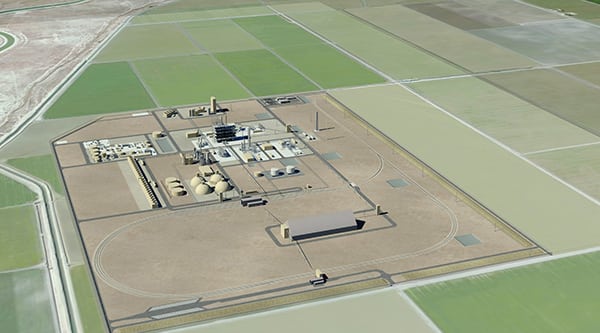
3. Under construction. An artist’s rendering of Duke Energy’s 795-MW Edwardsport IGCC plant near Vincennes, Ind. Courtesy: Duke Energy
He mentioned the current status of several other IGCC projects:
-
Mississippi Power has a proposal pending to build an IGCC plant in Mississippi, and it could be under construction shortly if it is approved by the state’s Public Service Commission.
-
TECO Energy’s Polk 6 IGCC project received tax credits but was put on hold due to cost and regulatory uncertainty.
-
Hydrogen Energy’s Carson project received credits but ran into siting difficulties and is now being reengineered for a location in California’s Central Valley.
-
The federal government may have awarded tax credits to other IGCC projects, but after announcing the first group of recipients, the government decided it could not announce subsequent decisions due to taxpayer confidentiality concerns, according to Phillips.
Jenkins pointed out that although such tax credits are helpful, they are insufficient as the sole incentive to drive these projects forward.
"For example, $135 million tax credits were awarded to several IGCC projects," he said. "However, at a total installed cost of $2.3 billion, the tax credits amount to only about 5% of the total project cost, and they do not provide the ‘cold, hard cash’ needed up front to fund these projects. Combinations of tax credits, loan guarantees, and direct cofunding by state and federal agencies can add up to the more significant amounts needed to enhance the project economics and move them forward more quickly."
Comparative Costs of IGCC-Generated Electricity
If in the future some level of CO2 capture and storage is mandated for new coal-fired power plants, that regulation will narrow and perhaps close the cost-of-electricity gap between IGCCs and PCs, Phillips predicted. EPRI has also looked at technical improvements that could make IGCCs more competitive. (See the free EPRI Report 1013219 on the EPRI website.)
"Among those innovations, the one that would provide the biggest improvement is using larger, higher-firing-temperature G and H class gas turbines instead of F class turbines," he said. These turbines offer two advantages for IGCCs: first, the larger size provides savings from economies of scale and second, the higher efficiency decreases fuel costs and also decreases the amount of CO2 that must be captured (on a lb-CO2 /MWh basis)."
Jenkins was also optimistic that IGCC technology will become more competitive. As the planned IGCC plants gain operational experience, that will led to continued enhancements in efficiency and availability for the next fleet of IGCC plants. In addition, IGCC plants may be able to utilize higher percentages of low-cost opportunity feedstocks, such as pet coke, thereby further lowering power generation costs.
IGCC’s Future Prospects
POWER asked the three experts to look into their crystal balls and forecast how far along they think IGCC technology will be in both the short-term and the long-term future.
"With only one IGCC currently under construction, another pending, and only two IGCCs currently in operation in the U.S., it is obvious that IGCC technology will play only a small role in generating electricity in the short term," Phillips said. "Whether its role will expand in the future will depend in great part on the ability of suppliers to decrease capital costs so that their technology is competitive with other options."
Jenkins was more willing to make a definite prediction about IGCC’s long-term fate. "Not much change in the short term," he said. "But once the handful of planned units have been in operation a few years, and there is more certainty with respect to CO2 emission limits or reduction requirements, IGCC should become a viable choice for coal-based power generation. Since these first IGCC plants are planned for start-up in the 2012 to 2013 timeframe, the next fleet incorporating these enhancements would likely begin operation in the 2017 to 2020 timeframe."
Likewise, Stopek was optimistic about the technology’s future. Once GHG rules are settled and the economy gets back on track, utilities will be able to better assess their needs for added capacity and replacement capacity, he said. As their requirements become more defined, and if the government takes an aggressive stand on CO2 emissions, he expects that at least one-half of all new coal plants will be gasification-based. However, he does not think all the capacity will be IGCC. He believes that there will be a wave of coal gasification to produce substitute natural gas first. These plants may have natural gas combined-cycle plants installed on the same property or simply supply gas to the pipeline. This development will be in response to the growing demand for gas-fired generation capacity that will meet the earlyterm CO2 limitations.
"By 2020 I would not be surprised to see IGCC with hydrogen-fired engines," he said. "These will be more efficient overall and will provide a lower carbon footprint. After more than 35 years working on the development of IGCC technology, the wide-scale deployment of this technology will be a gratifying achievement."
—Angela Neville is POWER‘s senior editor.