
Articles By

-
 Coal
CoalDesigning HRSG desuperheaters for performance and reliability
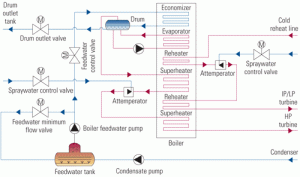
Increased cycling of combined-cycle plants has made precise control of attemperator spray water within heat-recovery steam generators more important if damage to their hardware and piping is to be avoided. Complicating the issue is the industry’s still-limited experience with cycling and the fact that demands on the attemperator and turbine bypass of cycled plants are more stringent than those on baseloaded units.
-
-
Poor priorities
I couldn’t help but marvel at the synchronicity of two unrelated events over the past few weeks. The first, on January 12, was the rare cancellation of a major military acquisition program with problems called "too expensive to fix." It takes an Act of Congress to kill most military contracts due to the pork flowing […]
-
-
 Gas
GasFleetwide standardization of steam cycle chemistry
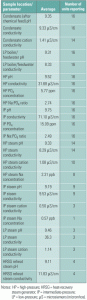
Nearly five years ago, a major IPP began standardizing steam cycle chemistry feed, control, and monitoring across its combined-cycle fleet. This article discusses the steps taken, the costs incurred, and the technical and financial benefits achieved. Although the project focused on non-cogeneration plants, the findings detailed below are broadly applicable to other kinds of plants. However, the specific implementations (especially of the chemistry standards) described may have to be modified slightly for application to cogen plants.
-

-
 Coal
CoalGas turbine "refueling" via IGCC
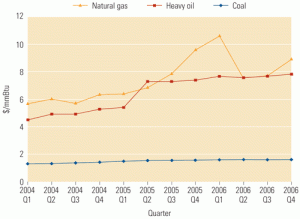
The jury is still out on the economic and technical feasibility of burning gasified coal to generate electricity. Gasification technology has yet to be proven on a utility scale, especially with Powder River Basin coal as the feedstock. And on the generation side, there are more questions than answers about the capital cost and availability of integrated gasification combined-cycle (IGCC) plants. But with natural gas prices high and rising, it’s definitely worth examining whether it would be economically and technically feasible to convert the existing U.S. fleet of gas-fired combined-cycle plants to burn gasified coal.
-
 O&M
O&MO&M staff keep their cool at Alaskan plant
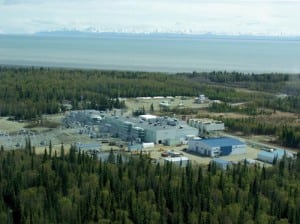
Operating a combined-cycle power plant profitably is no walk in the park, even under ideal conditions. But the extreme conditions at the Beluga Power Plant—from isolation to volcanoes—challenge its staff every day in ways that operators in the lower 48 can only imagine.
-
News
Poor Priorities
I couldn’t help but marvel at the synchronicity of two unrelated events over the past few weeks. The first, on January 12, was the rare cancellation of a major military acquisition program with problems called "too expensive to fix." It takes an Act of Congress to kill most military contracts due to the pork flowing […]
-
 O&M
O&MInclude generators and exciters in your outage inspections
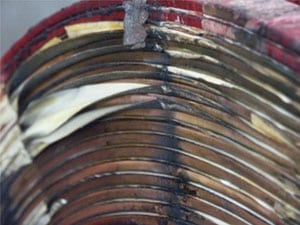
Generators and exciters don’t get much respect during scheduled outages. If yours fall into that category, a strategy that includes regular inspections and routine maintenance is all the more important for identifying incipient problems that could bring a plant down. Read on to learn how to keep your generator or exciter from suffering any of the problems shown in the dramatic photos.
-
 News
NewsEnvironmental quandary shuts Mohave plant
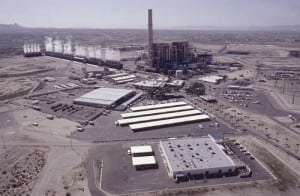
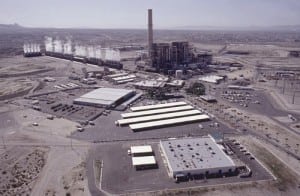
Southern California Edison (SCE, Rosemead, Calif.) closed the 1,580-MW coal-fired Mohave Generating Station in Laughlin, Nev., on December 31. In a filing with the California Public Utilities Commission (CPUC), SCE said it expects the plant to remain off-line for four years—the time it will take for the utility and the plant’s other owners to battle […]
-
-
 News
NewsFluor completes Texas project
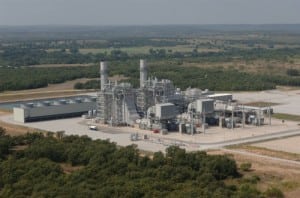
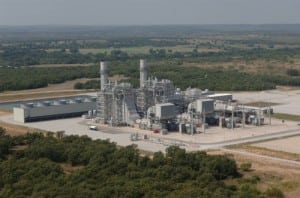
Fluor Corp. (Aliso Viejo, Calif.) has finished building and commissioning the 620-MW Jack County power plant (Figure 2) near Jacksboro, Texas, for Waco-based Brazos Electric Cooperative Inc. The natural gas–fired, combined-cycle plant officially came on-line on February 1. 2. Texas 2 x 1 step. The gas-fired, 620-MW, combined-cycle Jack County Generation Plant was built and […]
-
-
News
Russia says "da" to floating nukes
The Russian Federation plans to start building a floating nuclear power plant this year. According to the country’s atomic energy agency (Rosatom), the first plant will be small (3 MW) but could lead to the development of offshore plants with capacities of several hundred megawatts. The pioneering plant will be sited off the coast of […]
-
-
 News
NewsPearl Harbor cable links past, future
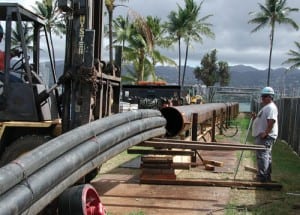
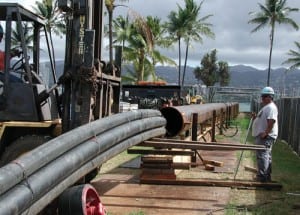
A new, mile-long submarine transmission cable in Pearl Harbor (Figure 3, p. 10) will facilitate the U.S. Navy’s plan to renovate and expand historic Ford Island. Honolulu-based Hawaiian Electric Co. Inc. (HECO) recently laid two new 46-kV lines beneath the bridge connecting the island to Oahu. The trickiest part of the installation was avoiding the […]
-
-
 News
NewsA breakthrough in hydroturbine design
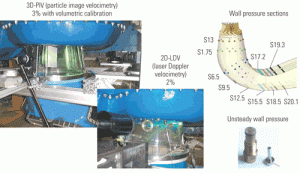
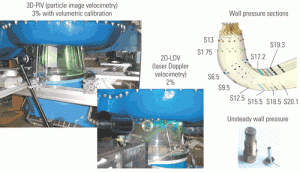
One of the distinguishing characteristics of deregulated power markets is variable demand. The ability to operate efficiently at partial loads can determine whether a plant is profitable or not. This need creates special challenges for hydroelectric turbines, because at partial loads they often exhibit strong swirl in the draft tube at the outlet of the […]
-
-
Legal & Regulatory
Get involved!
The Combined Cycle Users’ Group (CCUG) was formed to address issues of importance to users, particularly the interactions among the major systems of combined-cycle power plants: the steam turbine, combustion turbine(s), and heat-recovery steam generator. The added value of becoming a CCUG member is the opportunity to interact with other operators, as well as designers, […]
-
 Legal & Regulatory
Hybrid generation markets endanger competition and innovation
Competition in power generation fosters technical innovation, cleaner power plants, and downward pressure on prices. Before the 1980s, such competition was almost nonexistent: vertically integrated utilities built and operated the vast majority of U.S. plants with oversight by state regulators. The Public Utility Regulatory Policies Act of 1978 and the Energy Policy Act of 1992 […]
-
 Business
New edition of steam plant bible
The long-awaited 41st edition of Babcock & Wilcox Co.’s (B&W’s) Steam: Its Generation and Use (Figure 5) is now available for ordering on the company’s web site, www.babcock.com. The release of the book is worth noting by power plant engineers for two reasons: The tome is the world’s longest continually published (since 1875) engineering text, […]
-
Business
Correction
In "U.S. utilities driving for a license" (November/December 2005), we wrote that Bechtel Corp. is part of the UniStar consortium. Bechtel Corp. is not a member but is working for UniStar as a contractor.
-
 Instrumentation & Controls
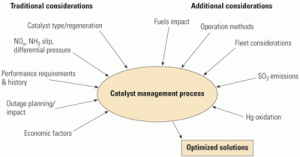
Long-term catalyst health care
Now that many U.S. selective catalytic reduction (SCR) systems are in their fifth or sixth year of operation, a number of utilities are shifting their attention from implementing the technology to operating and maintaining it. Catalyst management and performance are key to the successful operation of any SCR system.
-
 Business
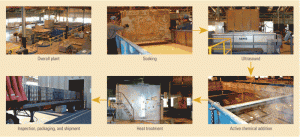
Catalyst regeneration: The business case
As an alternative to purchasing new catalyst, technological and economic advantages make a compelling case for regenerating rather than replacing the metal or ceramic that enables selective catalytic reduction systems to capture NOx.
-
 Business
The 2005 Global Energy Awards
The Roosevelt Hotel in New York City was the site of the 2005 Platts Global Energy Awards (GEA). The seventh annual black-tie soiree was the most global ever. Some 400 top executives from more than two dozen countries on five continents gathered at the Roosevelt on December 1, 2005, to honor the energy industry’s "Best […]
-
 Coal
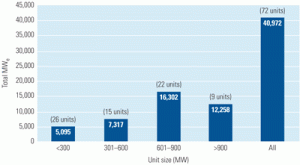
CoalEstimating SCR installation costs
The EUCG surveyed 72 separate installations of selective catalytic reduction (SCR) systems at coal-fired units totaling 41 GW of capacity to identify the systems’ major cost drivers. The results, summarized in this article, provide excellent first-order estimates and guidance for utilities considering installing the downstream emissions-control technology.
-
 Legal & Regulatory
Gas storage investment stymied
The U.S. needs to add 600 to 800 billion cubic feet (Bcf) of natural gas storage capacity ASAP. Independent storage providers (ISPs) are the entities best equipped to build this needed infrastructure, but they continue to be restrained by anachronistic regulatory policies. The Federal Energy Regulatory Commission’s (FERC’s) December 2005 rule-making to modify its […]
-
O&M
Focus on O&M (February 2006)
CFB refractory repair; Upgrading conductivity monitoring; Low-cost maintenance of spinning reserve