
Articles By

-
 Legal & Regulatory
Passing on regulatory risks undermines renewable mandates
More than 20 states now require their investor-owned utilities to serve a certain percentage of their load with renewable energy by a date certain. Other states are considering following suit. Failure to meet its "renewable power" mandate can subject a utility to financial and other regulatory penalties. If structured and supervised correctly, these initiatives […]
-
 News
NewsPOWER magazine’s Top Plants of 2006
On the following pages, we introduce the magazine’s 12 Top Plants of 2006. Among this year’s winners are two solar energy plants and another that marries fuel cells with heat and waste gas recovery. As those projects make clear, a plant doesn’t have to be big to earn kudos from us. What we typically like […]
-
 O&M
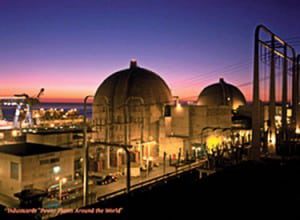
O&MImproving the reliability of turbine lube oil supply
Five years ago, San Onofre Nuclear Generating Station’s Unit 3 turbine experienced substantial damage after the supply of oil to its bearings failed. Because the turbine coasted down without oil after it tripped, its bearings, journals, and steam path needed extensive repairs. A follow-up investigation revealed lube oil system vulnerabilities that were subsequently corrected. The lessons learned might also improve your turbine-generators’ lube oil reliability, saving you many millions in lost revenues.
-
Business
Gencos embrace benchmarking as strategic tool
Today’s utility business models re-emphasize utilities’ traditional mission—producing and delivering reliable, affordable power. Tracking how well that mission is executed is the raison d’être of modern plant performance benchmarking.
-
 O&M
O&MComputer-based hydro plant scheduling
Hydroelectric power plant managers face unique scheduling challenges. They have a finite amount of water in their reservoirs available for energy production, and they need to schedule generation according to market demand to maximize profits from their limited “fuel” supply. Hydro power plants are capable of producing products other than electricity. Among them are ancillary […]
-
 O&M
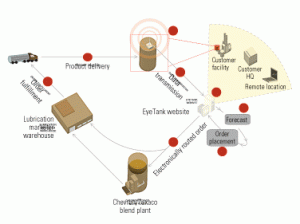
O&MMonitor your fluid levels online
Although fluid monitoring technology has come of age in recent years, its level of sophistication varies widely across industries. Some users of bulk chemicals, fuels, and other fluids use state-of-the-art systems with bells and whistles like automated data gathering and transmission. At the other extreme, some tank farms still “stick the tanks.” Although 95% of large […]
-

Backroom deals
Richard Nixon was the master of the “big lie” in politics. Once, when his cronies expressed concern about some “liberal” statements he had made, he told them to “ignore what I say and watch what I do.” That insight into an elected representative’s true state of mind is as useful today as it was a […]
-
 O&M
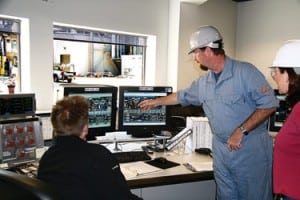
O&MStandardizing PdM, fleetwide
The pressure on power producers to supply reliable electricity is unyielding. Forced outages, which usually are caused by unexpected component failure or systemic problems, can prove very costly to both bottom line and reputation. To reduce the frequency and duration of unscheduled outages, many gencos are implementing comprehensive predictive maintenance (PdM) programs. Such is the […]
-
 Business
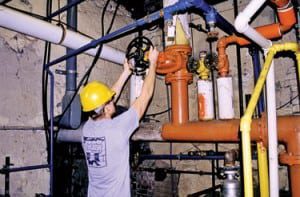
World-class teaching lab prepares next generation of plant operators
The Williamson Free School of Mechanical Trades near Philadelphia has been training power plant operations professionals for 112 years, and its graduates hold top positions at many major gencos, refineries, equipment suppliers, and design and construction companies. Testimonials indicate that it provides one of the best models for training tomorrow’s plant operators.
-
 Coal
CoalCoal: The cornerstone of America’s energy future
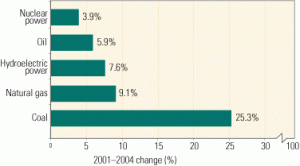
In April 2005, U.S. Secretary of Energy Samuel W. Bodman asked the National Coal Council to develop a “report identifying the challenges and opportunities of more fully exploring our domestic coal resources to meet the nation’s future energy needs.” The council has responded with eight specific recommendations for developing and implementing advanced coal processing and combustion technologies to satisfy our unquenchable thirst for energy.
-
 Coal
CoalGlobalization: The new millennium’s "invisible hand"
Participants in the CEO Roundtable at Electric Power 2006 raised a plethora of issues affecting decisions on future electric power generation. Representing a cross section of power producers, the industry leaders made clear that, although globalization has lost its luster in the power generation sector, its impact on the domestic industry remains profound. Ten years […]
-
 Coal
CoalSafety still Job No. 1 for PRB users
If coal is to be “America’s energy future” (see p. 42), the work of the Powder River Basin Coal Users’ Group (PRBCUG) will have a lot to do with making it so. Since 1999, the PRBCUG (see sidebar) has fostered the safe, efficient, and cost-effective use of the fuel as it watched its membership swell […]
-
 Synfuel
Combined Cycle Users’ Group completes another successful year
The third annual meeting of the Combined Cycle Users’ Group (CCUG) was held May 2–4 in Atlanta at Electric Power 2006, in cooperation with the ASME Power Division Combined Cycles Committee and other industry groups. The CCUG’s leadership (Figure 1) drives the group to address issues involving the major components of a combined-cycle plant and […]
-
 Coal
CoalClean Coal: Clean Coal Technology Is Not an Oxymoron
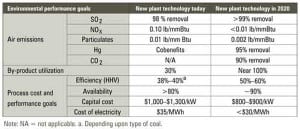
In the late 1980s, the U.S. Department of Energy (DOE), in conjunction with industry and state agencies, started the Clean Coal Technology (CCT) program. The aim of the CCT program was to develop technologies, increase efficiency, and reduce the environmental effects of burning coal in power plants. Today, pollution controls for new and existing plants […]
-
Coal
Coal Users Community: Capitalizing on Coal: The Challenges and Opportunities
Demand for energy in America continues to grow. So too does the challenge of generating it in a reliable, affordable, and an environmentally sensitive manner. Given the U.S.’s abundant coal reserves, the nation’s electric utilities are pursuing a variety of strategies to keep coal a key fuel source for generating electricity. Developing Technologies One approach […]
-
Coal
Coal Users Community: NCTA helping to resolve coal transportation infrastructure problems
The Mission of the National Coal Transportation Association (NCTA) is to provide education and facilitation for the resolution of coal transportation issues in order to serve the needs of the general public, industry, and all modes of transportation. This is accomplished through the sponsoring of educational forums and by providing opportunities for the lawful exchange […]
-
 Coal
CoalControls: Building the Digital Power Plant of the Future
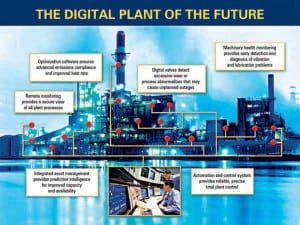
History has shown that the proper deployment of automation on new construction projects can make the difference between a moderate performer and an industry-leading unit, between average financial results and accelerated profitability. Given the magnitude of a new coal-fired plant construction project, automation is often viewed as just one of the many components essential to […]
-
 Coal
CoalCover Story: Coal-fired Electric Power Capacity Continues to Increase
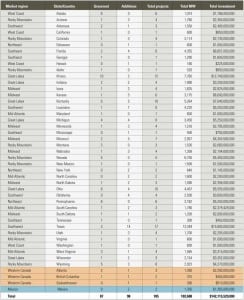
In the U.S. electric power industry, coal is making a comeback as a fuel of choice for new generation projects. During the construction boom that occurred from 1999 to 2003 about 90% of new electric generation utilized natural gas – fired combustion turbines. Unfortunately, over the past few years natural gas supplies have tightened and […]
-
Coal
Editorial: Industrial Perspectives
Is the U.S. supply of coal sufficient to meet the increased demand for coal-fired generation? With the increasing demand for coal to generate electricity, the big question is, How reliable is the supply and transportation of the fuel? Currently, Industrial Info Resources (IIR) is tracking 185 new coal-fired power projects, and if all were to […]
-
O&M
Projects
Kansas City Power & Light Installing SCR at La Cygne Generating Station Kansas City Power & Light (KCP&L), a subsidiary of Great Plains Energy, has awarded The Babcock & Wilcox Company (B&W) a contract for the installation of new emissions control equipment on Unit 1 at its La Cygne Generating Station. When completed, the selective […]
-
 Coal
CoalPollution-Control Technologies: Multi-Pollutant Removal Systems Are a Clean Coal Technology
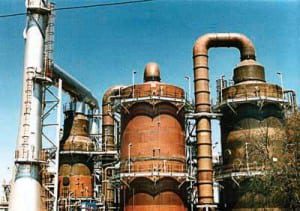
The first power plants were built about 130 years ago. Coal was then, and is still today, the major fuel used for power generation. Currently, about 1,400 pulverized coal – fired units, with an average age of more than 30 years, generate over 50% of U.S. electric power. The use of low-sulfur coal and improved […]
-
 O&M
O&MProject Planning: Repowering or Replacement: What Is the Solution?
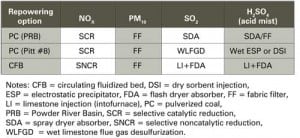
Between 1998 and 2002 the U.S. experienced an unprecedented power plant construction boom that consisted mostly of gas-fired, combustion turbine – based power plants. This surge in power plant construction had several driving forces, including electric power deregulation, the emergence of non-utility power producers, a sustained period of plentiful and inexpensive natural gas, and the […]
-
 Coal
CoalCase Histories: Pulverizer Upgrades Are Reducing Fuel Costs
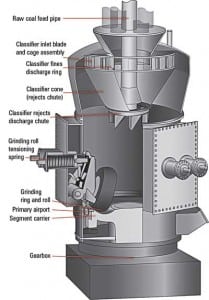
St. Johns River Power Park (SJRPP) is a two-boiler, 2 x 660-MW station jointly owned by JEA (formerly Jacksonville Electric Authority) and Florida Power & Light (FPL). JEA is the plant operator. The Foster Wheeler boilers went into commercial operation in 1987 and 1988. Each boiler has seven OEM vertical spindle pulverizers (mills) and 28 […]
-
 Instrumentation & Controls
Solving plant vibration problems
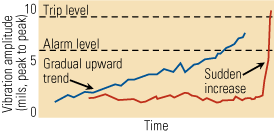
Solving insidious vibration problems in rotating equipment may sometimes seem like a black art that requires the right incantation. But identifying the root cause of the vibration is actually a science. By using cutting-edge vibration measurement tools in concert with computer simulations, plant operators can arrive at a permanent, cost-effective solution to virtually any vibration […]
-
 Gas
GasDesigning duct burners for variable GT loads
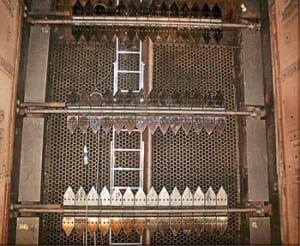
Duct burners use supplementary firing to increase the heat energy of a gas turbine’s exhaust, making it possible to increase the output of a downstream heat-recovery steam generator (HRSG). Early systems of the 1960s took a conventional approach to burner design. The exhaust of the turbine was directed into a windbox and then into a […]
-
 Wind
WindGreener than thou
U.S. wind power is on a roll, with wind farms sprouting like weeds. But in the near future, utilities may end up paying higher prices for wind capacity because state regulators are, in effect, imposing an artificial floor on national demand for generation fueled by renewable resources. At last count, at least 20 states had […]
-
 Gas
GasGlobal Monitor (May 2006)
Nuclear hot streak continues/Who’s winning in U.S. wind power?/ Canadian wind picking up too/ Brazilian port powers itself/ Biomass meets CHP in Sweden/ Power surfing from Scotland to Germany
-
 Water
WaterFocus on O&M (May 2006)
Desalination, Italian style; How to minimize DI operating costs; Advanced flow meter works with shorter pipe runs; Why tubing beats piping.
-
 Legal & Regulatory
State monitoring fails the cost/benefit test
Steven F. Greenwald and Christopher A. Hilen Utility regulators in California and other states have begun subjecting power plants to extensive oversight of their O&M activities. These oversight programs are a response to allegations that generators purposely shut operational plants down to drive electricity prices up during the 2000–2001 energy crisis. These state initiatives […]
-
 Water
WaterRecycling, reuse define future plant designs
The Valley of the Sun went off the water wagon on March 4, ending a record 136 consecutive days without measurable rainfall. That first 0.05-inch sip, followed by a 0.18-inch gulp the next day, only left residents yearning for more. But Mother Nature was only teasing, because the rest of March remained dry. On March […]