Improving existing wind power facilities, and developing larger and better new installations, is driving the sector’s expansion.
The global market for wind power continues to grow, even as some countries scale back their former targets for wind energy due to policy shifts and other issues. China is still the leading country when it comes to deploying wind energy; various reports utilizing government and other data sources show China’s total installed wind power generation capacity was at least 640 GW at the end of 2025.
The World Wind Energy Association earlier this year said China has an overall share of more than half of the world’s wind power capacity. The agency said China accounted for 77% of global wind power additions in 2025—installing about 130 GW—though growth outside China was mixed, with just five of the top 30 countries for wind power generation capacity showing gains above the global average.
The Global Wind Energy Council (GWEC) recently reported that five wind turbine manufacturers had topped 100 GW of installed generation capacity as of year-end 2025. The leaders include Denmark’s Vestas, which with more than 201 GW of installed capacity was the first turbine manufacturer to pass the 200-GW milestone. Other top manufacturers are China’s Goldwind, Spain-headquartered Siemens Gamesa, U.S.-based GE Vernova, and China’s Envision.
The GWEC in its annual Global Wind Market Development Supply Side Data Report said global wind turbine original equipment manufacturers (OEMs) installed 28,395 new turbines worldwide in 2025, an increase of 23% from 2024. A report from Wood Mackenzie earlier this year said the U.S. wind sector installed more than 8 GW of wind power capacity in 2025, up 49% over the prior year. The group in its US Wind Energy Monitor said the U.S. is expected to install about 11 GW of new wind power capacity in 2026.
Ben Blackwell, CEO of GWEC, earlier this year noted the achievements for the wind power industry and acknowledged continued challenges for the sector. “This impressive growth comes despite years of challenging business conditions and supply chain disruptions and is a testament of the wind sector’s growing importance as a source of reliable, homegrown renewable energy at a time of turmoil in international import-based oil and gas markets,” said Blackwell. “We now have five companies that have each installed more than 100 GW, which is enough electricity to power many of the world’s largest economies. But this is only just the beginning. With wind power meeting 9.5% of global electricity demand today, we see enormous potential for wind manufacturers from all regions to continue to expand and grow their operations across existing and emerging markets.”
Onshore and Offshore
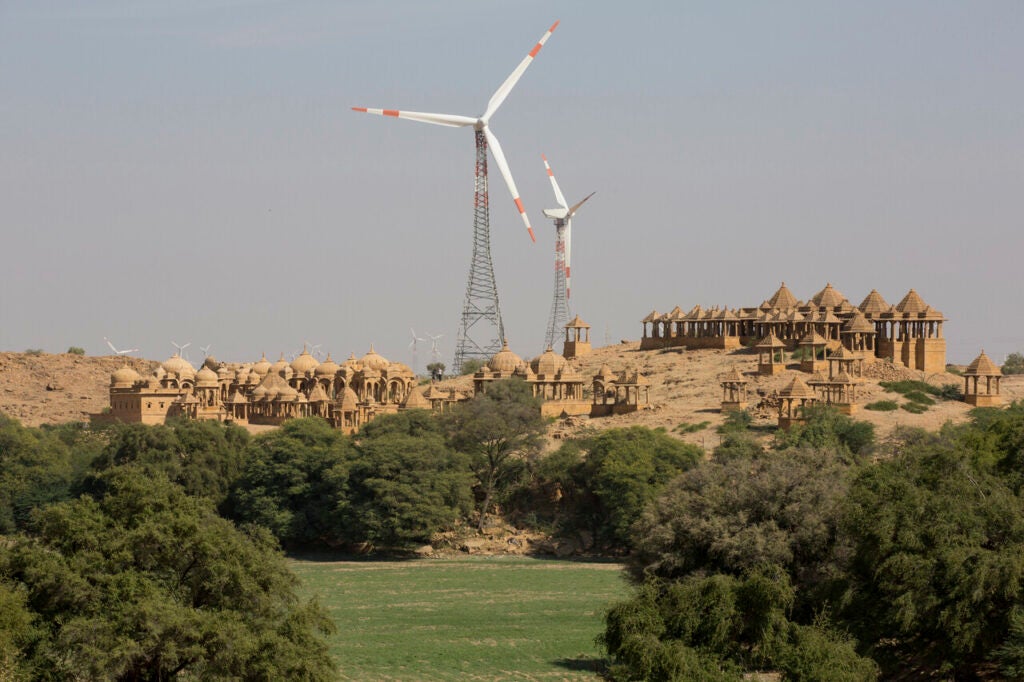
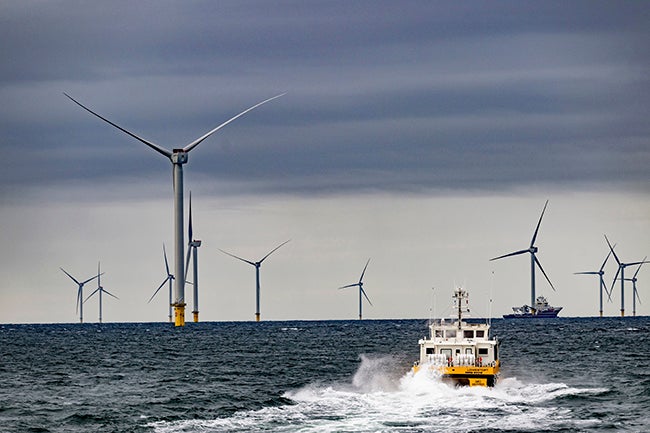
Energy industry analysts continue to tout the advantages of wind power, while differentiating between onshore wind and offshore wind. Onshore wind is faster to build and cheaper to maintain than offshore wind, and is considered among the most affordable renewable energy resources, similar to solar power. The intermittent generation of onshore wind is a talking point, though, as is its visual and aesthetic impact. Offshore wind (Figure 1) is considered more efficient than onshore locations because winds at sea are usually steadier and stronger—but opponents of offshore installations also cite their environmental impacts on marine and avian ecosystems.
 |
|
1. Offshore wind installations are considered more efficient than onshore sites because winds at sea are usually steadier and stronger than winds over land. Courtesy: Envato / Image-Source |
Much of the focus in the wind sector is tied to equipment manufacturing, including ever-larger turbines for both onshore and offshore installations. Sustainability is part of the discussion as well, with advancements focused on the circular economy and a drive to create fully recyclable turbine blades. Wind power sites, similar to the solar power industry, also now increasingly include energy storage so that excess power can be stored and then discharged into the power grid when needed.
Tapas Peshin, who holds a PhD in Energy Resources Engineering from Stanford University, and is Product Lead, Transmission & Reliability, with PCI Energy Solutions, talked with POWER about some of the challenges for today’s wind energy sector.
“Wind’s reliability problem is mostly a geography problem,” said Peshin. “The wind is almost always blowing somewhere. The question is whether the grid can move that energy across a wide enough area and schedule it a day ahead. Regional day-ahead markets in the West, such as SPP Markets+ [Southwest Power Pool’s services that centralize day-ahead and real-time unit commitment and dispatch] and CAISO’s EDAM [California Independent System Operator’s Extended Day-Ahead Market], matter for wind because they widen the footprint over which variability averages out.”
Peshin, like other industry experts who spoke with POWER, said pairing wind power with energy storage is of significant importance. “Storage paired with wind is less about holding power for days and more about shaping it. A battery that can shift a few hours of overnight wind into the evening peak makes that wind something an operator can actually commit to, not just a forecast,” said Peshin, who also noted how transmission constraints impact wind power.
“The binding constraint on wind is rarely the turbines,” said Peshin. “It’s transmission. A wind project without firm transmission and a clear scheduling path will be curtailed exactly when it’s producing the most, which undercuts both its economics and its climate value.”
Juan Pablo (JP) Cerda, CEO and co-founder of Renewabl, a UK-based climate tech and renewable energy company, told POWER that wind power’s reliability should not be underestimated. “For a buyer, reliability is a count of hours: how many of the year’s 8,760 [hours] does your contracted generation cover? Wind lifts that count because it generates at night and rarely drops at the same time as solar—in the UK, IRENA [International Renewable Energy Agency], citing Ember, puts days when both are low at only 2% of the time. Storage covers the rest by moving the midday surplus into the hours you are short, and the market does not pay for that shift yet.”
Cerda also said wind power can help with the challenge of energy demand from data centers. “A data center draws a flat load around the clock, so an annual renewable total hides the night hours,” said Cerda. “Wind is the main technology that covers them: in our German data center modeling, solar alone covers 41% of hours and wind alone 75% at the same annual volume, so for a flat load the technology mix is the biggest lever. At Renewabl we measure that hourly baseline for corporates and data centers, then run the tenders that move it.”
Technology Advancements
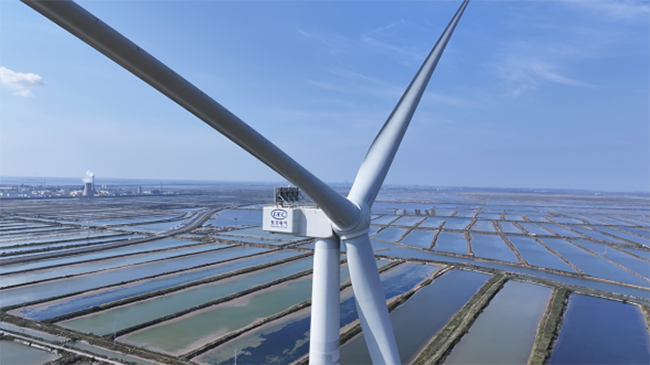
The evolution of wind turbines has brought ever-larger equipment to market in recent years, both for offshore and onshore installations. Mingyang, a Chinese company, is developing a 33-MW offshore wind turbine, according to a document distributed at a recent wind power event in China. At present, the world’s largest-capacity offshore wind turbine is the Dongfang DEW-26 MW-310 (Figure 2), built by Dongfang Electric Corp. in China. The 26-MW unit features a 310-meter rotor diameter and a 185-meter hub height, comparable to the height of a 60-story building. The tallest wind turbine, though, is considered to be GICON’s 365-meter-tall unit, built in Germany by GICON and Sprind. It has just 3.8 MW of generation capacity, but uses a steel lattice support structure combined with a telescoping inner tower to reach nearly 1,200 feet in height—taller than the Eiffel Tower in Paris, France.
 |
|
2. The Dongfang DEW-26 MW-310, built by Dongfang Electric Corp. in China, is to date the largest offshore wind turbine in the world. The turbine entered commercial operation in late October 2025 in Dongying, in East China’s Shandong Province. Source: Chinese government news release/sasac.gov.cn |
Mingyang has also developed the MySE 22-MW offshore wind turbine, which features a rotor diameter of more than 310 meters and is engineered to resist severe typhoon conditions. Siemens Gamesa’s SG DD-276 is an offshore turbine rated at 21.5 MW and with a 276-meter rotor diameter. Mingyang’s equipment also includes the MySE 18.X-20 MW, with a rated output in the 18- to 20-MW range, with rotor diameters ranging from 260 meters to 292 meters (853 feet to 958 feet). It is designed for offshore environments and features anti-typhoon technologies.
Dongfang also has developed the DEW-18 MW-260, rated 18 MW with a rotor diameter of 260 meters. Goldwind has a GWH252-16 MW turbine that has a rotor diameter of 252 meters. Vestas’ portfolio features the V236-15.0 MW offshore turbine, which has a 236-meter rotor diameter.
The largest onshore wind turbine is considered to be the 15-MW Sany SI-270150, developed by China’s Sany Group. Other Chinese manufacturers, including Envision, Goldwind, and Windey, have models ranging from 7.7 MW to 10 MW of generation capacity. Industry analysts have said that larger turbines, capable of producing more energy and in turn doing so more efficiently, also could be key for powering data centers—a point made often by those who spoke with POWER.
“A fascinating fact is that the companies most involved in the AI [artificial intelligence] infrastructure buildout are those most committed to sustainability goals. And the need for unprecedented amounts of power for data centers is turbocharging the hunger for clean power,” said Jay Ruckelshaus, PhD, co-founder and head of Partnerships & Policy at Gravity, a company that helps customers cut energy costs and support sustainability through cost and emissions reductions. “The companies doing this well treat clean energy procurement as part of their energy strategy, not as a separate line item for sustainability. For data centers, like other industries, reliability is increasingly of concern. For most operators, a portfolio approach is key. Wind can contribute electrons when solar output drops, and vice versa—and both can be supplemented by increasingly economical storage options. When those projects are new, they add supply to the grid.
“There’s a natural alliance between being smart with your energy spend and being smart with your emissions,” said Ruckelshaus. “Every ounce of power a data center saves through better cooling or more efficient computing doesn’t have to be generated, so each new wind project covers more of the load and there’s less strain on the grid at peak times. The cheapest and cleanest kilowatt hour is still the one you never have to buy. Moreover, as power prices rise in many markets, the marginal value of energy efficiency is growing.”
Sustainability, Reliability, Flexibility
Grid integration of renewable energy is often part of discussions about system flexibility, because the output from renewables such as wind changes depending on weather and time of day. Several of those who spoke with POWER noted that wind energy can present a complex engineering challenge because weather patterns are ever-changing. Wind speeds are not constant, so wind energy cannot be relied on for baseload power. Integrating energy storage, though, means excess electricity can be saved and then discharged to the grid as needed. Pairing wind with other renewable resources, including solar and hydropower, can create a stronger generation profile. And advanced weather forecasting methods, supported by AI and real-time meteorological data, is allowing electric utilities and grid operators to better predict wind profiles at times days in advance.
Paul Hines, vice president and chief scientist with EnergyHub, a group that supports utilities in managing load growth and virtual power plants, told POWER flexibility is of increasing importance to maintaining grid reliability and balancing electricity supply and demand, particularly as more wind energy comes online.
“Wind has an important role to play in meeting growing electricity demand. In many regions, it complements solar by producing more electricity during evening and overnight hours when solar isn’t generating,” said Hines. “Wind production also varies with wind speed, which creates an operational challenge for a grid that needs to balance electricity supply and demand every second of every day.
“As more wind and solar generation comes online, maintaining that balance requires that we add flexibility to the grid to move power away from times of plenty to times of scarcity,” said Hines. “Historically, grid operators have relied heavily on dispatchable fossil generation [primarily natural gas] to respond to changes in demand. Today, resources like batteries, EVs [electric vehicles], and smart thermostats give utilities more options for adjusting electricity consumption based on available generation.
“Two capabilities are especially important as the generation mix evolves: forecasting and demand flexibility,” said Hines. “Accurate forecasts help grid operators anticipate changes in wind production, while demand flexibility allows them to respond by shifting consumption or dispatching flexible resources when needed. Together, they help utilities make better use of renewable generation while maintaining reliability and managing costs.”
Carolyn Kissane, associate dean of the New York University (NYU) School of Professional Studies (SPS) Center for Global Affairs, told POWER, “Wind power can advance sustainability and energy security by generating electricity without fuel combustion or exposure to volatile fuel prices, a problem around the world today. Its contribution to reliability depends on the system.”
 |
|
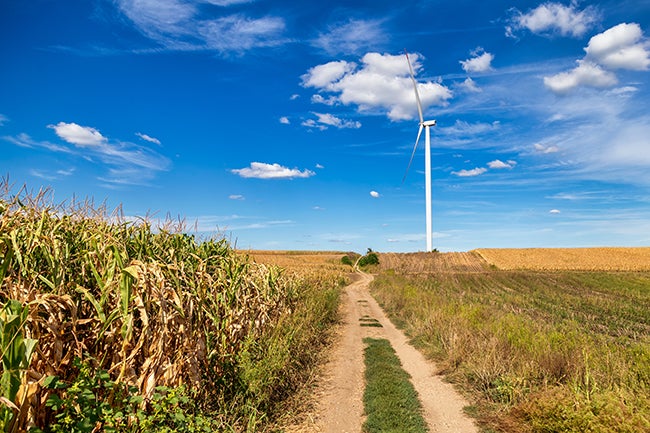
3. Where wind farms are located is key to their output and efficiency. Most onshore installations are in more rural areas, where the open land is conducive to greater wind speeds. Courtesy: Envato / PedaltotheStock |
Kissane, founding director of the SPS Energy, Climate Justice, and Sustainability Lab, added, “Pairing wind with storage helps manage fluctuations and shift electricity to periods of greater demand. Transmission, geographic diversity, and complementary generation remain essential, particularly during prolonged periods of low wind. Wind is best placed in geographies with strong wind speeds [Figure 3].”
Mike Mohamed, head of Energy Transition at Solomon Partners, a New York City-headquartered investment bank that works with clients in the infrastructure, power, and renewable sector, along with other industries, said pairing wind power with energy storage is important to ensure a reliable supply of power.
“As wind is intermittent and energy storage is instantaneously dispatchable, storage can be used as a short-term bridge tool to smooth out minute fluctuations of wind output to ensure a consistent and reliable stream of energy,” said Mohamed. “Furthermore, during periods of excess wind production, storage can charge from the wind asset and wait on standby for periods of low or non-existent wind in order to extend the wind asset’s deployment window.”
The Data Center Question
Wind energy may not be the first choice of many data center operators when it comes to finding a power supply, but its use is increasing in importance, especially among companies looking to lower carbon emissions. Analysts told POWER that one modern wind turbine can produce as much power as tens of thousands of solar panels, with the potential to produce energy day and night. Wind power also can help stabilize energy costs; siting data centers near wind farms or co-locating them with behind-the-meter renewable energy assets can protect against grid price volatility.
 |
|
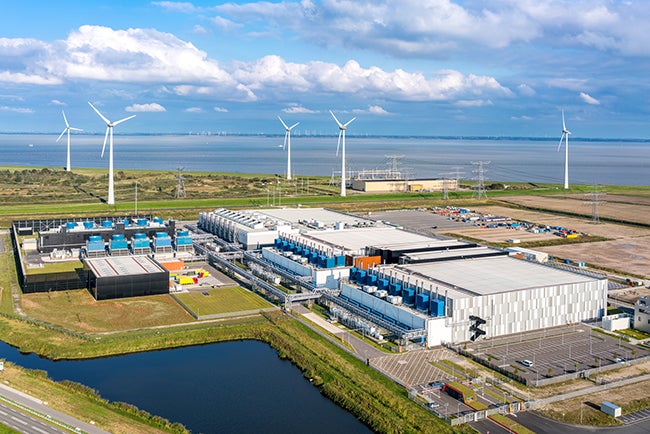
4. Wind turbines spin near Google’s Eemshaven, Netherlands, data center. Courtesy: Google |
Mohamed said wind power can be important for data center operators to support their need for electricity (Figure 4). “Wind projects tend to be large in size and are typically located in rural communities,” he said, and noted such installations can “provide sufficient power and ample space for large data center builds. However, as wind is an intermittent resource, it must be used as part of a comprehensive energy strategy that pairs wind generation alongside batteries and backup conventional generation resources.”
Mohamed told POWER, “Wind paired with solar tends to complement each other quite well as peak production windows are often staggered, providing a longer-term, lower-carbon energy supply. Select data center owners have started to pursue acquisitions of operating wind farms as they provide an immediate ability to draw on power at scale.”
Kissane said that “for data centers, buying wind power is part of a broader strategy to secure dependable, less carbon-intensive electricity. In some cases, companies buy credits to support wind projects that do not directly connect to their project but are important for reducing their overall emissions footprint.”
Said Ruckelshaus, “The Electric Power Research Institute projects that data centers could use between 9% and 17% of U.S. electricity by 2030, up from about 4%–5% today. That’s a big new load for the grid, and the Department of Energy has pointed to land-based wind, along with solar, storage, and efficiency, as some of the fastest and most cost-competitive ways to meet it.
“Data center operators are also exactly the kind of buyer clean energy project developers need: large, creditworthy, and ready to commit to buying power for many years,” said Ruckelshaus. “When an operator agrees to take the output of a new wind farm for a decade or more, that contract is often what gets the project financed and built.”
Hines said, “The grid needs a tremendous amount of additional capacity, and it needs it quickly. Data centers, manufacturing, EVs [electric vehicles], and heat pumps are all contributing to growing electricity demand. Meeting this demand while maintaining reliability, keeping electricity affordable, and limiting emissions will require utilities to make the most of every available resource.
“Wind and solar are essential parts of that equation,” said Hines. “In the right locations, they can be deployed relatively quickly to help meet growing demand. Although their output varies with weather conditions, storage and flexible demand help manage that variability by shifting consumption to low-demand periods and injecting power when needed. Forecasting is equally important because it allows grid operators to anticipate when renewable generation will be available and plan accordingly.
“The opportunity is to coordinate these resources rather than manage them independently. When wind generation is abundant, utilities can shift flexible consumption into those hours,” said Hines. “When renewable output is expected to decline or demand is approaching a peak, batteries and other distributed resources can help reduce pressure on the grid. New generation and infrastructure investments are necessary, but utilities also need to make better use of the capacity already available. Coordinating renewable generation, storage, and flexible demand can help accommodate growing loads while managing costs and emissions.”
Repowering
Repowering of wind energy projects is a major step for supporting sustainability in the sector, and increasing the ongoing reliability of installations. Exus Renewables North America in September marked commercial operation of its Highland North and Cambria wind repower projects in Pennsylvania. The company noted that completion of the repowerings comes as demand for clean power from data centers and other large energy users continues to climb in the area. Exus officials said Cambria’s output is contracted under a signed power purchase agreement with a Fortune 500 technology company, noting that a growing number of corporate power buyers are turning to repowered wind sites for capacity that can come online without the multi-year interconnection timeline a new project requires.
“Highland North and Cambria show what repowering can deliver: proven wind resources, established infrastructure, and a faster path to new capacity,” said Jim Spencer, president and CEO of Exus Renewables North America, at a ceremony marking completion of the projects. “Completing both projects is a milestone for our Pennsylvania portfolio and for the communities that have supported this work.”
Cambria, a 61.6-MW facility, initially came online in 2008. Highland North, with 75 MW of capacity, first entered service in 2012. The projects together bring Exus’ owned wind power generation capacity in Pennsylvania to 306.9 MW. Vestas supplied the turbines for both projects, with JMS Energy serving as balance of plant contractor. Some $356 million in construction financing was led by KeyBanc Capital Markets. The repower replaced each turbine’s nacelle, blades, and generator on the existing towers and foundations, extending operating life another 30 years.
Seth Wilmore, vice president of Wind and Energy Transition at Exus, told POWER, “Finding efficiencies inside an industry that is already efficient means looking hard at how we treat the assets we’ve built. Repowering is one of the clearest examples. When we repower a wind project, we’re getting more clean energy out of a site that already has the land, the interconnection, and the community relationships in place, which is about as efficient as development gets. To date, we’ve repowered over 516 MW of wind projects.”
Wilmore continued, “What happens to the old equipment matters too, and as an industry we have more work to do there. Recycling options for blades and panels aren’t where they need to be yet. At our Twin Ridges repower, we partnered with Carbon Rivers to upcycle the fiberglass blades and keep them out of the landfill, and at our Highland North and Cambria wind repower projects, we donated one of the retired nacelles to the Universal Technical Institute Inc. in San Antonio [Texas] so students could train on real equipment. Those are steps in the right direction. We’re continuing to look for options that make sense on future projects, because the long-term credibility of renewables depends on getting end of life right.”
 |
|
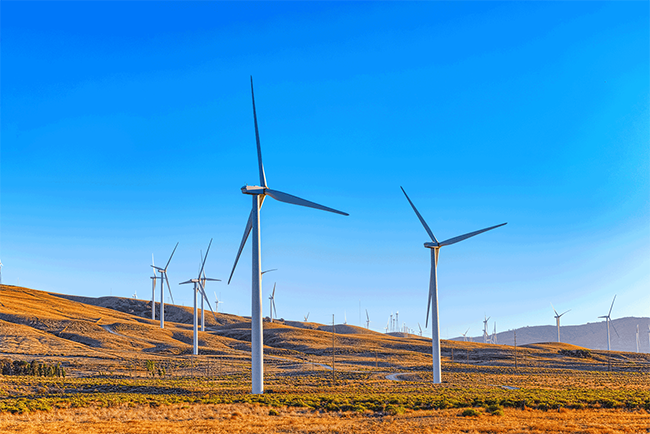
5. KK Group, headquartered in Denmark, said it recently secured its first U.S. wind farm repowering contract. The company said it will provide targeted repowering through converter control upgrades. Courtesy: KK Group |
KK Group, a Denmark-headquartered company with offices in 10 countries (including a dedicated U.S. regional division based in Houston, Texas), in October announced it had secured its first repowering order (Figure 5) in the U.S. The company, formerly known as KK Wind Solutions, in a news release wrote, “As U.S. grid requirements evolve, aging control technology makes it increasingly challenging to keep older wind turbines connected. KK Group will provide targeted repowering through converter control upgrades on 33 GE 1.5-MW turbines for a U.S. utility, helping extend the generating life of the existing assets.” The company continued, “By replacing aging converter controls with KK Group’s upgraded technology, the utility will be able to keep its existing turbines operating while supporting compliance with current grid requirements.”
Kim Wichmann-Hansen, president of KK Group US, said, “Replacing a wind turbine that still has years of productive life ahead of it doesn’t always make sense. But keeping older turbines operating also means ensuring their technology can meet the requirements of today’s electricity grid. By upgrading the controls, we can help operators bridge that gap and get more value from assets they already have.”
Wichmann-Hansen told POWER, “As the global wind fleet ages, extending the productive life of existing turbines—and therefore the amount of renewable energy produced—will become increasingly important to reducing the environmental impact of the industry. Repair, refurbishment, and targeted repowering all have an important role to play. By repairing or upgrading critical components, rather than replacing them unnecessarily, operators can extend turbine lifetime while reducing demand for new materials, manufacturing, and associated emissions.
“The opportunity is to make repair and refurbishment a more integral part of wind turbine maintenance, bringing these capabilities closer to where turbines operate,” said Wichmann-Hansen. “This can help reduce transport-related emissions, shorten repair times, and keep existing wind assets generating reliably for longer. For power electronics and control systems, our experience shows that on-site refurbishment can reduce lifecycle emissions by up to 95% compared with replacement.”
KK Group’s CMC1 Converter Controller is at the center of its U.S. project. The converter controller helps manage how electricity generated by the turbine is converted and delivered to the grid. By replacing the older controller while retaining the existing converter and other major turbine infrastructure, the solution provides a targeted way to modernize the turbine without replacing major components that can continue operating, according to the company. KK Group said that to expand the application of CMC1 across different converter systems, it is working with power electronics specialist ZOPF to develop interface technology that enables the controller to integrate with existing converter hardware.
“Wind turbines are designed to operate for decades, but technology and grid requirements continue to evolve. Even when major turbine components remain operational, aging control systems can make it increasingly difficult to maintain reliable operations and meet current grid requirements,” said Wichmann-Hansen. “Targeted repowering addresses this challenge by upgrading critical technology while retaining infrastructure that can continue operating. This helps operators manage technological obsolescence, support grid compliance, and extend the reliable operation of existing wind assets.
“Our first U.S. repowering project is a good example of this approach. We are upgrading converter control technology on 33 GE 1.5-MW turbines, helping a U.S. utility extend the operating life of its existing assets without replacing major components unnecessarily,” said Wichmann-Hansen. “With a large and aging installed wind fleet in the U.S., we see significant potential for targeted repowering, alongside monitoring, maintenance, and repair, to support a more reliable and sustainable wind industry. In short, we put today’s knowledge into yesterday’s turbines—to ensure they also operate tomorrow.”
Equipment Recycling
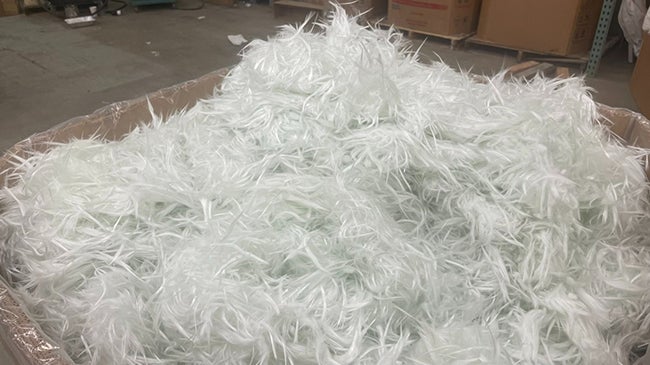
Energy industry analysts often point to equipment recycling as a key element of sustainability in the renewable energy space; wind power is no different. The U.S. Department of Energy (DOE) has said about 85% to 90% of the mass of a wind turbine is made of materials that can already be commercially recycled. The agency said most of the unrecycled materials include fiber-reinforced composites such as carbon fiber and fiberglass (Figure 6), which are found in wind turbine blades, nacelle covers, and the cover for the hub that connects the blades to the wind turbine.
 |
|
6. Carbon Rivers, with funding from the U.S. Department of Energy (DOE), demonstrated a pyrolysis process that recovered glass fiber at 99.9% purity from several end-of-life waste streams, including wind turbine blades. Source: DOE / Carbon Rivers |
Critical minerals used in the wind energy industry, including rare earth elements from the neodymium and dysprosium magnets used in generators, also do not have commercial-scale recycling options, according to the DOE.
There are, though, several ongoing recycling efforts. Leon Mishnaevsky Jr., a professor at the Department of Wind and Energy Systems at Technical University of Denmark (DTU Wind), pointed POWER toward the group’s WISEWIND project. Mishnaevsky Jr. coordinates several projects aligned with sustainability and reliability of wind turbines. He noted that the WISEWIND effort focuses on developing new blade materials designed to “ensure re-processability, easy reparability, and repeated recyclability of blades. [A] new generation of recyclable wind turbine blades, based on vitrimer resins, is developed, on the basis of a digital twin of blade materials ‘from cradle to cradle.’ ”
The WISEWIND consortium includes DTU Wind, Siemens Gamesa Renewable Energy, and ReFlow ApS, an environmental consultancy firm. Mishnaevsky Jr. said that in the project, “various recyclable composites were tested for their application in wind turbine blades, and advanced computational models of their recycling were developed. DTU also organizes a series of bi-annual international conferences on sustainable wind turbine blades, most recently in 2024 and again in 2026.”
Veolia was one of the first companies in the U.S. to recycle wind turbine blades at scale. The company works with OEMs, contractors, and others. The firm’s program involves crews that “cut the large fiberglass blades into manageable sections and run them through industrial shredders and grinders to produce a confetti-like or chunk-sized material.” The company said it is used in cement co-processing, where “the shredded material is sent to partner cement kilns,” and “65% to 75% of the blade material replaces raw silica, limestone, and other minerals in the cement mix… 28% of the material serves as a high-heat alternative fuel source that replaces coal in firing the kiln.”
Veolia has said, “Each processed blade replaces roughly 5 tons of coal, 2.7 tons of silica, 1.9 tons of limestone, and 1 ton of other raw materials… The co-processing method cuts net carbon dioxide (CO 2) emissions by about 27% compared to traditional Portland cement manufacturing.”
Among the companies recycling used wind power equipment is Ohio-based Canvus, which takes retired, non-biodegradable fiberglass wind turbine blades and turns them into functional public furniture and art. The Dutch company Blade Made has turned old blades into bus shelters and bicycle storage units; the Port of Aalborg in Denmark is known for its sustainable bicycle shelter built from a decommissioned wind turbine blade. And used blades have been used as noise barriers on interstate highways in the U.S.
Said NYU’s Kissane, “Sustainability [in wind power] also requires planning for retirement… extending equipment life, recovering valuable materials, and scaling recycling for turbine blades.”
—Darrell Proctor is a senior editor for POWER.