Modern power challenges—from renewables and microgrids to artificial intelligence factories—are driving renewed adoption of digital twins as flexible, high-fidelity environments for zero-risk experimentation and improved decision-making.
Digital twin simulation is a longstanding technology in the power industry. Simulation usage in managing power began decades ago, with the original systems largely used to improve operator training.
In those early years, adoption of digital twin technology accelerated rapidly after industry incidents highlighted the importance of training and preparedness to avoid outages and other incidents. Organizations wanted operators to be trained as thoroughly as possible, with experience-based lessons that would translate directly into actionable outcomes, so they invested heavily in simulation technology to accomplish that goal.
While modern automation and digital technologies make power industry operations much safer today, digital twin technology is no less relevant. In fact, simulation is being rediscovered and reimagined in response to today’s new power system challenges—the rise of renewables, artificial intelligence (AI) factory expansion, and global electrification. What has changed is not the concept of simulation technology, but the capability, accessibility, and scope of digital twins. Modern digital twins are no longer niche training tools, but instead are becoming foundational platforms for operations, engineering, and grid integration.
Digital Twin Basics
A modern digital twin simulation is a virtual replica of both the facility and the control system. In a digital twin, the physical facility is replaced with a mathematical model that behaves like the real system. The control system software believes it is operating the real process, even though it is only interfacing with a digital model that mimics the facility.
 |
|
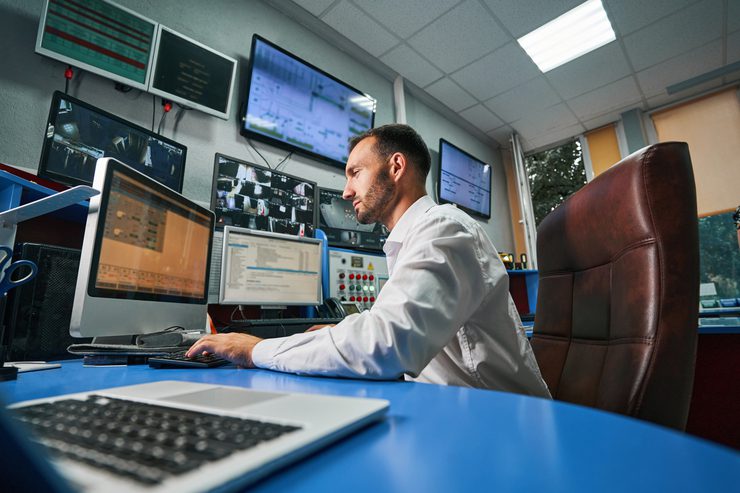
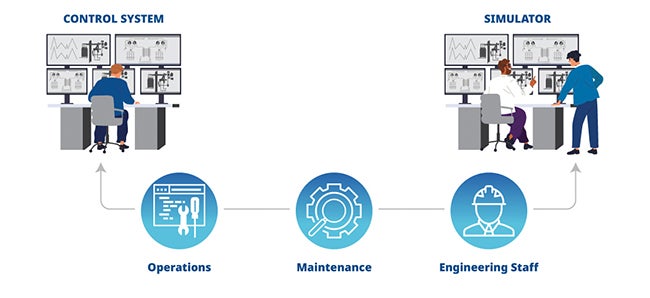
1. The most effective digital twins use the facility’s actual control environment, allowing simulated controls to look and behave like the live system. Courtesy: Emerson  In This IssueFull issue |
This digital solution is fundamentally different from simplified simulations or spreadsheet-based calculators. The complex first-principles-based models supporting a true digital twin provide users with a sandbox tool closely mimicking their actual control environment. Users not only learn and test the theories behind their actions, but also intentionally take actions as though they are operating the facility, gaining valuable experience for critical situations (Figure 1).
From Specialized Hardware to Fully Virtual
Today, advances in technology have democratized the use of digital twins. Early simulators required rooms of specialized hardware and proprietary systems. In those solutions, the control system was a literal physical controller that interfaced directly with the simulated models through simulated I/O (input/output).
As computing advanced—unlocking technologies like servers, workstations, and consumer operating system environments—digital twins became more accessible. In fact, while some organizations are selectively reintroducing physical controllers as part of their digital twin solutions, for tasks like patch testing before deployment, nearly all power industry digital twins today are virtual. By leveraging virtualization software running on-premise or in the cloud, teams have been able to unlock flexibility without sacrificing capability.
The shift toward fully virtualized power facility digital twins decouples the model from any specific hardware or on-premise control system infrastructure. As a result, these twins can be instantiated, updated, and scaled within cloud environments, enabling centralized model management, elastic compute for high-fidelity simulations, and broad accessibility across geographically distributed stakeholders.
From Training Simulator to Lifecycle Tool
With the expansion of capability and accessibility has come new use cases for digital twin technology in the power industry. Modern digital twin simulations are still powerful training tools for power generation and distribution organizations, but many companies are dramatically expanding their use case by investing in digital twins as lifecycle simulation tools.
 |
|
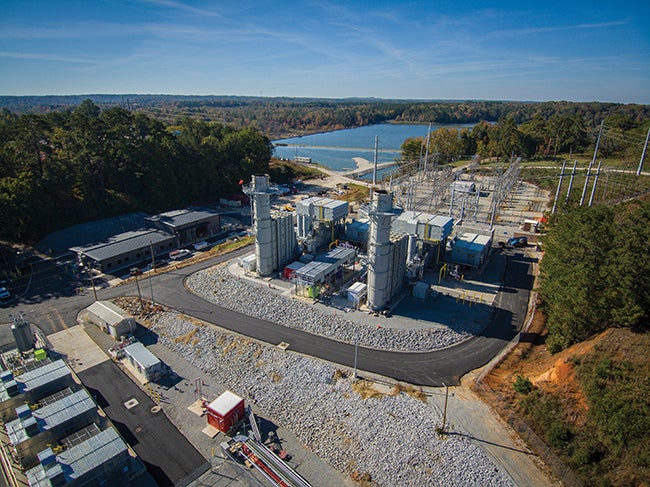
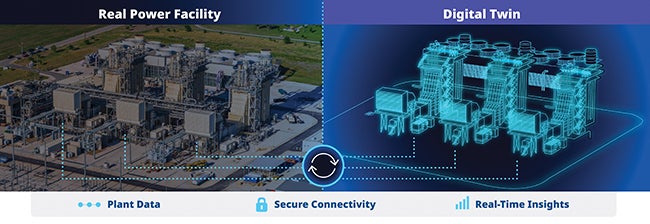
2. A digital twin is a virtual replica of both the facility and its control system, enabling safe, realistic testing and training. Courtesy: Emerson |
An increasing number of teams are leveraging their digital twin for engineering design, control strategy development, project testing, patch and update testing, pre-startup validation, operator training, engineer training, and ongoing scenario analysis across the facility’s lifecycle. Instead of a design tool that is shelved after the project or a training tool that becomes less useful as the facility and its operations or personnel change, today’s most advanced digital twins are evergreen lifecycle tools designed to be permanent engineering and operational assets (Figure 2).
Digital Twins Support Renewables Operations
One of the key modern trends driving an increase in adoption of digital twin simulation is the rise of renewable energy in the power sector. Traditional thermal plants have always required significant operator interaction, making them perfect candidates for operator training models. While renewable generation facilities require fewer operator manual actions, they generate far more system-to-system interactions, the complexity of which necessitates the use of powerful engineering and training tools.
In a renewables facility, assets often come from many different original equipment manufacturers (OEMs), and all systems from those OEMs must communicate seamlessly. However, I/O is typically not the traditional hard-wired voltage and current signals but rather network messaging via a wide array of protocols—such as Modbus, DNP3, IEC61850, IEC60870-104—or even proprietary protocols. This is where a digital twin can be a critical engineering tool.
Getting all the I/O lists correct during a project is challenging, as is maintaining them across system changes. From an engineering standpoint, register maps often change, especially during startup and commissioning. Documentation alone is often insufficient to catch integration errors.
In the most advanced modern digital twins, smart grid extensions incorporate actual network communications into the simulation. Using smart grid extensions, engineers can simulate Ethernet, networked I/O, and messaging, not just analog signals. This empowers teams to test register maps, protocol changes, and communication paths offline.
The key value is that network issues that are nearly invisible on paper become obvious when the simulated system is executed. Teams not only engineer faster, but they operate with higher confidence, as what works in the digital twin will also work in the live environment.
Renewables Require the Right Fidelity
The increasing introduction of renewable energy assets into power generation portfolios has increased the need for more fit-for-purpose simulation tools for the power industry. The inverter-based resources common in renewable energy systems have changed simulation requirements.
Traditional power generation plants that are governed by rotating machine dynamics operate close to nominal frequency and voltage, as protection systems prevent operation outside of very tight boundaries. In contrast, in inverter-based resources such as solar, wind, and battery energy storage systems (BESS), boundaries often blur between generation, transmission, and distribution. In these use cases, the electrical dynamics become more complex, and tight control is critical.
Today’s most advanced digital twin systems leverage smart grid extensions with a completely redesigned electrical solver for high-fidelity electrical simulations. These systems more easily simulate off-normal conditions, such as off-nominal frequency and unbalanced three-phase systems, which can occur in renewables, especially in microgrids. Teams can identify these conditions in the system as it operates in the digital twin, allowing them to adjust as necessary without risking equipment damage.
Hybrid Fidelity Delivers Flexibility
High-fidelity modeling of some systems is essential for accurate simulations. Critical assets like turbines, BESS control, and grid interfaces often need high-fidelity modeling to ensure the most accurate control. However, modeling every element of a process at the highest fidelity typically adds unnecessary cost, complexity, and time to digital twin projects. Essential assets and balance of plant equipment can often use lower-fidelity models, while still providing accurate indications.
Today’s advanced digital twin software empowers users to build models with a wide range of fidelities. Using boundary blocks, engineers can set a boundary, inside of which all modeling is high fidelity. Outside of the boundary, users can create less detailed or lower-fidelity models, but everything works seamlessly, and they still see the correct indications on the operator graphics.
For example, in a model for a renewables system, the digital twin might contain both solar assets and a BESS so the team can run different weather conditions through the model and see the impact on output. The battery chemistries in the BESS would likely be modeled at a lower fidelity, perhaps simply illustrating the representative dynamics of charging and discharging. In contrast, the battery controls and irradiance in the same digital twin would likely be modeled at a higher level of fidelity.
The same example extends to more traditional generation as well, such as in a scenario designed for an AI factory. The islanded power sites at AI factories increasingly rely on BESS to help manage the massive load swings of hundreds of megawatts per minute occurring during AI training. Much like the solar example, the BESS charging dynamics could be modeled at middle- to low-fidelity, while the turbines and load-responsive battery control would be high-fidelity models. Conversely, the digital twin could incorporate high-fidelity models from equipment OEMs, such as the battery OEM providing a high-fidelity simulation of the battery chemistry, or the inverter OEM providing a model of the inverter response to frequency events.
In summary, modern digital twin software with hybrid fidelity capabilities helps ensure realistic control behavior without unnecessary computational expense.
Bring Your Own Controls
Another advantage of modern digital twin simulation software is its flexibility to use third-party controls without the need for emulation. The most effective simulation software is already part of the facility’s control system, making it easy to develop simulated controls that look and act like the live system. More advanced solutions also allow OEM controllers to be plugged into the environment. This avoids the need to emulate OEM logic and provides true multi-controller interaction inside the digital twin.
For example, a combined cycle plant might have a different OEM control system for the turbine than the master control system managing the facility. With an advanced digital twin, the engineering team can connect the turbine’s control system directly into the simulation, avoiding the risk that emulation might make the simulation less reliable or user-friendly.
Evergreen Simulation
Control systems change continuously over time. Historically, this has led to discrepancies between the control system and the digital twin. As time passes and those discrepancies increase, bringing the model and the core system back in line becomes more complex and expensive.
Modern digital twin platforms include intuitive curation tools to eliminate drift and help simulation software stay evergreen. The curation tool makes it easy to push live updates such as configuration changes, control strategy changes, graphics updates, alarm limits, and database changes into the digital twin from the software interface, helping synchronization become routine rather than a major project.
Time to Re-Engage With Digital Twins
Modern digital twin simulations are faster, more accurate, and more accessible than ever. Built to address today’s realities in the power industry, simulation software makes it far easier to navigate expanding electrification, grid complexity, the rise of renewable energy, and workforce transitions.
Moreover, today’s digital twins are proving their value as lifecycle tools to support operational excellence. Organizations that stopped at training simulators are missing immense value and potential for competitive advantage.
In the highly complex, competitive modern power industry, digital twins are no longer optional. They are instead strategic enablers of reliable and intelligent power systems, helping drive efficiency, innovation, and flexibility now and for the foreseeable future.
—Rick Kephart is the vice president of technology for Emerson’s power and water solutions business.