Drought conditions across the Southeast have begun affecting power plant operations. According to the Associated Press, 24 of America’s 104 nuclear reactors are in areas now experiencing the most severe levels of drought, and 22 of those plants draw their cooling water from rivers and lakes. Recently, the level of several of those lakes nearly fell to the minimum necessary to continue reactor operation. Last August, for example, Tennessee Valley Authority said that higher inlet water temperatures caused by lower water levels had forced load curtailments or plant shutdowns at its Browns Ferry, Gallatin, and Cumberland plants. Reduced hydro generation has been another consequence of the drought (see “Water’s role in power generation”).
In past years, the major obstacle to new plant development was either access to transmission lines or the price and/or availability of a particular fuel. Recently, water availability became an additional hurdle, and one that looks to grow higher.
At the nexus of water and power generation are a wide variety of societal issues, policy and regulatory debate, environmental questions, technological challenges, and economic concerns. Water is emerging as a significant factor in economic development activities. Planning efforts must consider the availability and quality of water resources in a given locality or region to ensure that supplies are available to accommodate existing and future water consumers over the long term. Failure to do so can result in stunted growth, economic flight, inequitable development, and even open conflict.
Today, many plants are finding that a sustainable source of water has become a top priority. Energy-water issues have become increasingly visible in recent years. As important examples, consider passage of the Energy Policy Act of 2005; repeated introduction of the Energy-Water Efficiency and Supply Technology bill; increasingly severe regional drought conditions across the U.S.; additional difficulty siting new plants in arid regions; and further media attention to and public concern over water availability and supply.
This article discusses some of the technical, regulatory, and political issues that frame the water-electricity debate. Given the increasing perceived value of water, the generation industry’s understanding of and response to these issues will be critical to America’s future.
Water’s role in power generation
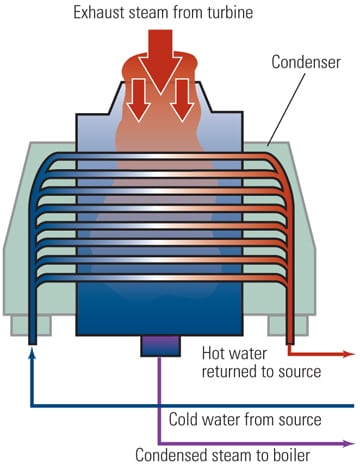
The two primary evaporative technologies are categorized as wet and dry; hybrid systems are also in use. Wet systems dissipate heat to the atmosphere either by recirculating water through a cooling tower (Figure 1) or by constantly replenishing an evaporative cooling pond.
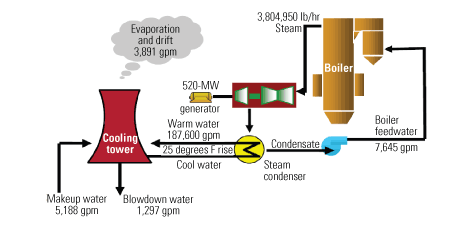
1. Ins and outs. A wet recirculating cooling water system for a 520-MW coal-fired power plant. The flows shown are typical, so the plant uses about 12 million gallons of water per hour. Source: NETL
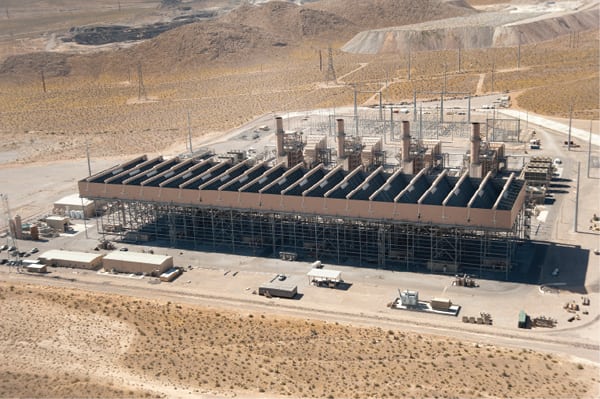
Dry cooling systems use an air-cooled condenser, rather than a cooling tower or pond, to evaporate the heat produced by condensing steam. They use no water but are more expensive than once-through or wet evaporative systems.
As Table 1 shows, in the U.S. roughly 43% of thermoelectric generating capacity uses once-through cooling, while 56% evaporates heat via wet recirculating cooling towers or cooling ponds; only 1% makes use of dry cooling. It should be noted that the data for combined-cycle plants represent only about 7% of the total capacity currently in operation. Not all plants provided cooling data, so the table had to be created by extrapolating information available at the time.
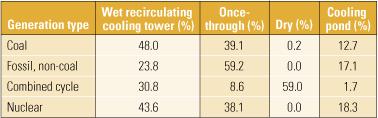
Table 1. Cooling technologies by generation type. Totals are weighted averages of the column, based on capacity. Source: NETL
Historically, the choice of cooling technology for a particular plant depended on the quantity and quality of local water sources as well as cost and performance comparisons of different systems. The use of closed-loop systems, however, is likely to become much more prevalent in the future due to Clean Water Act Section 316(b) provisions and public pressure.
Demographics and tradeoffs
Drought conditions are not limited to the Southeast. A Government Accountability Office (GAO) report prepared in 2003 addressed the issue of freshwater supply at the state level. It indicated that, assuming normal rainfall conditions, the water managers of 36 states anticipated shortages in localities, regions, or even statewide over the next 10 years (2003 to 2013). The report went on to say that “drought conditions will exacerbate shortage impacts.”
The Energy Information Administration’s (EIA’s) latest forecast—its Annual Energy Outlook 2007 (AEO 2007)—estimates that U.S. thermoelectric (thermal, for short) generating capacity will grow from approximately 709 GW (net, taking into account plant retirements) in 2005 to 862 GW in 2030. Accordingly, thermal power plants will increasingly compete for freshwater with residential, commercial, agricultural, and industrial users—particularly in regions with limited freshwater supplies. In addition, current and future water-related environmental regulations will also challenge the operation of existing power plants and the permitting of new ones.
The growth in power demand will not be geographically uniform, so capacity expansion will differ by region. Regions with strong population growth (such as the Southeast and Southwest) show high growth in water consumption, while regions with minimal to modest population growth (Midwest and Mid-Atlantic states, for example) exhibit modest growth in consumption.
For example, although the EIA projects a 22% jump in installed thermal capacity on a nationwide basis by 2030, it expects a 58% increase in the West and a 30% increase in the Southeast. Significantly, both regions have among the fastest rates of population growth (Figure 2) and are already struggling to find enough supplies of freshwater to meet demand.

2. U.S. population growth trends, 1970–2030. Each block on the map represents one county. The height of each block is proportional to that county’s population density in the year 2000, so the volume of the block is proportional to the county’s total population. The color of each block shows the county’s projected change in population between 1970 and 2030, with shades of orange denoting increases and blue denoting decreases. The patterns of recent population change—growth concentrated along the coasts, in cities, and in the South and West—are expected to continue. Source: U.S. Global Change Research Program
Because supplies of freshwater are limited, its withdrawal and consumption will have to be allocated carefully by governments. These decisions have long been extremely important in many foreign countries, and they are likely to become top priorities at various levels of government in the U.S. in the near future. Like all decisions involving a limited resource, tradeoffs will be inevitable. At the end of the day, someone will have to determine which is more important: making water available for drinking and personal use, for growing food, or for producing electricity. (see "National Energy Technology Laboratory solicits water management technologies applications".)
More precious than power
In the future, developers will find it more difficult to permit new plants due to water concerns. At the same time, existing plants will experience increasing pressure to reduce their water withdrawal and consumption.
In 2006, Research and Development Solutions LLC contacted state government water monitoring agencies to ask if they limit freshwater withdrawal and/or consumption by thermal plants in their state. Of the 33 states that responded, 24% indicated that plants must either have a senior water right or purchase such a right from an entity willing to sell it. Another 18% indicated that limitations are imposed when water levels fall below a certain flow level or during water shortages. An additional 18% of states responded that water withdrawal and consumption rules vary regionally within the state; some areas have no limit, but areas that are water-sparse or over-allocated require water rights or special permits. The number of states with over-allocated water resources is expected to increase over time.
Concerns about water supply expressed by state regulators, local decision-makers, and the general public are already affecting power projects across the U.S. For example:
- In March 2006, an Idaho House committee unanimously approved a two-year moratorium on construction of coal-fired power plants in the state based on environmental and water supply concerns.
- Arizona rejected the permit application for a proposed power plant because of concerns about how much water the plant would withdraw from a local aquifer.
- A coal-fired power plant under construction in Wisconsin on Lake Michigan has been under attack from environmental groups for the potential negative impacts of the facility’s cooling water–intake structures on aquatic life.
- In February 2006, Diné Power Authority agreed to pay the Navajo Nation $1,000 per acre-foot of water needed for the proposed Desert Rock Energy Project.
- In an article discussing a proposed 1,200-MW plant in Nevada, opponents of the plant stated, “There’s no way Washoe County has the luxury anymore to have a fossil-fuel plant site in the county with the water issues we now have. It’s too important for the county’s economic health to allow water to be blown up in the air in a cooling tower.”
How NETL projects future water use
As part of its Annual Energy Outlook (AEO), the DOE’s Energy Information Administration (EIA) projects future levels of thermoelectric capacity. The AEO projections are based on the EIA’s National Energy Modeling System, which is revised yearly to reflect technology advances, supply and demand adjustments, and other market forces.
This analysis uses AEO 2007 projections of changes in generation capacity between 2005 and 2030 (Table 2) to calculate future thermal plants’ water withdrawal and consumption needs.

Table 2. Annual Energy Outlook 2007 thermoelectric capacity projections, 2005 to 2030. Values shown are in gigawatts. Source: EIA
After individual growth numbers for generation technologies are estimated, NETL’s Coal Power Plant database is used to determine the average water withdrawal and consumption estimates by plant capacity. Other DOE/NETL studies were used to estimate the performance and water consumption of the newer generation technologies, such as integrated gasification combined cycle and retrofit carbon capture. The analysis was performed for 13 separate North American Electric Reliability Corp. sub-regions.
How NETL projects future water use
As part of its Annual Energy Outlook (AEO), the DOE’s Energy Information Administration (EIA) projects future levels of thermoelectric capacity. The AEO projections are based on the EIA’s National Energy Modeling System, which is revised yearly to reflect technology advances, supply and demand adjustments, and other market forces.
This analysis uses AEO 2007 projections of changes in generation capacity between 2005 and 2030 (Table 2) to calculate future thermal plants’ water withdrawal and consumption needs.
Table 2. Annual Energy Outlook 2007 thermoelectric capacity projections, 2005 to 2030. Values shown are in gigawatts. Source: EIA
After individual growth numbers for generation technologies are estimated, NETL’s Coal Power Plant database is used to determine the average water withdrawal and consumption estimates by plant capacity. Other DOE/NETL studies were used to estimate the performance and water consumption of the newer generation technologies, such as integrated gasification combined cycle and retrofit carbon capture. The analysis was performed for 13 separate North American Electric Reliability Corp. sub-regions.
Cooling and consumption scenarios and drivers
The Department of Energy/National Energy Technology Laboratory’s (NETL’s) September 2007 update of its 2006 report, “Estimating Freshwater Needs to Meet Future Thermoelectric Generation Requirements,” found that the 192.6 GW of new thermal generating capacity expected to be built nationwide by 2030 could increase thermal plants’ freshwater consumption, especially in the more arid regions of the U.S.
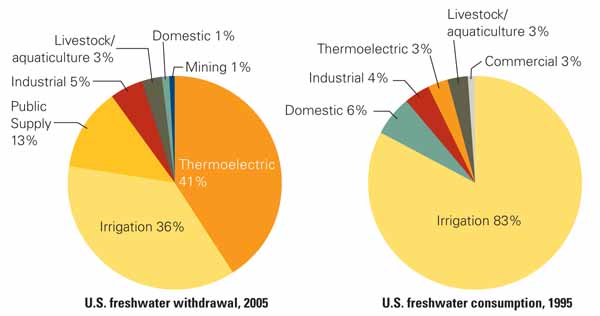
The update notes that the thermal power generation sector will remain a large water consumer for the foreseeable future, though its consumption will remain small compared with the “irrigation/agriculture” sector, which consumes 81% of total freshwater withdrawn. Withdrawals for both the irrigation/agriculture and thermal generation sectors will remain about 118 to 158 billion gallons per day (bgd). Although thermal plants consume far less water than they withdraw, the trend is steadily upward. Water consumption by all U.S. thermal plants is expected to grow steadily each year; however, the magnitude of growth is highly dependent on the power generation technology selected. In the face of growing competition for water resources—particularly in the arid West and Southwest, and in the expanding Southeast—regional and national efforts to reduce water withdrawal and consumption by thermoelectric power plants are only going to increase.
Let’s briefly examine the main scenarios presented in the NETL report. The descriptions for both cases refer to noncarbon-capture new thermal power generation system water use change by the year 2030. Each analysis (see “How NETL projects future water use,”) assumes the demand and capacity growth projections mentioned earlier and detailed in Table 2, which also breaks down projected capacity changes by technology type.
For consistency, the case numbers from the report are used in the figures. Case 2 is the regulatory-driven case for changes in incremental water withdrawal by 2030. This analysis assumes that the Clean Water Act 316(b) and future regulations dictate the need for recirculating cooling systems with freshwater makeup for all new capacity additions. Plant retirements remain based on age and operating costs. Case 4 is the dry cooling case for changes in incremental water withdrawals by 2030. In this case, regulatory and public pressure increase the market share of dry cooling for new capacity additions to 25%. The remainder will use recirculating cooling systems with freshwater makeup. Plant retirements are proportional to current water source and cooling technology used. For both cases, 2005 is the base year.
As Figures 3 through 6 illustrate, the range of increased water consumption varies considerably from region to region. Some show little increase in usage; others (more arid regions) are in line for considerable increases in freshwater demand.

3. Incremental change in power plant water withdrawal by 2030. Source: NETL
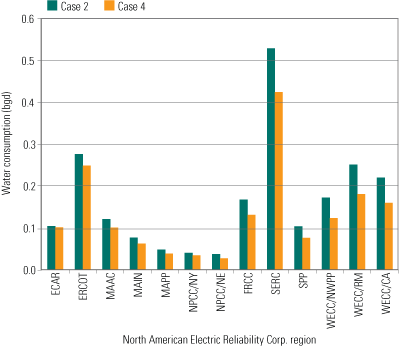
4. Incremental change in power plant water consumption in 2030. Source: NETL
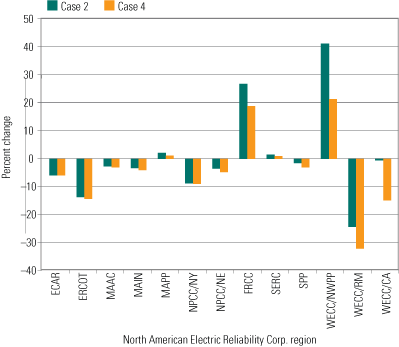
5. Percentage change in power plant water withdrawal by 2030. Source: NETL

6. Percentage change in power plant water consumption by 2030. Source: NETL
The main technical and regulatory drivers that impact freshwater usage and demand include those that follow.
Cooling water regulations. The largest impact on plant design of Clean Water Act Section 316(b) is that most new plants will have to use closed-loop, recirculating cooling systems or dry (air-cooled) systems. Open-loop systems are strongly discouraged, unless the permit applicant can either demonstrate that alternative measures can provide a water use reduction level comparable to that achieved through closed-loop cooling or make the case that compliance costs, air quality impacts, and/or energy generation impacts would outweigh the cost benefits and therefore justify an open-loop system.
Because Section 316(b) portends a greater reliance on closed-loop cooling systems, water withdrawal and consumption patterns for the thermal generation sector are destined to change over time. Even accounting for significant thermal capacity additions, NETL projects that water withdrawal levels will likely decrease in four of the five cases it examined due to retirement of older once-through cooling plants and the deployment of new, closed-loop systems. Water consumption, on the other hand, is expected to increase in all five cases examined because evaporative closed-loop cooling systems consume more water than open-loop systems.
Air quality rules. Existing and future air quality regulations will also affect water withdrawal and consumption patterns, although to a lesser extent than cooling water regulations. Tighter emission levels for SO2, for example, have sparked a mini-boom in the flue gas desulfurization (FGD) market. The size of the U.S. FGD market is expected to increase by more than 100,000 MW over the next 10 years. Although FGD water requirements are a fraction of those required for cooling purposes, FGD units require a significant amount of water to produce and handle the various process streams (including limestone slurry and scrubber sludge). Makeup water requirements for the FGD island at a nominal 550-MW subcritical coal-fired power plant are about 570 gpm, vs. about 9,500 gpm for cooling water makeup. Nonetheless, the additional FGD systems coming on-line within the next decade will place a greater strain on water supplies.
Recently, semi-dry FGD systems that substantially reduce water requirements for SO2 control have begun to enter commercial service at numerous plants, many in arid environments. (See "Benefits of evaporating FGD purge water," POWER, March 2008, for an analysis of zero-liquid-discharge [ZLD] options for scrubbers, and "Recycling, reuse define future plant designs," POWER, May 2006, for an in-depth description of a ZLD system at a large combined-cycle plant in the U.S. Southwest).
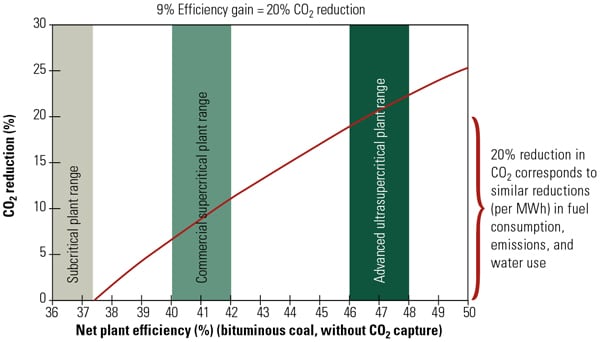
Impacts of carbon capture. In light of increasing calls to limit climate change and CO2 releases, it is of interest to try to quantify the effect that CO2 mitigation would have on future demand for freshwater. The EIA forecasts a 45% increase in coal-fired generation by the year 2030, including both pulverized-coal (PC) and integrated gasification combined cycle (IGCC) plants. The deployment of carbon capture technologies under development on these coal plants would likely increase power plant water requirements.
NETL evaluated three different scenarios associated with carbon capture and water. Let’s look at the third scenario, which represents the greatest potential impact on water. Following the EIA’s 2007 forecast that in the year 2030, 62 GW of power will be generated by PC plants that do not use scrubbers for SO2 control, scenario three does not include those plants for CO2 capture. It is assumed that the PC plants without scrubbers are the oldest plants and that it is not feasible to retrofit them with CO2 capture technologies. Such plants would have to comply with carbon caps by buying carbon credits. Scenario three goes on to assume that the 242 GW of scrubbed capacity and all new PC plants will be retrofitted with monoethanolamine (MEA) to absorb CO2 from their flue gas, while the IGCC component of new coal capacity would employ the Selexol process. Both processes are assumed to capture 90% of the CO2.
Both MEA and Selexol require water. MEA is designed to recover high-purity CO2 from low-pressure streams containing oxygen. The process uses a stripping tower to recover CO2 from the solvent. Cooling water is indirectly used to lower the temperature of the flue gas to about 100F. The compression and dehydration of the CO2 are the other processes that increase water use. Compressing the CO2 generates heat, so intercoolers are used between compression stages to cool the CO2 fluid. The CO2 capture system also requires water for washing, absorber intercooling, reflux condensing, reclaimer cooling, and lean solvent cooling. For IGCC, water (steam) is used in the water-gas shift reaction to increase the concentration of CO2. Water is also used to cool the syngas before it enters the two-stage Selexol process. It would also be needed for compressing the CO2 for subsequent transportation and storage.
In addition to direct water use, MEA retrofitted to existing PC plants will indirectly increase overall coal plant water use in order to compensate for the makeup of the parasitic power needed to operate the capture system. NETL assumed that MEA-based CO2 capture technology would derate the plant by 30%, resulting in the need to build new thermoelectric generating capacity to replace 73 GW of lost power.
For scenario three, NETL estimated that freshwater withdrawal and consumption would increase by 6 bgd and 4.3 bgd by 2030, respectively, compared with water use by coal plants in a noncarbon-constrained future (Figure 7). As seen in the past with other emission control technologies, R&D efforts are expected to promote improved efficiencies for current technologies and result in new technologies, therefore lowering water demands. (See POWER, January 2008, p. 46, for a set of suggestions for reducing power plant water demand.)

7. Relative water usage for new pulverized coal and IGCC plants. The integrated gasification combined-cycle data are averages of three different gasification technologies. Source: NETL
Other operating constraints. Several other regulatory actions warrant attention for their potential impact on water withdrawal and consumption. Section 303(d) of the 1972 Clean Water Act requires states, territories, and authorized tribes to develop a list of impaired waters not meeting water quality standards and then establish total maximum daily loads (TMDLs) for these waters. A TMDL specifies the maximum amount of a pollutant that a waterbody can receive and still meet water quality standards; it also allocates pollutant loadings among point and nonpoint pollutant sources.
TMDL requirements could constrain a power plant’s ability to discharge cooling water (as well as trace metals and other pollutants from flue-gas cleanup by-products) into a waterbody if it is impaired. Such a plant would then have to seek an alternate water source or install additional water treatment equipment.
This article is based on “Estimating Freshwater Needs to Meet Future Thermoelectric Generation Requirements,” 2007 Update (DOE/NETL-400/2007/1304, September 24, 2007). The report—available at www.netl.doe.gov/technologies/coalpower/ewr/pubs/2007WaterNeedsAnalysis-UPDATE-Final_10-10-07b.pdf—was prepared by Erik Shuster and Andrea McNemar of the National Energy Technology Laboratory and Gary J. Stiegel, Jr. and James Murphy of Research and Development Solutions LLC.