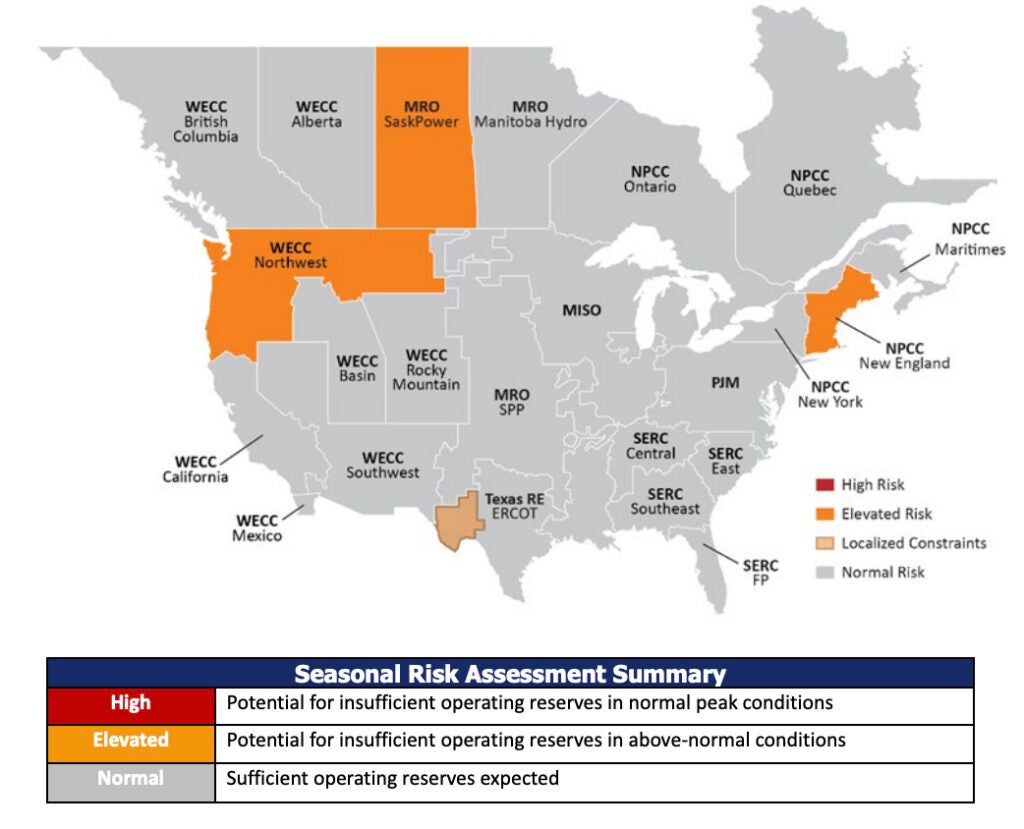
Developing a power project requires a delicate balancing of the needs and wants—perceived or real—of dozens of stakeholders. It only takes one dissatisfied party to slow or even stop a project. The tension between electricity production and environmental protection will only increase as more generating capacity—much of it coal-fired—is proposed to meet rapid load growth in most areas of the U.S. During the week of July 17, as this article was being written, all seven regional independent grid operators set new demand records that exceeded their 2005 peaks by as much as 9.9%. Those increases alone would require another 7,516 MW to come on-line.
Construction of any new plant entails an extensive permitting process, including obtaining a Prevention of Significant Deterioration (PSD) ruling and/or a nonattainment New Source Review, depending on the ambient air quality of the project site. Applicants must demonstrate that the air pollution control method chosen either implements a best available control technology (BACT) or would achieve a lowest achievable emission rate (LAER), compared with other emissions sources in their source category. Once a major source of pollutant emissions becomes operational, it must comply with the terms of its Title V operating permit and be recertified for compliance annually, and submit semiannual compliance monitoring reports.
Extracting data
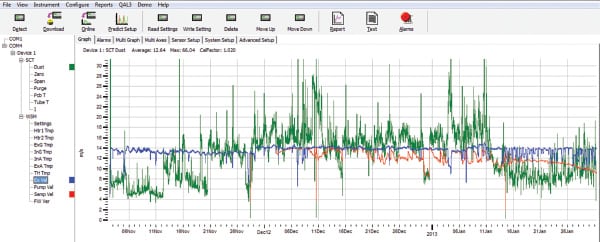
Generally, the emissions data included in a permit application for a plant come from the manufacturer of its boiler or gas turbine. For example, a gas turbine’s NOx emissions level and rate are specified at various ambient temperatures and load conditions, at typical (but not worst-case) humidity and barometric pressures (Figure 1). One conclusion we can draw from Figure 1 is that, although a unit’s stated NOx emission level depends on a particular set of operating conditions, its NOx emission rate varies with ambient temperature and relative humidity, as well as fuel quality. Also not to be discounted is the role that the accuracy of instrumentation plays in quantifying the actual emissions of a unit or a plant.
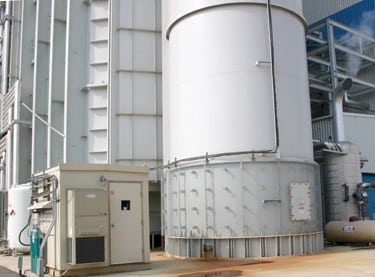
2. Hooked on NOx. The typical straight-extractive continuous emissions monitoring system (CEMS) instrumentation is usually protected by an enclosure. Courtesy: Mostardi Platt Environmental
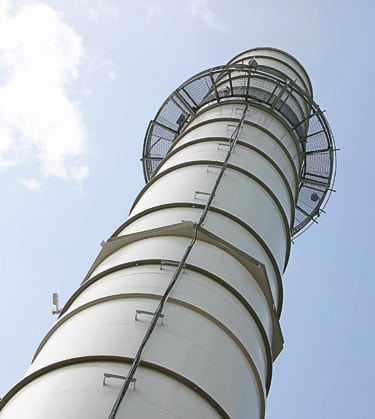
3. Pulling a sample. CEMS sample lines run up the side of the stack to the sample ports. Courtesy: Mostardi Platt Environmental
Dilution-extractive systems are a more common adjunct to solid-fueled boilers, such as utility units firing coal. The flue gases are diluted 25:1, 50:1, 100:1, or even 200:1 with instrument air prior to measurement. One advantage of dilution-extractive systems is that they do not require the gases to be conditioned prior to analysis. They are analyzed on a wet basis, with no correction for moisture content. After being delivered by the various analyzers, the gas concentrations are multiplied by the dilution ratio to retrieve the original concentration.
Another advantage of appending a dilution-based system to a coal-fired boiler is that flow monitoring is typically used to calculate mass emission rates. Because measurements of both gaseous components and flue gas flow rate are on a wet basis, calculations can be completed without regard to the moisture content of the flue gas.
Calculated risk
When using a dry-based extractive system, the monitored pollutant concentration (in ppmvd, or parts per million by volume on a dry basis) requires a diluent (oxygen in dry-based systems, carbon dioxide in wet-based dilution systems) to calculate the emission rates in lb/mmBtu. A typical gas turbine plant will calculate the mass emission rate (lb/hr) by multiplying the emission rate (in lb/mmBtu) by the heat input (mmBtu/hr). For dilution-based systems used with coal-fired boilers, the mass emission concentration typically is calculated directly from measurements of mass flow. The test methods and calculations are contained in the U.S. EPA New Source Performance Standards published in the Code of Federal Regulations (CFR) Title 40 (Protection of the Environment, Part 60), and Appendices.
In general, with proper engineering, design, operation, and maintenance, the CEM systems being used in industry today are reasonably accurate and reliable. Regardless of the device, however, sources of bias, variation, and system uncertainty will creep into the system (see box). Consider the following sources of uncertainty—and risk of noncompliance—when developing your emissions rate margin plan.
Uncertain future
State and federal regulatory agencies typically allow rounding to the granularity of the permit limit. For instance, if a plant’s permitted NOx limit is 9 ppmvd at 15% O2, a value of 9.4 ppmvd @ 15% O2 would be considered in compliance. However, if the permitted limit is listed as 9.0 ppmvd @ 15% O2, a value of 9.4 would be considered out of compliance. The same holds for mass emissions rates in lb/hr. Now might be a good time to check the number of significant digits in the values listed in your permit.
The controlling factor in an air permit for a gas turbine is usually the concentration limit, as defined by the BACT or LAER value in the permit. It’s important to realize that a source is not allowed to simply meet the concentration limit while exceeding the mass emission limit.
Table 1, a typical set of gas turbine data, illustrates the inherent uncertainty in mass emission calculations. The author’s firm has studied the level of uncertainly present in a 9-ppmvd NOx emission concentration (with 14.5% O2, a fuel factor of 8,685, a reported fuel flow of 1,800 kscfh, and a fuel heating value of 1,015 Btu/scf). The reported +/– values are representative of the expected ranges of uncertainty experienced by the gas turbine.
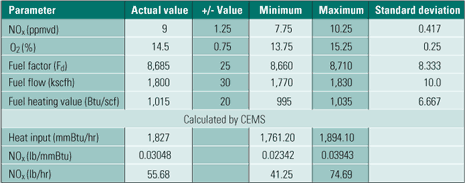
Table 1. Analysis conditions for CEMS emission calculations. Source: Mostardi Platt Environmental
The column of Table 1 labeled "actual value" contains the numbers calculated by the turbine’s manufacturer—in this case, 0.03048 lb/mmBtu and 55.68 lb/hr. Assuming that all the measurement variations were at their extremes, the NOx figures could drop to as low as 41.25 lb/hr (74.1% of expected) or rise as high as 74.69 lb/hr (134.14% of expected). However, the likelihood of all uncertainty accumulating in one direction or the other is quite remote. A more rational approach would be to determine how much margin should reasonably be applied to the mass emission rate to ensure that ongoing compliance will not be affected by measurement uncertainty.
Running the numbers
Using Statistica Release 7.1, a dataset of 100,000 cases of CEMS calculation runs was produced using the RNDNORMAL function and the standard deviations from Table 1. The values were then added to the actual values for each parameter. For instance, to generate normally distributed NOx concentrations around the actual value 9 +/– the uncertainty, the variable command was:
NOx (case 1…100,000) = RNDNORMAL(0.417) + 9
Similar variables were generated for the other calculation input parameters. Finally, the heat input, NOx (lb/mmBtu), and NOx (lb/hr) values were calculated for each case. The same descriptive statistics as those in Table 1 were then checked to ensure that the data sets were normally distributed before continuing the analysis.
Table 2 shows the results of the uncertainty analysis and the range of correction factors (Figure 4) that could be used to adjust the mass emission rates to reflect the degree of uncertainty present in the data collection. For example, the 90th percentile correction factor is a nominal 1.09; for the 95th percentile it is 1.11.

Table 2. Descriptive statistics of measured variables. Source: Mostardi Platt Environmental
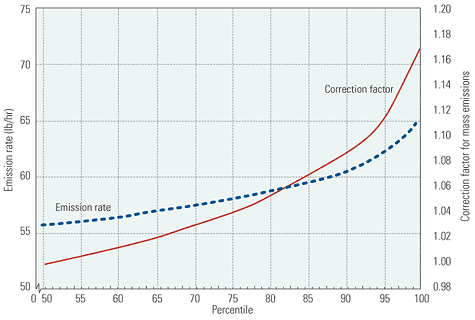
4. Range of accuracy. The level of uncertainty present in measurements of the level of NOx in flue gas a gas will determine the acceptable range of reported values. Source: Mostardi Platt Environmental
The practical application of this analysis should be clear: If we want to be 90% confident that the measured value of 9 ppm is accurate, reported values that are plus or minus 9% of the calculated 9 ppm must be considered compliant with the permitted limit. Each proposed emission source should first be evaluated for its own conditions by preparing a table similar to Table 1. Then the plant engineer should perform an uncertainty analysis to determine source-specific corrections for mass emissions.
Coal’s unique issues
Because the accuracy of measurements taken on coal-fired plants tends to have a wider range, even higher uncertainty margins are the result. Once again, the uncertainty present in all parameters used in calculations should be addressed on a case-by-case basis. Continuous flow monitoring devices have the most uncertainty; quite often, comparing the relative accuracy of data from flow monitoring with that of emissions testing flow traverses indicates that significant adjustments may be needed to get the monitors back into a valid range.
To simplify monitoring, many coal plants sample and analyze their fuel daily and measure their consumption of it annually instead of tracking sulfur dioxide (SO2) emissions directly. These facilities calculate SO2 emission rates from fuel flow, fuel heating value, and fuel sulfur content. Because the molecular weight of sulfur is 32, and the molecular weight of sulfur dioxide is 64, every pound of sulfur contained in the fuel is theoretically converted into two pounds of SO2.
Direct measurements of SO2 emissions from coal-fired units with SO2 analyzers, in conjunction with exhaust flow rate monitors, often produce numbers (in lb/hr) that are significantly higher than the theoretical values calculated from fuel sampling and analysis. This discrepancy is typically related to inaccuracies in continuous exhaust flow measurement techniques rather than inaccuracies in the SO2 analyzers.
For example, if the coal being burned has a sulfur content of 0.65% by weight and a heating value of 9,650 Btu/lb (HHV), a heat input of 3,300 mmBtu/hr would result in a maximum emission rate of 4,446 lb/hr (assuming 100% conversion of the sulfur in the coal to SO2). However, if the actual sulfur conversion rate is 97%, the emission rate would fall to 4,313 lb/hr. If the CEM system and exhaust flow rate monitor are operating accurately, the measured SO2 emission rate should agree with the 4,313 lb/hr rate determined from the fuel analysis. But if the exhaust flow monitor was reading 10% high, the CEM system would erroneously calculate an SO2 emission rate of 4,744 lb/hr, reflecting the uncertainty present in the system.
The proximity of the stack monitoring location to duct breaching and flow disturbances can cause significant stratification problems in some coal-fired units with physical constraints. Accordingly, these plants often create stratification test profiles to determine the best location for the stack probe. The stratification problems arise when load testing is conducted at only one or two load points rather than across the load range of the unit. As volumetric flow through the boiler varies, the flow profiles in the stack could change as well, leading to increased uncertainty.
—Joseph J. Macak III is a principal consultant for Mostardi Platt Environmental (Oak Brook, Ill.). He can be reached at 630-993-2127 or jmacak@mostardiplattenv.com.