
Demand for electricity—particularly for large-load users like data centers—is increasing, raising the question of how best to meet the new demand. While fossil fuels and renewables such as wind and solar have been challenged by competing political forces, a resurgence of nuclear power has increasingly been seen as a viable path forward.
COMMENTARY
Several traditional large nuclear plants that had recently suspended operations are in the process of being restarted, some explicitly to serve data center demands. But much of the broader emphasis has been on the promise of a new generation of small modular nuclear reactors (SMRs) that take up less space and are thought to be safer by design than their predecessors. While these new SMRs hold exciting possibilities for safe, flexible, low-cost, emission-free energy, they need to be built somewhere—and the cycles that other energy infrastructure projects encounter provide a cautionary tale as well as an ability to learn and for SMRs to stay ahead of the curve.
How Opposition Derailed Wind and Solar
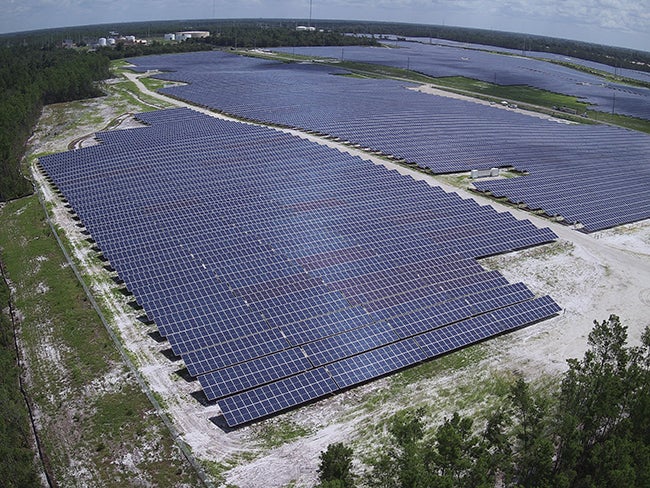
Pipelines of all kinds, electric transmission, wind farms, and solar projects have all run into significant local opposition in recent years, in no small part as social media has made organizing easier for opponents of infrastructure. Wind and solar are perhaps most illustrative. In the early days of utility-scale wind, about 30 years ago, it was often welcomed with open arms for addressing environmental issues, operating with zero fuel costs, and providing an injection of investment and tax dollars into state and local government.
For a variety of reasons beyond the scope of this article, that perspective changed rather suddenly, and by early 2024 a USA Today analysis showed that 15% of all counties nationwide had enacted moratoria or bans on new wind and/or solar projects. Notably, in zoning hearings we often heard renewables opponents argue that fossil-fueled generation was better. When utilities then suggested new natural gas turbines in the same or similar areas, it turns out the opposition was just as strong for those facilities. But in at least some cases, state legislatures and state regulators are responding by adopting statewide standards or state permitting processes to ensure a path toward needed new energy generation and desired investment.
Will SMRs Follow the Same Path?
The question is whether SMRs will undergo a similar cycle—from desired solution, to locally prohibited pariah, to saved by state action—and whether it can be avoided or shortened. One clear advantage SMRs have is federal preemption with regard to “radiological safety,” which limits the ability of local governments to regulate.
In This Issue
Full issueWhile case law on nuclear plants specifically is limited, the similar preemption on safety regulation of federally governed pipelines provides a much larger source of largely infrastructure-supportive law. Notwithstanding the impact of federal preemption, however, there has been a significant amount of legal activity lately to suggest the issue of SMR siting is ramping up. For example, in Arizona, the legislature passed and the governor in June of this year vetoed a bill that would have preempted most local zoning for SMRs either going in to prior energy generation sites or being collocated with data centers (although the governor’s veto message called for revisiting the issue in future legislative sessions to “develop a responsible regulatory framework … that encourages innovation while protecting public safety”).
In New Hampshire, in March 2026, the state’s governor created a task force to study and recommend policies to support SMRs—including investigating local ordinances that hinder the development of nuclear generation in the state. A similar process was initiated in Louisiana in 2025. And over the past year in Iowa, several counties have adopted specific local zoning provisions to regulate—but not prohibit—nuclear energy facilities. Along similar lines, Indiana passed a law that limited state jurisdiction and ceded permitting of nuclear facilities to the federal government, with supporters saying it merely complied with existing federal law, and opponents arguing that the jurisdictional lines are unclear and that the state voluntarily gave up more than was necessary.
Why New Technologies Struggle to Find a Home
Siting for new energy uses is often challenging in the best of circumstances: zoning ordinances may be old and don’t clearly contemplate new technologies leaving legal questions about whether uses are permitted or what kind of permits are needed. Questions over the division of local, state, and federal jurisdiction are common. Processes intended to be driven by evidence and reason get overwhelmed by loud opposition wielding disinformation traveling at the speed of the internet.
What the SMR Community Must Do Now
It is important to learn from how quickly the ground shifted (and in some cases, shifted back) for other energy technologies. Energy advocates and SMR developers need to engage early (ideally in tandem with their large-load partners as appropriate) to determine the lay of the regulatory land in their targeted geographies, to get a positive story out ahead of the inevitable disinformation, and to ensure a solid, workable legal framework exists that provides clarity and support.
The debate is ramping up, and history shows it can ramp quickly once it starts. Siting has become a significant drag on other energy technologies; this is the SMR community’s chance to ensure siting issues don’t stop SMRs from achieving critical mass. ■
—Bret Dublinske is an attorney and shareholder at Fredrikson & Byron P.A.