
Articles By

-
 Coal
CoalPollution-Control Technologies: Multi-Pollutant Removal Systems Are a Clean Coal Technology
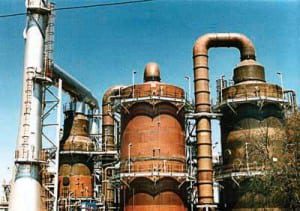
The first power plants were built about 130 years ago. Coal was then, and is still today, the major fuel used for power generation. Currently, about 1,400 pulverized coal – fired units, with an average age of more than 30 years, generate over 50% of U.S. electric power. The use of low-sulfur coal and improved […]
-
 O&M
O&MProject Planning: Repowering or Replacement: What Is the Solution?
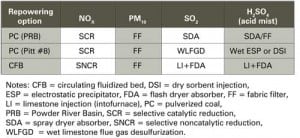
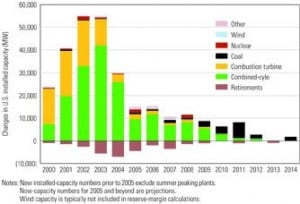
Between 1998 and 2002 the U.S. experienced an unprecedented power plant construction boom that consisted mostly of gas-fired, combustion turbine – based power plants. This surge in power plant construction had several driving forces, including electric power deregulation, the emergence of non-utility power producers, a sustained period of plentiful and inexpensive natural gas, and the […]
-
 Coal
CoalCase Histories: Pulverizer Upgrades Are Reducing Fuel Costs
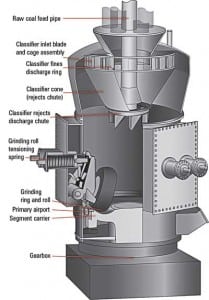
St. Johns River Power Park (SJRPP) is a two-boiler, 2 x 660-MW station jointly owned by JEA (formerly Jacksonville Electric Authority) and Florida Power & Light (FPL). JEA is the plant operator. The Foster Wheeler boilers went into commercial operation in 1987 and 1988. Each boiler has seven OEM vertical spindle pulverizers (mills) and 28 […]
-
 Coal
CoalClean Coal: Clean Coal Technology Is Not an Oxymoron
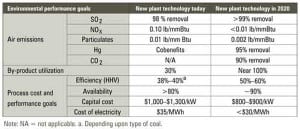
In the late 1980s, the U.S. Department of Energy (DOE), in conjunction with industry and state agencies, started the Clean Coal Technology (CCT) program. The aim of the CCT program was to develop technologies, increase efficiency, and reduce the environmental effects of burning coal in power plants. Today, pollution controls for new and existing plants […]
-
Coal
Coal Users Community: Capitalizing on Coal: The Challenges and Opportunities
Demand for energy in America continues to grow. So too does the challenge of generating it in a reliable, affordable, and an environmentally sensitive manner. Given the U.S.’s abundant coal reserves, the nation’s electric utilities are pursuing a variety of strategies to keep coal a key fuel source for generating electricity. Developing Technologies One approach […]
-
Coal
Coal Users Community: NCTA helping to resolve coal transportation infrastructure problems
The Mission of the National Coal Transportation Association (NCTA) is to provide education and facilitation for the resolution of coal transportation issues in order to serve the needs of the general public, industry, and all modes of transportation. This is accomplished through the sponsoring of educational forums and by providing opportunities for the lawful exchange […]
-
 Coal
CoalControls: Building the Digital Power Plant of the Future
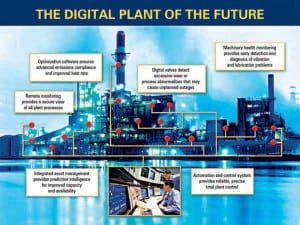
History has shown that the proper deployment of automation on new construction projects can make the difference between a moderate performer and an industry-leading unit, between average financial results and accelerated profitability. Given the magnitude of a new coal-fired plant construction project, automation is often viewed as just one of the many components essential to […]
-
 Water
WaterFocus on O&M (May 2006)
Desalination, Italian style; How to minimize DI operating costs; Advanced flow meter works with shorter pipe runs; Why tubing beats piping.
-
 Legal & Regulatory
State monitoring fails the cost/benefit test
Steven F. Greenwald and Christopher A. Hilen Utility regulators in California and other states have begun subjecting power plants to extensive oversight of their O&M activities. These oversight programs are a response to allegations that generators purposely shut operational plants down to drive electricity prices up during the 2000–2001 energy crisis. These state initiatives […]
-
 Water
WaterRecycling, reuse define future plant designs
The Valley of the Sun went off the water wagon on March 4, ending a record 136 consecutive days without measurable rainfall. That first 0.05-inch sip, followed by a 0.18-inch gulp the next day, only left residents yearning for more. But Mother Nature was only teasing, because the rest of March remained dry. On March […]
-
 Coal
CoalPreparation keyed Entergy’s responses to Katrina, Rita
With the 2006 hurricane season about to begin, climatologists are predicting that the Atlantic Ocean will spawn 17 “named” storms this summer and fall, with 9 categorized as hurricanes and 5 expected to be “intense.” Whether or not your plant lies in a vulnerable coastal area, you’d do well to learn a few lessons from Entergy’s unique experience last year.
-
 Coal
CoalCurbing the blue plume: SO3 formation and mitigation
Understanding why stack emissions become opaque leads to better choices of systems for controlling SO3 and other pollutants, based on current and future plant operating configurations.
-
 Coal
CoalHow accurate primary airflow measurements improve plant performance
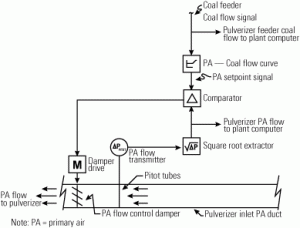
Primary airflow has a major impact on the efficiency, capacity, and cleanliness of pulverized coal–fired generation. Inaccurate measurements that underestimate primary airflow levels can lead to negative operational outcomes that include increased boiler gas temperatures, flyash loss-on-ignition, excessive NOx emissions, and higher-than-necessary fan power consumption. We remind you how to avoid those headaches.
-
 Gas
GasCheng Cycle flirts with 2 ppm NOx— and CO
Three years ago, an article in POWER described how Cheng Power Systems, by modifying the combustors of several popular gas turbines, had used steam injection to lower the units’ NOx output to about 5 ppm—but some models had substantial CO levels without combustor modifications. Since then, the company has developed new combustor nozzles that recently […]
-
 Coal
CoalDesigning and maintaining steam coil air preheaters for reliability and effectiveness
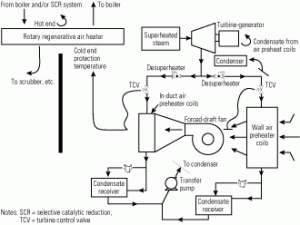
If engineered well and drained properly, a simple finned-tube heat exchanger can help maximize a fossil-fueled power plant’s combustion efficiency, capacity, and air pollution reduction. Use the guidelines in this article either to return a disabled steam coil air preheater to service or to improve the performance of a unit that may have been wasting […]
-
 Instrumentation & Controls
Solving plant vibration problems
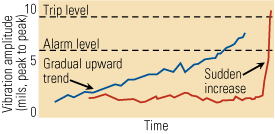
Solving insidious vibration problems in rotating equipment may sometimes seem like a black art that requires the right incantation. But identifying the root cause of the vibration is actually a science. By using cutting-edge vibration measurement tools in concert with computer simulations, plant operators can arrive at a permanent, cost-effective solution to virtually any vibration […]
-
 Gas
GasDesigning duct burners for variable GT loads
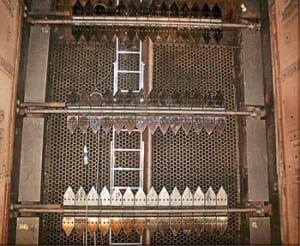
Duct burners use supplementary firing to increase the heat energy of a gas turbine’s exhaust, making it possible to increase the output of a downstream heat-recovery steam generator (HRSG). Early systems of the 1960s took a conventional approach to burner design. The exhaust of the turbine was directed into a windbox and then into a […]
-
 Wind
WindGreener than thou
U.S. wind power is on a roll, with wind farms sprouting like weeds. But in the near future, utilities may end up paying higher prices for wind capacity because state regulators are, in effect, imposing an artificial floor on national demand for generation fueled by renewable resources. At last count, at least 20 states had […]
-
 Gas
GasGlobal Monitor (May 2006)
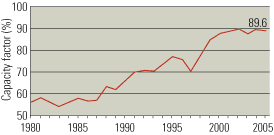
Nuclear hot streak continues/Who’s winning in U.S. wind power?/ Canadian wind picking up too/ Brazilian port powers itself/ Biomass meets CHP in Sweden/ Power surfing from Scotland to Germany
-
 Nuclear
Monster moisture separators
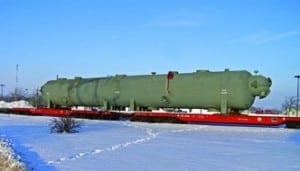
Thermal Engineering International (TEI) (USA) Inc. (Santa Fe Springs, Calif.)—a subsidiary of Babcock Power Inc. (Danvers, Mass.)—recently shipped two of the largest pressure vessels in the company’s 90-year history. The pair of huge (13-ft-diameter, 110-ft-long) moisture separator reheaters (MSRs) were designed at corporate headquarters and built in TEI’s factory in Sapulpa, Okla. The 300-ton MSRs […]
-
 Coal
CoalBig bucks for carbon sequestration
The California Energy Commission (CEC) recently awarded about $14 million for carbon sequestration projects to be overseen by the West Coast Regional Carbon Sequestration Partnership. Westcarb, as the partnership is known, is part of the U.S. DOE’s effort to deploy technologies through its Regional Carbon Sequestration Partnership (RCSP) program. New members Alberta and British Columbia […]
-
 O&M
O&MSWAT team helps shorten forced outage
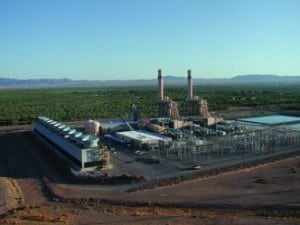
Calpine Corp.’s South Point Energy Center in Mohave County, Ariz. (Figure 1) is a 520-MW natural gas-fired, combined-cycle facility with two Siemens Westinghouse 501FD gas turbines and one steam turbine-generator with a BB33 high-pressure (HP) section, a BB65 intermediate-pressure section (IP), and a 65CC intermediate/low-pressure (LP) section. The plant entered commercial service in June 2001. […]
-
 O&M
O&MWireless vibration monitoring shows benefits
The 1,768-MW Baldwin Energy Complex in Illinois was the site of a joint-venture pilot project to demonstrate a wireless vibration-monitoring system for a coal pulverizer. The partners in the project were EPRI and the plant’s owner, Houston-based Dynegy Midwest Generation. A key objective of the project was to identify a reliable wireless system capable of […]
-
 O&M
O&MHow important is IR detector resolution?
Stretching meager maintenance dollars is a way of life for most maintenance staff. In past years, the cost of an infrared (IR) camera usually came down to a choice between a low-resolution 160 x 120-pixel camera or no camera at all. If the camera was chosen, it usually became clear before long that low resolution […]
-
Legal & Regulatory
Facilitate plant siting by relaxing ratemaking constraints
The U.S. needs new generating capacity in coming decades to meet growing electricity demand. The increasing scarcity of land within utility load centers, combined with environmental opposition to the siting of plants, often limits siting options to remote locations. Restricting power plants to distant sites necessitates additional transmission facilities, increases delivery costs and electric bills, […]
-
 Business
Balancing people, plants, and practices
An essential ingredient in the success of any business endeavor is thorough planning. We’ve all heard the axiom "proper prior planning prevents poor performance" or a variation on that theme. Why the need for peak performance? Competition within the industry has never been as intense, with utilities combining in search of economies of scale. The […]
-
 Instrumentation & Controls
Steam turbine upgrading: Low-hanging fruit
In 1500, Leonardo Da Vinci drew sketches of a device that rotated when hot air going up a chimney passed through a set of fan-like blades. Leonardo called his invention a "chimney jack," and although it only turned a roasting skewer, it gave birth to the idea of mounting blades on a shaft to convert […]
-
 O&M
O&MKeeping condensers clean
There’s a relatively easy way to make a steam plant more efficient and reliable: keep the tubes of its condenser(s) clean. According to George Saxon, Jr., VP of international sales and marketing for Conco Systems Inc. (Verona, Pa.)—a company whose specialty is cleaning and maintaining condenser tubes—"There are two major problems that result from dirty […]
-
 Instrumentation & Controls
A permanent solution to generator vibration problems
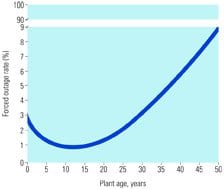
Remember the slogan, "Never trust anyone over thirty?" Chances are you’ve joined the ranks of the over-thirty generation and are dealing with your own personal "maintenance" issues—not unlike the fleet of generators at larger U.S. power plants, whose average age is about 30. Given the continuing growth in U.S. electricity demand and the cost and […]
-
 Instrumentation & Controls
Brain surgery breathes new life into aging plants
Age is wreaking havoc on the U.S. generation industry, especially the coal-fired sector. Industry conferences are replete with hand-wringing over the "brain drain," the lack of skilled personnel, the meager number of students pursuing engineering degrees, and the accelerated retirement of the older workers who make up the industry’s experience base. On top of this, […]