Data centers do what any industry would to continue operations during a power outage: Quickly pivot to their own emergency energy. As reported in several media outlets, a 10-minute grid outage in late July of this year on the East Coast caused data centers to hop off the main grid and switch over to their own backup power. The disconnection by the data centers was enough to cause flickering lights across half the U.S.
COMMENTARY
This time, all we experienced were flickers. With more data centers coming online across the country connecting to our grids, if another outage prompted all of them to switch to their own power sources all at once, next time we could have full-on blackouts. This is why grid utilities, data centers, and regulators are all looking at the next steps to prevent something like this from happening again. Behind-the-meter solutions have been a fix for long interconnection queues, but most data centers will need to connect to the power grid at some point. These large-load interconnections have introduced new grid-code requirements and pushed power stability and reliability to the brink.
In response, at the federal level, FERC is considering broader reforms for large-load interconnections, while NERC has been directed to develop mandatory reliability standards for computational loads. But it’s Texas, through ERCOT, that is furthest along with specific requirements. ERCOT’s large-load framework applies to facilities of 75 MW or more, and its proposed large electronic load ride-through rules would require qualifying data centers to remain connected through defined voltage and frequency disturbances rather than immediately dropping from the grid. But what do these evolving regulations and standards mean for reliability and consistency of power?
There is a simple, yet effective solution to large-load interconnection challenges—a reconfiguration of the typical uninterruptible power supply (UPS) system to support stability on both sides of the device.
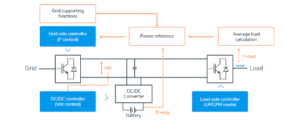
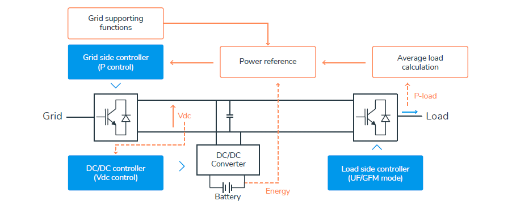
By reconfiguring the UPS system (Figure 1) to provide stability from both the grid- and load-side converters and pairing it with a continuously running battery, we could essentially prevent fluctuations in power consumption from the grid. This configuration allows for much better control of power and only requires the typical control functions used in converters.
Turning UPS Systems Into Grid-Stabilizing Devices
In the typical configuration, a UPS battery kicks in as the grid voltage drops, and the grid-side power consumption cuts off. Then when the grid voltage recovers, the battery transfers the load back to the grid with a delay. However, the proposed reconfiguration, when paired with a continuously running battery, would eliminate the need for consumption cut off and allow for smooth power and ride-through during times of disruption.
At its core, the reconfiguration is a double conversion type UPS with a grid-side converter, load-side converter, and battery DC/DC converter. The battery sits in the middle of the system and continuous helps to balance power by either supplying or absorbing excess power. The battery essentially acts as a buffer between the grid and the data center.
On the data center side (the load side), the converter manages voltage and frequency regulation, ensuring that the facility receives steady, regulated power to protect the IT equipment from the effects of fluctuations. Meanwhile, the grid-side converter controls the flow of power, helping to smooth demand changes and support stability.
With further modifications, this system could be used for grid-support functions, acting as a stabilizing power source that sets the rhythm for the electrical system. If necessary, grid forming control functionalities can be introduced for the grid side converters to reinforce the support further. With the right controls, the proposed configuration could help manage voltage, reactive power, frequency response, ride-through during grid faults, harmonics, and electrical oscillations.
Testing the Concept Under Real-World Load Swings
To demonstrate viability, my colleagues at Ramboll and I developed a test system featuring an AI data center training load profile with a peak load of about 100 MW. The UPS model had a total rated power of 120 MW, supported by a battery with a total capacity of 120 MWh (one hour of rated power supply). The grid-side converter operated in “grid-following” mode, where the battery follows the grid’s existing voltage and frequency, with both active power control and reactive power control (Q = 0).
The active power consumption at the load-side and grid-side converters are shown in Figure 2.
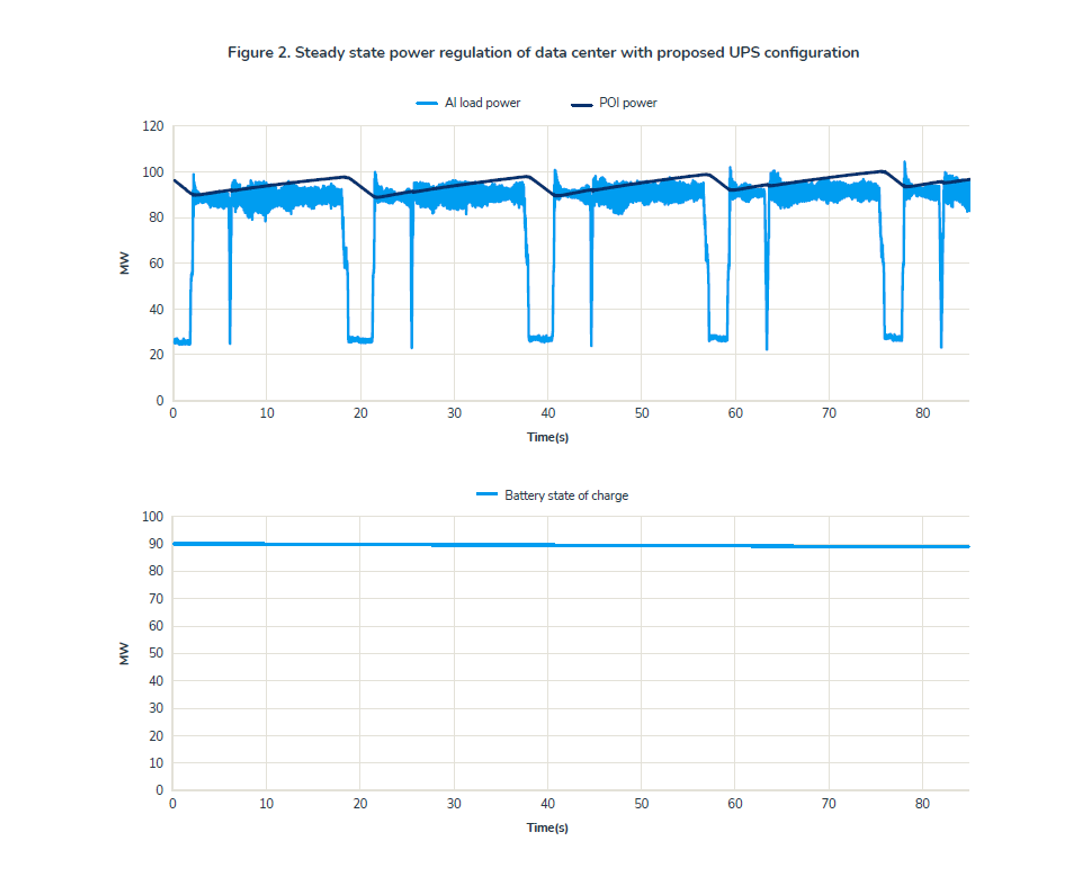
The test showed that the UPS absorbed the major load fluctuations and high-frequency ripples and kept the power draw smooth and gradual. For the small simulation time window, the state of charge (SOC) of the battery was kept almost at 90%. If necessary, the grid-side power can be kept even smoother by allowing a larger energy fluctuation in the battery.
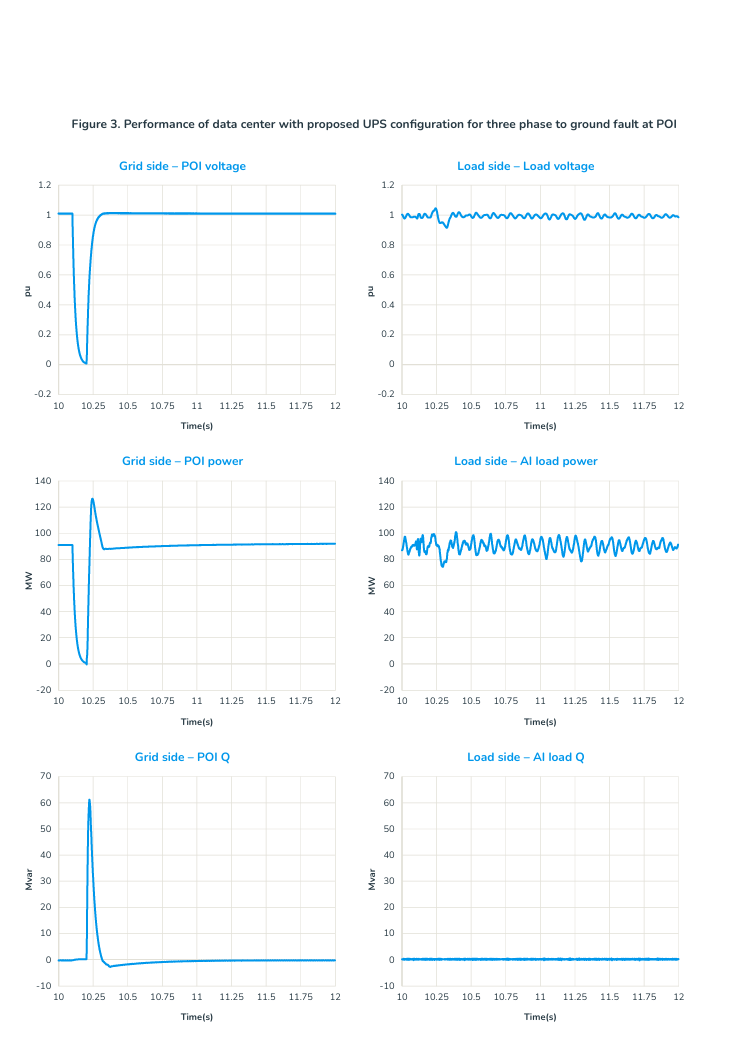
Figure 3 shows the system performance for a 100-millisecond, three-phase-to-ground fault at the interconnection point. The results showed no significant interruption on the load side, indicating that the proposed configuration maintained stable power throughout the disturbance. The grid side converter recovered well after the disturbance; similar to a well-designed BESS system.
Supporting Reliable Growth
As large data centers continue to reshape power demand, reliability will depend on solutions that support both facility operations and grid stability. This reconfigured UPS system, paired with a continuously running battery, can help smooth rapid load changes, maintain power through grid disturbances, and support emerging ride-through requirements without requiring a fundamentally new system architecture. For utilities, regulators, and data center operators, this practical, converter-based configuration offers a pathway to keep critical digital infrastructure online while reducing stress on the broader power system.
—Dr. Chandana Karawita is a senior technical manager for System Studies & System Analysis at Ramboll, a global architecture, engineering, and consultancy company founded in Denmark in 1945 with the mission to create sustainable societies where people and nature flourish.