Artificial intelligence (AI) is transforming the energy system: While the expansion of wind and solar power continues to progress across Europe, AI will ensure the efficient use of every generated kilowatt-hour. Intelligent algorithms that synchronize generation and consumption in real time will help stabilize grids, avoiding expensive curtailment. Software will become an important tool for an economical, reliable, and renewable energy supply. At EM-Power Europe, the international exhibition for energy management and integrated energy solutions, many exhibitors will present their AI-based solutions and digital innovations from 23–25 June at Messe München. Here, visitors can meet representatives from established companies, start-ups, and other industry pioneers. The joint booth AI for Smart Energy will appear for the first time. EM-Power Europe is taking place as part of The smarter E Europe, Europe’s largest alliance of exhibitions for the energy industry: Some 2,800 exhibitors and over 100,000 visitors from all over the world are expected to attend.
Thousands of producers and flexible loads are making the energy system increasingly decentralized and more complex, meaning load flows are constantly changing. AI can help to manage this complexity by analyzing large amounts of data in real time and recognizing patterns. It can forecast weather, performance, and yields, for example, to predict grid bottlenecks so countermeasures can be prepared. AI can also help to intelligently manage electricity generation and consumption, and avoid redispatch measures. Gerard Reid, co-founder and partner at the London-based finance company Alexa Capital, regards the development as “the biggest technological change in the history of mankind.” Digitalization is transforming the energy system from within, especially when it comes to managing power grids.
GridFM and Digital Twins: Simulation Speeds Up Grid Operation
Recent developments like grid foundation models (GridFM) are moving away from conventional simulations. Trained on huge data sets, AI massively speeds up planning, operation, and further development of the grid, while digital twins are recreating virtual copies of real power grids. The German Federal Ministry for Economic Affairs and Energy (BMWE) is funding the AMAZING (Automated Modeling, Analysis, and State Estimation Using Intelligent Grid Algorithms and Graph-Based Methods) research project under the leadership of the Research Center for Information Technology (FZI). The FZI is working with five grid operators to test how AI-generated twins can act as a blueprint for widespread use. This type of intelligent control saves time, money, and resources while minimizing the need for physical deployment.
Despite technological leaps, pan-European rollout is limited by incomplete data and outdated infrastructure. While some markets are making progress with rolling out smart meters, delays in countries like Germany highlight the need for fast, digital market penetration. Additionally, implementing these technologies requires new skills on the part of grid operators and strict European Union (EU) regulations in order to prevent cyberattacks. AI is not replacing humans, but rather is helping us to make highly complex decisions.
The European Union’s Plan
The EU wants to digitalize power grids and make them more dynamic and intelligent. This is intended to ensure a reliable power supply while compensating for the inherent variability of renewable energy sources. AI is expected to help reduce system losses and minimize feed-in curtailment by intelligently coordinating decentralized energy sources such as solar installations or battery storage systems to support overall grid stability and efficiency. Furthermore, AI should help to recognize potential cyberattacks. Pilot projects are already underway—from 2030, the grid is likely to be managed by AI, making the EU a trailblazer in this field.
Where AI Is Already Being Used
AI is already being deployed across a wide range of applications, including highly accurate forecasts for electricity generation from solar and wind energy installations. This not only helps grid operators maintain system stability and avoid costly interventions, but also enables more effective electricity trading, the reduction of price risks, and the more efficient marketing of renewable electricity. AI also makes the inspection of power line more efficient and supports the predictive maintenance of energy facilities, lowering operating costs. Studies show that implementing AI can reduce the costs of operating reserves by up to 15%.
EM-Power Europe Puts the Spotlight on AI
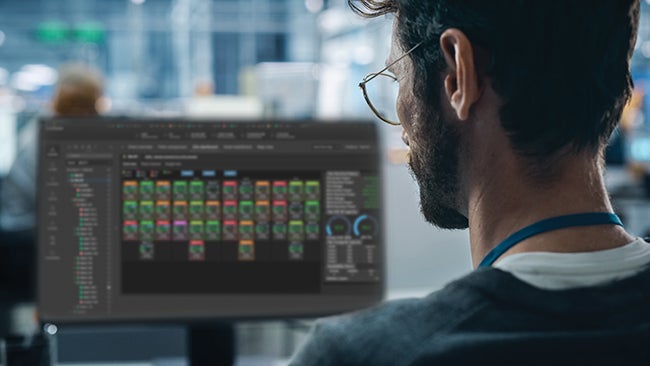
EM-Power Europe will display the whole range of products and services for the digital grid world. Exhibitors will present products for grid management, monitoring, and smart grids. Visitors will be able to explore AI-based software solutions for accurate energy system analysis, advanced simulation capabilities, and the integration of cybersecurity technologies. A key point of interest will be the new joint booth AI for Smart Energy, which will display a variety of AI applications. The accompanying EM-Power Europe Conference will be diving deeper into operative intelligence on June 23 with the session “Can We Trust AI to Run the Grid?” Experts will present measurable results from the field and define which data infrastructures and regulatory framework conditions are needed for AI to reliably support everyday grid operation.
The smarter E Forum (hall C5, booth C5.550) on June 24 will demonstrate how AI turns data into real added value. Using real-life applications in grids, buildings, and energy markets, speakers will show how companies can intelligently use existing flexibility options. The goal is to manage complex systems transparently and increase resilience along the entire energy industry value chain.
EM-Power Europe and the parallel events Intersolar Europe, ees Europe, and Power2Drive Europe will take place from June 23–25, 2026, as part of The smarter E Europe, Europe’s largest alliance of exhibitions for the energy industry, at Messe München.
For more information, please visit: