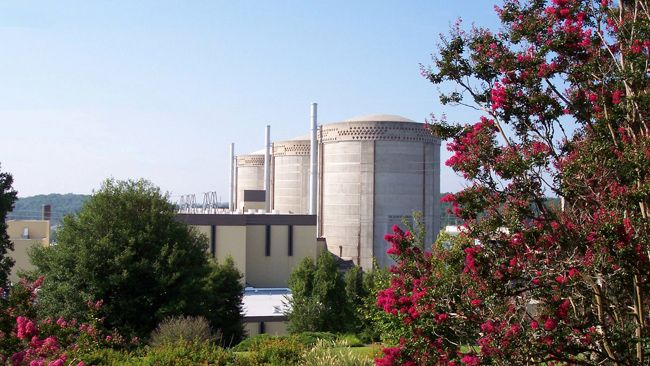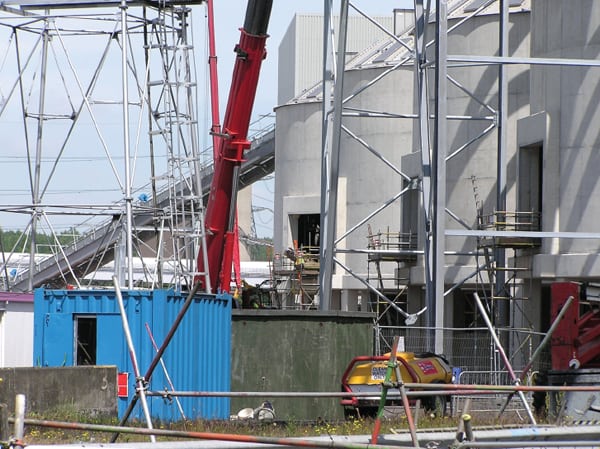
Public Service of New Hampshire (PSNH), the only regulated utility in New England that still owns its generating assets, commissioned the Northern Wood Power Project (NWPP) at its existing Schiller Station in December 2006. Schiller Station (Figure 1), in the city of Portsmouth on the Piscataqua River border with Maine, is PSNH’s third-largest facility and has been in continuous operation for six decades. The first three units were retired decades ago, but Units 4, 5, and 6—each rated at 50 MW and built in the early 1950s—remain hard at work. In the early 1980s, they were refurbished to burn less than 1% sulfur bituminous coal and No. 6 fuel oil. Now, Unit 5 is burning wood instead of coal.
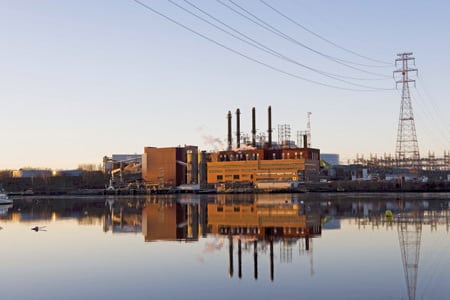
1. Better than new. Public Service of New Hampshire repowered Unit 5 of its Schiller Station with a wood-burning circulating fluidized-bed boiler. Sales of renewable energy certificates will completely pay for the project. Courtesy: PSNH
From dream to reality
"A little over four years ago, Northern Wood Power was just a vision that PSNH brought to state legislators with the promise of lower emissions, a revitalized forestry industry, and low electric rates for New Hampshire homes and businesses," said Gary Long, PSNH president and CEO, at the project’s commissioning ceremony on December 1, 2006. "We’ve demonstrated that PSNH can help New Hampshire lead the way in adding ‘green’ power production while maintaining a significant price advantage for our 490,000 customers."
PSNH well understands New England’s need for more usage of renewable energy and is prepared to invest in more regulated generation to help meet it. However, current state law prohibits PSNH from acquiring or building any new plants—including any powered by renewables. That was one of the tradeoffs PSNH made to retain its generating fleet after deregulation.
PSNH owns and operates about 62% of its needed generation capacity, a 1,150-MW portfolio consisting of hydro plus oil-, gas-, and coal-fired plants. The remainder is bought on the open market. Those purchases currently include the output of dozens of small, independent hydroelectric facilities and five privately owned biopower facilities in New Hampshire.
Paying its own way
NWPP is among the largest renewable energy projects in the U.S. and the only sizable one to replace a coal boiler with a biomass-fueled steam boiler. The project’s plan to make wood chips and other clean, low-grade wood materials the new fuel source was enthusiastically supported by New Hampshire’s forest industry. PSNH determined that repowering one of the 50-MW units at Schiller Station would generate enough revenue from sales of renewable energy certificates (RECs) and federal tax incentives to offset the entire $75 million capital cost of the project. After convincing the state legislature and a host of regulators that such a project was feasible, the Northern Wood Power Project was set in motion.
RECs represent generation of electricity produced from an approved renewable energy source. Utilities typically purchase them to meet state renewable portfolio standards (RPS) that require a certain percentage of their generation to come from renewables. If a utility chooses not to build its own renewable portfolio, it can purchase RECs at a stipulated default price to meet its RPS obligations. Purchasing RECs doesn’t mean you purchased the actual power they represent—you only get the "registration" of the green generation, not the "title," so to speak. A qualified generator now makes two marketable products: For every real electrical megawatt-hour produced, a paper REC is also generated.
PSNH estimates that the NWPP will generate between 300,000 and 400,000 RECs each year. Selling them will bring in about $15 million of additional revenue annually, helping to keep rates low for PSNH customers. Because the repowered Unit 5 is an open-loop biomass system, it also is eligible for a federal renewable electricity production tax credit of 0.9 cents/kWh for its first 10 years of operation.
Big, broad benefits
The 50-MW NWPP essentially repowered Schiller Station’s existing Unit 5, which was put into service in the early 1950s. Capable of burning coal or oil, the unit was predominantly fueled by the latter up until it was refurbished in 1984. Following the upgrade, Unit 5 burned coal until the NWPP went into service on wood in 2006.
The new, wood-fired circulating fluidized-bed (CFB) boiler was sized to produce 450,000 pounds per hour of steam at 1,250 psi and 950F. The existing Unit 5 turbine was overhauled, and PSNH was able to use the balance-of-plant equipment already in place—its generator, cooling water and auxiliary steam systems, as well as its feedwater, make-up water, and condensate equipment (Figure 2).
In 2002, initial studies were conducted for the NWPP with assistance from New Hampshire–based Bellwether Solutions LLC, which helped PSNH develop the project concept, evaluate the potential for REC revenue, and examine states’ RPS requirements. In the project’s early stages, PSNH also consulted Innovative Natural Resource Solutions LLC regarding fuel supply and the regional forestry infrastructure.
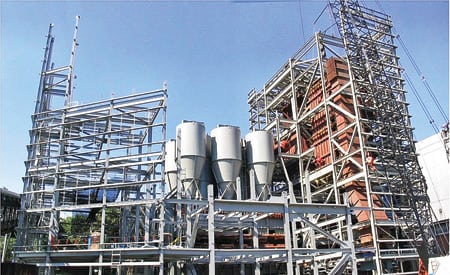
2. Work in progress. Unit 5’s boiler island during erection of the fluidized-bed combustor, before the building shell was completed. Courtesy: PSNH
In January 2003, PSNH hired the project engineering firm GenPower LLC (www .genpower.net) to assess the technical challenge of repowering one of the utility’s generating units. Schiller Station offered many advantages, including access to good transportation, the opportunity to leverage an existing plant’s resources (including a trained labor force), and the air-quality benefits of switching from coal to wood. The CFB boiler puts out 75% less NOx, 98% less SO2, and 90% less mercury emissions than the boiler it replaced. NWPP also contributes to the local economy by supporting New Hampshire timber companies and suppliers. PSNH estimates that the project will add about $20 million to the regional economy every year.
NWPP is also considered "carbon neutral," meaning that no additional net CO2 is released into the atmosphere by the burning of whole-tree wood chips and other biomass materials. And only about 1% (by volume) of the new fuel ends up as ash, which is being used as an agricultural fertilizer.
The NWPP repowering project broke ground in December 2004 and was completed in December 2006.
Delivering the fuel
Over 84% of New Hampshire is forested, and 93% of that area is classified as timberland by the U.S. Department of Agriculture’s Forest Service. Low-grade wood accounts for more than 50% of the standing timber volume and timber harvested in the state. Biomass materials consist of whole-tree wood chips (undried, unprocessed wood chips with bark attached), stumps, brush, and smaller low- lying vegetation, low-grade woods, and other plant material unusable in timber or paper production. These materials are produced by normal forestry practices such as timber harvesting and fire control, and by clearing land for homes, roads, and commercial development. PSNH only uses clean wood material and does not accept construction or demolition debris.
Although the new Unit 5’s main fuel is wood, the CFB boiler design can burn coal in a pinch. But doing so would cause the tax credits and REC revenue stream to evaporate, so coal would only be used if extreme system situations occurred.
New Hampshire is also home to one of the oldest, private forest conservation organizations in the country—The Society for the Protection of New Hampshire Forests, established in 1901. Safeguarding the state’s environment remains a fundamental mission of PSNH, which has put in place rigorous forestry practices that fuel suppliers to NWPP must follow. PSNH began the effort by partnering with the New Hampshire Timberland Owners Association. As part of the arrangement, PSNH agreed to meet wood procurement standards that benefit both the state’s economy and its forests. "Collaboration with public and private groups is a hallmark of this very successful project," says William Smagula, director of PSNH Generation.
To meet wood procurement standards, a forest management professional could certify that the source of the wood chips, if properly managed, could be reharvested within 15 to 20 years. In a 2006 report published by Dartmouth College titled, "Sustainable Energy Futures: The Potential for Wood Chip Energy at Dartmouth College and the Surrounding Region," the authors noted that "there exists within the state of New Hampshire a substantial opportunity to increase the use of wood chip energy in a manner consistent with sustainable forestry practices. The present decline in the pulp and paper industry reinforces the need for an alternative market for low-value wood, which would revitalize rural economies and support lumber production and other forest industries."
PSNH buys about 400,000 tons of whole-tree wood chips and other clean, low-grade wood materials each year for Northern Wood Power Project. "The purchases of wood chips alone represent a significant portion of the local biomass market, markedly improving the viability of this important segment of the state’s economy," says Richard Despins, manager of Schiller Station. So far this year, Schiller Station has received fuel from over 60 certified loggers or licensed foresters from New Hampshire, Maine, Massachusetts, and Connecticut. The largest logging company has about 20 employees, and the average employs about five.
Of course, buying wood and receiving it daily from myriad small suppliers is a lot more challenging than having a single coal supplier show up a few times a year with a big load. Since the new Unit 5 came on-line, about 50 to 70 tractor-trailers—each carrying up to 30 tons of wood chips—arrive every day. To mitigate their effect on local traffic, PSNH has funded over $1 million in traffic flow infrastructure improvements in Portsmouth.
Forming the team
GenPower began by creating the NWPP Owner’s Engineer team and retaining Careba Power Engineers LLC (www.carebapower.com) to help assess equipment layout options and other project design aspects. GenPower also retained MacMillan & Donnelly Inc. (www.mdeec.com) for air permitting support and Gorrill-Palmer Consulting Engineers Inc. (www.gorrillpalmer.com) to help with traffic studies, water permitting, and assistance in the local land use process. Cavanaugh Tocci Associates Inc. (www .cavtocci.com) was retained by PSNH to assist in acoustical consulting. PSNH and the GenPower team began work on the conceptual design of the Unit 5 repowering effort, which was named the Northern Wood Power Project, in the spring of 2003.
Not long after, the major equipment bidding process began in earnest. Procurement was segregated into two major turnkey contracts. The first was awarded in January 2004 to Alstom Power Inc. (www.power.alstom.com), which was named NWPP’s engineering-procurement-construction (EPC) contractor and the supplier of the CFB boiler island. Alstom awarded the boiler island construction to Cianbro, The Constructors (www.cianbro.com). The second EPC contract for the woodyard was awarded to Cianbro, as well, which teamed with Dean Oliver International (www.dean-oliver.com) to oversee the materials-handling engineering, as well as design and procurement.
Notices-to-proceed were given to Alstom and Cianbro within a few days of July 1, 2004, after all construction and environmental permits were in place.
Stacking wood
Wood’s low energy density and high water content (up to 50% by weight) makes fuel storage and pile management a real challenge. To accommodate the new fuel, Schiller Station "repurposed" a five-acre auxiliary coal storage yard to make room for a 19,000-ton wood storage facility.
The logistics of fuel supply begin with the weighing of arriving trucks on an above-ground, pitless weighbridge scale. Wood chips are dumped from the enclosed, 30-ton trucks at one of three truck-dump stations (Figure 3) with live bottom-receiving hoppers and then conveyed to the 85-foot-tall process building. Each dumper can handle four trucks per hour on a continuous basis. The connecting receiving belt conveyor and stacker systems both have a design feed rate of 400 tons/hr (tph) from the three truck dumpers. Each truck dumper feeds a receiving hopper with 4,800 cubic feet of storage, enough to hold the contents of two trucks. Wood delivery is permitted to occur 14 hours a day on Monday through Friday, and limited hours on Saturday.
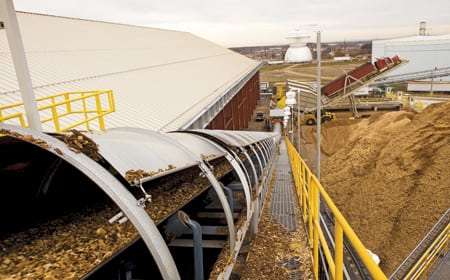
3. Challenging logistics. Tractor-trailer trucks dump 30-ton loads of wood chips at one of three unloading stations. Courtesy: PSNH
Wood received at the process building first goes through a material-size reduction system with a metal detector/remover, two scalping screens to separate oversize materials, and two fixed-knife hogs. Ferrous metals are removed from the material stream by a cross-belt electromagnet upstream of the scalping screens. Any ferrous and/or nonferrous metals that get past the magnet are detected by a tramp metal detector and diverted to a rejects transfer chute prior to the screening and hogging equipment. Each scalping screen can handle 300 tph. Each hog handles up to 110 tph of oversized wood chips at a nominal minus 2½-inch size (85% passing a 2½-inch square hole test screen at the maximum feed rate) and then returns the chips via the main fuel delivery conveyor to the wood stockpile. An outdoor storage area can also be used for as-received wood, which can be screened and processed at a later time.
The sized wood fuel then is directed to the wood fuel storage enclosure. From there, it is either stacked out within the enclosure or sent directly to the boiler wood storage bins. The stackout equipment is inside the fuel storage enclosure. The stockpile belt conveyor delivers processed fuel to an automated stacking belt conveyor system with a 48-inch overhead traveling tripper conveyor capable of stacking 400 tph of processed material in a longitudinal trapezoidal-shaped pile. The enclosed pile storage has a capacity of about 1,100,000 cubic feet. The overpile reclaimer’s computer (Figure 4) is programmed to ensure that the pile’s active zone is managed with first-in/first-out delivery of the stored wood fuel.

4. Pile management. A computer-controlled overpile reclaimer manages the inventory of the fuel storage building. Together, covered and uncovered facilities store a 14-day fuel supply. Courtesy: PSNH
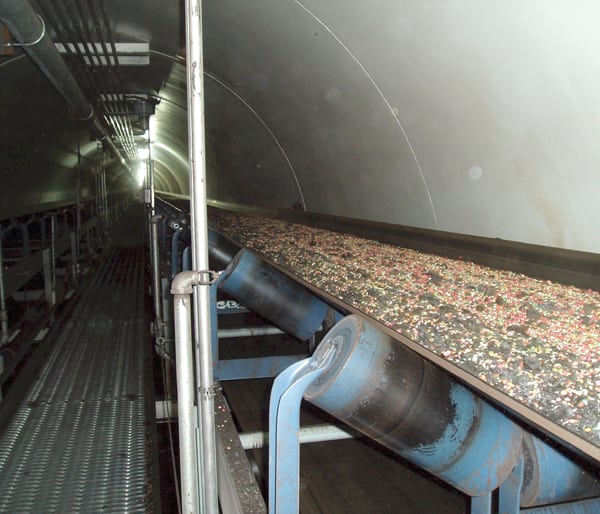
The wood fuel is then reclaimed from the fuel storage pile and sent on a 940-foot journey to the boiler building before entering the Alstom CFB system (Figure 5). The reclaim and boiler feed systems have design rates of 120 tph. Processed wood fuel is delivered to surge bins in the boiler building by the boiler reclaim belt conveyor. It is entirely an open-truss conveyor, except for an enclosed portion that crosses the railroad right-of-way. The reclaim system keeps the contents of the boiler surge bin within predetermined levels by controlling the feed of wood fuel to the conveyor based on a signal from the surge bin level controls.
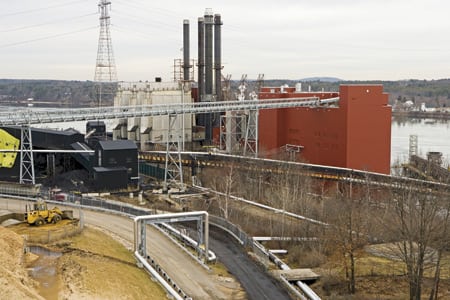
5. Conveyor tripping. One of the project’s biggest engineering challenges was shoehorning the new boiler house between the existing railroad tracks and the river. Note the 940-foot conveyor that moves the fuel to the boiler house. Courtesy: PSNH
The reclaim equipment comprises an overpile reclaimer and a belt conveyor. The operator decides what area or parcel of the pile he wants to reclaim, sets the travel limits, makes the first cut to dress the pile, and then places the reclaimer into automatic reclaim mode. Reclaim will continue automatically until manual intervention or full reclaim of the predetermined parcel, or until it receives a high-level signal from the boiler bin. If the signal is received while in automatic mode, the reclaimer will pause until it receives a low-level signal from the boiler bin, and then resume working. The fuel reclaim equipment’s variable-frequency drives enable load-following of the boiler burn rate without stopping the belt conveyor. This operation (Figure 6) is independent of the truck unloading operation.
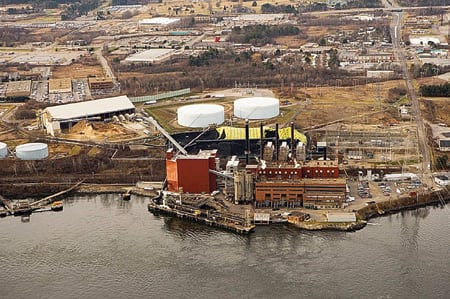
6. No room to spare. Logistically, the boiler island site was constrained by the river, railroad tracks on the back side, an existing coal conveyor to the south (left), and existing buildings to the north (right). In fact, the baghouse was erected straddling an existing wastewater treatment building. Courtesy: PSNH
Burning wood
Fuel delivered to the CFB is stored in one of two silos, for a combined 60 minutes of operation at maximum continuous rating (MCR). Each silo has a volumetric feeder, two feeder discharge chutes and isolation valves, and pneumatic spreaders that route wood fuel to the boiler.
A dedicated silo sized for 10 days’ operation at full load receives truck deliveries of limestone, which is used for SO2 removal when coal is burned. From the silo, the limestone is metered through a rotary valve into the injection piping. Two blowers supply the transport and injection air needed.
Inside the CFB, a bed material transfer system adjusts the height of the bed to tune the steaming rate during load changes. Bed material is pneumatically transferred to and from a refractory-lined bed material silo.
A gas-fired duct burner sized at 20% MCR preheats the fluidized-bed material in the furnace prior to solid fuel firing. Separate, 100%-capacity forced-draft and induced-draft fans move the air and combustion products.
A water-cooled screw removes bottom ash, whose temperature is reduced from about 1,590F to 400F by a cooler. A dense-phase, pressurized ash transport system handles flyash, bottom ash, and economizer ash. All types are transported to a single storage silo that straddles the roadway between the boiler building and the baghouse.
Air pollution controls on the Alstom CFB include a selective noncatalytic reduction (SNCR) system that uses urea supplied by Fuel Tech Inc. (www.fueltechnv.com) for NOx control, a limestone injection system to control SO2 and acid gases when burning coal, and a baghouse fabric filter from Wheelabrator Air Pollution Control Inc. (www.wapc.com) for limiting particulate emissions. The repowering of the Unit 5 boiler has produced net decreases in emissions of the criteria pollutants PM, PM10, NOx, and SO2. However, the project will result in increased net emissions of CO and volatile organic compounds. The table summarizes the net emissions increases/decreases permitted for the repowered Unit 5.
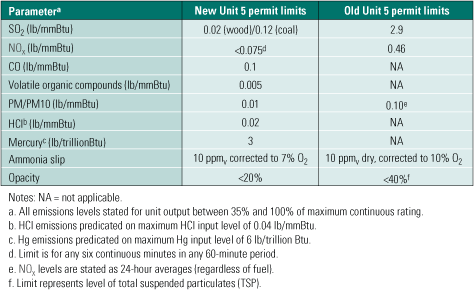
The Northern Wood Power Project’s emission limits reflect lower wood emission rates. Source: PSNH
Overcoming obstacles
One of the biggest challenges that the NWPP project team (Figure 7) faced was coordinating all the demolition and construction activities between the two operating units—with Unit 5 continuing to operate on coal for the first year of construction. Another unique challenge was the railroad spur that bisects the plant and afforded little room for the CFB boiler, which had to be built in close proximity to an active railroad line. Yet another was integrating the digital controls for the repowered Unit 5 in Schiller Station’s control room, where Units 4 and 6 are controlled pneumatically. Operators rose to the challenge and upgraded their skill sets so they can successfully operate both types of units.
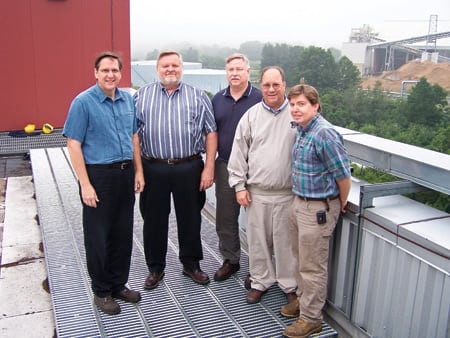
7. Teamwork pays. Schiller Station staffers assumed leadership positions on the NWPP team. From left to right are: Richard Despins (station manager), John Cloutier (I&C/electrical construction supervisor), Mike Hitchko (project manager), Henry Patrick (mechanical/civil construction supervisor), and Jim Granger (project engineer). Missing from the photo is David Packard (senior contract administrator). Courtesy: PSNH
With Northern Wood Power in service for its customers, PSNH is now looking for opportunities to build on what it learned from this project to help New Hampshire meet its goals for significant increases in the state’s green power production.