Over the past decade, power plant control systems have evolved from DCS-centered platforms with proprietary software, to open systems using industry standard hardware and software, and then to totally integrated plant automation systems with almost unlimited connectivity and the ability to interrogate field instruments from many different manufacturers. What’s next?
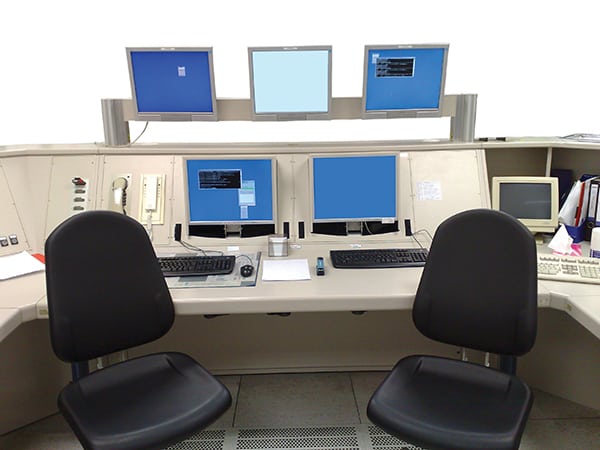
Today’s power plant control room is evolving into an almost office-like setting, typically quiet and with few staff. Gone are the large boiler-turbine generator (BTG) boards and vertical panels populated with indicators and strip chart recorders. Also gone are the numerous manual/auto control stations that allowed plant operators to individually access final control elements.
New technology has significantly changed the purpose of the control room. No longer a place where operators control, it is now just one of several portals for an integrated team of experts with the common objective of maximizing the value of the plant’s assets (Figure 1).
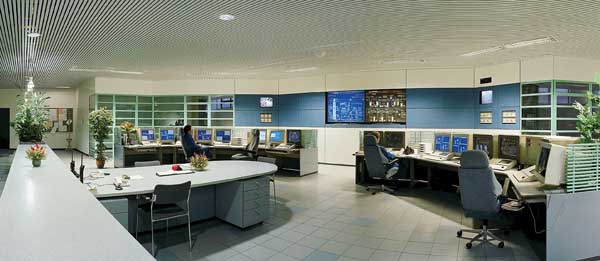
1.Control rooms are evolving. Gone are the large boiler-turbine gauge panel boards, the walls of instruments, and strip chart recorders. Decisions are made by a team of experts, most of whom will not be on site. Today’s automation systems include portals that allow people from all over the world to access information in real time. Courtesy: Metso Automation USA Inc.
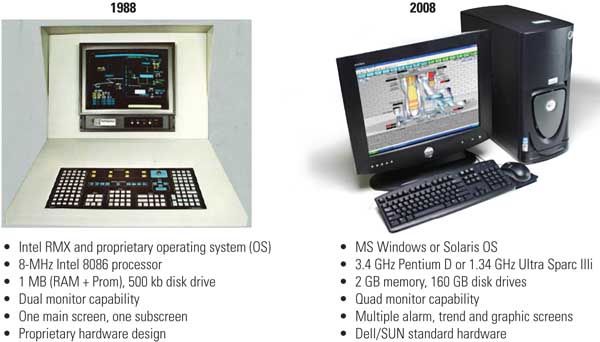
Over the past 10 years automation platforms have progressed from primarily proprietary hardware and software designs to systems that maximize the use of industry standard hardware and software. The Microsoft invasion has eclipsed most distributed control system (DCS) platforms. In addition, the hardware, including controllers and I/O modules, has gotten smaller while its computing power has increased geometrically.
Automation systems are also fast becoming commodities, yet generating companies (gencos) have not relaxed their requirements for a rugged design that includes components and modules that meet high standards for reliability. The typical power plant automation system is populated with rugged I/O modules that meet strict standards for isolation, surge-withstand capability, and environmental specifications. Remote terminations external to the I/O modules are still prevalent in many power plant installations and will surely be with us in the future.
Off-the-shelf hardware solutions have resulted in lower prices for hardware such as I/O modules and even controllers. Studies have shown that the value of hardware included in system shipments continues to fall while the value of software applications continues to rise. However, just because the technology is available doesn’t necessarily mean the technology is appropriate at any price.
At the same time, several different computer bus architectures have evolved, and no single one is more accepted than the others: Fast Switched Ethernet, Foundation Fieldbus, Profibus, ASI, DeviceNet, and others have all found wide acceptance by vendors and users alike. However, most automation system suppliers distinguish themselves with applications and services that are specific to an industry. The ability to supply products and services that enhance operations — increasing availability, increasing efficiency, and controlling emissions — is a major requirement of the power industry today, and its importance will grow in the future.
Beyond cheap computing and advanced software applications, an automation system must be designed to optimize the economics of plant assets. Deregulation has required greater awareness of optimizing operations. Maximizing availability, efficiency, and safety are crucial roles of an automation system. Furthermore, monitoring, reporting, and controlling emissions have been elevated, in some cases to the highest corporate level, largely because of regulatory scrutiny. In sum, the current operational environment is far more sophisticated than at any time before, yet we’ve just barely scratched the surface of automation system capabilities.
History of User Interfaces
The first direct digital control (DDC) systems of the 1970s offered graphical interfaces that mimicked conventional BTG boards. Displays were ineffective because only part of the process was visible at any one time. Displays could be swapped around, but only a small number of variables could be shown on the low-resolution monitors that were available. This problem was called the "keyhole effect": Operators were only able to view a very small number of plant variables at any time and were never able to get the complete "feel" of a plant.
In the 1980s the first DCS offered larger displays that took operator tasks into consideration. Historical information and trending illustrated process dynamics. Higher-resolution screens and windowing allowed more variables to be included on displays.
By the mid-1990s, supporting knowledge and operator guidance messages were included in most control systems. Their implementation and updating has been integrated into the process control system and its engineering tools. Typically, an operator now points at a process object to retrieve associated design knowledge and guides. This support provides basic knowledge and help but does not make decisions for the operator.
Intelligent expert systems promoted in the 1980s — such as neural networks, fuzzy logic, and other knowledge-based systems — have been used to optimize specific functions, such as emissions, unit heat rate, and boiler fireside cleaning. But they have not, for the most part, been used to support operator decision-making.
From Control to Supervision
Today, the operations team appears to be detached from controls processes, which puts more pressure on automation systems to not just control but also provide timely information to all parties concerned with plant operation — operations, maintenance, owners, and other specialists who can be called on to provide advice. Technology can enable personal interaction with an expert in a remote location who has real-time access to information from a process plant.
In the future, control systems will no longer control the process — they will supervise it! Plant functions such as operation, maintenance, and management will be tightly integrated across all plant functional areas, and data will be ubiquitous. The system will embrace the latest information and communication technologies (ICT), and multiple communication channels (some traditional and some personal, such as instant messaging) will be incorporated. Flexible, switchable interfaces will be at the heart of the systems. Additionally, the operator interface will evolve into a human computer interface that allows collaboration among all the interested parties, on- and off-site. This functionality, coupled with asset performance solutions, will allow all parties to participate in the operation and optimization of a plant.
This development is already taking a step forward. New "network-enabled cooperative groups," whose information is gathered from people’s private computer activities, are now available to the plant at a moment’s notice. A virtual network of experts is going to be built around production activities and will be supported by future automation systems.
Computer-Supported Cooperative Work
Significant contributions to process control systems in the area of knowledge management and collaboration within organizations has come from research in the field of computer-supported cooperative work (CSCW) and information systems. This research has suggested that the key issue is to design systems with explicit concern for the socially organized work practices of their users.
CSCW suggested in the 1990s that the retention of data and events should be facilitated by storing information in computerized files. It was suggested that information technology should support organizational memory by making knowledge easily retrievable in real time and by providing easy access to individuals with the appropriate knowledge. The familiar plant data historians and electronic diaries grew out of this research.
Recent ICT has enabled another new operating concept: collaboration management. Collaboration management facilitates the networking a team of on- and off-site specialists who all can see the same information available to plant operators in real time or via retrieval of historical information to enable the best decision-making.
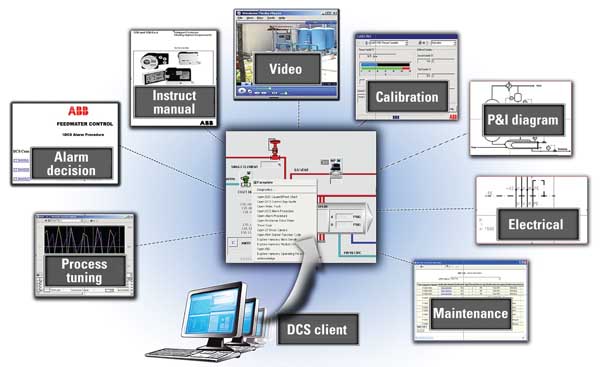
The next step in the evolution of ICT is to associate these communications with context, increased efficiency, and additional intelligence. Such system-based tools must automatically integrate important process variables and their historical trends with relevant activity, both human and process-oriented (events and alarms), and then enhance that data with information from diary entries. The end result is extracting knowledge from disparate information sources and, ultimately, enhancing the value of plant assets (Figure 2).
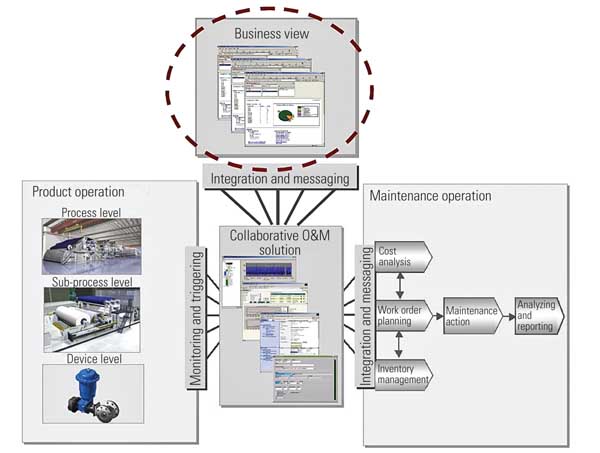
2. Consolidated data view. System portals allow experts located anywhere to view operating and financial data deep inside an organization to promote better decision-making, faster response, and increased management awareness. Advanced asset management software packages combined with fieldbus technology allow computer systems to monitor the process and plant equipment like never before. Source: Metso Automation USA Inc.
Control Anything from Anywhere
Automation systems are in a transformational stage. They are now "network enabled" and fast becoming communications channels that provide real-time information to those who provide input to the decision-making process.
Networked functionality is essential now that utilities and other gencos are faced with a new operational environment that requires them to constantly reconsider the generating assets needed to match demand based on externalities such as environmental constraints, water supplies, and, perhaps in the near future, the cost of carbon emissions.
Large power plants are typically supervised and controlled by production and maintenance staff that uses the process control system as a tool to automate process functions and gather and present information to be used by short- and long-term staff decision-makers (Figure 3). The exchange of ideas, access to expertise, and unrestrained exchange of information is indispensable. Under these conditions it is preferable that an organization behaving as a community be engaged to solve short-term problems and to develop evolving procedures for optimizing performance. Thus the role of the control system is to automate, inform, network, and store data.
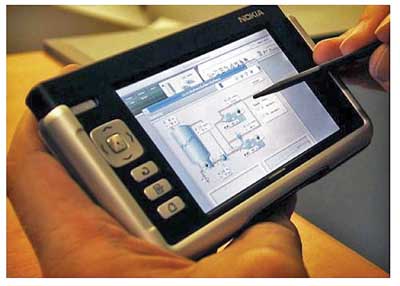
3. Stay in touch. Wireless engineering stations can access information from the system about field devices, receive information from other sources, and permit technicians to make configuration changes on the fly. Courtesy: Metso Automation USA Inc.
In the future, gencos will reach beyond their internal centers of excellence to gather expertise from outside their organizations to optimize operations through automation system "portals." Teams of experts will be preassembled as a "community" that shares common goals. Each member may have different expertise and will be called upon to render advice at any time and from anywhere.
Supporting Applications to Optimize Assets
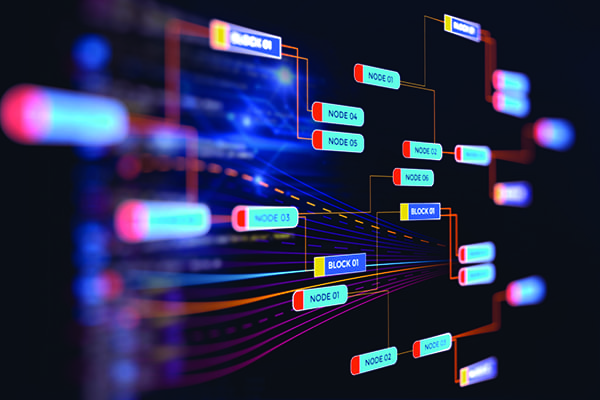
At the heart of the automation system are tools and advanced applications to allow gencos, their experts around the world, and automation suppliers to access information and real-time data from a portal to the automation system, and hence to the entire corporate business system (Figure 4). Thus, a community of experts all with the same objectives can collaborate. Additionally, performance-enhancing products and services can be provided through the portal to increase efficiency and minimize downtime. Clearly, bullet-proof tools for information security, notification management, messaging, and application integration are required.
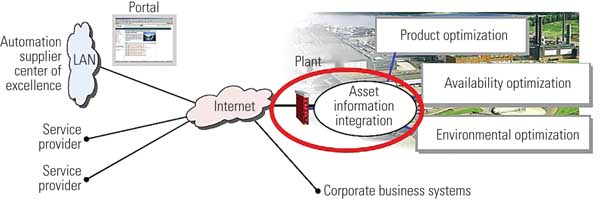
4. Cutting-edge access. Automation systems must facilitate predictive and condition-based collaborative maintenance management at the plant. Connectivity is provided to other corporate business systems, and information security must be guaranteed. Source: Metso Automation USA Inc.
Automation systems must include tools to enable remote proactive maintenance, to monitor and collect data from a system’s network and send notifications to the appropriate center of excellence, where it can be analyzed. Information from any plant device such as pumps, fans, valves, transmitters, electric motors, heat exchangers, boilers and turbine must be collected in real time. Also, quality and cost data are all available for scrutiny by experts anywhere in the world (Figure 5). A good example of how this technology can benefit an individual plant was provided in "Entergy’s Big Catch" in the October 2008 issue of POWER.
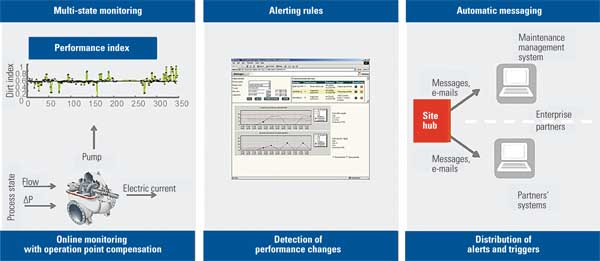
5. Future colleagues. Data and information will be transmitted to the automation supplier’s center of excellence and to the owner’s experts around the world. Enhancing the rate of return on plant assets requires expertise beyond the confines of the plant. Source: Metso Automation USA Inc.
The automation system then becomes a platform that runs or interfaces with many different application programs obtained from the "community." It becomes less and less a control system and more and more a recipient of supervisory optimization and control.
Automation companies can in some cases become suppliers of basic control systems, or platforms, for application experts located within the genco or for other consultants within the "community." This means that automation system platforms need to be, just like Linux, an "open system" for all to use, improve, and integrate (see sidebar).
In the future, automation systems will integrate and access products and services focused on maximizing production and availability. The computers may be at a power plant, but the expertise and software will inevitably be located elsewhere. All will be available through portals to the outside world to reduce operating costs by optimizing all the plant’s processes as a whole rather than piecemeal. The system will avoid unit trips through the use of condition-based monitoring and collaborative networks of experts, and it will provide for wide access to experts who can provide input on designs and operation.
In short, automation systems of the future will further improve plant reliability by leveraging communities of expertise with advanced, open information technology tools and hardware.
–Roger Leimbach (roger.leimbach@metso.com) is director of sales and marketing for Metso Automation USA Inc.