Most top utility managers treat their aging workforce problem (Figure 1) as either a retention or a recruitment crisis. If they focus on retention, they may respond to the demographic challenge with panic, offering unsustainable incentives in the hopes of retaining older workers. But incentive packages rarely take into account the way career paths have changed, the number of skilled retirees willing to do contract work, or the decoupling of service from location made possible by flexible grids and a global talent pool. Failing to recognize these choices, organizations run the risk of saddling their companies with a labor force incapable of adjusting to new paradigms of utility service. (See sidebar "Senate taskforce advises removing age barriers.").
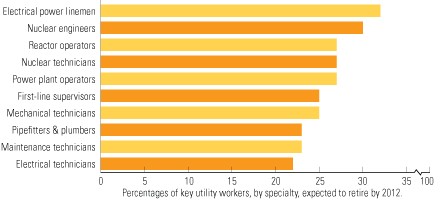
1. Brain drain. A large percentage of utility workers are expected to retire in the next few years. Even more are eligible for retirement. Source: U.S. Department of Labor
Leaders focused on recruitment often try to deal with the aging workforce challenge by hiring people to replace those who have left, or by rehiring retirees (Figure 2). But this recruit-to-replace approach simply puts new bodies into the existing pipeline without considering how automation and process innovation have already changed the nature of utility work. Attempting to replace traditional talent pools—whether craft workers or tiered managers—also perpetuates inefficiencies in the industry. Unfortunately, recruit-to-replace tactics are proving useful only as a way for executives to lay low while waiting for the climate to improve.

2. Survey says. An AARP survey of 400 businesses in New York State conducted in late 2006 sheds light on the tactics companies are using to prepare for a workforce shortage caused by the wholesale retirement of baby boomers. Most survey respondents said their firms have tried at least one tactic tested in the survey—most often, improving technology. Very few are currently offering incentives to delay retirement, but many are hiring older workers. About seven in 10 are assessing their current workforce, increasing training opportunities, and hiring younger workers. Source: “Preparing for an Aging Workforce: A Focus on New York Businesses,” AARP, May 2007
But neither panic nor laying low is effective in this environment, because both responses are based on false assumptions. Panic presumes that the current workforce challenge is a singular event caused by a demographic aberration, while waiting it out presumes that the underlying cause is simply a fluctuation in the business cycle.
In fact, the talent crunch is a tectonic shift in the nature of the economy and in the architecture of how work gets done. The real problem that utilities face is a knowledge crisis—a transformation in how knowledge is valued, leveraged, and distributed in the marketplace.
This shift is fundamental and permanent. It means that organizations seeking to build forward-looking infrastructures must assess how the roles that people play in the enterprise are changing. Doing so is particularly important for utilities because the nature of the physical infrastructure that supports the industry is changing. As smart technologies facilitate the creation of highly efficient, decentralized, and flexible grids, the way that people are organized to deliver services must also be reconfigured. As the market reshapes demand, talent in the utilities sector must be aligned to reflect the operation of the post-industrial grid.
Five steps forward
Making this realignment in a technologically and process-savvy way requires leaders to develop bold and comprehensive talent plans based on the recognition that human capital is the primary value in the post-industrial marketplace. These plans must sustain structures that are fluid enough to permit the smooth transmission of ideas and innovations. At the same time, they must also support the development and emergence of leaders with the skills to match talent with opportunity and to encourage entrepreneurship at every level.
Such a shift would represent a radical departure for utilities, which have traditionally lagged in human capital innovation. Given the scope of the challenge, the road ahead might seem rocky. But Booz Allen Hamilton’s experience working with industry leaders suggests that the following five practices can help utilities create a platform that addresses emerging talent demands.
Redefine knowledge management. Knowledge management has traditionally been considered an IT function, a way to archive competencies that can be plugged into the larger structure. But knowledge embedded in IT often can’t adapt or grow to meet changing needs. True knowledge management does not reside in technology but in what people know and do and how they share their knowledge with others. Only a comprehensive mapping of individual capabilities within the organization can accurately reveal where knowledge resides and needs to be adapted or retained.
Organizations talk about people being assets, but the real asset is the knowledge that people apply. To develop and retain this knowledge, it must be woven into the institutional fabric of the organization. This can only be done if an organization provides to its business units a suite of practices that capture and develop the strengths of individuals. These practices, whether craft-based apprenticeships or formal mentorships for managers, must be flexible enough to serve the needs of individual units yet consistent enough to support the organization’s culture. For that to be the case, knowledge management must be jointly owned by Human Resources and the business units.
Foster flexibility. Smart grids allocate power according to real-time demand, delivering service in response to constantly changing needs. Because demand for the product delivered—electricity—is flexible, the organizational and talent infrastructures that support it must be flexible as well.
Cross-training and matrixing help promote collaboration because both practices together constitute a flexible system for allocating workforce talent. Other helpful practices include promoting career mobility within the organization, job sharing, and providing semi-retired workers with a customer for their skills: their former employer (see sidebar).
By contrast, tenure-based systems that promote talent based on seniority or quota-based diversity equations inhibit an organization’s ability to attract and retain talent. The more receptive an organization is to a variety of work arrangements, the more its structure and operations will mirror those of the efficient smart grid on the horizon.
Support transparency. The deregulation of retail electricity markets has created demand for more transparent utility businesses. Just as buyers of products and services want to know their options so they can make informed choices, talented people want their organizations to share information that could affect their careers. Individuals who understand the value of their knowledge want to control their professional destinies. They won’t accept being told, “I know better” by a boss.
As a result, companies with progressive talent policies have begun posting job openings across divisions in open forums. In these organizations, people don’t need to get permission before responding to an opening in another division; their own initiative or interest is sufficient. Leaders in these organizations recognize that scarce talent must be optimized across business units, levels, and functions, and that transparency is essential to achieving that goal.
Such practices, however, are still uncommon in the utilities sector. For example, one large power provider recently lost a group of highly skilled people in a unit that was consolidating, even though equivalent positions were available in another unit across the street. This company missed the chance to retain a significant and highly trained pool of talent because individual units did not share their needs across the organization.
Decouple resources from location. Although globalization makes markets less stable, it can actually make the supply of talent more stable. Increasingly, mobile labor pools are able and willing to migrate to wherever their skills are in demand. The evolution of smart and flexible information delivery systems also gives talented people access to the tools that enable them to work in far-flung locations.
To exploit these possibilities, organizations that rely on specialized talent must adopt a global approach. Such an approach responds to a shrinkage of local talent by first evaluating how work actually gets done and how people, processes, and technologies might become more efficient. After that, the organization must consider the strategic role that outsourcing could play in building a flexible talent portfolio. Focusing too much on building capacity or on buying talent in specific localities can cause organizations to miss the opportunities that the globalized labor pool offers.
Although outsourcing has often been considered a dirty word in the community-based world of regional utilities, it can be essential to providing the infrastructure needed to establish robust talent alternatives. This is especially true for firms seeking to address scarcity in functions such as IT, HR, procurement, and legal support. Many have also noted that as the global economy has expanded, outsourcing has shifted from being a way to lower the cost of labor to a strategy for tapping into global centers of excellence.
Create strategic partnerships. Utilities have traditionally been structured as a series of silos that rationalize the flow of information up and down the chain of command but permit little communication across functions and levels. Transparency undermines the power of silos by making it difficult for them to hoard information and by encouraging partnerships between and among previously isolated business units. In addition, the collaborative architectures on which today’s technology and delivery systems are based have begun to erode silos in even the most hidebound organizations.
Collaborating with HR
The biggest obstacle to the development of a true knowledge organization is the silo that divides strategy from Human Resources. In the new world of electric utilities, strategic capacity and dexterity depend on the development of flexible talent infrastructures. Knowledge can become embedded in the processes, practices, and fabric of the organization only if it is fully integrated into business units. For this to occur in a coordinated way, HR must become a partner in developing the organization’s strategy.
This requires a new mindset among business unit leaders who have become accustomed to thinking of HR executives as “staff,” expert only in their specific discipline or domain. It also requires a mental shift among HR managers who have become comfortable being categorized in this limited way. HR leaders seeking to break down silos and gain credibility as strategic partners must sharpen their business skills and focus their efforts on actively promoting the growth of the business. At the same time, management of the transactional and customer service aspects of the HR function must continue, often with greater demands than before.
HR is most effective when it models a collaborative approach with business units while emphasizing its commitment to people. There are many tactical ways to achieve this, including developing programs that support career mobility and deploying systems for housing internal résumés that support cross-referencing. On the strategic level, HR should take the lead in identifying business opportunities that result from the skillful leveraging of human capital and in positioning itself as the standard-bearer for transformative change. HR should also work to do a better job of selling this vision throughout the organization.
A forward-looking strategic partnership starts with a proactive evaluation of the critical workforce capabilities needed over the next decade and the creation of maps that identify talent gaps before they arise. These maps can provide a basis for detailed plans that identify which capabilities can be developed, added to the existing pipeline, or offshored.
No time to lose
As is often the case, the aging workforce crisis is actually an opportunity—for utility leaders to transform their approach to the recruitment, management, and development of human talent. Cultural change will inevitably spark resistance that leaders must counter by addressing leadership and succession issues to ensure that those in leadership positions understand the scope of the present transformation.
It’s also critical that top managers understand how quickly the transformation must occur. Although the aging of the utility workforce has long been on the industry’s radar screen, the need to address it is becoming acute (see table). Nothing less than a fresh understanding of how talent is leveraged will ensure utilities’ sustainable competitiveness in the years ahead.

That big boom you’re hearing. Utilities have higher-than-average percentages of older workers and smaller-than-average percentages of younger workers, which leaves them more vulnerable to the effects of baby boomer retirements. Data are for electric power generation, natural gas distribution, and water and sewage utilities combined. Source: Bureau of Labor Statistics, U.S. Department of Labor, Career Guide to Industries, 2008–09 Edition
—Jeff Akin (akin_jeffrey@bah.com) is a principal with Booz Allen Hamilton, where he leads the firm’s Human Capital Management business for private-sector clients.