Aging programmable logic controllers (PLCs) are exposing power generation and industrial water facilities to growing operational risk. A structured migration strategy can reduce downtime, strengthen cybersecurity, and position plants for a digital future.
In today’s industrial water and wastewater environments, control systems must deliver more than basic automation; they must ensure high availability, operational safety, cybersecurity, and future scalability. Legacy programmable logic controller (PLC) and human-machine interface (HMI) platforms, while once reliable, are now limiting plant performance and exposing facilities to operational and business risk. This challenge is amplified in power generation, where control systems often operate in remote or unmanned locations and support critical processes such as water treatment systems that are essential to continuous plant operation.
At the same time, utilities are navigating new expansion, retrofit, and life extension projects to maintain a reliable power supply. As a result, aging control systems, many of which rely on components that are no longer supported, are becoming a growing liability, increasing the risk of system failure and unplanned downtime.
Why Modern PLC Upgrades Are a Business Imperative
The limitations of legacy systems go beyond obsolescence; they directly impact how plants operate today. Most aging control platforms were not designed to support today’s demands for high-speed data processing and advanced diagnostics that improve data quality and troubleshooting capabilities. They lack the redundant architectures and fault tolerance that reduce single points of failure and improve system reliability. They cannot support the secure Ethernet-based industrial networks that reduce cybersecurity risk and improve data-sharing capabilities across systems, nor the seamless HMI, supervisory control and data acquisition (SCADA), cloud, and Internet of Things (IoT) integration that enables advanced data analytics, alarming, and future readiness for artificial intelligence (AI)-assisted platforms.
As original equipment manufacturer (OEM) support sunsets and spare parts become scarce, these limitations become operational risks. A single remote PLC upgrade can take days to weeks. Repairs to an obsolete system may be impossible due to a lack of spare part availability. Proactive PLC upgrades eliminate these risks while unlocking performance improvements that directly impact operating expense (OPEX) reduction and plant reliability.
Outlined below are typical migration paths for systems:

In This Issue
Full issue- ■ MicroLogix ➝ CompactLogix (5069 series)
- ■ SLC 500 ➝ CompactLogix / ControlLogix
- ■ PLC-5 ➝ ControlLogix 5580
- ■ Siemens S7-300/400 ➝ S7-1500
 |
|
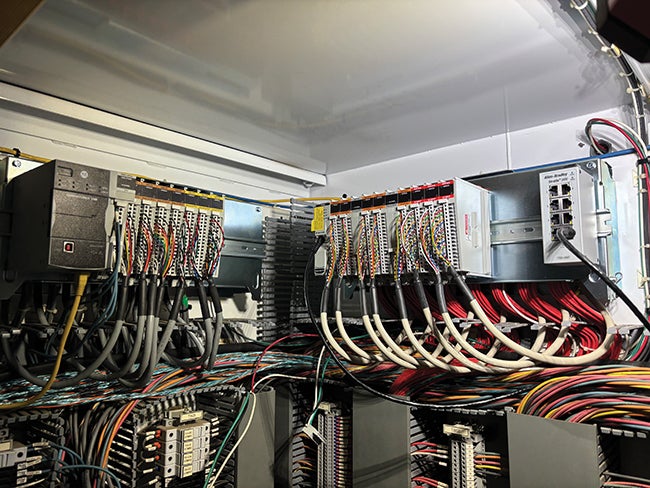
1. Control panel upgrades at a power generation facility. Courtesy: Aquatech |
When correctly implemented, each migration is engineered to preserve existing process functionality while enhancing system performance, reliability, and expandability. Upgrades (Figure 1) can be accomplished during outage windows. Partners with expertise in both process and controls should be selected to ensure a smooth startup and system transition following implementation. In addition, process expertise can be leveraged to optimize software and control logic programming.
Highly Engineered Migration Methodology
PLC upgrade strategy should balance risk mitigation, execution speed, and long-term maintenance. Because most upgrades must be completed within fixed outage windows, planning becomes a critical factor in overall project success. A structured approach ensures systems are migrated efficiently while minimizing operational disruption. The following areas should be considered in detail when executing an upgrade project.
Engineering and Planning. The process begins with a detailed control system assessment and gap analysis to evaluate existing systems, determine upgrade paths, and identify the highest-risk areas. This includes a hardware obsolescence and input/output (I/O) compatibility evaluation to determine what needs to be replaced and how existing signals can be integrated into the new architecture. A network topology review—covering configurations such as device-level ring (DLR) and star architectures—assesses whether changes are needed to support project goals or new standards. These efforts culminate in a migration roadmap with a phased cutover strategy, supported by a detailed, step-by-step execution plan that manages upgrades in a staged manner.
PLC and HMI Modernization. A central element of any migration is the conversion and optimization of control logic—including ladder, structured text, and function block programming—to integrate existing logic into the new PLC platform with refinements for new features and improved performance. Modular programming standards following industry best practices enable faster troubleshooting and future-proof logic updates. The upgrade also encompasses a full modernization of HMI and SCADA platforms (such as FactoryTalk View SE and ME, Aveva Plant SCADA, and WinCC), improving the ability to provide meaningful graphics for analysis and deeper operator insights into plant operations. Alarm rationalization, trend optimization, and operator usability improvements make data more actionable throughout the system.
Testing and Commissioning. Before installation, offline simulation confirms that control logic and graphics perform as expected, and factory acceptance testing (FAT) validates systems prior to startup at the site. Once on site, site acceptance testing (SAT), loop checks, and live cutover support ensure all systems are installed and functioning properly in the live environment. Operator training and complete as-built documentation round out the process, improving site readiness and enabling effective use of the upgraded systems.
This disciplined approach ensures predictable outcomes and minimal plant downtime.
Designed for High Availability and Cybersecurity
To address these challenges, modern PLC architectures are designed with resilience and security at their core. Redundant PLC processors, power supplies, and networks drastically reduce long-term outage risk, while managed industrial Ethernet switches improve control and security of data flow across the system. Secure remote access and role-based system controls segment access and management to specific user groups, limiting unwanted access and changes to critical settings.
Segmented networks aligned with cybersecurity best practices further strengthen the overall security posture. Together, these design elements significantly improve system resilience while meeting evolving information technology (IT) and operational technology (OT) security expectations.
Real-World Migration Success Under Tight Outage Windows
Across the power and energy sector, PLC modernization projects are often constrained by narrow outage windows, requiring precise planning and flawless execution. The following examples highlight how well-engineered migration strategies can minimize disruption while delivering immediate operational improvements.
 |
|
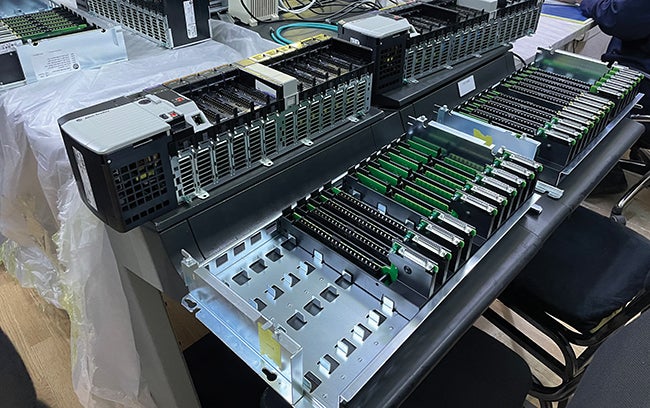
2. System upgrades at gas processing facility. Courtesy: Aquatech |
Gas Processing Facility. A legacy PLC-5 system was upgraded to ControlLogix 5580 (Figure 2) alongside a full SCADA modernization using Aveva Plant SCADA. The project included replacing aging HMI infrastructure with redundant storage systems to improve resilience. Full system cutover was completed in just eight days, reducing long-term risk associated with obsolete hardware while improving visibility and control.
 |
|
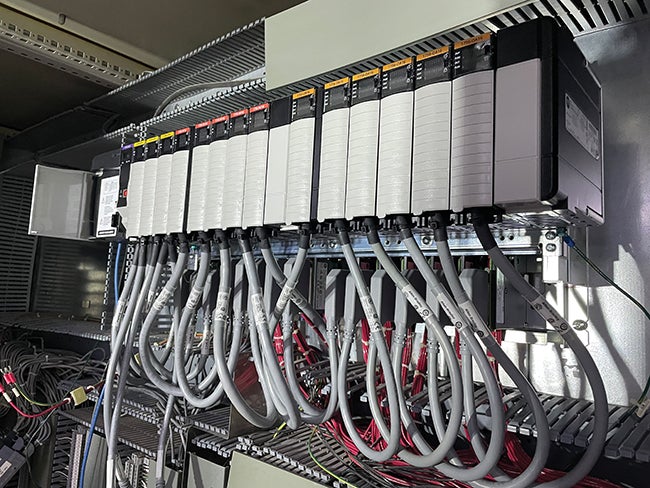
3. Upgraded control panel integration at a power generation facility. Courtesy: Aquatech |
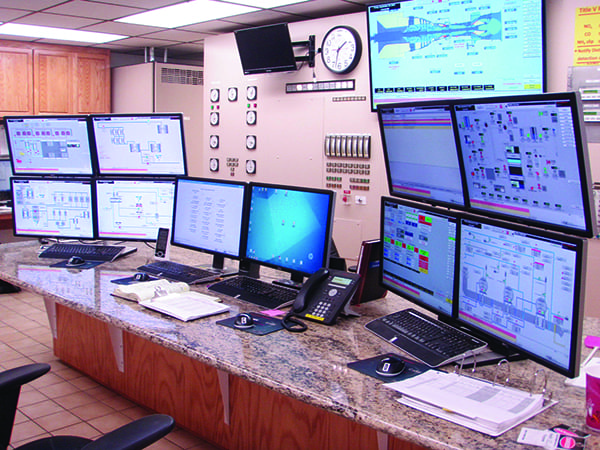
Power Generation Facility—Water Treatment System. A critical water treatment control system (Figure 3) supporting plant operations was migrated from SLC 500 to ControlLogix 5580. The upgrade also included modernization of the control room interface and integration of variable-frequency drive (VFD) systems into a ring-network architecture. Completed within a five-day outage window, the upgrade improved system reliability and enabled faster fault detection and operator response.
These examples demonstrate how modernization strategies translate into real-world execution under tight operational constraints.
Unlocking Digital and IoT Capabilities
Beyond reliability improvements, PLC modernization also enables a shift toward more connected, data-driven operations across industrial water systems. By enabling secure, real-time data exchange between plant assets and enterprise systems, upgraded control architectures support real-time data integration via MQTT, OPC UA, and REST APIs, as well as remote monitoring and centralized performance dashboards. These capabilities facilitate predictive maintenance strategies that reduce unplanned downtime and enable faster troubleshooting through improved diagnostics and alarm visibility.
For power producers, this level of connectivity is not just a convenience. It directly impacts plant availability. The ability to remotely diagnose and respond to upset conditions can mean the difference between sustained output and costly curtailment.
PLC modernization is no longer optional; it is a critical step in ensuring the reliability, security, and long-term viability of power generation and industrial water infrastructure. As legacy systems continue to age out of support, utilities that take a proactive approach to control system migration will be better positioned to reduce operational risk, improve efficiency, and unlock new levels of performance through digital integration.
What to Look for in a Controls Modernization Partner
Even the most well-designed upgrade strategy can fall short without the right implementation partner. Successful PLC migration projects require more than technical execution; they require a partner capable of balancing speed, risk management, and long-term system performance. Key considerations include:
- ■ Proven ability to minimize downtime through detailed pre-testing, simulation, and rapid on-site execution.
- ■ Strong engineering efficiency using modular design approaches and reusable automation frameworks.
- ■ Multi-platform expertise across major control systems such as Rockwell and Siemens.
- ■ Integrated process and controls knowledge, ensuring automation strategies align with real-world system performance.
- ■ Future-ready design capabilities, including cybersecurity, scalability, and digital integration readiness.
Selecting the right partner can significantly influence not only the success of the migration, but also the long-term performance and adaptability of the plant.
—Nishanth Sahaya is a senior automations engineer with Aquatech.