According to the State of the Global Climate 2024 report released by the World Meteorological Organization (WMO), the continued rise in global temperatures is driving a measurable increase in both the frequency and intensity of extreme weather events. Among these, tropical cyclones, including hurricanes and typhoons, as well as extreme precipitation events, have emerged as leading contributors to global economic losses associated with climate-related disasters. These evolving climatic patterns are fundamentally reshaping the risk landscape for energy infrastructure, particularly for renewable energy systems that are inherently exposed to environmental stressors.
For the solar power sector, the implications are especially significant. Research conducted by the U.S. National Laboratory of the Rockies (NLR, formerly the National Renewable Energy Laboratory [NREL]) indicates that extreme weather conditions, particularly those associated with tropical cyclones, can lead to substantial structural damage, foundation instability, and site flooding. In severe cases, solar power asset losses may reach up to 60%. As solar deployment continues to scale globally, ensuring system resilience under extreme climatic conditions has become a critical determinant of project bankability, operational continuity, and long-term asset performance. In this article, we explore resilience-oriented planning, design, construction, and operations and maintenance (O&M) of solar power projects in Taiwan, a natural disaster–prone area.
Situated within the highly active typhoon belt of the Northwest Pacific Ocean, Taiwan is frequently subjected to high-intensity wind events and torrential rainfall. In recent years, multiple typhoon events have demonstrated the vulnerability of solar power plants. During Typhoons Kong-rey, Shanshan, and Gaemi in 2024, flooding in coastal and low-lying areas of central and southern Taiwan caused damage to solar power plants. In 2025, Typhoon Danas followed an atypical trajectory along the Taiwan Strait before making landfall in central and southern Taiwan, bringing maximum wind speeds of up to 40 meters/second (m/s, 144 kilometers/hour [km/h]). The typhoon impacted approximately 135,000 photovoltaic (PV) modules, resulting in significant financial losses.
In response to these escalating risks, resilience-based engineering and operational strategies are increasingly being integrated across all stages of solar project development. From site selection and system design to construction execution and long-term O&M, ECOVE employs a holistic and systematic approach to strengthen system resilience, reduce vulnerability, and ensure stable long-term performance.
Site Assessment and Resilient System Design
In regions such as Taiwan, where land availability for solar development is inherently constrained, site selection becomes a critical factor influencing the safety, durability, and long-term viability of solar power plants. Consequently, comprehensive and systematic site assessment has become a critical factor in resilience-oriented planning.
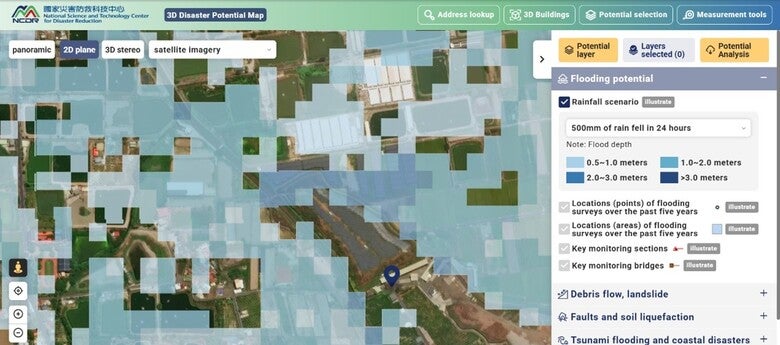
During the site evaluation phase, project teams integrate historical meteorological datasets, advanced academic modeling tools, and publicly available government data to assess both climatic and geotechnical risks. For flood risk analysis, flooding potential maps and soil liquefaction maps published by the National Science and Technology Center for Disaster Reduction (NCDR) are extensively utilized (Figure 1). These datasets enable a retrospective assessment of flood occurrences over the past five years and support scenario-based simulations of extreme rainfall events, such as cumulative precipitation of 500 millimeters within a 24-hour period. Such analyses provide critical insights into potential flood depths and soil liquefaction susceptibility. To complement these regional-scale assessments, site-specific geotechnical investigations are conducted to validate subsurface conditions. These investigations typically include soil drilling and standard penetration tests (SPTs), which provide essential information on soil density, stratification, and groundwater levels. The resulting data serve as key inputs for foundation design, particularly in areas characterized by soft soil conditions or high groundwater tables.
For sites identified with high flood vulnerability, a series of engineering adaptation measures are incorporated during the design phase. These include the implementation of stormwater diversion and detention systems, elevation of foundation structures, and raising of electrical equipment platforms to effectively mitigate localized flooding during extreme rainfall events.
In addition to flooding, wind loading from typhoons represents a major design consideration for solar power plants. For sites located along typhoon landfall trajectory, structural systems are designed to exceed the requirements specified in the Building Wind-Resistant Design Code issued by the Ministry of the Interior (MOI), Taiwan. In practice, site-specific design wind speeds are increased by an additional 10 m/s (equivalent to 36 km/h) to provide enhanced safety margins against strong wind. Structural analyses incorporate worst-case wind directions, terrain-induced acceleration effects, and aerodynamic influences from surrounding structures, ensuring that the design reflects realistic wind field conditions.
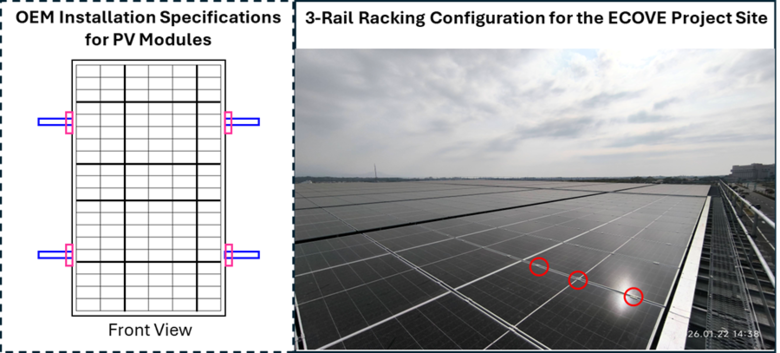
To further enhance system resilience, mounting configurations are designed to exceed the original equipment manufacturer (OEM) specifications for two-rail installation. In practice, a three-rail racking configuration is adopted to reduce localized stress concentrations and enhance overall structural stability. This configuration facilitates more effective load distribution, thereby mitigating bending moments and occurrence of wind-induced vibrations. As a result, the risk of module deformation, uplift, or detachment under extreme wind conditions is significantly reduced (Figure 2).
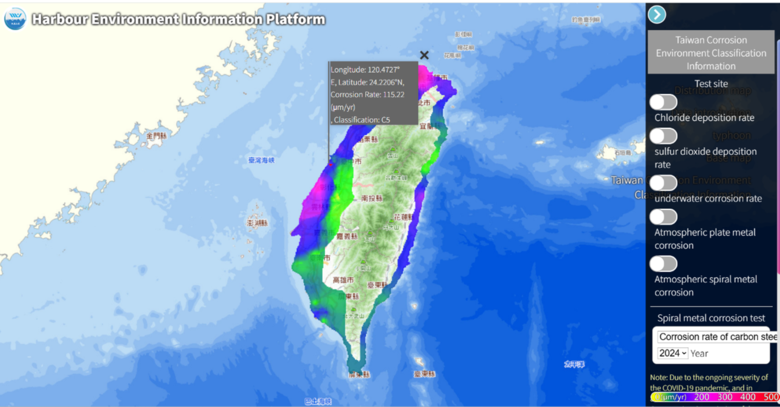
Material durability is equally critical, particularly for coastal installations exposed to salt-laden environments. Site-specific corrosion risk is assessed using the Harbor Environment Information Platform issued by the Institute of Transportation, Ministry of Transportation and Communications (MOTC), Taiwan (Figure 3), which provides a basis for evaluating salt spray corrosion levels and guiding material selection. For environments classified as C4 or higher, indicating high corrosion exposure, mounting structures are typically fabricated using aluminum-magnesium-zinc coated steel. The coating thickness is further specified based on the severity of the corrosive environment to ensure adequate long-term corrosion resistance. Fasteners are selected as 304 or 316 stainless steel to enhance resistance to oxidation and ensure long-term durability. These material strategies play a vital role in preserving structural integrity and extending the service life of solar power plants operating under harsh environmental conditions.
Integrating Resilience into Construction and O&M
During the construction phase, foundation systems are selected based on detailed geotechnical assessments, with common options including H-pile foundations, ground anchors, and reinforced concrete foundations. Construction activities are executed in strict accordance with structural calculation reports derived from prior risk assessments and engineering analyses, ensuring alignment between design assessment and field implementation. Upon mechanical completion, internal standardized inspection checklists are first implemented to conduct quality verification, ensuring that construction works are executed in full compliance with design specifications. In addition, independent third-party organizations, such as SGS Taiwan, are commissioned to perform verification of structural safety and material durability. These evaluations include field pull-out tests to confirm the mechanical strength of foundation systems, as well as compressive strength testing of concrete foundations. Such third-party validation enhances quality assurance credibility and strengthens overall system reliability.
Beyond construction, a comprehensive O&M strategy is essential for maintaining long-term resilience. Prior to typhoon and heavy rainfall seasons, standardized preventive inspections are conducted across the site, including:
- Torque verification of structural fasteners and module clips.
- Inspection of three-rail racking connection points.
- De-silting and clearance of drainage networks and culvert gratings.
- Waterproof reinforcement of conduit and cable entry seals.
For coastal solar power plants, inspection frequency is further increased to address elevated risks associated with atmospheric corrosion. Monitoring efforts focus on corrosion of mounting structures, cable trays, and fasteners, as well as module frame degradation, corrosion at dissimilar metal interfaces, and moisture ingress along module edges. Electrical system maintenance includes frequent cleaning of inverter air intake filters, along with rigorous inspection of enclosure sealing integrity and anti-corrosion treatments at electrical terminals. These proactive measures mitigate the deleterious effects of salt mist and high humidity, significantly enhancing system durability and long-term reliability.
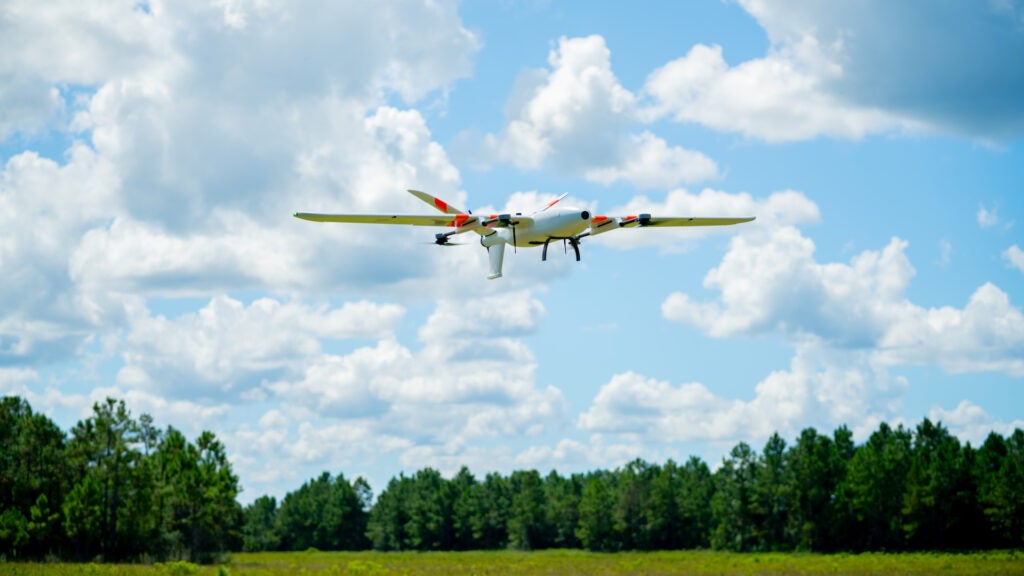
Following extreme weather events such as typhoons or heavy rainfall, post-event inspection protocols are promptly activated. These procedures integrate unmanned aerial vehicle (UAV)–based aerial surveys for rapid site-wide reconnaissance, complemented by infrared thermography and supervisory control and data acquisition (SCADA)–based performance diagnostics. Based on inspection results, identified deficiencies and potential degradation issues are systematically addressed through targeted repair and improvement measures.
For example, contact resistance at PV string connectors is highly susceptible to environmental corrosion and oxidation, leading to reduced power transmission efficiency. By applying super crystalline nanomaterials to cables and connectors, contact resistance can be effectively reduced, oxidation suppressed, and electrical conductivity enhanced. Field applications have demonstrated that such improvements can reduce power generation losses by more than 6%.
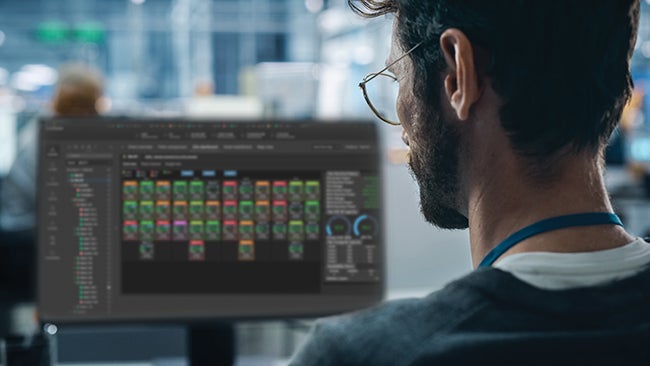
Each corrective action is further incorporated into a structured lessons learned framework, enabling continuous improvement of O&M strategies. In recent years, conventional monitoring systems have been upgraded into intelligent platforms equipped with artificial intelligence (AI)–based early warning and structural monitoring capabilities. This transition represents a shift from reactive alarm-based systems to predictive, data-driven asset management. By leveraging AI models to analyze historical operational data, degradation trends in PV modules can be effectively identified, enabling early detection of string-level anomalies. This allows potential faults to be addressed proactively before impacting energy generation performance (Figure 4).
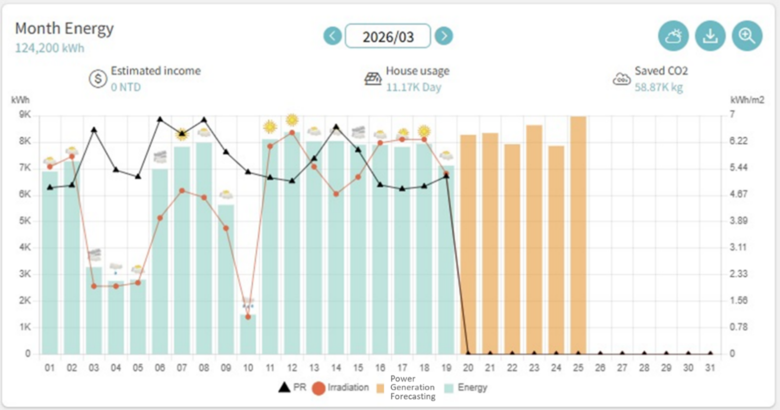
In addition to electrical diagnostics, indirect structural health monitoring is employed to evaluate the system’s mechanical stability. By analyzing subtle fluctuations in inverter output power in conjunction with wind speed measurements, it is possible to estimate wind-induced loads on mounting systems and evaluate the risk of micro-deflections or structural misalignment. This integrated monitoring and analytics approach not only enhances operational visibility but also significantly improves the resilience and structural reliability of solar power systems operating under extreme environmental conditions.
As climate change continues to intensify the frequency and severity of extreme weather events, integrating resilience into solar power plants planning has become imperative. ECOVE implements a comprehensive approach that combines site assessment, resilient engineering design, high-quality construction practices, and proactive O&M strategies to ensure system reliability under increasingly challenging environmental conditions. By systematically addressing climate-related risks through both engineering and data-driven operational measures, the solar power plants can enhance asset durability and safeguard energy production.
—Li Pei-Chen is an engineer in the Development Division at ECOVE Environment Services Corp., Liu Chi-Chia is the assistant Chief Engineer in the Operations Division II at ECOVE Environment Services Corp., and Yen Hsin-Hui is the assistant Chief Engineer in the Development Division at ECOVE Environment Services Corp.