The cooling needs of thermoelectric power plants account for a significant amount of freshwater use in the U.S. The future promises increased competition for that water from agricultural, residential, and commercial users. (See POWER, April 2008, “New coal plant technologies will demand more water.”)
Given limitations on freshwater availability, the need for water-stingy cooling technologies is growing–an issue covered in the January 2008 issue of POWER (“Costlier, scarcer supplies dictate making thermal plants less thirsty”). One technology in particular–closed-loop, evaporative cooling–can be very cost-effective for the main heat transfer needs of simple- and combined-cycle power plants.
Closed-loop evaporative coolers (also known as wet surface air coolers, or WSACs) have an extensive and admirable track record at facilities in a wide variety of industries. Applications in the power industry include auxiliary fluid loop cooling, direct steam condensing, and inlet air chilling refrigerant condensing. In the U.S., a WSAC unit has been cooling a 240-MW plant near Springfield, Mass., since 1993, and many similar units are working throughout North America and overseas.
ABCs of WSACs
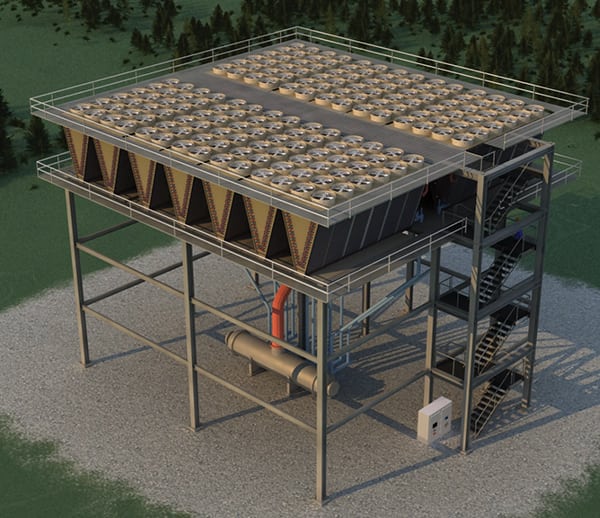
The basic operating principle of a WSAC is rejection of heat by evaporation. The fluid/vapor to be cooled or condensed flows through tube bundles in a closed-loop system. A large quantity of water (generally 7 to 10 gpm/ft2 per coil face area) from the unit basin is sprayed downward over the tube surfaces (Figure 1). Simultaneously, fans induce air flow over the bundles in a co-current direction. Evaporative cooling takes place at the exterior tube surfaces. The saturated air stream leaving the tube bundle then makes two 90-degree turns into the unit’s fan plenum. The reduction in velocity returns almost all of the large water droplets to the basin. The air is then discharged out of the unit through the fan stacks.
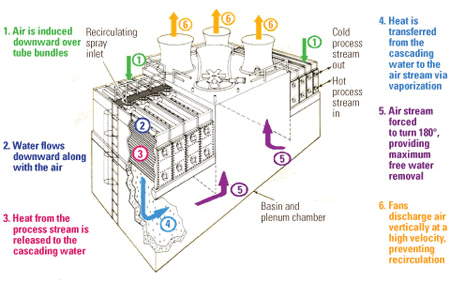
1. Go with the flow. The co-current flow of air and water in a wet surface air cooler increases the system’s heat transfer efficiency, reduces scale deposition on active surfaces, and virtually eliminates drift of water droplets into the environment. Source: Niagara Blower Co.
Keeping the process stream inside the tubes is important for three reasons:
- It maintains thermal performance.
- It minimizes and simplifies maintenance.
- Open-loop spray water never contaminates the process stream. This allows poor-quality water to be used as makeup and enables operation at higher cycles of concentration (see sidebar). It also eliminates exposure of the process fluid to the environment.
WSAC put to the test
Three summers ago, a wet surface air cooler (WSAC) from Niagara Blower Co. was independently tested for 147 days on the 550-MW Unit 3 of the 1,500-MW San Juan Generating Station (SJGS) in New Mexico to determine its ability to cool poor-quality circulating water. The project was funded by the Electric Power Research Institute and the U.S. National Energy Technology Laboratory.
A unique aspect of WSAC technology is the continuous flushing of tube surfaces by a dense flow of spray water, which prevents suspended matter and mineral scale from depositing on them. Scale and suspended solids eventually settle in the WSAC basin or on noncooling surfaces.
The purpose of the pilot test was to determine if WSAC technology could cool process water at cycles of concentration that would be considered excessive (highly scale-forming) for a mechanical-draft cooling tower. To accomplish this, blowdown from the Unit 3 cooling tower at SJGS was fed to the WSAC pilot as makeup.
Between July 5 and November 29, 2005, the WSAC was operated for 2,898 hours at an equivalent of 24 to 70 cycles of concentration (based on freshwater normally supplied to SJGS cooling towers). Ten cycles of concentration is considered a safe limit at this plant to control mineral scale formation.
During the testing, Unit 3’s cooling tower, with a capacity of 220,000 gpm, was operated within a range of parameters (see table). Continuous chlorination was used to maintain a residual of 0.1 to 0.2 mg/l of chlorine in the cooling tower’s circulating water. A phosphonate-type inhibitor was used for scale control, and an azole-type corrosion inhibitor was used to protect the copper-based admiralty brass metallurgy of the main condenser.
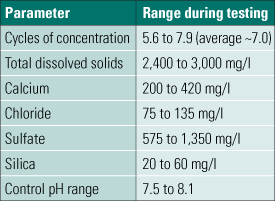
Operating parameters for test of a wet surface air cooler. Source: Niagara Blower Co.
The goal of the testing was to determine the degree to which blowdown from Unit 3’s cooling tower could be concentrated in the WSAC and still maintain heat transfer. At the outset of testing, it was decided to operate at 5,000 microSiemens/cm conductivity (blowdown from Unit 3 to the WSAC had a conductivity of about 2,500 µS/cm).
As testing progressed, the plan was to increase the conductivity control setting on a stepwise basis, with the intent of determining the cycles of concentration (and chemistry) at which heat transfer would start to deteriorate. This threshold was never reached, however, because conductivity control proved problematic. Nonetheless, the WSAC proved able to operate at very high cycles of concentration with significant levels of suspended matter without degrading heat transfer.
To summarize the major findings and conclusions of the pilot testing:
- Throughout the testing, the WSAC tube exterior surfaces were visually clean and smooth to the touch, with no apparent mineral deposits or biological film. At the completion of testing, there was no visible scale on the heat transfer surfaces (tube externals). Cooling was sustained throughout the test period.
- Cycles of concentration varied (somewhat erratically at times) from 3.5 to over 10 during the test period. The average for the test period was 4.4 cycles. This was equivalent to 24 to 70 cycles of concentration (30 cycles average), based on Unit 3’s cooling tower freshwater makeup. This was far in excess of the control level for the cooling system: 10 cycles of concentration (based on calcium sulfate saturation).
- Heat transfer was maintained throughout the testing; the temperature difference across the bundles was steady. Heat transfer was only a problem when one or more of the unit’s three fans were taken out of service.
- The bundles with Cu-Ni tubes exhibited slightly better heat transfer than titanium and 316 stainless steel bundles (even with signs of corrosion in the interior Cu-Ni surfaces).
- Calcium and silica cycles of concentration paralleled flow-based and heat-based cycles, but they were always less. This was attributed to calcium and silica dropping out of solution to form mineral salts at elevated cycles.
- There was no measurable benefit to the WSAC pilot from residual concentrations of the scale and corrosion inhibitors injected into Unit 3’s cooling tower blowdown.
- The exterior surfaces of the tubes fared well with respect to visible scale and corrosion. Only the Cu-Ni tubes showed signs of corrosion on the internal surfaces (non-WSAC side).
- Mineral scale and suspended matter (measured as turbidity) were very evident throughout the testing. Total suspended solids levels greatly exceeded cooling system standards, making it clear that solids control is very important to the use of WSAC technology in this manner. However, given the operating conditions (high cycles of concentration, formation of extensive mineral scale, and very high levels of suspended matter in the bulk cooling water), the WSAC performed well by maintaining heat transfer throughout the test period.
The co-current flow of air and water creates an unobstructed spray system that is fully accessible for observation and maintenance. Another plus of the design: Because the air passes over the water in the system before and during its contact with the tube bundle, the mixed water temperature remains above freezing. This protects the tubes from freezing even when the ambient air temperature is below zero. The co-current flow also ensures complete coverage of tube surfaces (there are no bare spots, as seen with counterflow designs), reducing further the potential for fouling and freezing.
A WSAC is able to cool process fluids to within 8 to 10 degrees Fahrenheit of the wet bulb temperature, which is always lower than the ambient dry bulb temperature. As a result, a WSAC can deliver cooling water at 80F even on a day as hot as 110F (ambient).
Comparing cooling technologies
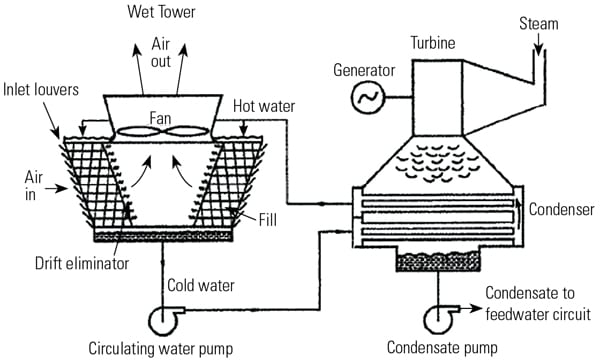
As you are doubtless aware, there are two other system designs suitable for power plant-scale heat transfer applications (Figure 2). One is the conventional open, mechanical-draft cooling tower with heat exchanger; the other is a dry, air-cooled system (see the previous, related story, "Air-cooled condesers eliminate plant water use").
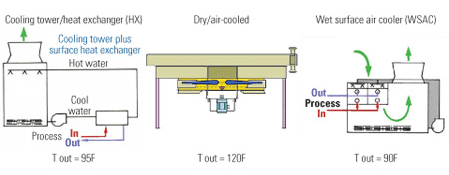
2. Power plants’ three main evaporative cooling options. Performance based on 100F dry bulb, and 80F wet bulb. Source: Niagara Blower Co.
In an open tower configuration, there are two system loops–one open, one closed–and each requires a heat transfer device to work. The open-loop water first flows through a heat exchanger, which removes heat from the process fluid via sensible heat transfer. The water then is pumped to the cooling tower, where it is cooled via evaporation.
This system design has two approach temperatures: a sensible approach in the heat exchanger and a latent approach to the wet bulb temperature in the cooling tower. The difference limits open tower systems’ practical ability to cool the process fluid to within 10 to 15 degrees Fahrenheit of the wet bulb temperature. What’s more, the system’s configuration (open tower and heat exchanger) limits the number of cycles of concentration permissible in the cooling tower, based on the quality of makeup water and the fouling potential of the heat exchanger.
By comparison, a WSAC directly cools the process fluid via more-effective latent heat transfer, and it does not require an additional heat transfer device to accomplish its mission: heat removal. It has only one approach to the wet bulb temperature (8 to 10 degrees Fahrenheit) and requires less air (fan horsepower) to remove the total heat load. Typically, less horsepower is also needed to drive spraying, which translates into lower operating costs and a smaller carbon footprint.
In the other system design–the dry (fin-fan) system–the closed-loop fluid is cooled directly via sensible heat transfer. As a result, a dry cooler’s approach temperature is based on the dry bulb (ambient) temperature. In addition, due to the inefficiencies of sensible cooling, the realistic approach temperature is between 20 and 25 degrees Fahrenheit.
The WSAC’s direct cooling of the process fluid using more-efficient latent heat transfer means that its approach temperature is based on the wet bulb temperature–which, as mentioned, is always lower than the dry bulb temperature. The benefits of WSACs are more pronounced at warm-weather plant sites. For example, on a day when the dry bulb temperature is 100F and the wet bulb is 75F, a dry (fin-fan) system will be able to deliver cooling water no cooler than 125F. Under the same conditions, a WSAC would easily be able to produce 85F cooling water at its outlet.
Due to the efficiency of its heat transfer technology and its lower air flow requirements, a WSAC typically has a 25% smaller footprint than a dry cooler and requires 60% less horsepower to operate. Furthermore, a WSAC uses tubular surface coils, which are much less prone to fouling and plugging than the closely spaced fins of a dry cooler. Finally, in fin-fan units, the passage of cold air directly over the tubes can lead to freezing within them at low ambient temperatures. In a WSAC, by contrast, the recirculating spray water is kept warm by direct contact with the heat source, and thus can help insulate the tubes from freezing-cold air.
Because it is a closed-loop system with no plastic “fill” or heat exchanger to become clogged or scaled, a WSAC typically requires much less blowdown than a conventional evaporative cooling tower. Another plus of the technology: Makeup water can come from almost any source (including cooling tower blowdown, blowdown from a reverse osmosis or demineralizer system, plant discharge, produced waters from drilling or mining operations, scrubber wastewater, sewage treatment plant effluent, or seawater).
Finally, WSACs require little maintenance. The spray system is accessible for inspection and maintenance with no need to shut down the unit or remove any obstructions, such as tower fill. And, because it is a closed-loop system, maintenance and cleaning of heat exchangers are eliminated.
Inside a WSAC
The key parts of a wet surface air cooler are its tube bundles, its basin, and its mechanical components.
Tube bundles. As mentioned, inside a WSAC the process fluid stays within the closed-loop tube bundles. The bundles can be made of almost any material, which should be selected to accommodate the composition of the process stream (inside) and the quality of spray water (outside). All bundles can be designed for high-pressure use per ASME and TEMA codes.
There are two basic types of tube bundles: serpentine and straight-through. Serpentine bundles cost less, are fabricated with a continuous tube circuit, and can be designed to accommodate pressures up to 2,500 psi. Straight-through bundles feature headers that can be removed to provide complete internal access for in situ inspection and cleaning while the balance of the unit remains in service. Additionally, the tube bundles can be retubed using the existing headers. Tube sheet thicknesses are designed to meet TEMA/ASME standards. This bundle style offers the lowest process side pressure drop.
The tubes’ material, diameter, wall thickness, length, and row depth and width can be optimized to provide the most cost-effective thermal performance for any application. Typical material choices include black or galvanized carbon steel, stainless steel, admiralty brass, duplex stainless steel alloy, titanium, and copper alloys. There are tradeoffs between tube material and the quality of makeup water and its treatment, so make sure a water treatment professional participates in your procurement process.
The basin. Many factors must be considered when selecting the material for a WSAC’s basin. Metal basins are generally the most economical choice for smaller units. They are commonly made of prime carbon steel that has been hot-dip galvanized after fabrication.
In many parts of the world, it is less expensive to construct the basin on-site out of concrete, and the savings increase with unit size. A 3-foot-high “swimming pool” must be poured to enclose the basin water level.
A third possibility is using fiberglass reinforced plastic (FRP) for the fan plenum (center section) or the entire structure. FRP is corrosion-resistant and, in some instances, can be less expensive than concrete.
Mechanical components. Direct-drive, heavy-duty, self-lubricating, totally enclosed air over (TEAO) fan motors are typically placed directly in the air stream in designs requiring fans of 5-foot diameter or less. The blades of these smaller fans are made of heavy-duty, epoxy-coated plastic and have adjustable pitch. For WSACs requiring larger fans, right-angle gear drive designs with totally enclosed fan-cooled (TEFC) motors located outside the air stream are used in conjunction with fiberglass reinforced epoxy fan blades.
The spray water distribution system in WSACs of all sizes is typically a low-pressure, high-flow design (generally 7 to 10 gpm/ft2 of coil surface). The system is made of galvanized carbon steel for factory-assembled units and of PVC material for field-erected systems. To ensure reliable complete coverage, large-orifice, nonclogging nozzles are used.
WSAC applications in power
The flow of its process stream within a closed loop makes a WSAC versatile enough to perform various tasks within a power plant. Among them are the following.
Auxiliary cooling of turbine oil loops, boiler fire eye control systems, and other equipment. By dedicating a WSAC to a cooling loop, the loop can be operated independently, enabling the use of any plant blowdown source as spray water makeup.
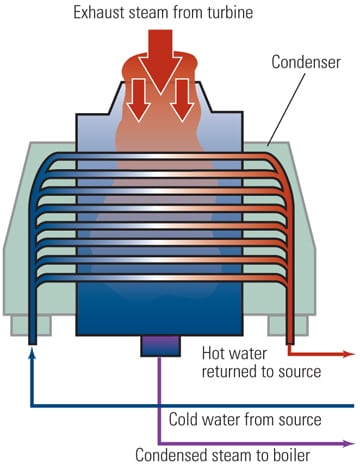
Steam condensing. Whatever the plant’s fuel, steam condensing efficiency is important to steam turbine performance and therefore to overall plant output. By using a WSAC (rather than a cooling tower and surface condenser), steam can be condensed directly from the steam duct into the tube bundles. The technique typically reduces parasitic (fan and pump) losses by as much as 50%.
Turbine inlet air chilling. A WSAC can be used as a condenser on a refrigeration system used to cool the inlet to a gas turbine. As with steam condensing, efficiency is important to net plant output. In most cases, a WSAC will be more efficient (requiring less power per ton) than alternative technologies.
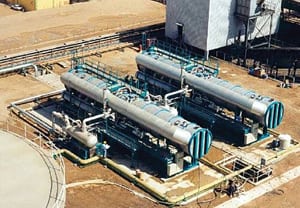
Supplemental cooling and condensing. Many plants see their thermal performance degrade over time, usually due to fouling of air-cooled condensers and coolers. A WSAC can be used as a supplemental steam condenser (Figure 3) to recover lost performance. During periods when the vacuum exceeds optimal design, some of the steam can be condensed in a WSAC, lowering the backpressure on the turbine. If the auxiliary loop coolant temperature gets too high, problems with the turbine and other mechanical components can arise. When the loop temperature exceeds safe limits, the WSAC can be used as a “trim cooler” to lower the temperature. In both cases, blowdown or poor-quality water can be used for spray makeup.
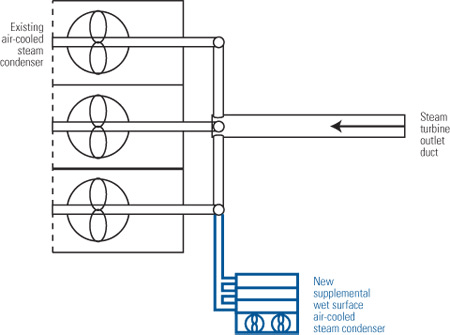
3. Lost and found. Using a WSAC as a supplemental steam condenser can recover thermal performance lost to fouling over time. Source: Niagara Blower Co.
Water issues
Like conventional evaporative cooling towers, operating WSACs produce three phenomena that must be controlled: drift, plume, and emissions of particulate matter (PM).
“Drift” is the term applied to water droplets (of the same chemical composition as spray water) that escape into the environment. Where drift is a major issue for open cooling towers due to their countercurrent flow of air and water, it is less of a problem for WSACs, with their co-current design. In a typical WSAC, the drift is only about 0.02% of the recirculating spray rate. Installing high-efficiency drift eliminators can reduce the percentage to as low as 0.0005%.
The drift discharged from the WSAC’s fan stack contains a variety of materials. When a water droplet evaporates, its particulate content is released into the air and either is carried away by wind or falls to the ground.
Many plants are required to calculate how many pounds of PM10 they discharge annually, with and without the use of drift eliminators. Because WSACs produce little drift, their PM output is significantly below most permit standards. Since the spray water rate is only about 10% that of a cooling tower, the total drift of a WSAC will be significantly lower.
A plume is the visible (often blue) cloud created above a cooling tower or WSAC when its water vapor output condenses in cold weather. Some communities place restrictions on the aesthetics of power plants, such as plumes, operating within their jurisdiction. All of the methods of plume abatement developed for cooling towers (including cold air introduction, using reheat coils, and partial wet/dry operation) are applicable to the WSAC.
Minimizing water use
With more stringent regulations on water withdrawals and increasing costs for water purchase, treatment, and discharge, many power plant developers may feel that dry cooling is their only technology option. That may not be the case. WSAC technology can reduce a plant’s water consumption by enabling the reuse of water that has already been used at least once. An example is a combined-cycle plant that uses cooling tower blowdown as makeup to the WSAC auxiliary loop cooler (Figure 4).
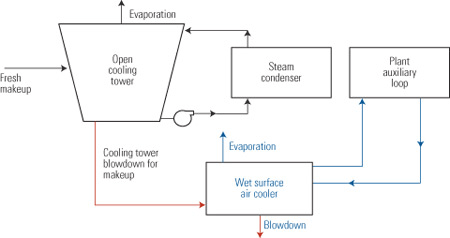
4. Trim job. When the auxiliary loop temperature exceeds safe limits, the WSAC serves as a “trim cooler” to lower it–and avoid equipment overheating problems. Source: Niagara Blower Co.
Many WSACs are chosen to add capacity to “thermally challenged” plants. This allows for additional direct cooling without having to add more tower capacity, or to purchase additional makeup water.
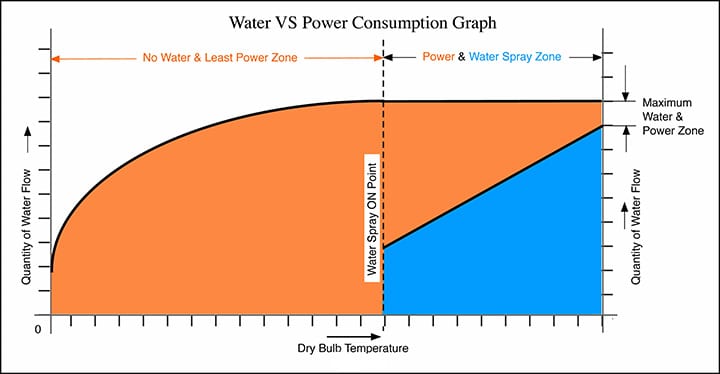
At water-constrained sites, when insufficient water is available to use evaporative cooling for the entire thermal load, a hybrid WSAC with a dry (finned) section and a wet (tubed) section (Figure 5) may be just what the doctor ordered. Use of such a system can save as much as 50% of annual water use requirements (Figure 6).
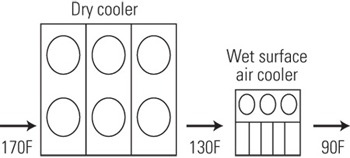
5. Sharing the load. At water-constrained sites, when not enough water is available to use evaporative cooling for the entire thermal load, consider using a hybrid WSAC with a dry (finned) section and a wet (tubed) section. Source: Niagara Blower Co.
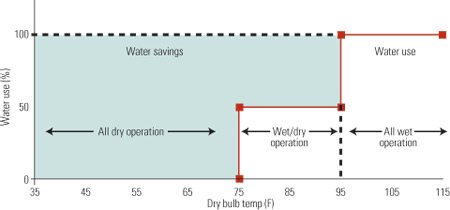
6. Half-full, not half-empty. Operating the parts of a hybrid WSAC system according to ambient temperature can produce big savings–of both water and money. Source: Niagara Blower Co.
The bottom line
With more stringent water-use restrictions and higher costs for obtaining, treating, and disposing of water, power plants are evaluating more efficient technologies for cooling and condensing. Closed-loop, evaporative wet surface air coolers have proven to be cost-effective heat rejection systems that also reduce the amount of freshwater required.
—Peter G. Demakos, PE (pdemakos@niagarablower.com), is president of Niagara Blower Co.