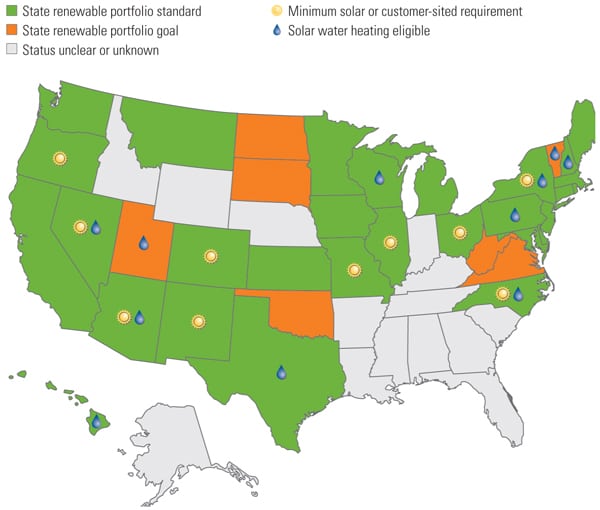

The length of term allowed for power sales contracts is a critical determinant of the ability of states to meet their increasingly ambitious renewable power targets. Many utilities advocate limiting terms to 10 or perhaps 15 years for renewable energy contracts, emphasizing the "flexibility" that shorter terms offer. In contrast, contract terms of 20 or 30 years allow renewables to be more price-competitive and lock in any savings for a longer period. Nonetheless, utilities resist longer-term contracts for fear that their prices could someday be "over-market," exposing the utility to criticism by regulators and the public.
Longer terms for renewable technologies provide a real and immediate benefit: acceleration of the imperative transition away from fossil fuel–based generation. The supposed risks of longer terms are distant and speculative; at some point, the prices will be "above market."
Extended terms enable new generation
Extended terms have traditionally been a major enabler of the development of new sources of generation. In the post–World War II era, numerous hydroelectric facilities were financed and constructed with 50-year sales contracts, rewarding electric consumers even today with low prices and additional power sources. Analogously, 30-year terms were the foundation of Public Utility Regulatory Policies Act qualifying facility (QF) generators built during the 1980s.
Offering 30-year contracts to today’s renewable energy producers would likewise help jump-start the development of additional renewable capacity. Renewable projects offer lower, more stable fuel costs than fossil-fueled projects, but their up-front capital costs are higher than those of natural gas–fired combined-cycle projects. A longer term allows the developer of a renewable power project to obtain longer-term financing for the project, amortize its debt over a longer term, and thus offer lower and more competitive prices to purchasing utilities. Longer terms also facilitate the obtaining of financing, offering lenders the opportunity in the incremental years to recoup any possible prior payment delinquencies. Additionally, longer terms enable a fairer comparison of renewable projects and competing utility projects whose economics are typically premised on a 30-year life, allowing lower imputed financing and depreciation costs.
Risks vs. benefits
Given the supposed insistence by state legislatures and regulators on renewable power, why the resistance to longer-term contracts? It is the fear that future power prices will decline and that long-term contracts will lock the utility into "above-market" purchase obligations. In contrast, shorter terms offer optimal flexibility and the best assurance that utility purchase costs will better correlate with the then-current "market."
Opponents of long-term renewable contracts often point to the California QF experience. During the 1990s, market power prices were often perceived as being below the prices in the 30-year California QF contracts entered into in the 1980s. As a result, California utilities paid hundreds of millions of dollars to "buy out" over-market QF contracts.
However, this California experience should not determine the optimal contract term to accelerate development of renewable power. First, the prices in the disparaged California QF contracts were set by the regulator and were recognized almost immediately as being substantially over market. Today, most renewable contracts are awarded through competitive solicitations, the bids are ranked on sophisticated net present value calculations, and a futures market for power exists. Thus, the risk that contracts will be awarded at prices that will be consistently above market is remote.
Second, the reduction of the power costs that California experienced during the last decade were attributable to slow economic growth and relatively low and stable natural gas prices. The current policy imperatives for renewable power are predicated on the basis that oil and natural gas prices will be neither low nor stable. Moreover, the premise that California QF power in the 1990s was "over-market" is necessarily speculative. What would have been the price of power if there had been no 30-year contracts, no QF projects, and the utilities had continued to construct fossil fuel and nuclear projects with excessive cost overruns?
In all events, the specter of "over-market" prices and stranded facilities should be outweighed by the real benefits of extending 30-year contracts for renewables. Foremost, if the economic externalities and geopolitical advantages are accorded any weight, it is a certainty that renewable power will be less expensive than fossil-fuel alternatives over the full 30-year term regardless of the "price" of power. Moreover, the worst risk of 30-year terms for renewable power is "above-market" prices, and that is a risk that can be managed. In contrast, the risk of insufficient renewable power—continued overreliance on fossil fuels—is not acceptable. Potential shortages of—and escalating prices for—oil and natural gas, global warming associated with carbon emissions, and international strife inherent in a fossil fuel–dominated energy world warrant taking the "risk" of offering 30-year contracts to renewable producers.
—Christopher A. Hilen is Of Counsel to the Energy Practice Group of the national law firm Davis Wright Tremaine LLP. He can be reached at 415-276-6573 or chrishilen@dwt.com. Steven F. Greenwald leads Davis Wright Tremaine’s Energy Practice Group. He can be reached at 415-276-6528 or stevegreenwald@dwt.com.