Power plant operators, especially those located in countries with enforceable carbon emissions standards, are concerned about their CO2 emissions. But for Helsingin Energia—which provides power, heating, and cooling for Helsinki, Finland’s 300,000 residents—the main concern is local warming, not global warming. In Helsinki, temperatures on midsummer afternoons only reach an average 21C, and for half the year daytime temperatures are below 10C.
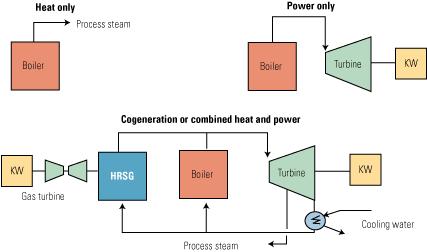
Unlike other parts of the world, where the norm is to site huge power plants away from population centers, Finland has adopted the strategy of maximizing plant energy efficiency by placing electric generators near cities and capturing the excess energy to provide building heat.
“Helsinki is quite cold, and in the wintertime we need to warm up the houses,” says Taneli Lampinen, an engineer for Helsingin Energia. “Since 1952, Helsinki has been using combined heat and power. It is now all over the city, with 92% of the heating being done by district heating.”
But although combined heat and power (CHP) is extremely efficient in the winter, when there is a demand for the waste heat, summers are a different story. To boost its year-round efficiency, Helsingin Energia has installed dual mode equipment at its Vuosaari Power Plant: In the winter, steam is used to heat homes and buildings, but in the summer that heat is used to drive a steam turbine generator. To boost efficiency even further, the company generates and stores heat overnight in the form of hot water, making it readily available for use during peak morning hours and making the turbines available for generating electricity during the day, when demand is higher.
“This combined power and heat production is the cornerstone of our operations, providing efficiency and environmental benefits as well as economic ones,” says Lampinen. “Our overall annual efficiency, depending on the weather and the price of electricity, averages 80%, but in 2009 it was close to 90%.”
This efficiency led the European Parliament in November 2008 to award Helsingin Energia with a European Regional Champion Award in the Energy Champion category, stating that “Helsingin Energia possesses unique capabilities and know-how, which make it the world leader in cogeneration and energy efficiency.”
A Long Tradition of Power Production
The first local power plant was built in 1884, and by 1900 there were 30 separate producers providing electricity, mainly for lighting. In 1907, the city built its own steam plant, and two years later all the independent producers were merged into the city utility. In 1957, with the opening of the coal-fired Salmisaari A plant, it also began offering district heating for buildings in the city.
Several other plants were added over the years, the most recent being the Vuosaari Plant, which began operations in 1991. Unlike the earlier facilities, Vuosaari was designed to run on natural gas from Russia. With this addition, the majority of the city’s power now comes from natural gas, and more than 90% of the buildings receive district heat. “It is also possible to run oil as a reserve fuel,” says Lampinen, “But we have a 10-year deal for the gas, so its prices don’t change as often as oil or coal prices.”
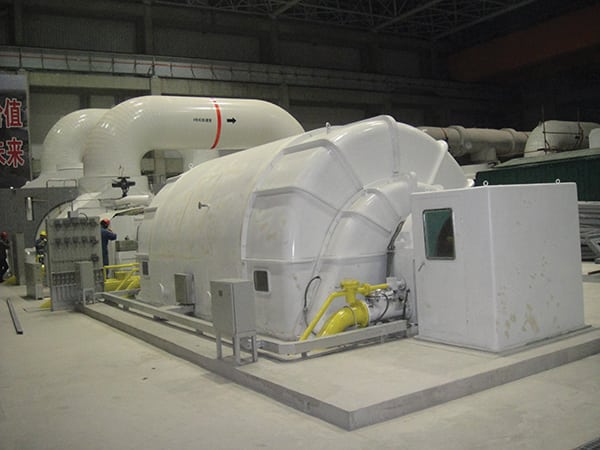
The Vuosaari plant is based on two combined-cycle units. Vuosaari A has two Siemens V64.3 gas turbines (now called SGT-1000F). Those units are ISO rated at 53 MW each, but in Helsinki’s cold winters, that rises to 63 MW each. The 500C flue gas boils water to drive a 40-MW single-cylinder backpressure extraction turbine from MAN-GHH coupled to an ABB generator, boosting the total electrical output to 165 MW. In the winter, the units also provide up to 162 MW of district heating. The system has a maximum design efficiency of 91% when used for CHP (Figure 5).
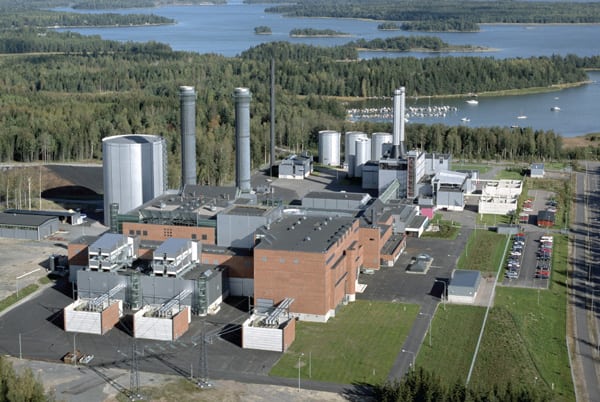 |
| 5. Flexible plant design. Helsingin Energia, the city utility of Helsinki, Finland, constructed its Vuosaari Power Plant to generate electricity plus thermal energy for space heating during the winter. During the summer, that same thermal energy is used to generate additional electricity with a steam turbine. Courtesy: SSS Clutch Company Inc. |
The second unit—Vuosaari B—went online in 1997, using the newer and much larger Siemens V94.3 gas turbines (now called SGT5-4000F), which are rated at 163 MW at an ambient temperature of 0C, and higher during winter. The exhaust goes to a Foster Wheeler Energia Oy boiler, which drives an ABB Stal steam turbine (145 MW backpressure steam turbine only, 172 MW backpressure and condensing turbines both operating) connected to a 200-MVA GEC Alstom generator.
In winter, the plant can operate at up to 92% efficiency when generating 470 MW and 400 MW(thermal) of district heat.
Simple Energy Storage
As part of its efficiency plan, the Vuosaari plant creates hot water overnight and stores it in a 25,000–cubic meter storage tank at close to 100C. Lampinen compares it to the way that natural gas pipeline operators pressurize a pipeline as a means of storing energy in pipes (Figure 6).
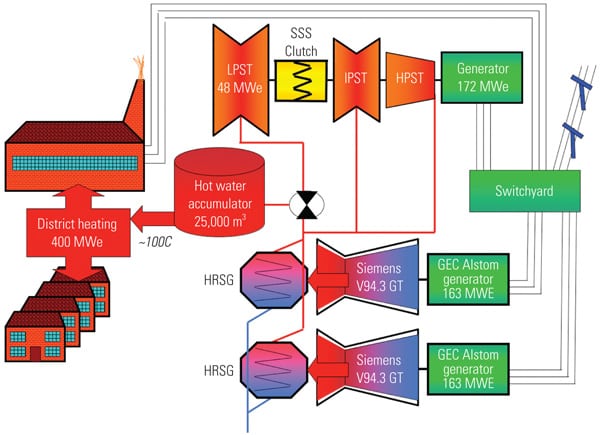 |
| 6. Efficient thermal storage. Thermal energy produced by the plant during the night can be stored as 100C hot water that’s ready for use in the morning. The overall energy usage at Vuosaari Power Plant is often above 90%. Source: SSS Clutch Company Inc. |
“If you have already pumped the gas into the pipeline from Russia to Helsinki, if there is a breakdown in the pumping equipment, you have several hours to repair it,” he says. “We have the same situation, where we have the heat already stored. It is like a battery: We can charge the district heat network at nighttime, so in the early morning hours it is available.”
He says that this arrangement works best in the spring and autumn. Summer months don’t require heating, and in the winter, heat is required around the clock.
Balancing Act
Although both the Vuosaari units are designed for greater than 90% efficiency, operating the plants requires balancing the factors of fuel prices, electrical demand, weather, and the prices of carbon credits. The electrical market was deregulated in June 1995 under the Energy Market Act, and sometimes it is cheaper to purchase power on the market than to generate it locally. At other times it is better to generate extra electricity to sell to the grid.
The Kyoto Protocol also has an impact. The Vuosaari plant operates on natural gas and so has lower carbon dioxide (CO2) emissions than Helsingin Energia’s coal-fired plants. The utility now generates 48% of its electricity with gas compared to 36% for coal. As a result, the average amount of CO2 emissions has dropped from 400 g/kWh in the Kyoto reference year of 1990 to 290 g/kWh currently.
Nevertheless, due to rising power demand, the utility still emits 20% more CO2 (4.1 metric tons) than it did in 1990 (3.4 mt). The utility does, therefore, have to factor in the carbon costs when making its generation decisions.
Finally, temperature plays a role. Because the Vuosaari plants achieve their efficiency through CHP, and heat is not needed in the summer, it may be more efficient to shut the plant down and just buy electricity from other sources.
Flexible Operations
To give plant operators the operating flexibility required, ABB-Stal Utility Division used a clutch from SSS Gears Ltd. for Vuosaari B. The SSS clutch is a freewheeling clutch. When the device connected to the output shaft of the clutch is moving faster than the input side, the clutch disengages. When you apply power to the input side, however, and its speed matches or exceeds the speed of the output side, then the clutch engages (Figure 7).
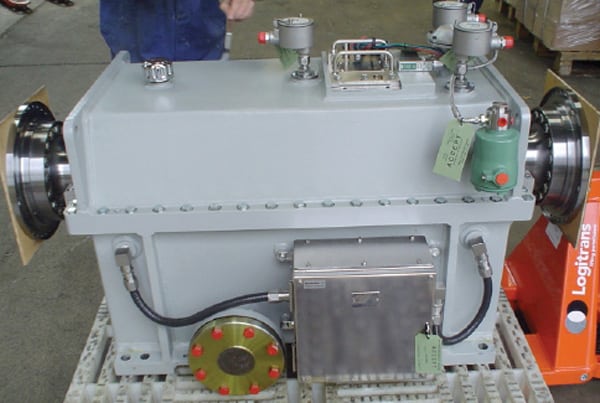 |
| 7. Clutch operation. A clutch installed between the low- and intermediate-pressure turbines allows the plant to disconnect the low-pressure turbine and use that steam to produce thermal energy for district heating. When more electricity is required, the steam used for heating is redirected to the low-pressure turbine. When the low-pressure turbine reaches driveline speed, the clutch engages, adding its horsepower to the driveline to produce an additional 48 MW. Courtesy: SSS Clutch Company Inc. |
The clutch was installed between the low- and intermediate-pressure turbines. When the demand for electricity is low at night, the steam can be redirected from the LP turbine and used to heat water, which is stored in a hot water accumulator for use when needed. As the steam is cut down, the clutch disengages the LP turbine from the HP/IP turbine. Then, when electricity demand rises, the steam is redirected to the LP turbine and the clutch reengages, bringing the 48-MW LP turbine back online. “The SSS clutch allows the turbine to operate as both a baseload and a peaking generator, while also providing district heating when needed,” says Lampinen.
—Contributed by SSS Clutch Co. Inc.