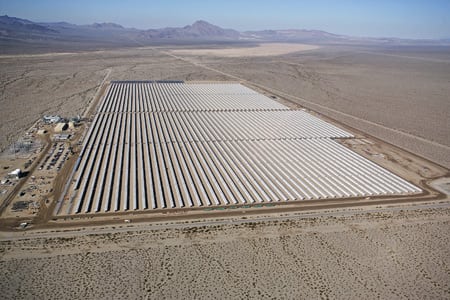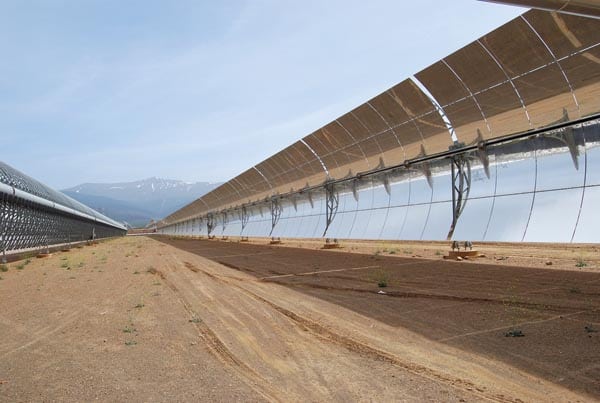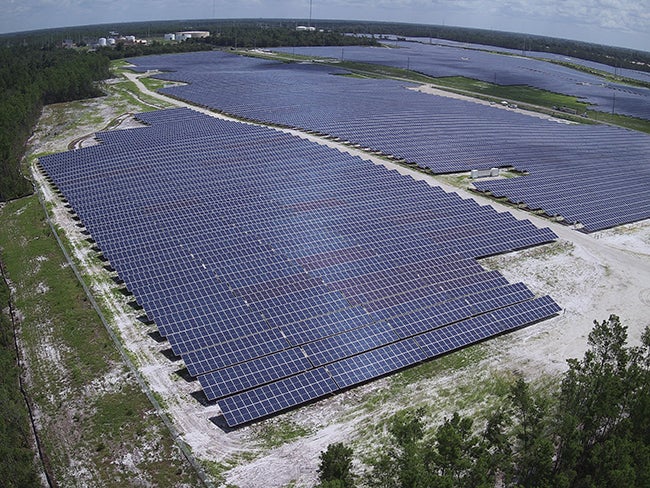
Solar energy projects over the past few years have been predominantly based on photovoltaic (PV) cells. But given enough land and flat plate collectors, just about any size plant could be constructed. Developers are still pushing the limits on PV plants, with the world’s largest PV-based plant now rated at 10 MW (see profile of the Bavaria Solarpark) and larger plants being actively considered. Perhaps the most well-known solar thermal projects are the Solar Electric Generating Systems (SEGS) III–VII plants built beginning in the mid-1980s and now owned by Kramer Junction Co. Each of the five 33-MW systems continues to operate reliably, selling its output to Southern California Edison.
Together, all of the SEGS plants (I–IX) have a capacity of about 354 MW. One unique aspect of the SEGS design is its ability to supplement generation to meet peak load demands by firing with natural gas during periods of low solar energy intensity. Since the SEGS installations, advances in parabolic trough solar technology and organic Rankine cycle (ORC) power technology have made small parabolic trough plants more economically feasible.
Desert developments
Arizona Public Service (APS) is an equally familiar name in solar energy development; the utility owns an extensive portfolio of over 5.6 MW of fixed, tracking, and concentrating PV systems across Arizona. The company’s interest in solar project development literally "comes with the territory"—among U.S. states, Arizona gets more than its fair share of sunshine. These projects all have helped APS develop a keen sense of which solar technologies provide the most bang for the buck. In fact, the APS STAR facility is a world-class solar research facility whose primary mission is understanding how these technologies perform in utility and customer applications.
The Saguaro Solar Power Plant (SSPP) was designed to solve a number of pressing problems for APS and others interested in developing solar energy. At the corporate level, the project will help satisfy some of APS’s obligation under the Arizona Environmental Portfolio Standard (EPS) to generate a portion of its electricity from solar resources. A corollary objective is to evaluate the cost and performance of concentrating solar power (CSP) and ORC technologies for use in future renewables projects. In addition, the U.S. DOE’s Solar Technology Program will use the site to help baseline the cost and performance of the current generation of parabolic trough technology and evaluate the design, installation, O&M, and performance of CSP designs (see box).
Concentrating solar power technologies
Solar thermal or concentrating solar power (CSP) plants have a marked resemblance to conventional steam plants. The obvious difference is the fuel source: A CSP system concentrates solar radiation to either heat an organic working fluid or to superheat steam, which then is expanded in a turbine-generator to produce electricity. In both cases, the working fluid is condensed after its expansion and returned to the collector to close the cycle.
Existing CSP plants use one of three alternative collector designs (Table 1). Parabolic troughs are used by the APS 1-MW demonstration plant described in this article. In the central receiver approach, large mirrors track the sun and concentrate solar energy on a central tower to heat a working fluid. A working fluid also is heated in the third approach, but by parabolic dish reflectors that concentrate solar energy at the focal point of the individual dish.
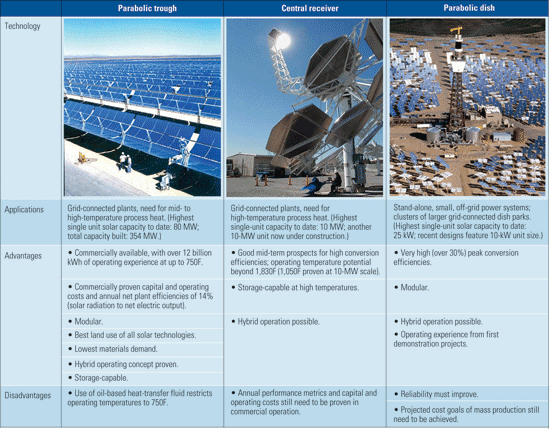
Table 1. Comparing solar thermal power technologies. Source: Concentrated Solar Thermal Power—Now! (Greenpeace International, European Solar Thermal Industry Association, and IEA/SolarPACES, 2005). Photos courtesy of National Renewable Energy Laboratory
Mix and match
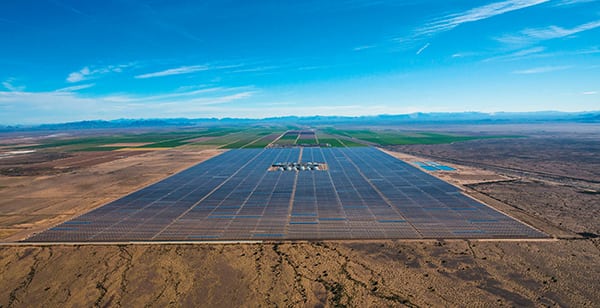
APS decided to competitively procure a 1-MWe parabolic trough plant with an organic Rankine bottoming cycle for installation at the company’s existing, gas-fired Saguaro Power Plant near Red Rock, Ariz., about 30 miles northwest of Tucson (Figure 1). The overall plant site occupies about 25 acres, with 13 devoted to the SSPP. The plant has 111,300 square feet of parabolic trough solar collectors that are designed to produce 2,000 MWh/yr; Table 2 summarizes other key specs. Using a four-step process (Figure 2), the plant’s power block—an Ormat Energy Converter (OEC)—generates 1.35 MW (gross) and 1.0 MW (net).
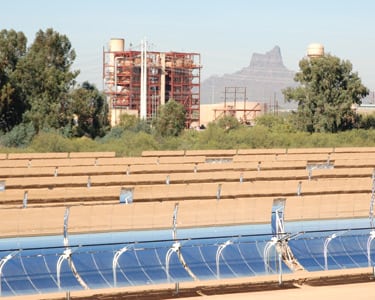
1. PV plus peaker. Arizona Public Service is operating a 1-MW concentrating solar power, organic Rankine cycle plant on a parcel adjacent to its Saguaro gas-fired power plant. Courtesy: Arizona Public Service

Table 2. Saguaro Solar Power Plant performance summary. Source: Arizona Public Service

2. Sunshine to megawatts. Flow diagram of the Saguaro Solar Power Plant system. Source: Arizona Public Service
In August 2002, APS chose Solargenix Energy Inc. (Raleigh, N.C.) and Ormat International (Reno, Nev.) to develop the plant. Solargenix did the system integration and provided the parabolic trough solar field; Ormat provided the ORC power plant. APS also partnered with Sandia National Laboratories (SNL) and the National Renewable Energy Laboratory (NREL)—as a team, known as SunLab—for technical support and to offer the project as a potential test bed for evaluation of parabolic trough technologies and thermal energy storage designs.
Get with the program
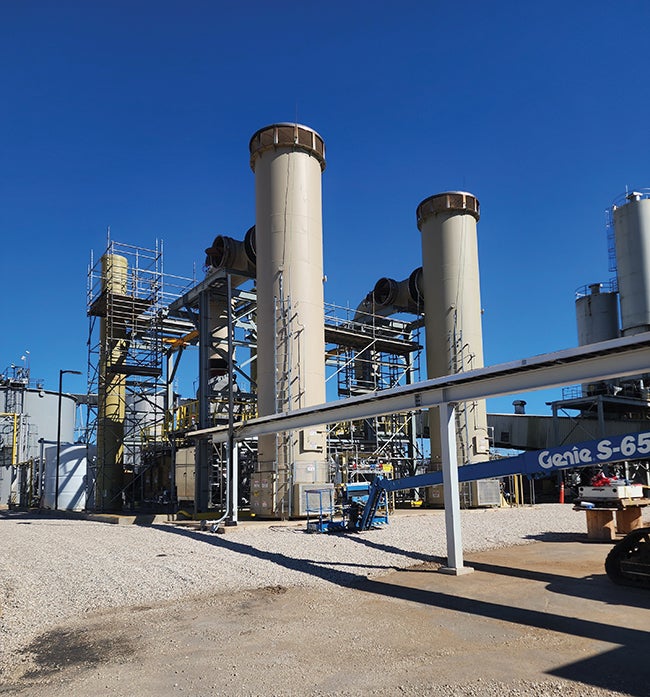
Solargenix was responsible for the plant start-up, with APS acting as a technical consultant. The plant had to be in service by December 31, 2005, for APS to take advantage of the solar production tax credit that expired the next day. Site work began in June 2004 with grading, the building of a security fence, and installation of a water line from the existing Saguaro power plant. Solargenix worked closely with APS to coordinate all construction activities for the SSPP project (Figures 3 and 4).
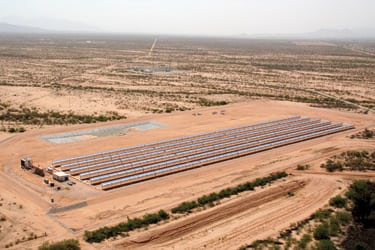
3. Perfect formation. The north end of the site contains the Ormat power block, cooling towers, and control building. Courtesy: Arizona Public Service
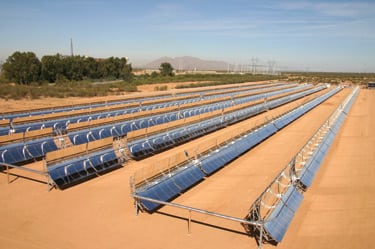
4. Collection agency. Solar collector loops are arranged in six rows (three loops) of collectors, each 1,300 feet long. Each loop consists of eight Solargenix solar collector assemblies. Courtesy: Arizona Public Service
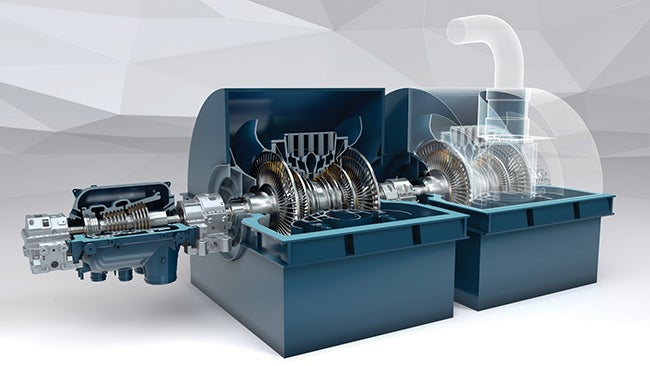
Foundation work began early in 2005 and was followed by installations of underground electrical infrastructure, the solar field, and the power plant. The site fabrication process was optimized for assembly and installation of the Solargenix solar collector assemblies (SCAs), pedestals, drive units, local controllers, mirrors, and the Schott heat collection elements (HCEs). Naturally, Ormat was responsible for the design and installation of the OEC (Figure 5), which was shipped to the site late last year. Electrical work (motor control centers), controls, the solar tracking system, and a new Maximo-based O&M tracking system also were completed in late 2005. APS and Solargenix just met the initial operation deadline of December 27, 2005.
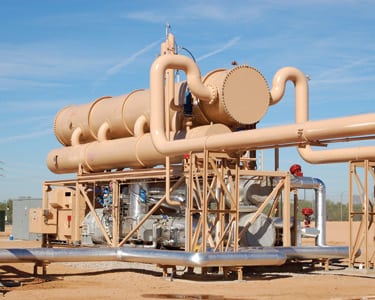
5. Packaged power. Ormat supplied the 1.3-MW organic Rankine cycle module. Courtesy: Arizona Public Service
Familiar features
The north end of the site contains the OEC power block, cooling towers, and control building. The Solargenix solar collector loops encompass the larger south end of the site, including six rows (three loops) of collectors, each 1,300 ft long and spanning 50 ft row to row. Each loop consists of eight SCAs, oriented north-south. The site allows for future solar field expansion to a total of six loops. The east side of the site includes a 1.5-acre evaporation pond.
The Ormat power plant is a fairly standard organic Rankine cycle adapted from geothermal applications. Its working fluid is n- pentane. An organic bottoming plant makes sense for a small plant like this, but for larger plants a steam bottoming cycle probably would be needed to achieve higher conversion efficiency. The Ormat OEC is a complete engineered system comprising a turbine, a preheater, a vaporizer/superheater, a recuperator, and a water-cooled condenser. The power block’s footprint is approximately 8 ft by 40 ft.
The OEC control cabinet houses the control system, which uses programmable logic controllers interfaced to local controllers at each of the SCAs. The main control system interface PC is located in the main Saguaro Plant remote control room. The control system, when started, automatically accelerates the turbine to synchronous speed (conditioned on solar field fluid supply) and then switches the generator to the mains. Once linked, the control system monitors and controls the operation of the generating unit.
The plant was designed to operate unattended, to minimize O&M costs. During the design phase, generating efficiency was sacrificed to achieve those goals. The plant operates in very straightforward fashion. In the morning, it starts up as the sun rises. The solar field’s heat-transfer fluid (HTF) is circulated in bypass mode until it reaches a minimum temperature (currently, about 300F); simultaneously, the OEC goes into its start-up and warm-up phases. Once threshold temperatures are met, valves modulate to send the HTF to the OEC.
From this point forward, the power block’s output is a function of solar insolation and HTF temperature. The OEC then is operated until several operating parameters fall below certain thresholds—for example, as a result of the sky becoming cloudy. At that point, operation of the solar field returns to bypass mode, with the HTF either rising to the operating-temperature window or cooling for standby or shutdown conditions. The system automatically shuts down just before sundown each day.
Chasing the sun
Each SCA is an independently tracking assembly of parabolic trough solar collectors. Every collector includes parabolic reflectors (mirrors), a metal support structure or space frame assembly, a receiver tube, and a tracking system. In contrast to the LS-2 and LS-3 designs used at the SEGS plants, each SCA has a 16.4-ft aperture (like the LS-2) but is 328 ft long (like the LS-3). The mirrors are identical to those used on the LS-2 (Figure 6)

6. Capturing the sun. An organic fluid is heated by solar energy concentrated by the Solargenix solar collector assembly. Courtesy: Arizona Public Service
Eight SCAs are pieced together to form each solar collector loop. The ends of the three loops in the solar field are attached to cold and hot HTF headers, which are routed along one side of the solar field to and from the OEC power block. The SCAs rotate around the horizontal north/south axis to track the sun as it moves across the sky over the course of a day. The axis of rotation is located at the collector’s center of mass to minimize required tracking power. The drive system uses hydraulic rams to position the collector. A closed-loop tracking system relies on a sun sensor for the precise alignment required to focus the sun on the HCE with a precision of +/- 0.1 degrees.
Tracking is controlled by a local controller on each SCA. The local controller also monitors the HTF temperature and reports operational status, alarms, and diagnostics to the main solar field control computer in the control room. The SCA is designed to operate normally in winds of up to 25 mph and with somewhat reduced accuracy in winds of up to 35 mph. The SCA modules can withstand 70-mph winds in stowed position.
The SCAs start to absorb heat once the sun has risen 10 degrees above the horizon. The rate of HTF flow at the main Solargenix header is 235 gpm, at a design operating temperature of 550F and a maximum of 600F. The temperature of the HTF changes during the day with the intensity of solar insolation. Because the site’s minimum ambient temperature of about 50F is higher than the minimum allowable working temperature of the HTF, there is no danger of HTF freezing in the collectors.
The future of concentrating solar power plants under construction in Nevada
This February in Boulder City, Nevada, construction began on the 64-MW Solar One thermal plant (Figure 7), expected to be the third-largest solar power plant in the world when it begins production in March 2007. Like the Saguaro Solar Power Plant, the Solar One project uses Schott PTR 70 solar receivers, but it differs in how it converts thermal energy to electricity.
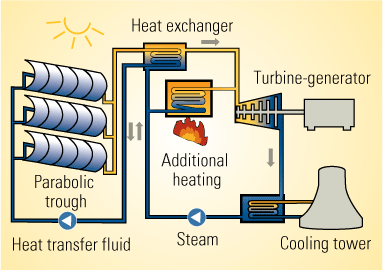
7. Advanced design. Flow diagram of the Nevada Solar One Project. Source: Solargenix
Solar One will use solar concentrators to heat a thermal transfer fluid to over 750F and then use that hot fluid to superheat steam for driving a conventional steam turbine. In this respect, the Solar One project is more similar to Kramer Junction Co.’s Solar Electric Generating Systems (SEGS) projects than to the Saguaro plant. A key difference is that improvements in plant design since the 1980s have reduced the natural gas requirements for the Solar One project to only 2% of capacity, compared with the maximum of 25% at SEGS.
One of the remarkable features of the Solar One design is that the plant’s steam side is virtually identical to that of a standard fossil-fueled power plant. "Except for the troughs, everything else is a standard natural gas plant," explained Scott Sklar, president of The Stella Group Ltd., a distributed-energy strategic marketing and policy firm based in Washington, D.C. "That’s what Solargenix has always maintained: You’re really buying a natural gas power block with solar attached. If you’re worried about risk, consider that the SEGS plants have been up and running for about 20 years and have operated nearly flawlessly."
Indeed, reliability—and what people are willing to pay for it—is a whole new ballgame. "There are fundamental differences between today’s electricity marketplace and the market of 15 years ago," said Rhone Resch, executive director of the Solar Energy Industries Association and a veteran of the natural gas industry. "Today, natural gas and peak power are incredibly expensive. As a result, utilities are scrambling to find generation sources that they can depend on for help in handling peak demand, and plants like Solar One exemplify what they’re looking for. The beautiful thing about the project is that it offers firm, dispatchable peak power."
The Solar One project is being designed and led by Raleigh-based Solargenix Energy Inc. Spain’s renewable energy giant— Acciona Group—which owns 55% of the commercial power plant division of the company. The project will use 19,300 carefully arranged troughs (Figure 8) to collect the endless supply of solar energy available in the Nevada desert. Solargenix puts the capital cost of Solar One in the range of $220 million to $250 million and estimates that busbar costs will be somewhere between 9 cents and 13 cents/kWh. Solar One’s production is already committed to Nevada Power Co. and Sierra Pacific Power Co. The plant is expected to begin operation in March 2007.
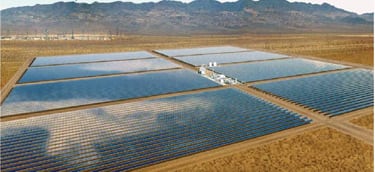
8. First in Nevada. Artist’s rendering of the Nevada Solar One Project now under construction. Courtesy: Solargenix
Lessons learned
The Saguaro Solar Power Plant was funded by APS customers using money from the environmental porttfolio standard. APS’s cost to build was 7% to 15% more—on a per-kW basis—than the large, tracking, "pure" PV plants that APS has deployed in the past. Much of the additional cost was eaten up by auxiliaries associated with the trough plant—namely, the evaporation pond, cooling tower, site development, and flood control. Obviously, the per-kW cost would be much lower if the plant were made larger. Indeed, it appears that a plant of this type with a capacity of 5 MW or more would be cost-competitive with next-generation solar thermal systems now under construction (see box).
Another lesson that APS learned was that wet cooling significantly improved power-cycle efficiency during the Tucson summer. Cost was a huge driver of the cooling water system design. A dry system would have cost about $400,000 more than the wet one, including the evaporation pond. The former approach also would have necessitated much more O&M. Finally, a performance penalty was caused by a lack of cooling capacity as well as the parasitic losses incurred by the use of more fans. APS would have considered hybrid cooling system for a larger plant.