Siemens ships first blade from U.S. plant
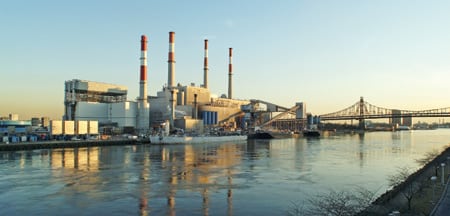
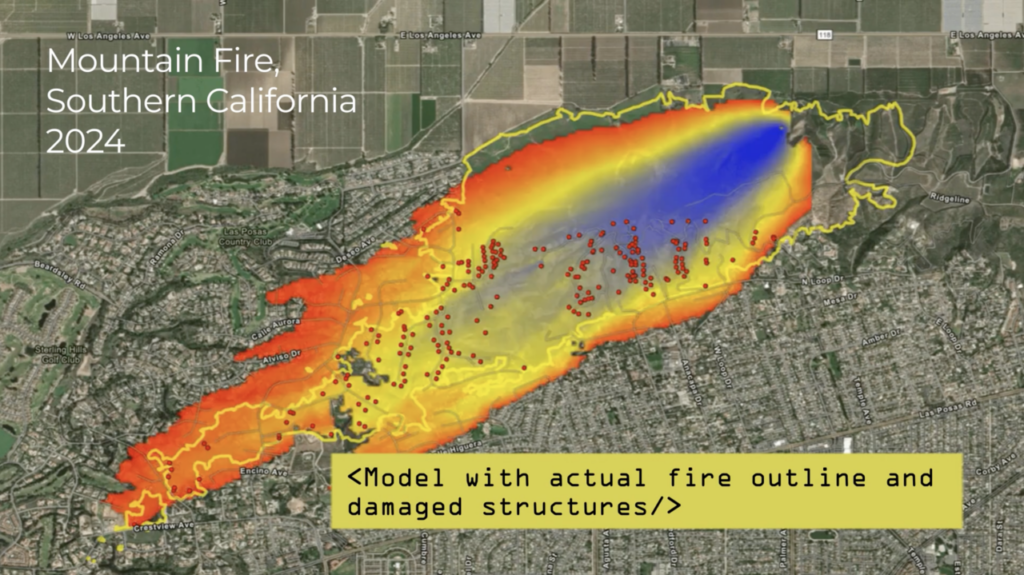
This August, the new Siemens wind turbine blade factory in Fort Madison, Iowa, shipped its first blades, bound for the Sweetwater Wind Farm west of Abilene, Texas. Each blade (Figure 1), cast in one piece in a single step from glass fiber–reinforced epoxy resin, is 148 feet long and weighs about 12 tons.
1. Blade runner. This huge wind turbine blade was the first to ship from the new Siemens blade factory in Iowa. Courtesy: Siemens Power Generation
Owned by Catamount Energy and the Australian investment banking firm Babcock & Brown, the Sweetwater project will see its generating capacity grow to 505 MW when it completes its final phase this December. Siemens will contribute 80 MW to this phase by supplying 45 of its SWT-2.3-93 wind turbine-generators, each rated at 2.3 MW.
“By expanding our wind turbine blade manufacturing capacity in the U.S.,” said Randy Zwirn, CEO of Siemens Power Generation Inc., “we are able to play a more significant role in helping the U.S. meet its growing electricity demand with clean wind energy and zero carbon emissions. [That demand] is expected to triple by 2020.”
Within the past three years, Siemens, based in Germany, has opened new manufacturing plants in Denmark and Iowa and expanded two existing factories in Denmark. Siemens said it expected to be employing 400 people in its U.S. wind business by the end of September 2007.
The U.S. Department of Energy says its goal is for the U.S. to get 6% of its electricity from wind by 2020. That’s an ambitious target, according to many industry sources. Wind, said Siemens’s Zwirn, "is a viable, cost-competitive source of renewable energy that will continue to have an important role in the overall energy mix, alongside conventional power generation sources."
Wind power critics, such as veteran energy analyst Glenn Schleede, note that its competitiveness is entirely due to federal and state subsidies, the largest of which is the federal production tax credit of 1.9 cents/kWh. Countering the effect of that credit, recent supply chain problems have slowed the boom in wind power. Schleede recently circulated a report that Clipper Windpower, a partner with BP in wind development in the U.S., saw its stock drop in London trading because of component problems.
Reuters reported that tests at Clipper’s turbine factory in Cedar Rapids, Iowa, found a fault in the drive train of the company’s 2.5-MW turbine. Clipper said it faced a loss in the first half of the year because it was "constrained" in obtaining externally sourced parts.
In other Siemens news, the company said that a consortium that it heads has won an order to build a two-unit, 800-MW combined-cycle gas-fired power plant in Singapore. As part of the deal, the partners will convert two existing combined-cycle plants to cogeneration service.
According to Siemens, the total value of the deal, including a 10-year service agreement, is $717 million. The Siemens portion of the deal, which includes a Singapore state-owned investment company, is $517 million. The new plant is scheduled to come on-line in early 2010.
GE’s frames hit 1,000
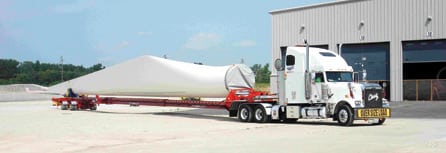
Also in August, General Electric sent out its 1,000th F-class gas turbine, to Saudi Electricity Co. for its Riyadh Power Plant No. 8 project. John Krenicki, CEO of GE Energy, said, "Since its introduction in 1987, our F-technology [turbine] [Figure 2] has made a major impact both on the power generation industry and General Electric Co. Over those 20 years, activities associated with all aspects of our F-technology, including sales and services, have produced in excess of $30 billion for the company."

2. "F" makes the grade. GE’s F-class turbine has racked up 1,000 sales, making it the best-selling combustion turbine-generator technology in the world market. Saudi Arabia’s national electric utility bought No. 1,000. Courtesy: GE Energy
GE says that since December 2006 it has pocketed $3.6 billion in revenue from gas turbine–based projects. Of those projects’ 77 turbines, 45 are F-class.
Krenicki said the sale of the 7FA gas turbine to the Saudis represents a "surge in new power plant activity in the Middle East, one of the most important growth areas for GE Energy in the world today. The need for additional supply in the region is driving strong demand for power plant equipment and services, as evidenced by the recent commitments our business has received."
The Frame 7FA delivered to the Saudis is one of four to be shipped to Riyadh. GE says its F-class turbines operate in 45 countries and have racked up more than 20 million operating hours. Numbers like those, says GE, make the company the "global leader in advanced gas turbine operating experience."
GE introduced F-series combustion turbine technology in 1987. According to industry data, the company’s 7F is the most reliable F-class machine in the industry, with a 99.1% reliability ranking. GE claims its Frame 9FB machine has achieved an efficiency of 58% in a combined-cycle configuration.
Of the F-class machines that GE has shipped, about 875 have come from the company’s plant in Greenville, S.C. Many of the remaining 125 units were built at the company’s factory in Belfort, France.
Battery problems hit hybrid EV programs
Hybrid gas-electric cars may have hit a technical wall. This summer, Toyota Motor Corp. announced a delay in its next generation of hybrid vehicles, to be based on lithium-ion battery technology. Toyota said it was experiencing serious problems with the batteries.
Just days later, Tesla Motors, the developer of the highly hyped, high-speed Tesla all-electric roadster (Figure 3), sacked its CEO/founder and announced it was delaying the rollout of the sexy, $100,000 sports car. The Tesla speedster also is designed to run on lithium-ion batteries similar to those in your laptop and Blackberry.
The Tesla allegedly can zip from zero to 60 mph in four seconds, do 135 mph, and go 200 miles on a charge. It is said to be powered by hundreds of the lithium-ion batteries. The car is based on a Lotus platform from the UK. But a production version has yet to appear.
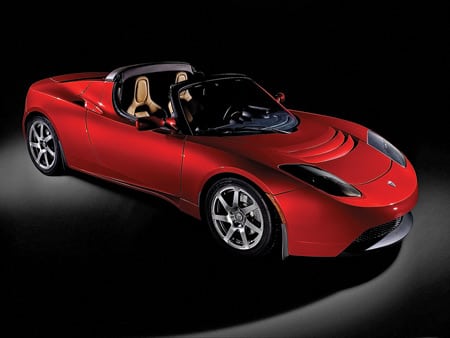
3. Not ready for prime time. Hybrid car makers are experiencing big problems with lithium-ion batteries. Tesla Motors, whose planned all-electric roadster is shown here, has announced a delay in its roll-out plans that many believe is linked to battery problems. Courtesy: Tesla Motors
Toyota, reported The Wall Street Journal, has pulled the plug on its lithium-ion hybrids for at least a couple of years. A Toyota executive told the Journal’s Norihiko Shirouzu, "It’s going to be a long drought and we don’t look forward to it."
The now well-known problem with lithium-ion batteries is their propensity to burst into flames. A year ago, Dell and Apple, which use the batteries in their laptops, had to recall many units on the heels of reports of fires, including one caught on video that was widely seen on the Internet. Sony Corp. also has reported problems with the lithium-ion batteries used in its laptops.
Toyota had hoped to roll out a new generation of hybrids based on the new technology, replacing the nickel-metal-hydride battery technology in use since the Prius made its debut in Japan in 1997. Toyota said it will sell over 200,000 Prius hybrids in the U.S. this year. But it now appears doubtful the company will meet its goal of 600,000 sales in America by 2010.
Batteries are crucial to the future of tomorrow’s "plug-in" hybrids, which will use more of them, for recharging by standard AC outlets during off-peak demand periods. According to industry experts, existing battery technology isn’t sufficient to realize the promise of the plug-ins, which need much greater power density. The electric utility industry also is pushing plug-ins because recharging them will boost off-peak power sales.
Meanwhile, Tesla appears in turmoil. Martin Eberhard, founder and CEO of the Southern California startup, has been demoted to "president of technology." Major investor and chairman Elon Musk now appears to be in charge.
The Tesla roadster, sold in advance to a list of Hollywood green celebrities (reportedly including actors Ed Norton and George Clooney, comedian Jay Leno, and California governor Arnold Schwarzenegger) at $100,000 a pop, now won’t appear in commercial version until later this fall—if at all.
The company hasn’t said much about the delay. The web site of Edmunds Automotive reported that Eberhard told a group of auto journalists that the delay was the result of a change in transmission suppliers.
The respected UK science blog, The Register, suggested that the Tesla roadster’s real problem is its Li-ion battery pack. "Its main snag," said the entry by auto writer Lewis Page, "assuming it achieves the projected specs, is that [the batteries] will take hours to recharge . . . seriously [limiting the car’s] usability." Page made no mention of the batteries’ flammability.
In a mid-August letter to the folks who have anted up $100,000 to claim one of the vehicles, Eberhard said he hopes to have the cars in production "by the end of next month." He added, "We have a good chance of meeting this goal, but to be fully transparent, I want you to know that while it is within our reach, it is not yet fully within our grasp." By the end of September, the cars were not yet in production.
Solar thermal rebounds in California
Solar thermal generation is heating up in California, with two firms announcing in-state projects that will use the sun to boil water, creating steam for a turbine-generator. The Golden State already has nine solar stations totaling 354 MW, developed by bankrupt Luz International between 1984 and 1991, that are still on-line.
Last month, the successor to Luz, BrightSource Energy, filed an application with the California Energy Commission to build a 400-MW solar power field in the Mojave Desert. BrightSource’s chairman is Arnold Goldman, the founder of Luz International.
The plan is for the company to build three separate solar power tower and collector fields, two rated at 100 MW and the third at 200 MW. The proposed site, known as Ivanpah (Figure 4), is about five miles southwest of Primm, Nevada, on the California border. BrightSource CEO John Woolard said the company is negotiating with California utilities for the purchase of the plants’ output. Charlie Ricker, a BrightSource vice president, told the San Jose Mercury News that the plant could be operational by 2010. The company is building a pilot project in Israel.
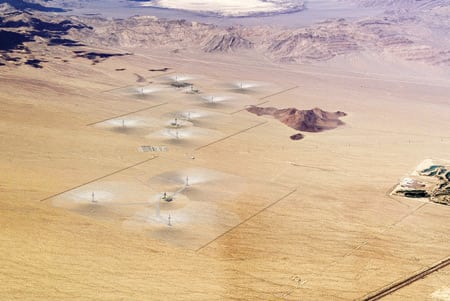
4. Luz redux. An artist’s rendering of the layout of BrightSource Energy’s planned solar thermal project in California’s Mojave desert. The firm is the successor to Luz International, which built more than 300 MW of solar thermal capacity in the Mojave before going bankrupt in the early 1990s. Those projects still generate power. Courtesy: BrightSource Energy
According to the Mercury News, BrightSource landed $30 million in venture capital in the second quarter of this year. Among the investors, said the newspaper, is VantagePoint Venture Partners, one of the venture capital investors in Tesla Motors, the electric sports car developer.
Separately, Ausra Inc., a solar thermal developer based in Palo Alto, Calif., with operations in Australia, announced in September that it has received $40 million in venture capital from Khosla Ventures and Kleiner, Perkins, Caufield & Byers. According to C/Net, an online news service, Ausra is planning to file for a permit to build a 175-MW solar thermal plant in the Mojave. Ausra was formed in late 2006.
Ausra uses Fresnel lenses to concentrate sunlight on water-filled tubes (Figure 5). David Mills, while at Sydney University, conceived the technology and developed it between 1995 and 2001, according to an Ausra press release. Mills is known for academic advances in non-imaging optics and solar thermal energy.
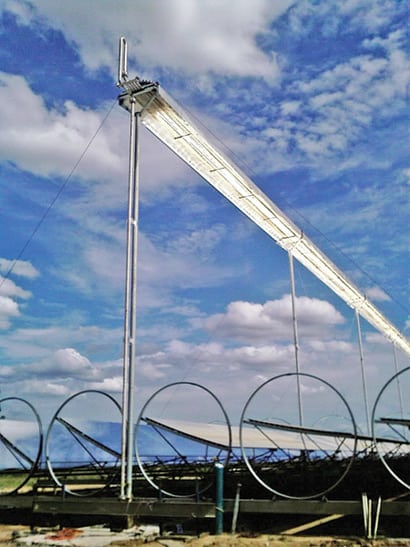
5. Luz successor gets a competitor. Ausra Inc. of Palo Alto, Calif., has landed a big chunk of venture capital for a Fresnel-lens solar thermal project in the California desert. The structures shown are part of a 40-MW project using the company’s technology in New South Wales, Australia. Courtesy: Ausra Inc.
Peabody’s Illinois coal plant gets green light
A federal appeals court in late August upheld the air permit for Peabody Energy’s $2.9 billion, 1,600-MW supercritical Prairie State coal-fired plant southeast of St. Louis.
The Sierra Club had challenged the Illinois Environmental Protection Agency’s approval of the permit for the mine-mouth plant. The environmental group argued that use of "best available control technology" (BACT) would require the plant to burn western low-sulfur coal, rather than high-sulfur Illinois coal. A three-judge panel of the 7th Circuit U.S. Court of Appeals in Chicago disagreed.
Writing for a unanimous court, Judge Richard Posner found that while the federal Clean Air Act does make "clean fuels" a control method, there is a common-sense limit to the act’s implementation. He wrote that "nuclear fuel is clean, and so the implication, one might think, is that the agency could order Prairie State to redesign its plant as a nuclear plant rather than a coal-fired one, or could order it to explore the possibility of damming the Mississippi to generate hydroelectric power, or to replace coal-fired boilers with wind turbines. That approach would invite a litigation strategy that would make seeking a permit for a new power plant a Sisyphean labor, for there would always be one more option to consider."
Posner observed, "The project that must be addressed when evaluating BACT is the project for which an application has been submitted, i.e., a proposed mine-mouth power plant. . . . Accordingly, the use of a particular coal supply is an inherent aspect of the proposed project." Posner was joined in the opinion by judges Michael Kanne and Ann Claire Williams.
Bruce Niles, director of the Sierra Club’s National Coal Campaign, told Gatehouse News Service, "Most of the large power plants in Illinois have switched to Western coal." He also criticized the state’s EPA, which implements the federal law, for not considering CO2 emissions from the plant, although the U.S. EPA has not issued rules for their reduction.
Niles said his group has not decided whether to appeal the decision, either in the 7th Circuit or the U.S. Supreme Court.
In a press release, St. Louis–based Peabody Energy noted, "The decision caps an extensive six-year regulatory review process that includes approval by the Illinois Environmental Protection Agency and the U.S. Environmental Protection Agency." Peabody intends to market the power produced through municipal joint-action agencies that are equity partners in the project. Raj Rao, CEO of Indiana Municipal Power Agency, said, "Prairie State will achieve high efficiencies and low emissions that are far superior to America’s current generating fleet, benefiting more than 1.7 million Midwest families."
Peabody said groundbreaking is likely this fall (Figure 6). Bechtel Power Corp. is the lead contractor and is overseeing site preparatory work. Prairie State has already ordered Babcock & Wilcox boilers, Toshiba turbines, and emission control equipment from Siemens Power Generation. Unit 1 is expected to come on-line in 2011, with Unit 2 following the next year.
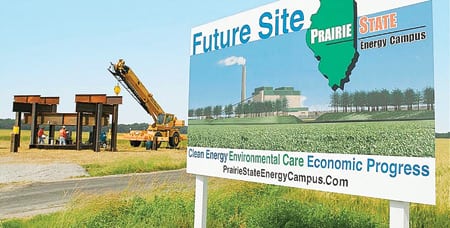
6. Building on the prairie. Peabody Energy expects to break ground soon on a 1,600-MW supercritical coal-fired plant southeast of St. Louis. This August, a federal appeals court upheld the plant’s air permit, rejecting objections by the local Sierra Club that the mine-mouth plant should have considered using Powder River Basin coal instead of local high-sulfur coal. Courtesy: Peabody Energy
EPA could sink 278-MW CFB unit
The U.S. Environmental Protection Agency may have thrown a regulatory monkey-wrench into plans by East Kentucky Power Cooperative (EKPC) to add a fourth, 278-MW unit to its coal-fired Spurlock Power Station (Figure 7) in Maysville. EKPC supplies power to 16 distribution cooperatives with 1 million customers.
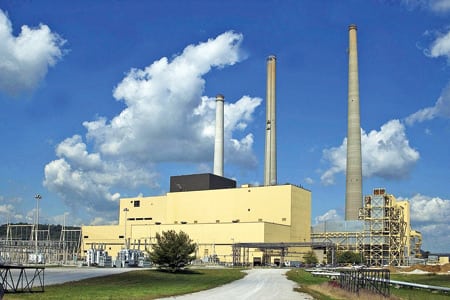
7. Endangered CFB. East Kentucky Power Cooperative’s plans for a fourth, 278-MW unit at its Spurlock Power Station, shown here, are now in jeopardy. The U.S. EPA and a Kentucky court say the utility must show why the proposed circulating fluidized-bed unit can’t burn low-sulfur Powder River Basin coal. Courtesy: East Kentucky Power Cooperative
EPA Administrator Stephen Johnson sided with the Sierra Club in an appeal of the decision by the Kentucky Division of Air Quality to give an air permit to the proposed circulating fluidized-bed (CFB) unit. A similar CFB unit went into service at Spurlock in 2005. Spurlock Unit 1 (325 MW) and Unit 2 (525 MW) are conventional, pulverized coal–fired baseload plants.
The EPA upheld the complaint by the environmentalists, concluding that state air-quality regulators and EKPC must show more definitively that low-sulfur coal isn’t feasible for the new unit. The ruling said the state and the utility must explain why the plant can’t burn Powder River Basin or eastern low-sulfur coal. CFB units have the ability to burn diverse fuels. EKPC says it is experimenting with burning tires in the earlier CFB unit, Unit 3.
EKPC spokesman Nick Comer told reporters that the air permit remains valid and that the ruling "does not affect the construction schedule or the design of Spurlock 4, and we are proceeding." The co-op says the unit is scheduled to enter service in 2008.
The EPA ruling came on the heels of an August 6 Kentucky state court ruling rejecting the air permit for the 1,600-MW Thoroughbred plant that Peabody has proposed building in Muhlenberg County. According to the Louisville Courier-Journal, in court filings seeking an expedited review attorneys for the state said the Thoroughbred ruling jeopardizes both the Spurlock project and Louisville Gas and Electric’s 750-MW expansion of its Trimble County generating station.
Attorneys for the Kentucky Environmental and Public Protection Cabinet wrote, "The ruling of the circuit court places the future of those operations and the corresponding electricity they will provide in question." The court, they argued, created "an uncertainty that is disruptive" and jeopardizes "the mining of coal, which is an essential element of the economy of Kentucky and therefore raises an issue of public concern."
Longest-serving NRC commissioner dies at 58
Edward McGaffigan Jr., the longest-serving member of the U.S. Nuclear Regulatory Commission in history, died Sept. 2 in Arlington, Va., of complications from metastatic melanoma cancer. He was 58.
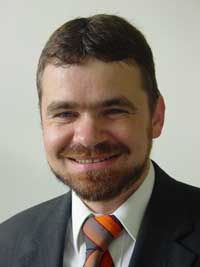
McGaffigan (Figure 8), a Democrat, served on the NRC from 1996 until this year. He was widely viewed as nonideological and intensely intellectually honest. His service on the NRC won praise from both the nuclear power industry and antinuclear organizations that he often opposed.
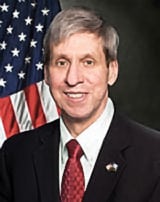
8. NRC’s McGaffigan dies at 58. Edward McGaffigan, who served 11 years on the U.S. Nuclear Regulatory Commission, succumbed to cancer last month. Courtesy: Nuclear Regulatory Commission
Last January, facing incurable cancer, McGaffigan announced that he would step down at the NRC, pending nomination and confirmation of a successor. But he changed his mind in the spring, as the result of chemotherapy success, and notified the White House that he intended to continue his service on the NRC.
Though McGaffigan, a Boston native and a physicist, was a protégé of Senate Energy Committee Chairman Jeff Bingaman (D-N.M.), he long proclaimed that he was a John F. Kennedy Democrat. He was the son of a Boston laborer and the first of his family to graduate from college, receiving a bachelor’s degree from Harvard in 1970. He earned master’s degrees in physics from Cal Tech in 1974 and from Harvard in public policy in 1976.
McGaffigan joined the Arms Control and Disarmament Agency in 1975 and the U.S. Foreign Service in 1976. He worked on arms control and energy policy related to the Soviet Union from the U.S. embassy in Moscow in 1978. He emerged from that stint a determined opponent of the Soviet Union and its ideology and worldwide policies.
From 1981 to 1983, during the Reagan administration, McGaffigan worked at the White House Office of Science and Technology Policy. He then joined Bingaman’s staff on the Senate Armed Services Committee.
Responding to McGaffigan’s death, Bingaman said, "Ed McGaffigan was a man of great intellect and vision. He understood policy and politics, which made him an extraordinary public servant. Ed made a great contribution to me in my efforts in the Senate during the time he worked with me. He was universally respected and admired for his ability and integrity. I have lost a great friend and trusted counselor."
President Clinton appointed McGaffigan to the NRC in 1996 and renewed the appointment in 2000. President Bush renominated McGaffigan to another five-year NRC term in 2005. Congress did not act on the nomination prior to his death.
McGaffigan was a dedicated runner, completing six Marine Corps marathons. According to his obituary in the Washington Post, he ran a half-marathon a few months before his death.
A strong supporter of nuclear power, McGaffigan was no pushover to the nuclear industry or its foes. When antinuclear forces began attacking nuclear plants’ vulnerability to terrorist assaults by air in the wake of 9/11, McGaffigan called the notion of absolute protection bogus. "When they change the law to require absolute assurance of perfect protection," he said, "there won’t be a lot of nuclear reactors in this country. Also, there won’t be a lot of cars or McDonald’s."
Yet McGaffigan also was a major critic of the U.S. Department of Energy and the nuclear industry’s push to make Yucca Mountain in Nevada the nation’s high-level nuclear waste dump. The project, established by the 1982 Nuclear Waste Policy Act, has been stalled for more than two decades. McGaffigan told the Las Vegas Review-Journal, “It may be time to stop digging, and may be time to rethink. I think Yucca Mountain has been beset by bad law, bad regulatory policy, bad science, bad personnel policy, [and] bad budget policy, throughout its history.”
Danielle Brian of the Project on Government Oversight, which often warred with the NRC and McGaffigan on power plant security issues, said, "Ed McGaffigan exhibited a quality that is sadly waning in Washington—a total commitment to public service without any interest in parlaying his time in government into personal profit."
Brian added, "You could be sure that if Ed took a position—even if you disagreed with him—you knew that he took that position because he really believed it was for the good of the public, and not because it was politically expedient or [because] he was hoping to curry favor with a future employer. He gave a damn."
McGaffigan’s death leaves two vacancies on the five-member NRC. Republican Jeff Merrifield left the commission earlier this year.
POWER digest
News items of interest to power industry professionals.
FERC staff scopes out DR. In a report issued last month, the staff of the Federal Energy Regulatory Commission found that utility demand response (DR) programs are growing, and making a dent in electricity use during periods of peak usage. The report estimated that in 2006 DR programs lowered electricity consumption between 1.4% and 4.1% during those times. The agency did not assess the statistical significance of those energy reductions.
The Energy Policy Act of 2005 mandated that FERC annually assess the impact of DR programs and advanced metering. FERC staff found these trends in its 2007 report:
- Increased utility participation in DR programs.
- More participation by organized (RTO/ISO) markets.
- More attention to smart-grid applications.
- More interest in projects on the part of states and the federal government.
- More interest by third parties in aggregating DR savings.
Commissioner Jon Wellinghof, FERC’s lead on DR programs, said, "The findings of the staff report signal that there has been a change in the national demand response dialogue from ‘should we do it?’ to ‘how do we do it?’ This report should provide real value to regulators, policymakers, utilities, and consumers in this rapidly growing and ever-important electric resource sector."
A new source of nuclear fuel? Toronto-based Mega Uranium Ltd. says its prospecting in Argentina’s Patagonia region in Chubut Province has had "encouraging results." In 1978, the Argentina Atomic Energy Commission, using airborne radiometry, originally detected the presence of uranium there.
Mega says a program of "geological mapping and reconnaissance rock chip sampling of the Guanaco prospect area" found two levels of uranium mineralization at the top and base of a Quaternary terrace 3 to 5 meters thick. The upper level is only about 5 to 10 centimeters below the surface. Sampling of the layer returned values on the order of 100 to 200 ppm of U3O8, the oxide form of uranium that is most common in nature. The second layer was found to contain uranium oxide at a concentration of about 500 ppm.
In the second phase of the work, said Mega, the company excavated 25 trenches to demonstrate "that the two mineralized layers maintain their continuity, thickness, and radioactivity over a 5-km by 1.7-km area. Mega said it is awaiting assay results for 72 samples collected from those trenches.
Alstom inks significant deals. The Paris-based industrial giant (www.alstom.com) has landed major contracts in the United Arab Emirates, the UK, and China. Together, the deals are worth $3.6 billion, with Alstom’s share amounting to about $2.8 billion.
As part of a consortium, Alstom will supply the UAE with a 2,000-MW power plant and a 130-million gal/day desalination plant. Both will be sited in Qidfa and built around Alstom’s GT26 gas turbine. Alstom says its share of that project is worth $1.6 billion.
In the UK, Alstom says RWE’s npower is building a 1,650-MW turnkey combined-cycle plant at Staythorpe in central England that will cost $904 million. It, too, will use the GT26. Alstom will build the plant, supply its main generating equipment, and provide spare parts under a long-term agreement.
In China, the Alstom order, worth $188 million, is from the industrial group Dong Fang for four 1,000-MW steam turbine-generators for a conventional power island in a new nuclear plant to be built in northern China. Alstom’s dealings with the Chinese nuclear industry date back to the construction of Daya Bay 20 years ago. It was the first large-scale Chinese nuke and the first in the country to use French technology.