Stretching meager maintenance dollars is a way of life for most maintenance staff. In past years, the cost of an infrared (IR) camera usually came down to a choice between a low-resolution 160 x 120-pixel camera or no camera at all. If the camera was chosen, it usually became clear before long that low resolution can mean missing some details when performing thermography.
If you’re fortunate enough to have the budget for an IR camera this year, you’ll be pleased to learn that IR cameras’ prices have dropped like those of most electronic devices. Now you can choose between high and low resolution. For example, with sticker prices starting at $25,000, professional high-resolution 320 x 240-pixel cameras used to be too costly for anyone but full-time thermographers. That has changed with the introduction of cameras costing less than $15,000 with a high-performance, 320 x 240-pixel microbolometer detector.
With choices come questions. Now inquiring minds want to know: Why is higher resolution important in thermal imaging? Why have professional thermographers been willing to pay the premium for the 320 x 240-pixel detectors used in uncooled, focal-plane-array cameras?
Pixels are the data acquisition points for thermal measurement, and the data are used to create a visual image from the thermal profile. The more pixels and data points, the more accurate the thermal interpretation and the higher the resolution of the thermal image. High resolution is particularly important because it allows identification of smaller image details and therefore more-accurate temperature measurements, for the same field of view.
To make IR cameras affordable to wider range of users, vendors have introduced detectors with pixel counts of 160 x 120, with or without interpolation. However, their resolution is only one-fourth that of 320 x 240 detectors: 19,200 pixels vs. 76,800. The larger detector produces an image twice as wide and twice as high, with four times the data for a given field of view.
Higher rez, higher accuracy
High-resolution cameras enable thermographers to work much farther from a target without losing measurement accuracy. A target must cover at least 9 pixels to be accurately resolved, or else the resulting temperature measurement will be compromised when the camera averages in extraneous background. Low-resolution detectors interpolate a greater area between pixels and averages in temperature readings unrelated to the target. In practice, the temperature of a target can be measured as accurately at a distance of 60 ft by an IR camera with a 320 x 240 detector as by a camera with a 160 x 120 detector at 30 ft (Figure 7).
|
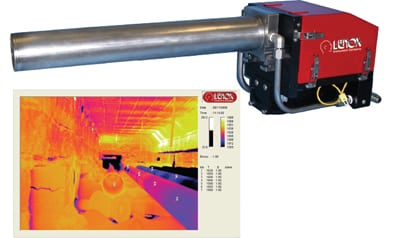
7. It’s all about working distance. Perfected proprietary technology allows a low-cost, uncooled microbolometer infrared detector to image in very narrow spectral bands at high temperatures. Shown on top is a typical image viewed by the operator. Courtesy: Mikron Infrared Inc.
|

Resolution is even more important in IR imaging than it is in digital photography, and who hasn’t heard even amateur shutterbugs boast about the resolution of their newest digital camera? In IR imaging, resolution affects temperature measurement accuracy—not just image quality.
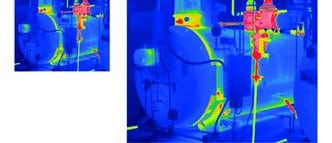
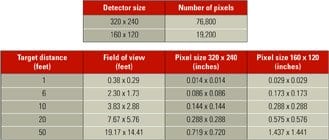
A 320 x 240 detector with 76,800 temperature-measuring pixels can resolve an area smaller than a tenth of a square inch at 6 feet, whereas the 160 x 120 detector, with just 19,200 pixels, can’t image anything smaller than twice that size (Figure 8). With more background averaged into temperature readings, the readings are inherently less accurate. Likewise, the low-resolution thermal image looks as if it’s made of tiny little squares (the pixels), no matter what the viewing size (see table).
|
8. Dot’s it. An image taken at a resolution of 160 x 120 pixels (left) has only one-fourth the information as one taken at 320 x 240 pixels (right). Courtesy: Mikron Infrared Inc.
|
|
Pixel count vs. resolution and field of view Source: Mikron Infrared Inc.
|
Another fine point in detector design is fill factor—the space between pixels on the detector that has to be interpolated when the image is formed electronically. The newest detectors have reduced this spacing by 25%, giving them the highest fill factor and best imaging capability.