It’s a given that nobody knows the future; however, making year-ahead predictions about other parts of the power generation industry, particularly the U.S. portion, is relatively easy. In marked contrast, anticipating what will happen in the smart grid realm gets harder every day.
One thing does seem clear: The concept of a smart grid may have been born in the U.S.A., but it’s hitting an adolescent growth spurt just about everywhere else first. Meanwhile, in the U.S., both the regulators and companies that see great potential in a smarter grid are realizing that making substantial smart grid progress will first require making both people and policies smarter.
There’s one exception, one piece of the smart grid, that could face fewer obstacles to adoption, and that’s because it offers more obvious and visible benefits to its users: electric vehicles (EVs).
China Courts Vendors
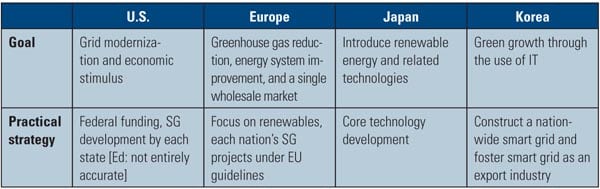
As noted in an earlier article, relatively weak federal policy power (as compared with the power of state public utility commissions, in this case) and the huge number of utility companies in the U.S. combine to make developing a coherent smart grid strategy daunting. Most other developed and developing countries have two advantages: stronger central governments that can provide broad policy support and environmental goals whose attainment requires smarter grids. Last year in our forecast issue, we looked at smart grid activities in a number of countries. This year China is stealing the spotlight.
From renewable generation technology to massive transmission projects to EVs, China is moving fastest and accounting for the largest share of smart grid dollars globally.
State Grid Cooperation of China (SGCC) announced a "Strong and Smart Grid Plan" in mid-2009, whose focus is an ultrahigh-voltage power grid. And though one source claims that China’s smart grid exists only on paper, one could argue that China is starting work on a different part of the grid: the long-haul, high-voltage part that has such an impossible chance of getting permitted in the U.S. The same account notes that "China is expected to invest 300 billion yuan [about US$45 billion] in smart grid each year in the following 10 years. On the entering of the overall construction phase in 2011-2015, total investment in smart grid will approximate to 2 trillion yuan [US$0.6 trillion], said [an] insider with the State Grid Corp."
In November, Engineering News-Record published a story from AsiaPulse News stating that China’s 2011-2015 smart grid plans will cost nearly $100 billion (620 billion yuan). Whatever the eventual number is, it’s big.
Comparing those projections to projected dollars to be spent on smart grid development in the U.S. is difficult given the number of different entities responsible for placing orders and paying the bills. However, GTM Research conveniently made a five-year projection for the same time period and anticipates the U.S. smart grid market growing "from $5.6 billion in 2010 to $9.6 billion in 2015." That’s an order of magnitude less than China plans to spend.
A Chinese press release from October confirmed the emphasis on transmission and said that 5% to 7% of total grid investment in China is focused on making it more intelligent. State Grid Corp. expects that percentage to reach 14% to 15% by 2020. "The major regions receiving investment for smart grid construction include densely populated and economically developed East China, Central China and North China. The aggregate investment in these regions will account for over 85% of the total."
Look for global companies, including U.S.-based ones, to be partnering with China to develop smart grid projects because, as General Electric’s (GE’s) Jeffrey Immelt said at the GridWise Global Forum in September, that’s where the market is. GE has already made good on that prediction. In November, GE and State Grid Corp. of China (SGCC) announced several joint ventures that are “part of GE’s plans to invest US$2B in China through 2012.” The smart grid piece of the pie includes working with Wuhan Nari, a subsidiary of SGCC, “to improve the efficiency and reliability of China’s electric grid by developing and implementing asset optimization technology solutions” that will include grid automation elements. In addition, GE will “work with Electric Power of Shanghai (EPS), controlled by SGCC, to jointly acquire a 77.5 percent controlling stake in Shanghai Tianling Switchgear Co., a Shanghai-based company developing and selling green power distribution equipment.” A goal of that partnership is “to deploy and deliver cleaner and more efficient infrastructure projects, such as high-speed rail and electric vehicle charging,” the GE press release said.
China, the world’s largest market for automobiles, has already been in the news for its EV pilot projects, and more are sure to come. Reuters, for example, reported in October that China is expected to have 1 million EVs by 2020. A pilot program that began last June provides rebates of up to $9,000 to electric and hybrid car buyers.
Automaker Volkswagen plans to begin testing its battery-powered Golf Blue e-motion in China in 2011. The car could be available for sale in China by 2013. (The Volkswagen USA website doesn’t mention anything about EVs, even on its concept cars page.) Nissan Motor Co., General Motors Co., and Daimler AG are also planning to sell EVs in China.
According to Bloomberg Siemens AG was expected to sign a contract in November to supply the Chinese city of Song Xiao with EV charging infrastructure, though the company had not announced a deal as of early December.
Whether lessons learned by these and other global companies in China will translate easily to other markets is an open question. What’s less questionable is that global corporations and China both stand to benefit from their smart grid partnerships.
U.S. Smart Grid Dollars to Shift to DA and EVs
Smart meters are easier for most people to understand conceptually than all the other electricity monitoring and regulating devices that are slowly being installed between the points of generation and the points of delivery. Smart meters are also relatively easy to install. So it’s no surprise that meters were an obvious place for both utilities and state and federal dollars to go. Smart meter/advanced metering infrastructure (AMI) deployments will continue. However, without smarter lines, smart meters cannot deliver all their promised benefits.
That’s where the technologies that can enable the diagnostic and self-healing capabilities of a smart grid come in. Distribution automation (DA) falls within that realm. (For specifics about one DA application, robotic inspection of power lines, see “EPRI Identifies Four Breakthrough Technologies for 2011,” also in the Jan. 2011 issue of POWER.)
Both GTM Research and Pike Research are predicting that DA will rival AMI for attention in the coming year. That would be a good thing for reliability and could help utilities demonstrate that a smart grid is more than smart meters—but that those smart meters, connected to other digital devices, are an integral part of a smarter, stronger grid.
Utilities, venture capitalists, and the federal government are not the only entities spending money to accelerate development of a smarter grid. In mid-November, GE announced five innovation award winners of its $200 million open innovation challenge, the “GE ecomagination Challenge: Powering the Grid.”
The winning ideas were: “a lightweight inflatable wind turbine; a technology that instantly de-ices wind turbine blades so they never slow or shut down; an intelligent water meter that can generate its own power; a cyber-secure network infrastructure that allows two-way communications grid monitoring and substation automation from wind and solar farms; and a technology [that] solves short-circuiting and outages from overloaded electric grids by enabling precise control over their flow and power.”
But that’s not the only money GE is spending on the smart grid in the U.S. In November, the company announced that it would buy 25,000 electric vehicles by 2015 for its corporate fleet, starting in 2011 with the Chevrolet Volt. (Though the Volt is a plug-in hybrid electric vehicle—PHEV—rather than all-electric. For more on PHEVs, see “Electric Vehicles: The Uncertain Road Ahead.”) GE obviously has a vested interest in EVs (see the discussion of its WattStation charging device below), but it is also demonstrating that the private sector—beyond utilities—has a role to play in bringing a smart grid to life. It will be interesting to see what other corporations announce large EV purchases in 2011.
EVs Finally Gain Traction
Although the majority of smart grid news in the past couple of years has focused on smart meters, a smart grid consists of far more than meters, and this looks like the year that the general public may start to understand that. Why? Because smart grid technology is finally talking a language Americans understand: the language of cars. 2011 could be the year that plug-in electric vehicles gain traction, at least in selected markets, where recharging infrastructure is strategically rolled out.
What looks different as we head into 2011 is that enough manufacturers are rolling out EV models in 2011 to be visible. In the U.S., GM, Nissan, Mitsubishi, and Tesla (which got a $465 million DOE loan for a manufacturing facility in Jan. 2010) are the most well-known, but there are more than 30 EV manufacturers worldwide.
Just as important, a variety of recharging options are reaching actual city streets. Perhaps most important, more consumers seem to be interested in giving EVs a road test than are interested in being test drivers of home energy management systems that may help them save a little money but otherwise have no personal payoff. In the U.S. at least, being able to show off and rev up the latest automotive technology in public has more powerful appeal than privately adjusting when and how we use electricity in the home.
Charging stations have already hit some streets, and more are scheduled for 2011. Among the several companies involved is ECOtality, which is working with BP to install more than 15,000 charging stations at workplaces but also shopping centers and movie theaters in 16 cities in six states plus Washington, D.C. ECOtality got a $115 million DOE grant to install the charging stations by July 2011. The company claims that its Blink charger is the fastest available.
Coulomb Technologies, another DOE dollars recipient, is part of the ChargePoint Network, an open-platform network of charging stations around the globe. As the company explained in July, “The $37 million ChargePoint America program is made possible by a $15M grant funded by the American Recovery and Reinvestment Act through the Transportation Electrification Initiative administered by the Department of Energy. ChargePoint America will provide 4,600 public and home ChargePoint Networked Charging Stations by October 2011” in nine metropolitan locales from California to Texas to Washington, D.C. and Florida. Its vehicle partners are Ford, Chevrolet, and smart USA.
Most visible nationally, even in markets where it isn’t yet being installed, is GE’s WattStation. Ads for the eye-catchingly designed recharging stations feature carefree young adults on a road trip plugging in to the stations at stops along the way.
In some places, charging is free with selected devices at the moment thanks to underwriting by tech and retail companies. Details of charge time, cost, and payment options vary by device vendor, which means we’ll find out over time which technology and business models work best in specific locales.
The Smart Grid Job Market
The implications of a smart grid are becoming more visible all the way from education and training programs to new job descriptions. Whether the supply of aptly trained workers can keep up with demand remains to be seen.
At the GridWise Global Forum in September, an entire session was devoted to "Transforming the Workforce." At the same time as the grid is (slowly) getting smarter, fewer U.S. students are showing interest in the types of educational backgrounds (heavy on information technology as well as engineering) that will be required to deploy and maintain a smarter grid. As a result, one short-term solution has been to take people with tech skills and train them in the utility business. Another way of putting this—as Itron Vice President, Professional Services Mark de Vere White did—is that companies are stealing smart grid workers from each other.
There are a few bright spots, however. Dr. Mohammad Shahidehpour, Bodine Chair Professor and director of the Electricity Innovation Center at the Illinois Institute of Technology (IIT), said that in his 30 years of teaching, he has "never seen so much excitement" about electrical engineering courses. He has 80 students in his smart grid course, 90 in his sustainable energy course, and IIT is starting a new smart grid training center. Even though the state of Illinois was broke, it managed to provide $2.5 million for a new program to train students in smart grid technology. The new center will partly focus on career changers and will be interdisciplinary in nature, involving mechanical, materials, and electrical engineering—which are all needed to understand wind energy, for example.
New job descriptions for folks in utility communications and customer care offices are also emerging and will continue to evolve. As participants at the GridWise Global Forum repeatedly acknowledged, getting consumers to change their behaviors in ways that maximize smart grid benefits is going to require new (and better) customer interaction skills and more sophisticated (and varied) public relations (PR) strategies.
Naperville, Ill., for example, was in the spotlight in late 2010 for its hiring of a PR firm to handle the majority of communications related to its municipal utility’s $22 million smart grid project. According to an October news release from the city, "Over the next fifteen years, there is a potential to save Naperville electric customers more than $30 million in today’s dollars. This initiative serves as a model for upgrading and automating the city’s electric distribution system to meet consumer needs, achieve dramatic improvements in reliability and lower operations and maintenance costs." Given the difficulties encountered by ComEd in the same month (a court ruled that the utility commission overstepped its authority in 2008 by approving a rider for the utility’s smart grid plans), Naperville may prove to have spent wisely.
Rewiring People and Policy
How well state public utility commissions (PUCs) will handle smart grid projects in the coming year is anyone’s guess. One would hope that commissioners are quickly getting up to speed on all the elements that contribute to a smarter and stronger grid and that they understand how those elements are interrelated. That’s important because, as noted above, smart meters alone will not instantly deliver a smarter grid; they are, however, a necessary tool for achieving the level of load responsiveness the U.S. is going to need if the transmission stalemate persists.
Continued push-back from PUCs should prompt utilities to take a more holistic view of smart grid investments. Those that can illustrate how a strategically planned series of investments will benefit customers both in the short and long term are likely to fare better than those that simply ask to recover costs for discrete projects. For example, despite a very rocky deployment history and soured relationships with the city of Boulder, Xcel Energy’s SmartGridCity project in November won a settlement allowing it to raise rates across Colorado to pay for the multicomponent project (though the decision still had to go to the PUC and could yet go to court). As more pilot projects around the country gather and assess data, those results should help future projects demonstrate the value of proposed technology and program updates.
More Fear Factor Stories
Fear and conspiracy theories sell—whether you’re in print or online—so expect to see more coverage of the outliers, those who believe radio frequency radiation from AMI is a threat to human health, for example.
From Maine to New Mexico to California, individuals and groups have voiced fears about AMI because of concern about radio frequency radiation, despite assurances from utilities that the technology is safe. It might be tempting for utilities to dismiss such concerns as groundless, but—although some people will never be persuaded by facts—such concerns also indicate that utilities have not done a good enough job of explaining (in easy-to-understand, visible ways) the newest technology to hit their industry in a lifetime. Though utilities might think that introducing smart grid technology in a bill-stuffer is sufficient, it’s not; most people receiving paper bills toss bill-stuffers in the trash and concentrate on paying the bills.
More effective would likely be a coordinated public information program that included newspaper and television articles, interactive web applications, and in-person demonstrations at everything from community fairs to schools. Until utilities get better at interacting with customers, expect resistance to smart grid plans from individuals and PUCs.
Of even more concern is media coverage of low-credibility/high-fear-factor stories being sold by apparent experts. Take, for example, the claims published by Scientific American (dated Oct. 5 online): “A network of drone smart meters could cause a swath of the grid to power down, throwing off the grid’s electrical load. The imbalance would send large flows of electricity back to generators, severely damaging them or even blowing them up.”
This apocalyptic scenario just didn’t sound right to me, but my PhD isn’t in physics or engineering, so I checked with our editor-in-chief, who does have a PhD in mechanical engineering, and he confirmed that “Whoever wrote that has absolutely no idea how the grid works and. . . . . It’s wrong on so many planes that it’s difficult to reply.”
To put the best possible spin on this sort of story, the grid is an already complex system, and overlaying a web of digital communication and control tools makes it exponentially more complex. Even within the electric utility industry, few will completely understand all the ramifications of every technology, which is why it will be so important to confirm that “expert advisers” and vendor prospects actually know what they are talking about. It’s also another reason for utilities to figure out how to communicate the facts about the smart grid to customers in ways that don’t require customers to take the initiative.
Utilities Learn Some New Dance Moves
The need for utilities (especially in the U.S.) to partner with new types of business partners, and more of them, will only increase in the coming year and beyond. Those partners will range from data aggregators and analysts to distributed generation suppliers to "smart" appliance manufacturers and EV charging station vendors. Rather than relying on a single dance step, as they have for over a century, utilities will need to master a variety of more sophisticated moves.
New business models that, for example, might put utilities into the customer-sited distributed generation (DG) business—while playing fairly with customer- and third-party-owned DG—also will need to be developed. That’s likely to evolve slowly and regionally as utilities propose new ways of financing smart grid–related projects.
To that end, utilities will need to educate PUCs and reevaluate their relationships with regulators, because the smart grid value proposition is in some respects completely different from business as usual.
If there is any hope for making the U.S. grid stronger, more secure, and more flexible—whether you call the myriad projects required to achieve that goal “smart grid” projects or not—something’s got to give. In fact, something’s got to give a little at all pressure points: centralized and distributed generators, transmission and distribution operators, utility business models, customer care skills, customer behavior, and regulatory structure.
In short, utilities aren’t the only ones who will be introduced to some new dance moves in the coming year.
—Gail Reitenbach, PhD is POWER’s managing editor.