
POWER
-
 News
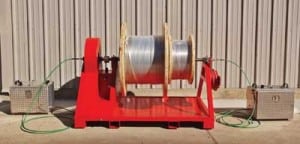
NewsTwo-Line Spooling Unit
The new Dual Pneumatic Spooling Unit allows users to run two different fluids at different pressures simultaneously with complete control and safety, says its developer, Mid-South Control Line. The unit’s pneumatic mechanism uses air, which is then exhausted. Overload and fire hazards are decreased, and unit life is increased. The unit accommodates control lines of […]
-
 Environmental
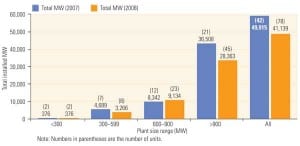
Update: What’s That Scrubber Going to Cost?
POWER published a summary of the flue gas desulfurization system scrubber cost survey conducted by the EUCG’s Fossil Productivity Committee in our July 2007 issue. Although the detailed results of the latest survey are proprietary to EUCG members that participated in it, we are privileged to present the newest summary data. The bottom line: Costs continue to rise but appear to be more predictable.
-
 News
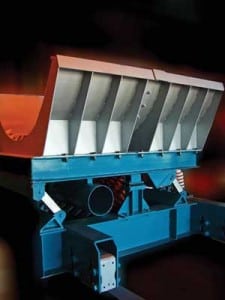
NewsVibratory Ash Extractor
The Vibratory Ash Extractor (VAX) recently unveiled by United Conveyor Corp. is designed to improve operational efficiencies for dry bottom ash – handling at plants whose operators want to transition away from wet systems. Suitable for pulverized bituminous and subbituminous coal boilers, the VAX can also be retrofitted for lignite-fired boilers. To minimize forced boiler […]
-
 O&M
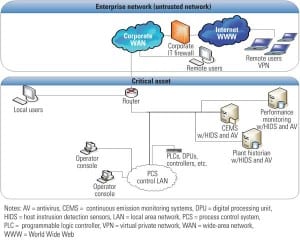
O&MHelping Power Plant Control Systems Achieve NERC CIP Compliance
This guide offers suggestions from a control system engineering perspective for protecting power-generating units that are determined to be critical cyber assets
-
 News
NewsBelow-the-Belt Protection
Skirtboard sealing systems are installed on the sides of belt conveyor loading zones to contain material, eliminate spillage, and reduce cleanup expenses. The new Double APRON SEAL Skirting system from Martin Engineering provides two wear surfaces on a single elastomer-sealing strip that’s installed along the bottom of the skirt board. When the bottom side of […]
-
Commentary
Energy Efficiency Takes Center Stage in Texas
For decades, it’s been well-known in the country and western (C&W) music industry that "if you’re gonna play in Texas, you gotta have a fiddle in the band." The guitars, drums, harmonicas, and piano — they’re all expected on stage. But as the legendary C&W group Alabama recognized, a fiddle is a must when performing […]
-
 Hydro
HydroWhat’s Damming Hydrokinetic Power in the U.S.?
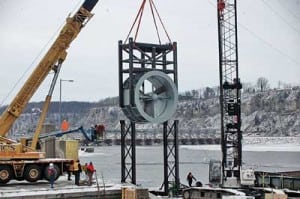
Barely a month after the U.S. Federal Energy Regulatory Commission (FERC) licensed the nation’s first commercial hydrokinetic power station, Houston-based Hydro Green Energy in January completed installation of the first of two turbines at an existing run-of-river hydropower plant on the Mississippi River for the Minnesota city of Hastings. When the second turbine is installed later this spring, the two hydrokinetic turbines will constitute a floating array that will sit on top of a barge at the Army Corps of Engineers’ Lock & Dam No. 2.
-
 Waste to Energy
Power Generators Turn to Diverse Fuels
Like the airline industry, power generators all over the world have been seeking alternative fuels with which to produce electricity, and the blends are bound to get stranger. One company is looking to make liquid fuels from chicken fat, beef tallow, and pork lard, for example. Here’s a list of innovative fuels that generators could use in the near future.
-
 Solar
SolarPV Sales in the U.S. Soar as Solar Panel Prices Plummet
Solar panel prices have taken a 10% tumble since October last year, and they are expected to drop another 15% to 20% this year, owning to an oversupply from the mass of new factories and draining demand in Germany and Spain, where solar incentives were recently cut. In the U.S., the low prices — pushed even lower by the renewed solar tax credits that took effect on Jan. 1 and other incentives — have heightened demand, both on the distributed generation level and at utility scale.
-
 News
NewsSuperconductor Motor for Navy Passes Full-Power Test
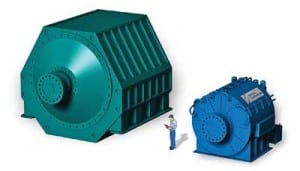
American Superconductor Corp. (AMSC) and Northrop Grumman Corp. in January said they successfully completed a full-power test of the world’s first 36.5-MW high-temperature superconductor (HTS) ship propulsion motor.
-
News
Carbon Goes Subprime
European Union (EU) carbon trading proponents are finding support for their market-based emission trading scheme (ETS) in freefall like the market price of carbon in the EU. This unanticipated consequence of the ETS really should not have come as a surprise. Free Allowances The ETS, often described by EU regulators as the world’s most advanced […]
-
 Hydro
HydroSaving the Dead Sea
If measures aren’t taken immediately to replenish the rapidly shrinking Dead Sea, the very salty body of water in the Middle East will shrivel up within 50 years — and that could pose an environmental calamity, experts have warned.
-
Business
POWER Digest (March 2009)
News items of interest to power industry professionals. RWE and E.ON to partner on new UK nuclear capacity. German giants RWE AG and E.ON AG on Jan. 14 said they would partner to develop new nuclear power stations in the UK. The 50:50 joint venture will have a long-term focus on seeking secure sites being […]
-
Hydro
International Organization to Push Renewable Energy
Seventy-five countries from around the world joined a new political agency dedicated to the acceleration of green energy this January, but several notable nations — including the U.S., Canada, Australia, UK, Japan, and China — were not among them.
-
Legal & Regulatory
Generators Propose a Plan for Carbon Pricing
With the U.S. economy currently in a free fall, some utility industry leaders and elected officials argue that carbon cap legislation should be put on hold while the country recovers financially. However, President Barack Obama has a different game plan.
-
 O&M
O&MBest Management Practices for Coal Ash Ponds
The unfortunate coal ash spill at the Tennessee Valley Authority’s (TVA’s) Kingston Fossil Plant that occurred on December 22 has heightened national awareness of the problems associated with utilities’ coal ash surface impoundments if they are not properly maintained.
-
 Coal
CoalPolish Plant Beats the Odds to Become Model EU Generator
Once a Soviet satellite, Poland is now transforming into a thoroughly modern nation. To support its growing economy, this recent European Union member country is modernizing its power industry. Exemplifying the advances in the Polish electricity generation market is the 460-MW Patnów II Power Plant — the largest, most efficient (supercritical cycle), and environmentally cleanest lignite-fired unit in the country.
-
 O&M
O&MReduce Costs with Wireless Instrumentation
New wireless technologies for power plant instrumentation offer significant cost savings when compared to traditional wired networks. The value of this cost savings is especially relevant in the highly competitive power industry, where aging facilities are common and upgrades are an expensive necessity. Modern wireless networks offer a reliable upgrade path that even provides some unexpected benefits when compared to traditional copper networks.
-
 Water
WaterFlue Gas Desulfurization Wastewater Treatment Primer
Purge water from a typical wet flue gas desulfurization system contains myriad chemical constituents and heavy metals whose mixture is determined by the fuel source and combustion products as well as the stack gas treatment process. A well-designed water treatment system can tolerate upstream fuel and sorbent variation over time and consists of multiple process treatment steps arranged in just the right order to produce wastewater acceptable for discharge.
-
 News
NewsTemperature Detectives
Wahl Instruments’ two newly released digital resistance temperature detectors (RTD) — the DST500 Temperature Indicator and the DSX500 Transmitter Thermometer (shown here) — feature high-precision temperature measurement technology and a 1-inch LCD display. The units are available in a variety of standard and custom-built probe configurations, including mercury-in-glass (MIG) standard tapered bulb for drop-in direct […]
-
 Water
WaterOak Creek Power Plant Upgrades Cooling Water System
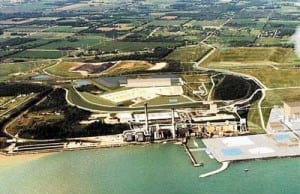
Formed suction intake designs have been used in many large vertical pump stations in flood control projects. Space limitations at the Oak Creek Power Plant Expansion Project near Milwaukee, Wisconsin, created a unique opportunity to apply this technology to an 800,000-gpm cooling water system upgrade for the entire Oak Creek Power Plant.
-
 News
NewsOil Eater
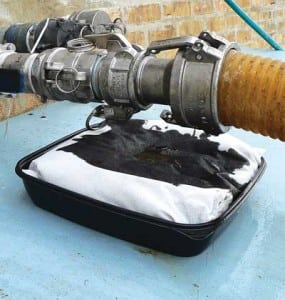
Kafko International’s new Oil Eater Absorbent Drip Pan is designed to handle leaks that are too large for an absorbent pad, and which occur in tight spaces, such as under machinery and pipes. The drip pan is made of sturdy plastic and houses an absorbent pillow made of plant fibers and other reusable resources. When […]
-
Nuclear
900 U.S. Reactors by 2035?
A professor and consultant who has experience and connections with just about every part of the nuclear power world concludes that the U.S. will need to add 900 nuclear reactors in the next quarter century.
-
 Instrumentation & Controls
Distributed Control Technology: From Progress to Possibilities
The past decade has seen an explosion of technology that has significantly altered the process control industry. The adoption of commercially available technology driven by desktop computing has allowed suppliers to focus on applications to enhance the process and deliver ever-greater value to the user.
-
 Coal
CoalSri Lanka Commissions Major Thermal Power Plant
The Sri Lankan government in December commissioned the first phase of the 300-MW Kerawalapitiya Thermal Power Plant, the nation’s biggest combined-cycle power plant project. The $300 million plant in the western part of the country commenced operations by generating 200 MW (Figure 7). In its second phase, it will expand to 300 MW. Per government estimates, power produced by the plant is priced at about 20 rupees or $0.18/kWh.
-
 Instrumentation & Controls
Optimize Your Plant Using the Latest Distributed Control System Technology
Distributed control systems are powerful assets for new and modernized power plants. Thanks to three product generations of technology innovations, these systems now provide new benefits — including improved O&M efficiency, greater plant design flexibility, and improved process control and asset reliability — that help competitive plants advance in the game.
-
 O&M
O&MFERC Focuses on Internal Compliance Programs
By now, most electric industry participants are aware of the mandatory reliability standards required by the Energy Policy Act of 2005 and managed by the North American Electric Reliability Corp. (NERC). Bulk-power system users, owners, and operators (known as NERC registered entities) are responsible for complying with the set of standards that are applicable to their operations in their specific region. Compliance is monitored by the NERC regions (Texas Regional Entity, Western Electric Coordinating Council, Reliability First Corp., Midwest Reliability Organization, SERC Reliability Corp., Florida Reliability Coordinating Council, Northeast Power Coordinating Council, and Southwest Power Pool) through spot checks, self-certifications, audits, and investigations.
-
 Instrumentation & Controls
Power Plant Automation: Where We Are and Where We’re Headed
Over the past decade, power plant control systems have evolved from DCS-centered platforms with proprietary software, to open systems using industry standard hardware and software, and then to totally integrated plant automation systems with almost unlimited connectivity and the ability to interrogate field instruments from many different manufacturers. What’s next?
-
 O&M
O&MPreventing Boiler Code Violations Creates a Safer Work Environment
Nearly 10% of boilers and pressure vessels inspected in the second quarter of 2008 were slapped with violations, which means that the violations put workers and equipment in danger, according to a quarterly report released by the National Board of Boiler and Pressure Vessel Inspectors.
-
 Instrumentation & Controls
Enhancing Plant Asset Management with Wireless Retrofits
Wireless technology is a mostly untapped resource in the power generation industry that can have a significant impact on the way business is done. It enables a greater degree of connectivity among devices for enhanced monitoring and asset utilization and has led to the development of new applications that improve productivity, uptime, and overall business performance.