
POWER
-
 Water
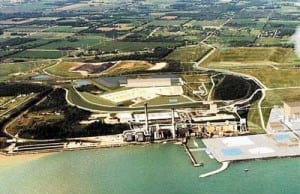
WaterOak Creek Power Plant Upgrades Cooling Water System
Formed suction intake designs have been used in many large vertical pump stations in flood control projects. Space limitations at the Oak Creek Power Plant Expansion Project near Milwaukee, Wisconsin, created a unique opportunity to apply this technology to an 800,000-gpm cooling water system upgrade for the entire Oak Creek Power Plant.
-
 News
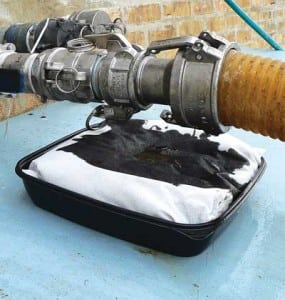
NewsOil Eater
Kafko International’s new Oil Eater Absorbent Drip Pan is designed to handle leaks that are too large for an absorbent pad, and which occur in tight spaces, such as under machinery and pipes. The drip pan is made of sturdy plastic and houses an absorbent pillow made of plant fibers and other reusable resources. When […]
-
 O&M
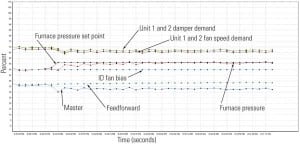
O&MBoiler-Tuning Basics, Part I
Tuning power plant controls takes nerves of steel and an intimate knowledge of plant systems gained only by experience. Tuning controls also requires equal parts art and science, which probably is why there are so few tuning experts in the power industry. In Part I of a two-part series, we explore a mix of the theoretical and practical aspects of tuning boiler controls.
-
 News
NewsA Hot Sticking Point
The Estick electronic contact temperature indicator provides an instantaneous digital readout of surface temperature at the point of contact with an accuracy of ±1%. Knowledge of the material’s emissivity is not required to get an accurate reading, says the device’s maker, TEMPIL, and it can gauge temperatures of ridged, polished, or nonpolished surfaces. The Estik’s […]
-
O&M
"Blueprint" Your Pulverizer for Improved Performance
Pulverizer throughput is determined by the coal fineness desired for a given coal. However, compromising on coal fineness when your pulverizer isn’t up to snuff can increase NO x and cause many furnace problems. Your least costly option for increasing pulverizer capacity is to pay careful attention to key dimensions and critical tolerances during your next overhaul.
-
 News
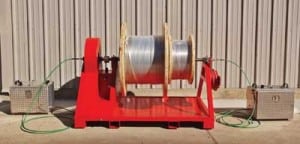
NewsTwo-Line Spooling Unit
The new Dual Pneumatic Spooling Unit allows users to run two different fluids at different pressures simultaneously with complete control and safety, says its developer, Mid-South Control Line. The unit’s pneumatic mechanism uses air, which is then exhausted. Overload and fire hazards are decreased, and unit life is increased. The unit accommodates control lines of […]
-
 Environmental
Update: What’s That Scrubber Going to Cost?
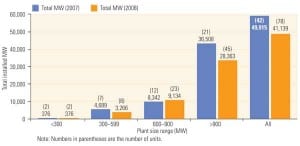
POWER published a summary of the flue gas desulfurization system scrubber cost survey conducted by the EUCG’s Fossil Productivity Committee in our July 2007 issue. Although the detailed results of the latest survey are proprietary to EUCG members that participated in it, we are privileged to present the newest summary data. The bottom line: Costs continue to rise but appear to be more predictable.
-
 News
NewsVibratory Ash Extractor
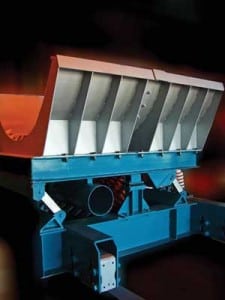
The Vibratory Ash Extractor (VAX) recently unveiled by United Conveyor Corp. is designed to improve operational efficiencies for dry bottom ash – handling at plants whose operators want to transition away from wet systems. Suitable for pulverized bituminous and subbituminous coal boilers, the VAX can also be retrofitted for lignite-fired boilers. To minimize forced boiler […]
-
 O&M
O&MHelping Power Plant Control Systems Achieve NERC CIP Compliance
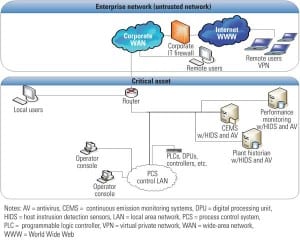
This guide offers suggestions from a control system engineering perspective for protecting power-generating units that are determined to be critical cyber assets
-
 News
NewsBelow-the-Belt Protection
Skirtboard sealing systems are installed on the sides of belt conveyor loading zones to contain material, eliminate spillage, and reduce cleanup expenses. The new Double APRON SEAL Skirting system from Martin Engineering provides two wear surfaces on a single elastomer-sealing strip that’s installed along the bottom of the skirt board. When the bottom side of […]
-
Commentary
Energy Efficiency Takes Center Stage in Texas
For decades, it’s been well-known in the country and western (C&W) music industry that "if you’re gonna play in Texas, you gotta have a fiddle in the band." The guitars, drums, harmonicas, and piano — they’re all expected on stage. But as the legendary C&W group Alabama recognized, a fiddle is a must when performing […]
-
 Hydro
HydroWhat’s Damming Hydrokinetic Power in the U.S.?
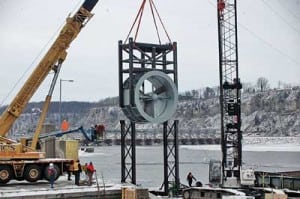
Barely a month after the U.S. Federal Energy Regulatory Commission (FERC) licensed the nation’s first commercial hydrokinetic power station, Houston-based Hydro Green Energy in January completed installation of the first of two turbines at an existing run-of-river hydropower plant on the Mississippi River for the Minnesota city of Hastings. When the second turbine is installed later this spring, the two hydrokinetic turbines will constitute a floating array that will sit on top of a barge at the Army Corps of Engineers’ Lock & Dam No. 2.
-
 Waste to Energy
Power Generators Turn to Diverse Fuels
Like the airline industry, power generators all over the world have been seeking alternative fuels with which to produce electricity, and the blends are bound to get stranger. One company is looking to make liquid fuels from chicken fat, beef tallow, and pork lard, for example. Here’s a list of innovative fuels that generators could use in the near future.
-
 Solar
SolarPV Sales in the U.S. Soar as Solar Panel Prices Plummet
Solar panel prices have taken a 10% tumble since October last year, and they are expected to drop another 15% to 20% this year, owning to an oversupply from the mass of new factories and draining demand in Germany and Spain, where solar incentives were recently cut. In the U.S., the low prices — pushed even lower by the renewed solar tax credits that took effect on Jan. 1 and other incentives — have heightened demand, both on the distributed generation level and at utility scale.
-
 News
NewsSuperconductor Motor for Navy Passes Full-Power Test
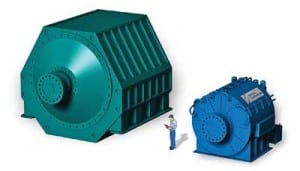
American Superconductor Corp. (AMSC) and Northrop Grumman Corp. in January said they successfully completed a full-power test of the world’s first 36.5-MW high-temperature superconductor (HTS) ship propulsion motor.
-
News
Carbon Goes Subprime
European Union (EU) carbon trading proponents are finding support for their market-based emission trading scheme (ETS) in freefall like the market price of carbon in the EU. This unanticipated consequence of the ETS really should not have come as a surprise. Free Allowances The ETS, often described by EU regulators as the world’s most advanced […]
-
 Hydro
HydroSaving the Dead Sea
If measures aren’t taken immediately to replenish the rapidly shrinking Dead Sea, the very salty body of water in the Middle East will shrivel up within 50 years — and that could pose an environmental calamity, experts have warned.
-
Business
POWER Digest (March 2009)
News items of interest to power industry professionals. RWE and E.ON to partner on new UK nuclear capacity. German giants RWE AG and E.ON AG on Jan. 14 said they would partner to develop new nuclear power stations in the UK. The 50:50 joint venture will have a long-term focus on seeking secure sites being […]
-
Hydro
International Organization to Push Renewable Energy
Seventy-five countries from around the world joined a new political agency dedicated to the acceleration of green energy this January, but several notable nations — including the U.S., Canada, Australia, UK, Japan, and China — were not among them.
-
Nuclear
900 U.S. Reactors by 2035?
A professor and consultant who has experience and connections with just about every part of the nuclear power world concludes that the U.S. will need to add 900 nuclear reactors in the next quarter century.
-
Engineers Week Is Feb. 15–21
I just renewed my professional society membership dues for the umpteenth year, and while writing the check, I paused to consider if I was getting good value from them. I expect to receive another "suitable for framing" certificate this year, as the number of my membership years ends with a zero, but I wondered if there were other, more tangible benefits.
-
 Nuclear
China’s Nuke Power Boom
China has put its nuclear power plans on a fast track, kicking off a construction frenzy worth billions of dollars. In the latter months of 2008, the nation inaugurated construction of seven reactors, and in 2009, work will begin on another 10.
-
-
 Nuclear
Eastern Europe Prepares for Nuclear Revival
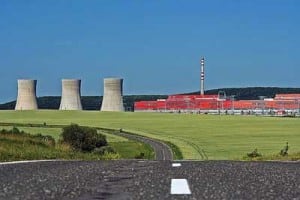
Despite hostilities that linger as a result of the 1986 nuclear nightmare at Chernobyl, Ukraine, and pressure from the European Union to shut down older-generation plants, Eastern European countries from the Baltic to Bulgaria are renovating existing nuclear plants or building new ones. If these projects become reality, the region will be able to secure its power supplies as well as cover the ongoing shortages in countries such as Greece, Macedonia, and Albania.
-
Legal & Regulatory
Oil—Unsafe at Any Price
A confluence of circumstances promised to make 2008 a transformative year for renewable energy in the U.S. States enacted additional, and more demanding, renewable portfolio standards, promoting accelerated and sustained development of "green" energy resources. Increasing concerns about global warming and climate change prompted some of this activity. However, the unprecedented escalation of oil prices to almost $150 a barrel (translating into prices at the pump in excess of $4) was the largest impetus for demands that this nation end its addiction to fossil fuels.
-
 Solar
SolarNew Technologies Could Improve Solar Cell Efficiencies
Declining oil prices, supply issues, and dwindling financing may have battered solar energy in recent months, but the industry seems to have sparred well in the research arena. An assortment of institutions separately announced breakthroughs in their quests to boost the efficiency of solar cells. The technological advancements ranged in approach, from the development of an antireflective coating to the formulation of more efficient solar cell materials, but all point to promising possibilities for the industry.
-
 Instrumentation & Controls
ISA POWID: Where Power Computing Professionals Meet
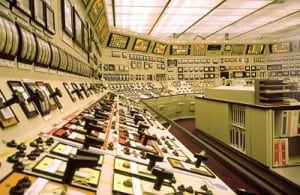
Which new and emerging technologies will be essential to your power plant’s success? Our special cover story series gives you a glimpse into the future of advanced distributed controls, wireless applications, and automation technologies.
-
 Business
An Energy-Generating Door
An energy-generating revolving door installed at Driebergen-Zeist railway station in the Netherlands is the latest experiment in eco-building. Dutch company Royal Boon Edam Group Holdings designed the manual door to match the newly refurbished station’s sustainable technology theme, while keeping in mind that the station — converted into a multifunctional area featuring restaurants and a tourist information and visitor center — holds 8,500 commuters at capacity.
-
 Instrumentation & Controls
Distributed Control Technology: From Progress to Possibilities
The past decade has seen an explosion of technology that has significantly altered the process control industry. The adoption of commercially available technology driven by desktop computing has allowed suppliers to focus on applications to enhance the process and deliver ever-greater value to the user.
-
 Coal
CoalSri Lanka Commissions Major Thermal Power Plant
The Sri Lankan government in December commissioned the first phase of the 300-MW Kerawalapitiya Thermal Power Plant, the nation’s biggest combined-cycle power plant project. The $300 million plant in the western part of the country commenced operations by generating 200 MW (Figure 7). In its second phase, it will expand to 300 MW. Per government estimates, power produced by the plant is priced at about 20 rupees or $0.18/kWh.