It’s now well understood that load growth on the grid is exponential and driven primarily by data centers. A range of generation types are racing to meet this demand. Renewable developers are well-positioned here, finding opportunity built into their existing projects or development pipelines.
Land and interconnection positions secured years ago for one purpose are now sitting next to a load they never planned around. The relationship between renewables and that load is complex. Renewables don’t provide firm, standalone power to a data center on their own. The opportunity instead runs through various paths: power purchase agreements covering a share of demand, or integration into a larger power master plan. Moreover, many renewable developers have in-situ projects electrically interfacing directly with new data centers built in proximity or might now expand to service new loads. Regardless of the scenario, many renewable developers are either interfacing with or leading data center developments.
A notable distinction is that renewable projects are permitted, financed, and interconnected as generation assets, while data centers are sited and interconnected as large loads. This difference affects the review process end-to-end. For example, renewable developers rarely deal with air permitting beyond a diesel backup engine-generator set, while thermal or firm generation for backup, bridge, or baseload duty required for data centers needs a bespoke air-permitting strategy built around the chosen technology. Proximity to communities can add its own zoning burden, and grid-connected versus islanded status can change the power pathway itself.
The rules governing both sides of the interface are still being written. Generation interconnection regulations have matured: FERC Order 2023 and its cluster-study process now runs across most regional transmission organizations and independent system operators (ISOs). However, data center large load interconnection is still in its infancy at the utility level with inconsistent guidance and state by state rollout. NERC issued its first guidance on large computational loads this year, with more expected by year-end and a consistent framework targeted for 2027. ISOs meanwhile require detailed studies and validated dynamic load models on day one, though compute models are often unavailable or under strict non-disclosure agreements.
Across the renewables integrated data center projects three patterns keep emerging:
1. Existing renewable assets encounter new reliability issues when data center loads connect to the same network
2. Greenfield data centers use phased behind-the-meter (BTM) generation, including renewables, to bridge a delayed grid connection while the utility adds parallel grid-support requirements
3. Fully islanded developments operate without a grid connection, requiring the generation stack, including renewables, to regulate voltage and frequency without an external reference.
Working through those scenarios repeatedly has produced a consistent set of lessons. Here are seven things renewable developers need to do right now if they want to optimize and derisk performance when interfacing with and/or developing data centers.
Understand and optimize both generation and large load interconnection requirements. Renewable developers know generation interconnection well, but a data center’s large load interconnection process is newer and less familiar, and it comes with grid-stability upgrades, dynamic modeling, ride-through, and voltage support many haven’t had to negotiate before. Developers who hold strong transmission and interconnection positions, load and generation, while navigating the grid-support equipment utilities now require, such as Flexible Alternating Current Transmission System, or FACTS, devices, have a real structural advantage.
Utility-scale Static Synchronous Compensators (STATCOMs) come from only three legacy suppliers, and demand has pushed lead times with steep price increases. If a STATCOM is required, ask to see the studies and run independent dynamic modeling to confirm, rather than accept the requirement at face value. Before starting negotiations, have a strong owner’s engineer, as errors at this stage can add years to a large load interconnection queue position and may therefore dictate the power development strategy.
Design projects as power campuses, not standalone renewable plants. Developers should plan for substations, future load growth, and co-located thermal, renewable, and storage infrastructure on the same site, rather than treating the renewable plant as a standalone asset. This is all in conjunction with the data center growth requirements and phasing. Planning for co-location up front, permitting included, is materially cheaper than retrofitting a site, and preserves land and interconnection capacity that can be difficult to recover later.
Renewables alone, even with battery energy storage systems (BESS), are not firm power. Renewable generation paired with energy storage isn’t enough to support a large data center’s reliability needs, particularly when islanded or largely self-supplied. A 1-GW islanded site has no external grid reference for voltage or frequency, and artificial intelligence training load ramps of 100 MW to 200 MW per minute can create inherent instability. While there are longer-duration storage technologies in development that could narrow this gap, they remain several years from commercial deployment at this scale. For a data center project to successfully ride-through a power disturbance, it will need to pair renewables and storage with firm, synchronous generation and voltage-stabilizing equipment to ensure that all components of the system, including the uninterruptible power supply, or UPS, is prepared for fluctuations in power.
 |
|
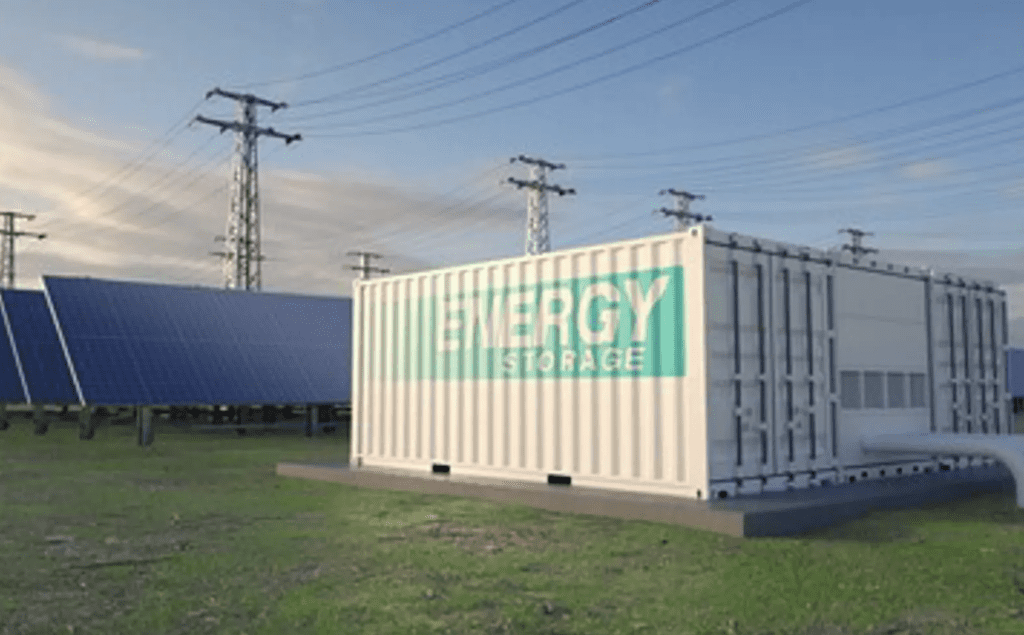
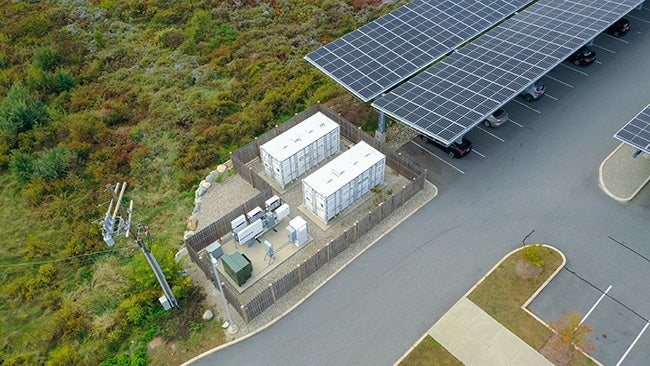
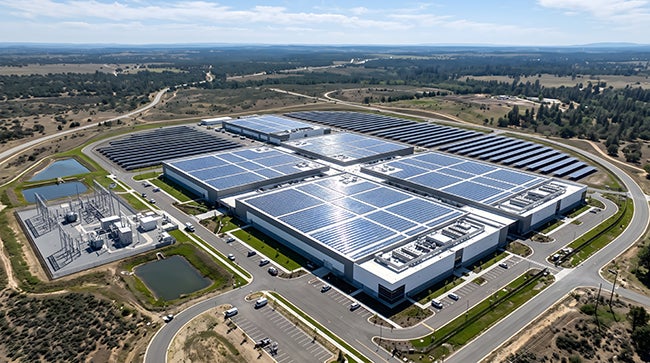
1. A large data center could utilize solar power and grid-forming energy storage to support its power needs. Courtesy: Adobe Stock photo used with permission of Ramboll |
Pairing standalone renewable generation with grid-forming BESS unlocks data center flexibility. Grid-forming battery storage gives renewable projects the flexibility to handle reliability, power quality, and load swings in ways a standard inverter can’t (Figure 1). This value often appears in unexpected situations that weren’t considered during the original design. For example, data center load swings can put mechanical stress on equipment like turbine shafts. With grid-forming storage already in the stack, developers can respond without redesigning the asset. But this fix only goes so far. Storage alone typically eases the problem rather than eliminates it, and closing the rest of the gap requires coordination with the equipment manufacturer to fine-tune system responses in real time. The broader point holds regardless of the specific issue: developers are better off having grid-forming storage in the project, as it creates leeway to absorb complications. That said, while grid-forming storage provides more than just backup power, on its own it isn’t enough to power a data center at scale.
Develop behind-the-meter power solutions. As utility connection timelines stretch, more developers turn to BTM generation to power up their data centers faster. BTM generation doesn’t have to be a permanent substitute for the grid; it can serve as a bridge, powering the load until a full interconnection is secured. Some regions are formalizing this path: PJM already runs a bring-your-own-energy program granting expedited load interconnection to developers who supply their own generation. They are even preparing a matchmaking program pairing load users to nearby independent power producers. A renewable project that can supply power directly through a BTM arrangement shifts the developer’s role from energy supplier to infrastructure partner. Sizing and optimizing that stack, i.e., PV, storage, and firm generation together, is the difference between a solution that works and one that creates problems.
Plan for multiple operating scenarios from the outset. A project can realistically start as an islanded microgrid, move through a bridge power phase, and land on a full utility interconnection. The strongest projects treat that sequence as one continuous plan rather than three separate builds, choosing bridge-phase equipment that can transition to permanent operation instead of being replaced or stranded once the grid connection arrives. Pairing battery storage with a faster device such as an E-STATCOM for the sharpest ramps or a high-inertia synchronous condenser for frequency support, often allows developers to right-size a smaller, cheaper battery rather than solving everything with storage alone. A BESS can also black-start the island if conventional generation isn’t available. Developers should decide early what happens to that generation once a permanent connection lands. Will they sell it back as an independent power producer or convert what began as a bridge solution into a long-term asset? Planning the full path this way, from islanded operation through bridge power to full interconnection, avoids expensive redesigns and stranded equipment later.
Design for demand response and future grid services. Utilities increasingly treat demand response participation as a condition of interconnection. Developers should think now about how onsite generation and storage will operate once a permanent grid connection is in place: Can the asset ride through the hours a utility asks it to curtail? The strongest projects preserve the flexibility to reduce load, support the grid, or export power when conditions warrant, rather than locking in a design that only works for day one.
The data center boom is creating opportunities that few renewable developers anticipated when they first secured land, permits, and interconnection positions. But success will not come from treating generation, storage, interconnection, and reliability as separate challenges. It will come from integrating them into a single power strategy that can adapt as projects evolve from islanded operation to bridge power to eventual full grid connection.
—Jonathan Howie is a senior managing consultant in Ramboll’s Energy division, where he serves as the U.S. Power Systems lead for the Transmission & Renewables markets.