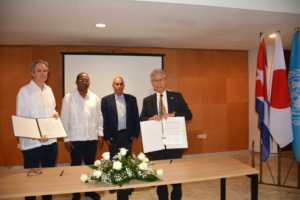
With support from the Japanese government, hospitals in several Cuban provinces will have access to renewable energy solutions to help ensure the continuity of medical services during power outages. These initiatives will be implemented under the leadership of the Cuban Ministry of Public Health (MINSAP), in collaboration with the United Nations Development Program (UNDP), and with the participation of the Ministry of Energy and Mines, the Cuban state-owned Unión Eléctrica, and local authorities.
The project will base its solutions on photovoltaic (PV) equipment, adapting them to each hospital according to its critical energy demand, building characteristics, and urban location. The initiatives include the installation of solar panels, batteries, and supporting equipment in 10 Cuban hospitals, four of them located in Havana and six others in different provinces of the country.
Furthermore, the project aims to strengthen the technical and institutional capacities of hospital staff, specialists, and technicians responsible for the operation, maintenance, and management of this solar technology. It also seeks to promote scalable and replicable renewable energy models for social infrastructure, aligned with national priorities and regulations. With a budget equivalent to $6.5 million, the project is expected to be implemented over a two-year period.
Cuba is currently facing an acute energy crisis, exacerbated by severe external restrictions and the sanctions policy declared by the Trump administration. The Cuban national grid experiences frequent large-scale blackouts, including several total nationwide power outages, severely impacting productive activities and social infrastructure.
Hospitals are among the most affected facilities, with outages threatening the continuity of critical medical services, the operation of life-saving equipment, and the preservation of medicines and vaccines. Cuban authorities have accelerated the installation of solar technologies for critical social services mainly in the health, education, and banking sectors. The Japanese government and the Japan International Cooperation Agency (JICA) are working with Cuba in the health and energy sectors on initiatives such as the Hospital Digitalization Project for Diagnostic Imaging, as well as on stabilizing the electrical grid and integrating renewable energy sources in Isla de la Juventud municipality. It is expected that the installation of these renewable energy solutions in Cuban hospitals will benefit 2.6 million patients and 27,500 healthcare workers.
In 2024, JICA announced a donation of approximately $20 million for the development of PV parks in the Caribbean nation. This Japanese donation complements other international energy cooperation programs that Cuba has received in recent years to boost the deployment of photovoltaic systems amid the island’s ongoing electricity crisis. Cuba has also received energy cooperation from China, Vietnam, Spain, and others, reflecting growing international concern over the island’s ongoing electricity crisis.
—Amaury Pérez Sánchez is a chemical engineer at the University of Camagüey in Cuba.