“As California goes, so goes the nation” is one way to describe how the Golden State often sets trends in pop culture and the larger culture. It also applies to the likelihood that new provisions in California’s scheme for regulating—and promoting—the development of renewable energy resources may be copied elsewhere.
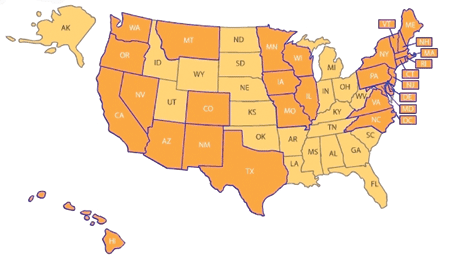
Like many other states (Figure 1), California has imposed renewable portfolio standards (RPS) on its utilities to force them to become “greener.” Renewable electricity typically has two components: the power itself, measured in kilowatt-hours, and renewable energy credits (RECs), also known as green tags or tickets. One REC is earned for every MWh generated by a renewable energy plant. If a utility generates more than enough green power to meet its annual RPS requirement, it can sell its excess RECs on the open market at their going price. If it can’t (or doesn’t choose to) meet the mandate with its own production, the utility has to buy RECs earned by others. RECs represent the environmental benefits of generating power from renewable resources, as opposed to producing electricity by burning nonrenewable resources such as fossil fuels.
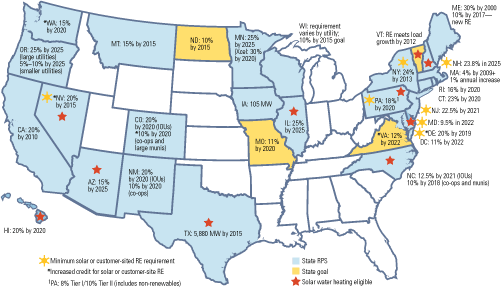
1. Crazy quilt. As of March 2008, 29 states and the District of Columbia had enacted some form of renewable portfolio standard. Each percentage represents the minimum share of a utility’s capacity powered by renewable resources. The utility may own that capacity or purchase it, and associated renewable energy certificates, from independent power producers. Source: DOE’s Database of State Incentives for Renewables & Efficiency
Two camps have different views of the best way to use RECs to meet environmental and resource planning goals. The more conservative camp believes that regulatory regimes should never allow RECs to be sold separately from the energy that generated them because such separation gives utilities that purchase RECs to meet their RPS a “license to pollute.” The other camp—the REC trading camp—feels that renewable energy development will benefit more if RECs and their associated energy are allowed to be sold separately. The REC trading camp continues to gain adherents as transmission resources are unable to keep pace with growth in renewable generation.
Firming and banking wind power
One of the services available to both camps is the ability to “firm” wind energy. Utilities that generate lots of wind power frequently offer buyers the option of smoothing out the delivered product by averaging its capacity on an hourly basis. A typical example is “hour-ahead firm” energy; if weather and wind forecasts indicate that a wind farm will generate 25 MW over the next hour, the utility guarantees that 25 MW will be delivered from its generation portfolio during that hour, regardless of the wind farm’s actual generation. Given wind’s inherent variability, which can cause operational and stability headaches, paying an extra $15/MWh for firm energy is attractive to some buyers.
A further service that may soon be offered to utility purchasers is the ability to “bank” wind energy. This concept envisions a utility storing the RECs associated with wind power production until a more advantageous time for the recipient, and then releasing them for sale along with new, not necessarily renewable, energy. Although this scheme would only work for those in the REC trading camp, it does provide a big benefit: delivery of “wind power” during peak-demand periods.
The impetus for this banking service is found in the newest (third) edition of the California Energy Commission’s Renewables Portfolio Standard (RPS) Eligibility Guidebook (download from www.energy.ca.gov/renewables/documents/index.html). In Section D of Part II, the guidebook states that “Electricity may be delivered into California at a different time than when the RPS-certified facility generated electricity. . . . Further, the electricity delivered into California may be generated at a different site than that of the RPS generated facility . . . out-of-state energy may be “firmed” or “shaped” within the calendar year.”
This language allows those in the REC trading camp to bank the renewable energy for delivery at some later time, and other sites to provide the energy that is ultimately delivered to the receiving utility. Presumably, these sites can deliver nonrenewable energy (“brown energy”), but it will be considered “green” as long as the RECs created by the renewable power production are credited exclusively to the delivered energy.

Take it to the bank
The ability to bank wind energy has multiple and far-reaching implications. Operationally, the major effect is to set a value on wind power capacity. One of the major shortfalls of using wind as a source of electricity is that wholesale-market dispatchers cannot rely on wind capacity being available to meet load (see sidebar “Loss of wind forces Texas to brink of blackout”).
Wind is typically assigned a capacity value of about 10% of total installed wind farm capacity. That is, for every 100 MW of wind turbines installed, the utility’s energy control center typically expects about 10% to be on-line at any given time. Some utilities do not assign any capacity value to wind; they use spinning reserve or fast-start generation to compensate for any shortfalls. For example, in Texas, ERCOT purchases these as “ancillary services.” Others use wind power to store energy for later use as on-peak capacity, for example by pumping water into a storage facility and then dispatching the hydroelectric energy during peak-demand periods.
Economically, the benefits of banking wind energy are enormous. Wind is capricious, but in most places it is stronger, and therefore capable of producing more power, at night, an off-peak time. Its value to a utility ranges from $15/MWh to $50/MWh. But in California, where wind speeds are higher than average, the typical wind energy price of over $70/MWh often causes negative cash flow for a utility. Even accounting for the value of RECs (whose prices are estimated to climb as high as $30/MWh), a 50% loss per MWh would not be atypical.
To compare the economics of banked energy versus unbanked wind energy, let’s see what firming wind energy would cost. Currently, the market is charging about $20/MWh to bank wind energy. So, if we purchase the wind energy for $75/MWh and then add $15/MWh to firm it and $20/MWh to bank it, we’re looking at $110/MWh as the total cost of wind energy. However, banked wind energy is more like solar power in that it is renewable energy that can be received on-peak. In fact, banked wind energy’s dispatchability makes it more valuable than solar because its capacity is much firmer.
Banked wind energy can be used on-peak; during the hottest summer days, it is worth $80/MWh to $300/MWh. Even taking into account the $30/MWh cost of a REC, buying wind at $110/MWh would be beneficial to most utility bottom lines.
Contractually, the acquisition of wind energy will change drastically due to the benefits of banking. Some utilities, like Southern California Edison (SCE), are willing to pay a premium for power delivered on-peak but much less for off-peak energy. For example, if SCE secures a wind deal for $100/MWh, the utility’s pro forma contract structures payments so they average $100/MWh over the year but are $328/MWh during the summer peak and $65/MWh during off-peak periods and winter months. The acceptance of energy banking by state energy regulators will enable contracts to be restructured to eliminate premium payments.
Connect the plants
Because they are powered by an intermittent resource, wind farms have an average capacity factor that rarely exceeds 40%. This has three negative and related consequences:
- Much of the transmission capacity built to deliver wind power to grids is underutilized.
- Transmission must be overbuilt to deliver wind-generated electricity.
- The cost of transmitting wind power is two to three times that of transmitting the production of conventional power plants.
However, if the wind energy is banked, it can be transmitted as a firm resource, allowing all of its transmission capacity to be leveraged. Assuming a $7/MWh cost for transmission and the usual wind power capacity factor of 33%, banking wind energy and transmitting it later (raising the capacity factor to 100%) would produce a potential transmission savings of $14/MWh.
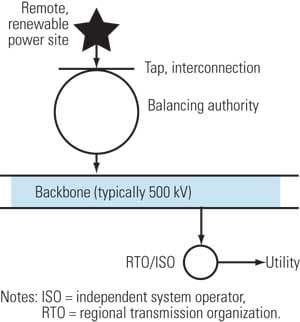
However, banking wind energy does pose some challenges to transmitting it. Wind farms are usually sited in remote areas where the wind is strongest, so hundreds of miles of transmission lines are typically needed to bring their output to load centers. While firm transmission is an increasingly scarce commodity, transmitting wind energy in real time has been less problematic because wind speeds are usually higher during off-peak periods. At those times, transmission capacity is readily available, although mostly as non-firm, day-ahead scheduling. Banking wind energy for on-peak consumption requires that on-peak transmission be available to move it to load centers. Since on-peak transmission is harder to come by, other steps must be taken.
Members of the REC trading camp would suggest that a utility do the following: Buy the wind energy at one location, spin off its RECs, and sell the wind energy as “brown energy” locally. The utility can then combine the RECs with brown energy at a second location that has better transmission access. Many in the camp believe that this legislative “sleight of hand” can help address the need for green energy by making the shortage of on-peak transmission moot. State regulators may impose some restrictions on how the trick is accomplished. For example, the California Energy Commission’s guidebook stipulates that the control area operator doing the firming and banking must be part of the Western Electricity Coordinating Council (WECC).
Guaranteeing generation
One of the obstacles preventing wind plants from becoming a first-rate electricity resource is the inability of wind farm owners and developers to accurately predict and guarantee wind energy delivery. Wind energy resource assessments typically use several years’ worth of wind data. These assessments typically develop estimates of long-term mean wind speeds based on on-site anemometer data or on reference anemometer data from a nearby location.
Once estimates of wind speeds have been made, they can be used to create power curves that estimate the electrical energy that wind turbines would produce at each speed. The resulting forecast, based on both estimates, is a probability-based energy production level for a wind farm. For example, “P99 energy” is the term used for the annual amount of energy predicted to be available at a point of delivery with a probability of 99% or greater. “P50 energy” describes the (larger) amount of annual energy expected to be available at a probability of 50% or more.
Since P99 energy has a 99% probability of meeting the expected energy production level each year, it typically becomes the “annual guaranteed energy” expected of a particular wind farm. Accordingly, a wind farm’s P99 level is calculated and certified by an industry wind assessment expert. Performance damages are sometimes sought if the plant fails to deliver the guaranteed generation. Sometimes, a “failure to perform” clause in a contract is triggered at a certain percentage of the P50 level or of another P level. It all depends on the negotiations between the utility customer and the owner of the wind farm.
Probability-based energy production levels also affect the building of wind farms because, as part of their financing, the level of expected revenues is based on substantiated generation numbers. If a wind farm’s guaranteed generation is from P99 wind, any revenues from additional sales of wind power with a lower P level are not used toward capital recovery or to meet investors’ return on investment targets. For this reason, the price of wind power at other P levels is usually substantially less than that of P99 wind. Since the only real costs incurred by the seller are incremental operation and maintenance costs, the prices paid for wind energy at levels other than P99 are typically 60% of that paid for P99 wind.
This bracketing combination of minimum annual energy guarantees and lower prices for non-P99 wind encourages wind farm developers to accurately present the generating capability of their plants. If the guaranteed generation is set too low, then more energy would be sold at the discounted rate each year. Conversely, if the guarantee is set too high, performance obligations might not always be met and could possibly result in the assessment of costly damage payments.
In planning their renewable resource portfolios, utilities typically choose suppliers willing to guarantee wind energy generation with low levels of uncertainty. The ability of wind farm developers to offer and meet an annual level of guaranteed generation is a significant milestone for an industry on the cusp of maturity.
Guaranteeing availability
As wind power becomes more important to more utility resource portfolios, so does the availability of wind farms. Some utilities address the issue by specifying in their contracts with wind farms a target mechanical availability for the project, such as 98% for smaller wind turbines or 95% for the megawatt-size turbines. This, along with annual generation guarantees, enables them to more effectively establish the reliability of wind power resources. The two guarantees work hand-in-glove, because it is conceivable that a wind farm could meet its annual guaranteed generation level with poorly performing wind turbines. Typically, guaranteed generation is an annual target, while mechanical availability is based on quarterly turbine performance statistics.
The main objective of requiring mechanical availability is to ensure that a wind farm is properly maintained and operated. But it also ensures that a minimum amount of energy is generated over a given period if the minimum mechanical availability number of the wind turbines is met. If this minimum production is not achieved, an energy shortfall will be declared and the wind farm owner will have to find a way to make up the difference that would have been generated had the turbines been fully available.
Calculating the guaranteed generation of a typical wind plant for a given period of time (usually one quarter of a year) illustrates these points. Guaranteed generation is calculated using the following formula:
GG = EQE x MAF = EQE x MAR x AH/TH
Where: GG is guaranteed generation.
EQE is the expected quarterly energy generated.
MAF is the mechanical availability factor. (Wind turbine manufacturers typically guarantee the mechanical availability of their units for two to five years following installation. After this period, it is up to the wind farm owner/operator to perform the maintenance necessary to ensure their required availability.)
MAR is the mechanical availability requirement (a percentage usually around 97%).
AH is actual hours—the number of hours in the given period, less two hourly sums. They are the total hours during the period that turbines are not operational because (1) they are being maintained, (2) there is a major power system emergency, or (3) wind conditions are too weak or strong.
TH is total available hours—the number of hours in a given period during which a wind farm’s turbines are physically capable of producing electricity.
Example calculation
Consider a 50-MW wind farm with an annual 35% capacity factor and turbines whose required mechanical availability is 97% for a given quarter. Now assume that, during a 90-day quarter, the wind farm has 30 hours of scheduled maintenance, 10 hours of power system emergency, and 40 hours when wind speeds are above or below the turbines’ operating range. Further, assume that during that quarter the wind farm generated 34,800 MWh.
For this quarter, the AH of the turbines is calculated as:
AH = (24 hours/day x 90 days/quarter) – (30 hr + 10 hr + 40 hr) = 2,080 hr
Since there are 2,160 hours in a calendar quarter, the turbines’ MAF during the same quarter would be:
MAF = 0.97(2,080/2,160) = 0.9341
The wind farm’s GG for this quarter would be the product of its EQE and MAF. In this case, the EQE would be the product of 50 MW, the number of hours in the quarter, and the projected capacity factor. Using our definitions, EQE would be 50 MW x 2,160 hours x 35%, or 37,800 MWh.
As a result, the wind farm’s GG for this quarter is 37,800 MWh x 0.9341, or 35,309 MWh. Because only 34,800 MWh are delivered to the meter, there would a shortfall of 509 MWh that the wind farm owner would have to make up.
Utilities typically buy wind energy using a power purchase agreement that may include an option to purchase the wind farm later as well, after its tax credits have expired (usually 10 years after its commissioning). In such cases, mechanical availability guarantees take on even more importance. Obviously, the utility would prefer the wind farm to have a high availability when it takes ownership. The operator, on the other hand, would be financially motivated to let turbine maintenance slip the last few years of operation. Guarantees of mechanical availability give wind farm operators an incentive to be conscientious about maintenance right up to the turnover date.
—Robert Castro (robert.castro@alumni.usc.edu) teaches graduate level power classes at the University of Southern California and negotiates wind generation contracts for a local utility. Fernando Pardo (flpardo@aol.com) is a supervisor of renewable energy development at a local utility.