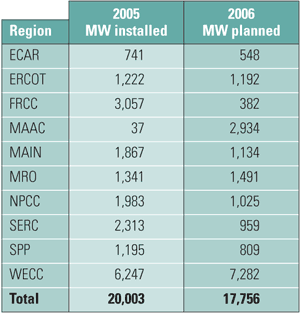
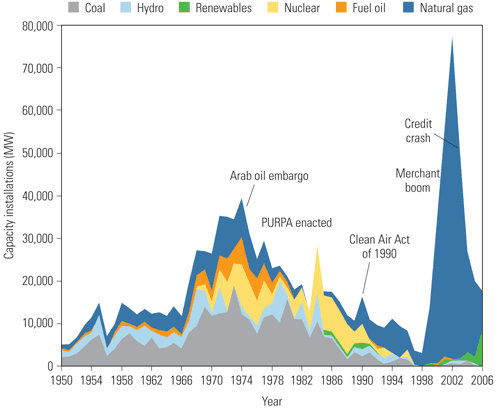
The boom-bust history of the U.S. electric power industry seems destined to repeat itself, with planned capacity additions for 2006 bottoming out at 17,756 MW—the lowest level in five years. In 2002 the plant building boom peaked when 77,100 MW were brought on-line, producing significant overcapacity in many areas. Capacity additions drifted downward in subsequent years: 50,678 MW in 2003; 27,033 MW in 2004; and 20,003 MW last year.
The 2006 additions come as reserve margins in 8 of the 10 North American Electric Reliability Council (NERC) regions are expected to sharply decline (see table). The confluence of the two trends is likely to exaggerate pockets of oversupply and undersupply in certain areas of the country, particularly the Northeast and Central regions.
Source: Platts
2005/2006 capacity additions by NERC region
The real surprise is the composition of the expected 2006 capacity additions—almost one-half (8,427 MW) is new wind generation scheduled to be commissioned during the year—the single highest annual total ever. Compare that to the 2006 capacity additions represented by natural gas–fired projects (largely combined-cycle plants): 8,440 MW. The remainder is accounted for by coal (496 MW) and small renewables projects, mostly wood and geothermal. In 2005 capacity additions featured a completely different mix: 16,556 MW were natural gas–fired and 2,758 MW were "fueled" by wind. What a difference a year makes (Figure 1).
Source: Platts
1. Roller-coaster ride. Annual capacity additions since 1950.
Gas prices rose, then sank
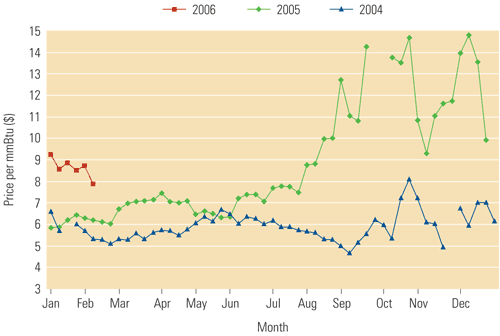
Coal still may be king of generation, but natural gas is getting plenty of attention, with prices fluctuating like a blip on a heart monitor. Developers of gas-fired plants are reeling from a sharp 2005 run-up of gas prices, which peaked in mid-December at almost $15.50/mmBtu (Henry Hub spot price) but then dropped to less than $8/mmBtu by the end of January. Many analysts believe average annual gas prices for 2006 will stabilize at a new average price of around $7/mmBtu—almost triple the $2.50 that combined-cycle plants enjoyed at the beginning of 2000.
Other analysts are betting that longer-term natural gas prices will dip to a new norm of between $5 and $8/mmBtu until enough liquefied natural gas (LNG) is imported to offset declining domestic production. In its December short-term energy outlook, the U.S. Energy Information Administration (EIA) raised its average spot gas price projection for this year at the Henry Hub by 3.3%, from $9.00 to $9.30 (Figure 2).
Source: EIA
2. Higher baseline. Natural gas spot prices at the Henry Hub.
Gas production is expected to be flat in 2006 and, over the next few years, to hover at around 18 to 19 trillion cubic feet (Tcf) annually. Since 2003 the count of active natural gas rigs has risen more than 30%, according to a November research note by consultancy Raymond James Financial Inc. The industry is now using almost every onshore natural gas drilling rig available. What’s more, gains in drilling efficiency have grown over the past two years. The net effect of all this activity, however, has been to maintain production growth essentially at zero, despite the 15% drop in Gulf production caused by Hurricane Ivan in 2004 and Hurricanes Katrina, Rita, and Wilma in 2005.
A complicating factor will be LNG imports. One analyst suggests that average prices could fall as low as $3.50/mmBtu once LNG becomes a more substantial ingredient of the U.S. gas supply mix. Now there’s an optimist, considering the regulatory hurdles and NIMBY chaff being thrown at developers of new LNG terminals such as the Long Beach project. The EIA predicted in an early release of its 2006 Annual Energy Outlook that, of the dozens of announced LNG terminal projects, only four will be built to serve U.S. markets—one on the Gulf Coast, one in Baja California, and two in eastern Canada.
The EIA went on to note that, although LNG (all imported) accounts for about 2% of current U.S. gas supply, plans are for the fuel to meet much of the country’s increased gas demand, expected to reach 22 Tcf in 2025. The Alaska natural gas pipeline, scheduled to break ground soon and be completed in 2015, will make another 1.8 Tcf available.
The issue for LNG is price. As LNG becomes a global commodity, many of the same supply/demand rules that apply to oil will come to govern its price. The gasoline price hikes of last fall in the wakes of Katrina and Rita should give us all reason to pause. Will we soon be dealing with a cousin of OPEC—OLNGEC?—on the world market?
Supersize me
Electric power is perhaps the last major U.S. industry in the U.S. to be looking to consolidation to increase economies of scale and cut operating costs. The repeal of the Public Utility Holding Company Act (PUHCA) by the Energy Policy Act 2005 (EPAct) could ignite a utility merger firestorm. EPAct handed significant new powers to the Federal Energy Regulatory Commission (see box, p. 32), which acted quickly by taking PUHCA off the books effective February 8. The repeal of PUHCA may or may not bear on the completion of four major utility mergers now pending: Exelon/Public Service Enterprise Group, Duke/Cinergy, MidAmerican Energy/PacifiCorp, and FPL Group/Constellation Energy. But it will certainly encourage additional megadeals widely expected to be announced in this and coming years.
The marriage of Exelon and Public Service Enterprise Group (PSEG) would create the country’s largest utility. The new entity—to be called Exelon Electric & Gas—also would be the country’s largest power generator, with 52 GW of capacity, 20 GW of it nuclear. Next in size would be the combination of Florida Power & Light (FPL) and Constellation, with 45 GW—24.5 GW of it merchant and 20.5 GW regulated. Although it would have less domestic impact, MidAmerican’s acquisition of PacifiCorp nonetheless would create a very large U.S. utility with a significant overseas presence; together, the two firms own and operate 123 plants in the U.S. and the Philippines with a cumulative capacity of 16 GW.
The four deals, however, may just be appetizers for the feeding frenzy anticipated this year, which could be the biggest for mergers and acquisitions since the late 1990s. The Exelon/PSEG and FPL/Constellation unions in particular might be prototypes of what could become the industry norm for years to come. Other utilities may not want to become as big, but they certainly want to be large enough to compete with the giants. In 1987 research analyst Edward J. Tirello, Jr. famously predicted—to much clucking—that the electric utility industry would consolidate from 150 companies down to 50 in five years. Tirello got the timing wrong, but he correctly identified the long-term trend. Many of his counterparts today say they wouldn’t be surprised if only 6 to 10 megautilities are dominating the U.S. landscape a few years from now.
The FPL/Constellation merger offers a new wrinkle—a traditional regulated utility joining forces with a company that has substantial unregulated assets. "We are an endgame player now," said Mayo Shattuck, the chairman, president, and CEO of Constellation, who will oversee the competitive wholesale and retail operations of the combined company as its chairman. Shattuck—who believes that generators, wholesalers, and retailers will need "scale, scope, and skill" to succeed—notes that there are about 100 U.S. companies that "could be considered ‘utilities.’" In contrast, Japan "has seven companies that supply . . . a population half [that] of the United States. So . . . you know over the course of the next 5 to 10 years" that there will be much more consolidation here.
Plants run by money managers?
Other utilities remain undaunted in their search for the diamond hidden in a mountain of coal. NRG Energy stepped into the major league of merchants with its acquisition of Texas Genco’s 11,000-MW fleet, bringing the firm’s total capacity to 25 GW and matching FPL/Constellation’s merchant hand. As part of the deal, NRG Energy received Nuclear Regulatory Commission approval to take ownership of Texas Genco’s 44% stake in the South Texas nuclear power plant.
Separate from the Duke/Cinergy deal, LS Power Equity Partners (a subsidiary of LS Power Group) has reached an agreement to purchase Duke Energy North America’s 5,275 MW of merchant capacity in western states and its 846 MW of capacity in New England for $1.5 billion, or about $245/kW. In both regions, reserve margins are low and wholesale prices often high. The deal is expected to close in June.
Still, LS Power—a $1.2 billion private equity fund created in 2005 with the aim of investing in power generation and related assets in the U.S.—will need to deal with three hard facts. Almost all of the capacity it is buying is fired by natural gas, some of the plants are old, and several operate only as peaking units. The fund expects to use third-party debt financing to help pay for the acquisition.
LS Power’s entry into the power business augurs a greater presence for equity firms. "The number of initial public offerings will increase in the energy sector in 2006 as companies spin off assets to lower debt, reward shareholders, and take out cash," New York–based consultancy PricewaterhouseCoopers wrote. And, says PricewaterhouseCoopers, look for lots of action in the independent power sector, "with private equity and hedge funds continuing to play a major role. Non-gas-fired power plants may fetch a premium leading to increased asset sales in this robust market, with coal-fired assets recently fetching upwards of $1,500/MW."
For sale—cheap
Meanwhile, the prices of gas-fired plants sold are taking a hit nationwide, with some modern merchant facilities fetching as little as 50 to 70 cents on the dollar. Peaking plants are being discounted even more deeply. The trend is most pronounced in regions (such as California, the Northeast, and the PJM area) where there is strong asset competition from utilities and in markets where deregulation wasn’t successful. The "build it and they will come" mentality has proved to be more myth than substance.
The good news, however, is that the freefall in prices for merchant generating capacity over the past three years appears to have halted. That should cheer sellers, because more than 100,000 MW of generation—an amount equal to that bought and sold since 2002—is expected to change hands in the next 12 to 18 months, Cambridge Energy Research Associates (CERA) said in a report issued at the end of last year.
When U.S. power plant sales began to gather momentum in mid-2002, lightly contracted or uncontracted merchant plants generally were not included in the deal flow, the CERA report explained. But that situation has changed since the beginning of 2004, with more than 80% of nearly 58,000 MW in announced transactions coming out of the merchant sector.
Although investors in the power sector have different objectives, they typically own generating assets for shorter periods than do strategic owners such as utility affiliates and IPPs. That mind-set poses significant challenges to plant O&M staffs whose planning horizons are measured in years rather than in financial quarters.
"The increasing participation of financial investors points to the deployment of additional capital in the market, increasing competition for assets, and a sustained near-term and future transaction volume," reads the CERA report. "In projecting 100,000 MW of near-term transactions, we considered assets currently owned by financial investors, given their shorter-term objectives."
CERA also said that pricing trends suggest merchant plant valuations will continue to show an increasing "locational bias, with plants in capacity-constrained, deregulated markets selling at higher pries than merchant facilities located in regions with excess capacity and more tightly regulated markets." Other drivers of merchant asset value include the uncertain structure of capacity markets, overcapacity and transmission bottlenecks (in some regions), relative fuel prices, and local and regional environmental regulations.
Lights out on Broadway?
For a good example of mismatched supply and demand, consider New York City, which expects to experience a generation shortfall by 2010. In addition to the need to meet peak demand that sets a new record each summer (last year’s was 11,304 MW), existing plants representing at least 3,000 MW are old enough to warrant replacement. Although plenty of power is available from upstate and Quebec, the Big Apple is a "load pocket" with too few transmission lines entering it. Accordingly, the New York State Reliability Council requires that 80% of the electricity consumed in the city be generated within it. Local planners estimate that the city will need to add 6,000 MW to 7,000 MW by 2025.
As usual, politics has made a bad situation worse. Four years after it expired, "Article X" siting (which provided a quick, one-stop permitting process for plant developers) has yet to be reauthorized by the state legislature. Its two houses have deadlocked because bills in the Democrat-controlled Assembly have sought a lower MW threshold for siting review and stricter environmental standards.