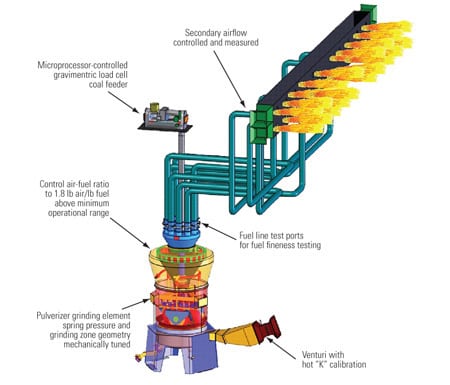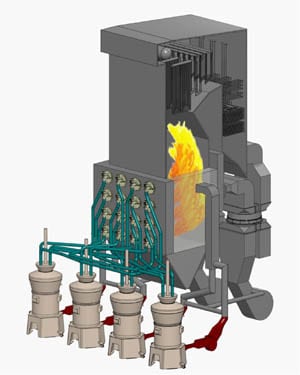
We complete our two-part series on pulverizer O&M practices with a step-by-step review of important areas where close attention to dimensions and design features will increase coal processing capacity. The first part of this series, published in the October 2008 issue of POWER ("Finessing Fuel Fineness"), explored the importance of balancing the fuel and air entering and leaving the pulverizer to achieve good coal combustion in the furnace. In this article, we focus strictly on pulverizer O&M practices that every plant should be following.
Manufacturing tolerances were much looser a generation ago, which resulted in a good deal more variation in key dimensions than we find acceptable today. For some readers, the term "blueprinting" will evoke memories of hot-rodding a Detroit V8 engine after carefully machining and assembling it to the manufacturer’s specifications or "blueprints." The expected result was power output greater than that of a stock engine straight from the showroom floor, and we were seldom disappointed. We’ll use the same vernacular in this article to refer to the process of restoring a pulverizer or mill (the terms are used interchangeably) to better-than-"showroom" performance.
Balancing Act
Pulverized coal ground finely and distributed to the burners is burned in suspension, much like natural gas. To optimize combustion in the furnace, the air-fuel mixture can be readily divided equally between coal pipes leaving the mill and will burn much like natural gas when the coal is ground very fine to a mean particle size of about 50 microns. Keep in mind that the density difference between coal and air is about 1,000 to 1. Performing this balancing act efficiently is a good indicator of excellence in pulverizer performance.
Improved pulverizer performance often can be achieved by blueprinting the tolerances and settings. Most of the coal-fired power plants we visit use vertical-spindle pulverizers or pulverizers with a vertical shaft that drives a grinding ring or table. "Verticle-spindle" is used generically in the industry to include pulverizers such as MPS, MB, MBF, RP, Raymond Bowl (RP), and others. Interestingly, when you look closely at two pulverizers sized for a given weight per hour throughput, many design and performance features are very similar. Let’s take two different original equipment manufacturers’ pulverizers sized for about 120,000 pounds of coal pulverization per hour: one an RP mill design (Figure 1) and the other an MPS design (Figure 2).
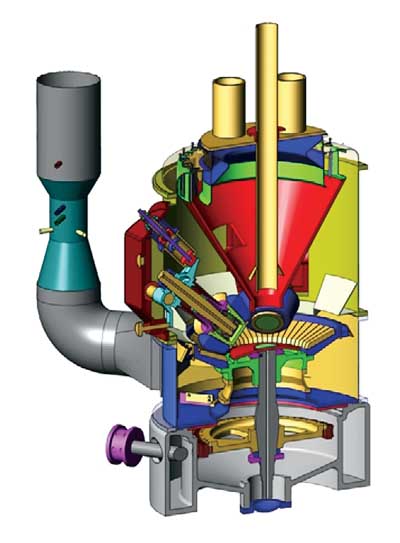
1. A typical RB pressurized bowl mill, size 983. Courtesy: Storm Technologies, Inc.
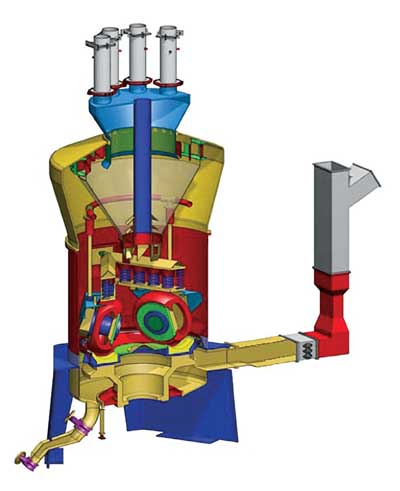
2. A typical MPS 89 pulverizer. Courtesy: Storm Technologies Inc.
Both mills have vertical spindles and horizontal grinding tables or bowls. In part one of this series, pulverizer capacity or throughput was described as being not simply a static rating in tons per hour. Rather, as that article explained, the capacity of a coal pulverizer is a complex function of the fuel fineness desired, the coal’s Hargrove Grindablity Index (HGI), and the coal’s raw feed size and moisture content (see Figure 3 in "Finessing Fuel Fineness"). Plant operators can only improve throughput of a given mill with a particular coal (moisture and HGI are typically outside operator control) by sacrificing fineness — by producing a coarser product for the burners.
This situation is akin to being between the proverbial rock and a hard place. Changing fuels or suppliers may not be possible to improve mill performance, and in many plants, mill throughput problems are more than likely caused by a new fuel supplier providing lower-quality fuel. That’s the rock. The hard place is the fact that reduced fuel fineness will directly contribute to increased NO x production and poorer furnace performance. The only option available to maintain mill throughput in many plants, beyond burner tune-ups, airflow optimizations, and coal pipe balancing or adding more sootblowers, is to optimize or blueprint the pulverizers.
A Four-Step Plan
Blueprinting a pulverizer isn’t rocket science, but it does require close attention to the details. Here is our four-step plan to restore and improve performance of your pulverizer, regardless of its age.
Step 1. Ensure that the grinding elements are in good condition. Make sure that the grinding surface profiles are optimum. That means using the original design grinding profiles for your mill. The majority of coal pulverizers sized around 120,000 pph use three grinding elements, referred to as journals, rolls, or tires. For best results, all three grinding elements should be replaced in matched sets. The concentricity, physical dimensions, and contours must be exactly the same. This is especially important when maximum preload pressure is required to produce maximum coal fineness and/or with lower-than-original design HGI. We have seen mills assembled with unmatched sets of three grinding journals using maximum spring pressure. The result of such setups: The main shafts break because of the unbalanced load. Matched sets of grinding elements and exactly the same size rolls with exactly the same contour are important for maximum reliability.
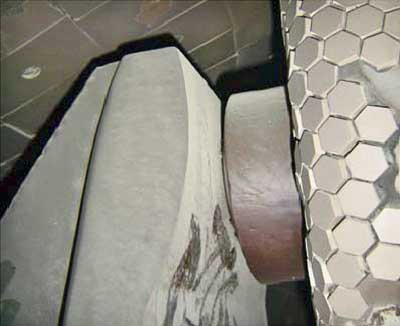
The grinding surfaces also must be in good condition and parallel (Figure 3). Don’t expect optimum performance if the grinding elements are well-worn or the tires are "flat" (Figure 4). Unusual wear patterns are often the result of uneven spring frame tolerances, alignment issues, pressure variations, geometry, and/or eccentricity issues.
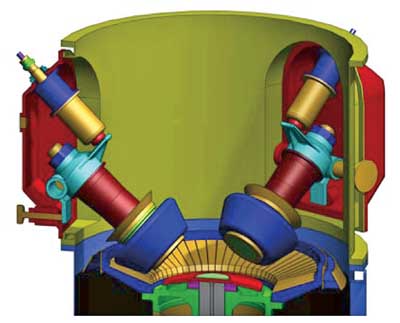
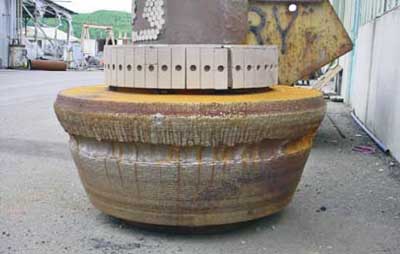
3. Walk the line. The profile of the roll should be parallel with the grinding ring profile. Courtesy: Storm Technologies Inc.
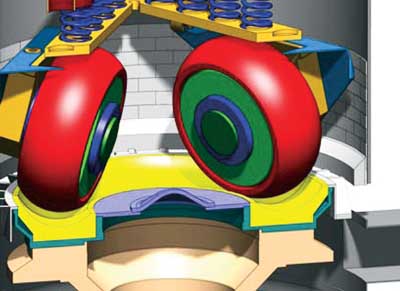
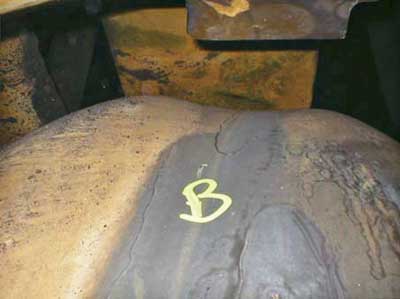
5. Perfectly round. In an MPS mill, the tire and table profiles must match, and the tires should not have flat spots. Courtesy: Storm Technologies Inc.
Step 2. Set the correct grinding pressure. Check your mill to confirm that the grinding roll or spring frame preload pressure is set correctly. Our experience with both RP and MPS pulverizers has been that mills designed for a throughput of about 120,000 pounds of coal per hour, an HGI of about 45 to 50, and coal fineness exceeding 75% passing 200 mesh will require about the same force on the grinding elements. It is reasonable to expect that grinding coal will take about the same amount of grinding element pressure regardless of the type of medium-speed, vertical spindle pulverizers you use.
In our experience the spring frame of an MPS mill tuned for maximum true capacity will be set at about 20 tons minimum force on the grinding tires. A bowl mill spring or hydraulic preload for this size of mill will also be about 20 tons of pressure. Lower-HGI fuel and greater than passing of 200 mesh requires the maximum pressure of the grinding elements. Keep in mind that in operation there is no metal-to-metal contact, and all coal grinding results from the pressure applied coal particle – to – coal particle on a bed of coal squeezed between the grinding elements.
Internal clearances are also very important. For example, a bowl mill spring canister can be set to the needed preload, but if it is not adjusted for the "button" to roll with assembly minimum clearance, then the preloading does not come into play until the roll rides up on a deeper bed of coal (Figure 5). Ensuring sufficient grinding pressure is absolutely essential, and it begins with setting this critical tolerance.
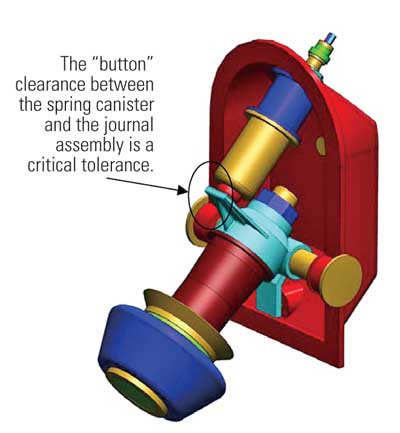
5. Keep your distance. The "button" clearance between the spring canister and the journal assembly is a critical tolerance. Source: Storm Technologies Inc.
For a spring frame mill, the hydraulic preload must be balanced across the mill and the grinding elements perfectly centered in the assembly (Figure 6).
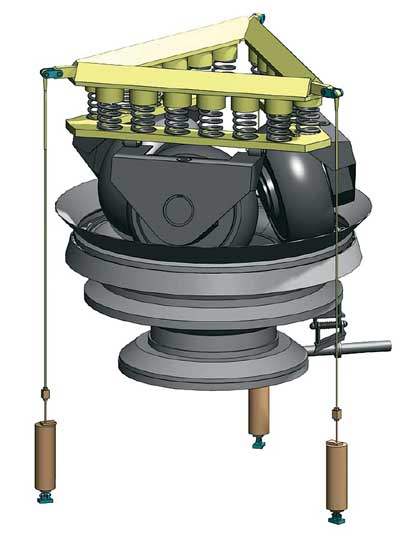
6. Balanced load. The MPS spring frame hydraulic preload must be carefully balanced and the spring frame centered for optimum mill performance. Courtesy: Storm Technologies Inc.
Step 3. Set the correct pulverizer throat clearance. An oversized pulverizer throat will require more than optimum primary airflow to minimize coal rejects. The pulverizer "free annular jet" of vertically flowing airflow, in our experience, must be adjusted for a minimum of 7,000 fpm under normal operation. Throats that are oversized will result in either excessive coal rejects (not tramp metal or pyrites, but raw coal).
Compounding the problem, high primary airflow is the main cause, in our experience, for poor fuel fineness, poor fuel distribution, and reduced furnace performance. Right-sizing the flow area of the pulverizer throats and matching them for compatibility with the coal pipes and burner nozzle sizes is essential for the best furnace performance. Furthermore, remember that there will be minor variation in mill capacity, fuel quality, and mill inlet airflow rates that must be considered when sizing the pulverizer throat flow area.
The vertically flowing air must be of sufficient velocity to suspend the granular coal bed in the grinding zone. Some designs use mechanical means to keep the coal above the under-bowl pyrite section, while others use airflow. Reducing coal rejects by mechanical means entails increasing the height of the "bull ring" extension ring or the extension of flat surfaces above the rotating throat to trap or dam coal particles mechanically so that they remain above the throat.
We prefer the optimum throat area fluidic solution to suspend the coal bed and reduce the potential for fires beneath the bowl or grinding table. Keep in mind that if the fuel is above 17% moisture and the air/fuel ratio is about 1.8, then the under-bowl primary air temperature will be above 450F. Any coal that falls through the throat opening will combust unless it is removed in mere minutes. Combustion of coal particles beneath the grinding zone is not a serious problem, as long as the mill is in operation. But if a mill trips or a boiler has a main fuel trip, then fires in the pyrites zone (beneath the grinding zone) are the most common cause of pulverizer "puffs," in our experience. A fire beneath the grinding zone provides the ignition temperature to initiate a mill "puff" when restarting a mill after a trip or restarting it after a main fuel trip when coal remains in the bed.
For safety as well as for performance reasons, properly sizing the mill throats is extremely important (Figure 7). The optimum throat area is determined by calculating the free annular jet area when the desired air/fuel ratio (usually 1.8 lb air/lb fuel) is known. Also, the throat area must be properly designed to be compatible with the flow areas of the burner coal pipes and coal nozzles (Figure 8).
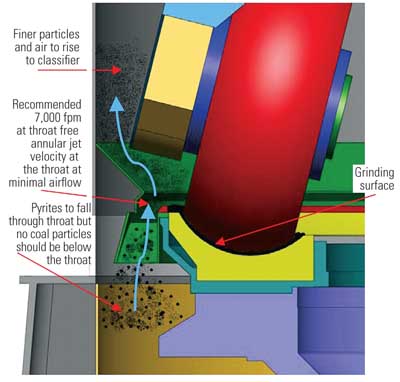
7. Optimum design. Ensure optimum arrangement of the mill throat and the coal flow path to improve mill performance. Source: Storm Technologies Inc.
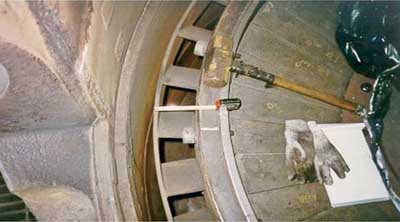
8. Close tolerances. Pulverized coal mills with throats that are too wide will have corresponding low throat velocity in the mill grinding zone that contributes to excessive coal rejects and fires. This is an example of an oversized mill throat. Courtesy: Storm Technologies Inc.
Step 4. Properly maintain the classifier. Once the grinding zone is blueprinted and put in first-class condition, the next component to examine is the classifier. The best furnace combustion performance is governed by uniform coal combustion by the burners and satisfactory coal fineness. Adequate fineness for both western and eastern fuels (Powder River Basin or bituminous) is a minimum of 75% to 80% passing 200 mesh and zero to 0.1% remaining on a 50 mesh screen (Figure 9). To achieve this fineness, the pressurized mill classifier must perform two functions:
-
It separates particles small enough to be supplied to the burners (mean particle size about 40 to 55 microns) from larger coal particles that need return to the grinding zone for regrinding.
-
It balances the distribution of coal to each coal pipe.
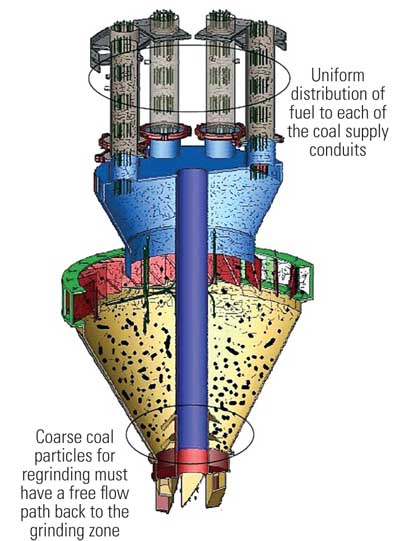
9. Why use a classifier? A classifier recirculates coarse coal in the grinding zone and balances the flow of coal to each burner line to the furnace. Source: Storm Technologies Inc.
The flow of coal particles through a classifier is several times the amount of coal flowing to the burners because of the large amount of coal recirculated within a pulverizer. For example, if a pulverizer is operating at 100,000 lb/hr coal feed to the burners, as much as 300,000 lb/hr or more may be flowing through the classifier for regrinding. For this reason the surface smoothness and inverted cone clearances are extremely important for good pulverizer performance.
Our experience over the years has helped us develop a number of proven minor enhancements for achieving best classifier performance. The critical dimensions indicated in Figure 10 include:
-
Surface smoothness of the classifier cone.
-
Synchronized classifier blade angles and lengths.
-
Inverted cone to classifier clearances.
-
Classifier outlet cylinder length and flared opening.
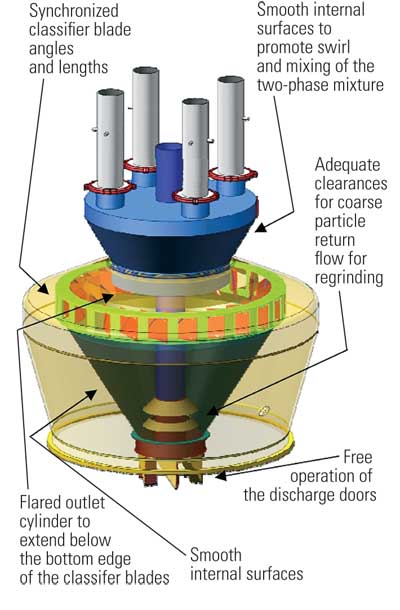
10. Better than good. Areas of the classifier where performance can be improved. Source: Storm Technologies Inc.
Other improvements that should be considered when overhauling a classifier include these:
-
Smooth surfaces in the upper turret section for good fuel spinning and uniform distribution (no surface discontinuities, such as "pad eyes").
-
Ensure the free movement and closure of the discharge doors (trickle valves).
-
Confirm the sound and good condition of the classifier cone assembly (no holes should be worn through).
-
Ensure the good mechanical condition of the classifier blades.
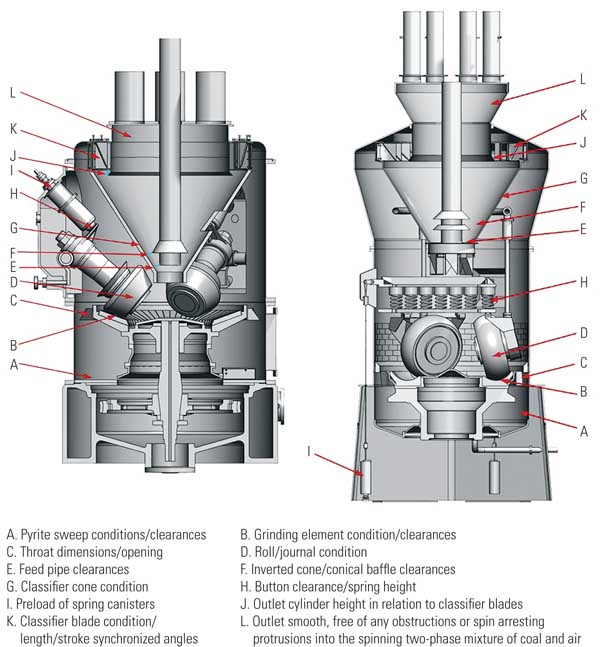
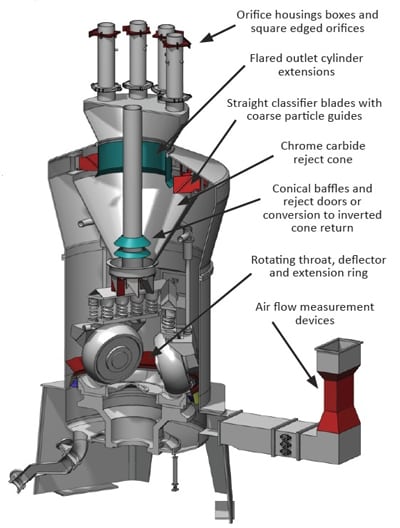
11. Mill design guide. An internal view of a typical vertical-spindle pulverizer and specific areas where special attention to dimensional tolerances and assembly dimensions can improve mill performance. Source: Storm Technologies Inc.
Figure 11 illustrates the locations of what we consider to be the most critical measurements and tolerances in the RP and MPS pulverizer designs.
–Richard F. (Dick) Storm, PE (rfstormsea@aol.com) is senior consultant for Storm Technologies Inc. and a POWER contributing editor.