Cap-and-trade programs are featured in at least two U.S. legislative proposals to reduce carbon emissions, usually by around 80% by 2050 using a 2005 baseline. The benefits that accrue from the immense investment required to reach these goals are nebulous and don’t occur until decades after the investment. Based on my back-of-the-envelope analysis, the cost-benefit ratio of these proposals does not pass a cursory cost-benefit analysis.
I have searched the literature and found little published on cost-benefit analysis of the latest cap-and-trade proposals such as the ill-fated American Clean Energy and Security Act (aka Waxman-Markey). The recently unveiled American Power Act (APA) seems to have more utility executive support than Waxman-Markey but still proposes to reduce CO2 by 80% over the same period.
Useful Financial Tool
A cost-benefit ratio is a simple financial tool, among many, used by prudent government managers to evaluate the beneficial impacts of environmental policies against project cost for a slate of alternatives. Often the analysis includes aspects of a project that are difficult to quantify, such as quality of life and expected health effects. Similar analyses were made prior to SO2, NOx, and other earlier pollutant reduction rulemaking. The results always found that the benefits for society far outweigh the costs.
What is the cost-benefit ratio for the proposed APA cap-and-trade regime? It’s time, as I have on several occasions in this column, to pull out my pen and envelope and run the numbers.
The Benefits
The APA proposes to reduce CO2 emissions by 17% by 2020, 43% by 2030, and 80% by 2050 from a 2005 baseline.
Recent Energy Information Administration data show that the portion of global CO2 emissions of all types attributed to the U.S. is 20.2%, decreasing (given the expected emissions increases from less-developed countries) in the out years. The trend in atmospheric CO2 concentration for the past few decades is about a 2 ppm per year increase, so I extrapolated the uncontrolled global ambient CO2 concentration in 2050 as 90 ppm over the 2005 baseline. The portion attributed to the U.S. is conservatively estimated as 20% of 90 ppm—let’s use 100 ppm globally or 20 ppm as the U.S. contribution. If CO2 is reduced 80% on schedule by 2050 per APA, then the U.S. contribution to the global increase will only be 20% of 20 ppm, or 4 ppm.
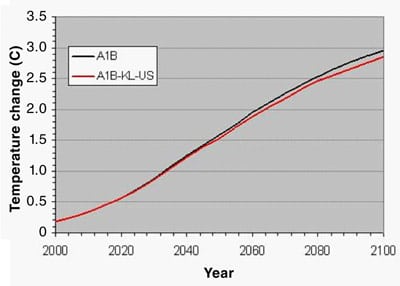
According to the Intergovernmental Panel on Climate Change (IPCC) Fourth Assessment Report (AR4), if carbon emissions continue unabated, then we should expect global average annual temperatures to increase by 2C (rounded up) by 2050 using the worst-case (Case A1B) projections. The estimated IPCC pre-industrial level of CO2 is 280 ppm, and unabated CO2 levels in 2050 are modeled as rising to 560 ppm, using the same Case A1B projections.
Let’s now put pen to paper. I estimate the maximum U.S. contribution to global temperature rise by 2050 as 2C x (18–4) ppm/280C = 0.1C over the next 45 years. The same calculation for the year 2020 is only a 0.02C temperature rise.
Climatologist Chip Knappenberger used the standard IPCC climate models to conclude that Waxman-Markey would decrease global average temperatures by about 0.1C by 2100, so my estimates are in the ballpark. For comparison, the accuracy of a high-quality thermocouple is ±1.0C.
The Costs
The Environmental Protection Agency’s (EPA’s) cost analysis of Waxman-Markey estimated that by 2020 each U.S. household would pay $160 per year and that the cost would rise to $1,100 per year by 2030 for a carbon-reduced economy. Other analyses found the numbers to be significantly higher (the Heritage Foundation predicts numbers 10 times larger), but let’s go with the EPA numbers. Under this plan—which includes many idealized and controversial caveats, assumptions, and footnotes too numerous to discuss—the EPA concluded that the Waxman-Markey carbon cap-and-trade system will cost up to 0.8% of our economic consumption by 2050 if it is not enacted.
The Ratio
The IPCC AR4 report concluded that a 4C temperature increase will cost the global community up to 3% of global economic output. Let’s use that ratio to scale our numbers to determine the benefits (actually, avoided economic and environmental damage) of carbon controls.
If we use a 0.1C temperature rise by 2100, then the U.S. will be hit with 0.1 divided by 4 equals 0.08% decrease in economic output from a non-carbon-controlled economy. In other words, the costs of compliance (0.8% drop in economic consumption) is 10 times the benefits received (0.08% temperature reduction). My quick and dirty analysis certainly has many flaws, but the result remains clear: A cost-benefit ratio of 10 is a very poor investment by any reasonable standard.
The day of the climate scientist as rock star has passed. A Gallup poll survey conducted March 4–7 found that 48% of Americans now believe that the “seriousness of global warming is exaggerated,” up from 31% in 1997. I expect this survey percentage to continue its rise as the public learns more about climate science irregularities and the cost of the EPA’s CO2 rules.
For professional politicians, these poll results probably carry more weight than a thorough business case analysis of the APA. However, the recent primary results show the public’s interest in supporting successful businesspersons that will appreciate a good case study over professional politician.
Be it poll-driven politics or business acumen, I expect our current and future Washington representatives will soon understand that carbon cap and trade is just another poorly timed energy tax and a legislative non-starter.
—Dr. Robert Peltier, PE, is POWER’s editor-in-chief.