The recently published Long-Term Reliability Assessment from the North American Electric Reliability Council (NERC) found that several areas of the U.S. and Canada risk falling below minimum capacity target levels within three years, as demand continues to outpace new supply. This risk of supply shortages requires action.
In addition to the usual solutions of more generation, transmission, and demand-side management, the required actions include increased attention to fuel supply and delivery—gas in particular—and the establishment of viable power pricing rules. Furthermore, a shift in mindset is needed, to a recognition that the power generation industry’s future market opportunity is not only in low-cost power but also in reliable power.
Fuel supply and delivery challenges
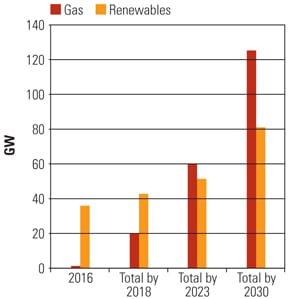
Natural gas supply or delivery interruptions can occur during extremely cold weather, when some gas pipelines are fully utilized to supply gas for home heating. Generating units whose fuel source can be interrupted can’t be counted as "available" capacity for meeting electricity demand requirements. These factors haven’t caused a widespread problem in the past, but the situation is changing rapidly. Almost half of the new power plants projected to be added through 2015 will be gas-fueled. Add all of this up, and it’s clear that we need more pipelines, we need delivery contracts that ensure the availability of these generating units, and we need them soon.
More pipeline capacity is only part of the answer. Gas suppliers don’t have to, and in many cases can’t, commit to building new pipelines without firm contracts for that service.
Power generators typically avoid firm gas transportation contracts because interruptible contracts are less expensive. In summer-peaking regions, purchasing year-round firm gas transportation to cover infrequent winter cold snaps may not be economically justified. But the risk of fuel interruption can be greatest in those cold months when high electricity demand coincides with high gas demand.
In essence, generators are taking the risk of flying standby rather than purchasing guaranteed, full-fare airline tickets. The difference is that, in the airline analogy, only the passenger suffers if he can’t get on his standby flight. In the power generation scenario, customers suffer. In extreme cases, our economy suffers too.
Some generators have addressed potential gas interruptions by making gas plants dual-fuel capable. But using oil, the likely alternative fuel, is expensive and raises environmental issues.
As the supply vs. demand picture tightens, more market operators have turned to incentives to ensure that power is available when demand is highest. Herein lies a taste of the more powerful and sustainable solution, which will require both regulation and market forces to have an industrywide impact.
The market responds
Federal regulators are beginning to put in place pricing policies that reflect the value of long-term reliability and firm, long-term contracts to the industry and consumers.
For example, the Federal Energy Regulatory Commission (FERC) recently approved an ISO New England market rule that requires power generators to make resources won in auction available to serve the regional grid when consumers most need electricity. If they don’t, they can lose a significant percentage of their monthly forward capacity market payment. The New York Independent System Operator and PJM Interconnection are establishing similar market rules.
These market operators have the right idea, and FERC is supporting them. Regulators and market operators need to do even more to provide effective price signals to make these longer-term commitments attractive to generators. Generators, for their part, need to help move things forward. The old way is no longer sufficient. It’s time for a new day in power generation.
A call for long-range thinking
NERC is not suggesting that generators sign money-losing contracts. Rather, we are making an operational statement based on fact: We need more power plants with fuel supply and delivery arrangements that will ensure that those plants are available when they’re most needed.
A reliable bulk power system is the shared responsibility of generators, electric and gas transmission companies, gas supply companies, NERC, the regional entities, and federal and state regulators. But generators hold in their hands the ability to put one very large piece of the solution in place: They can firm up gas supply and transportation (and electric transmission) contracts.
Let’s make 2007 the year that our industry shifts away from the past, tumultuous decade’s short-term planning strategy and returns to long-range thinking. With our eyes on the needs of the next decade and beyond, let’s act today to put in place the necessary market rules, contracts, and infrastructure that will eliminate the risk of supply shortages and preserve the reliability of the North American electric grid.
—Rick Sergel is president and CEO of the North American Electric Reliability Council, which is the government-appointed electric reliability organization for the U.S., Canada, and part of Mexico, working to ensure that North America’s bulk power system is reliable, adequate, and secure.