Owner/operator: AREVA Solar
The 5-MW Kimberlina Solar Thermal Energy Station is the first to use compact linear Fresnel reflector technology developed to generate continuous superheated steam, a key element for higher-efficiency power generation and integration with new and existing plants. The facility’s innovative technology helps deliver power even during periods of transient cloud cover.
 |
| Courtesy: AREVA Solar |
Situated in central California’s breadbasket region, Bakersfield is a key agricultural center and a center for petroleum extraction and refining. Now this area is harvesting another abundant resource: the sun’s energy.
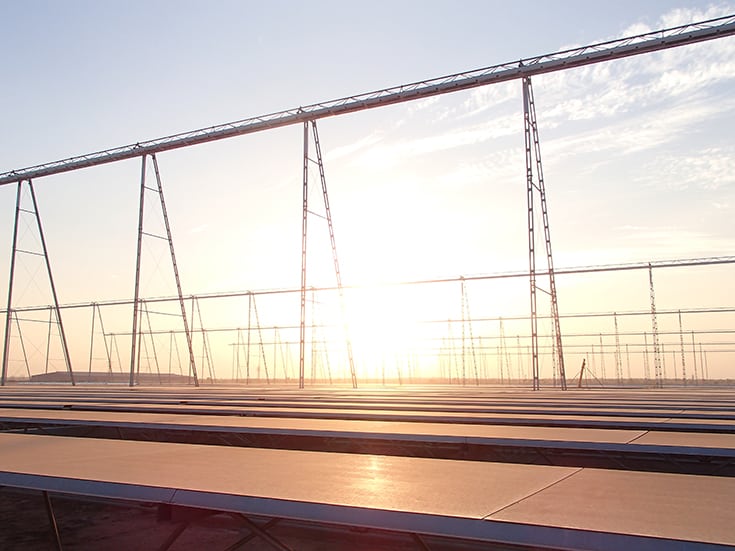
The Kimberlina Solar Thermal Energy Plant, (initially developed by Ausra, which was purchased by AREVA Solar in February 2010), began operation in 2008 with its first three solar steam generators (SSGs), which used saturated steam boilers. Since 2009, the plant has operated with approximately 96% availability. In 2010, AREVA Solar constructed, commissioned, and began operating its fourth solar steam generator (SSG4) at the 5-MW Kimberlina facility in Bakersfield (Figure 1), which is the first to use direct steam compact linear Fresnel reflector (CLFR) technology, a type of concentrating solar power (CSP).
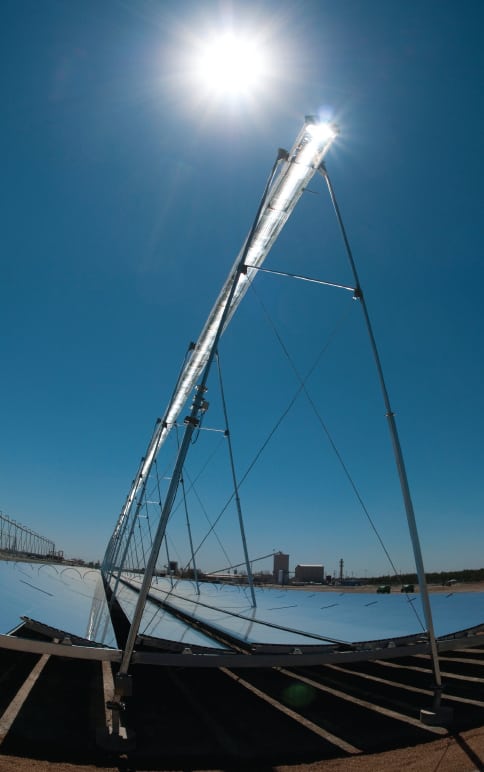 |
| 1. Solar light and heat. The Kimberlina facility in Bakersfield features the first once-through, direct steam compact linear Fresnel reflector (CLFR) superheated solar steam generator. This major technology advancement drives down costs for stand-alone CLFR plants and improves the integration of solar resources with fossil-fired power plants for solar augmentation and solar/hybrid power applications. Courtesy: AREVA Solar |
“It uses the most advanced CLFR technology in the world,†Katherine Potter, vice president of communications for AREVA Solar, told POWER in October. The result is lower costs for stand-alone CLFR plants and easier integration of solar resources with fossil-fired power plants for solar augmentation and solar/hybrid power applications.
AREVA Solar was able to achieve direct steam generation through a proprietary model predictive control system that overcame the challenge associated with parabolic trough systems of temperature gradients in the absorber tubes and controllability of the two-phase water/steam flow.
At full capacity, Kimberlina’s solar steam generators can generate up to 25 MW of thermal energy or up to 5 MW of electricity—enough power to supply 3,500 central California households, according to Potter. Field trials during September 2010 consistently demonstrated steam flow exceeding predictions during steady and transient conditions, while maintaining exit steam conditions at 60 ±3 bar and 370 ±20C. The SSG4 is expected to generate up to 450C superheated steam by year-end.
Kimberlina’s SSG4 proved that AREVA Solar’s CLFR technology can help deliver power even during periods of transient cloud cover. During “lights out†testing, SSG4 had sufficient solar thermal inertia to supply more than 18 minutes of superheated steam.
Kimberlina is designed to help meet California peak demand and has operated with high availability since it entered commercial operation. Its peak production comes during Central California’s peak demand times, when fossil-fired electricity is most expensive. A key benefit of solar energy is that the cost of its fuel—solar radiation—will remain consistent while the price of fossil fuels will remain volatile.
Technical Innovations
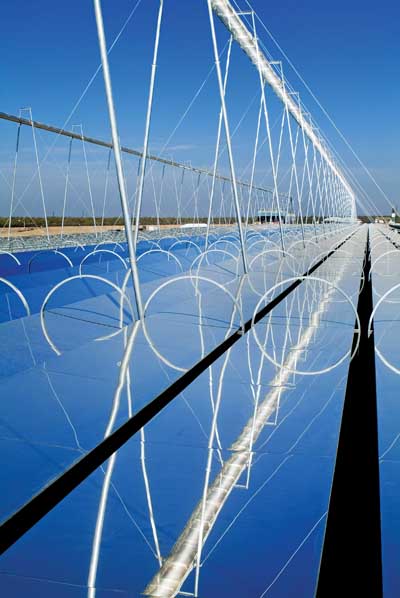
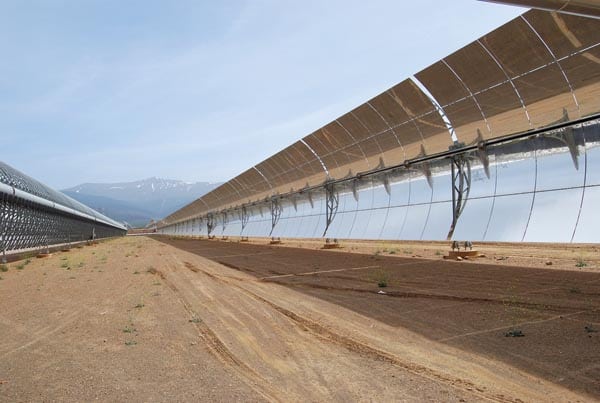
In order to generate solar power, CLFR technology uses long, thin segments of mirrors, or reflectors, to focus sunlight onto a fixed receiver. These rows of reflectors can concentrate the sun’s energy up to approximately 50 times. With AREVA Solar’s technology, concentrated energy is transferred through boiler tubes in the receiver, ultimately generating high-pressure superheated steam. Unlike some solar thermal technologies, AREVA Solar’s CLFR uses water as a working fluid, thus eliminating the need for costly synthetic oils and heat exchangers. And to maximize water conservation, CLFR uses a closed-loop system. Once heated, the superheated steam powers a steam turbine.
The SSG4 delivers sustained, superheated steam in a quick and cost-saving manner, Potter explained. The design improves steam production performance by eliminating steam separation and recirculatory systems. Once-through direct steam generation greatly simplifies the overall system design by eliminating vessels, tanks, pumps, heat exchangers, and ancillary equipment. The tube bundle incorporates multiple passes, with superheater tubes arranged in the high flux regions and economizer/evaporator tubes arranged in lower flux regions. This ensures sufficient heat flux to sustain superheated steam temperatures throughout the operating day and reduces the average bundle temperature to reduce radiant heat losses. By eliminating the recirculatory systems, the once-through SSG reduces cost and startup time substantially, while enhancing performance.
“Kimberlina served as the testing ground for AREVA Solar being named the first solar steam power boiler manufacturer to receive the American Society of Mechanical Engineers’ (ASME) ‘S’ Stamp Certificate of Authorization,†Potter said. “An ASME ‘S’ Stamp is considered the industry hallmark of acceptance and certification.â€
Plant Profile
The reflectors and receiver tubers used at Kimberlina were manufactured at AREVA Solar’s Las Vegas manufacturing facility. Construction management was provided in-house. Subcontractors were engaged for civil, structural, mechanical, and electrical activities, and the SSG4 boiler assembly was performed by AREVA Solar.
“Kimberlina’s SSG4 demonstrated the rapid erection of AREVA Solar’s CLFR design. Construction was accomplished over a six-week period within budget,†Potter said.
Unique for field-erected boilers, the SSG4 tube bundle was welded at grade. After being inspected, the receiver and tube bundle support structure was placed over the bundles, secured, and then the entire receiver structure, with boiler tubes, was hoisted to its operating position, 60 feet above grade. One of the most significant successes of the project was the scheduling and sequencing of commissioning activities. Overall—from permits, procurement, preparation and issuance of contract documents to construction and commissioning—the entire project took just six months.
Overcoming Obstacles
Although Bakersfield has a good solar resource during the peak summer demand period, it experiences less-favorable and less-consistent solar conditions in the fall and winter, Potter explained. This challenge provided AREVA Solar with a good opportunity to test superheated steam production during interim cloud coverage.
Unlike PV facilities, whose output is immediately interrupted by cloud cover, Kimberlina was able to sustain up to 18 minutes of superheated steam production during a period of cloud cover—demonstrating the benefits of solar thermal power and AREVA Solar’s CLFR technological advancement, according to Potter.
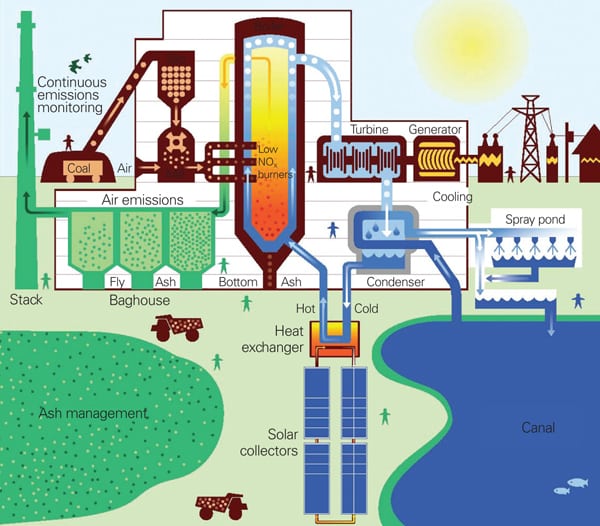
The environmental and visual impacts of power project development can often be of concern to the local community. Potter emphasized that “AREVA Solar designed its CLFR to minimize its environmental footprint.†The technology uses water as its working fluid, which eliminates the use of flammable synthetic fuels or expensive molten salts used in other CSP technologies. Its closed-loop system helps ensure maximum water conservation. CLFR is also the most land-efficient solar technology, using up to 2.6 times less land compared with other solar technologies. And, unlike fossil-fired power plants, solar power has no emissions.
Bright Future for CLFR Technology
AREVA Solar’s success at Kimberlina is leading to other commercial ventures. For example, the company is constructing a solar power augmentation project at the Kogan Creek coal-fired power plant in Australia and has been chosen as the preferred solar thermal provider for the Solar Dawn project in Australia. Potter said the company also is exploring product development advancements that would use CLFR for enhanced oil recovery applications.
—Angela Neville, JD, is POWER’s senior editor.