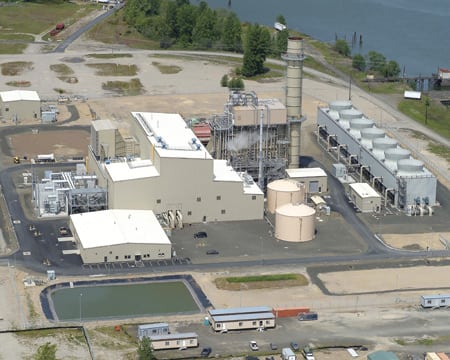
Bethlehem Energy Center (BEC) is a 750-MW (nominal) mid-merit merchant plant that entered commercial service in July 2005. It was one of the first plants to be approved and permitted under New York State’s Article X siting law.
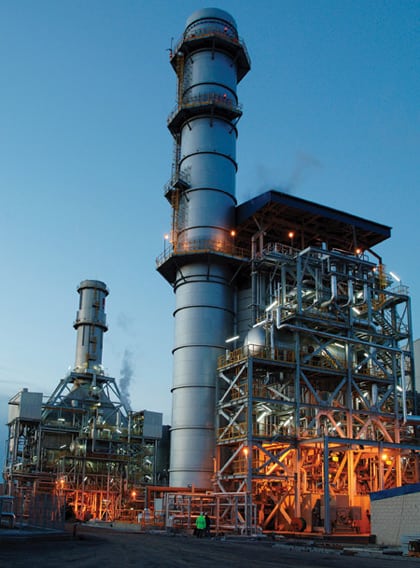
BEC (Figure 1) is located on the west bank of the Hudson River about 3 miles south of Albany. The plant has a 3 x 3 x 1 combined-cycle configuration: three GE 7FA combustion turbine-generators (CTGs) exhausting at 1,140F to three Nooter/Eriksen heat-recovery steam generators (HRSGs) whose outputs are combined to feed one GE D11 steam turbine-generator.
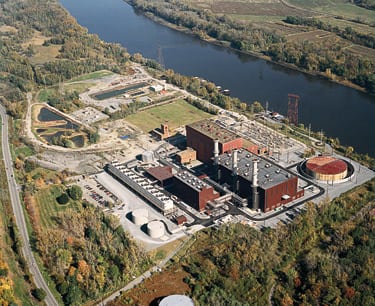
1. Sitting pretty. The new 750-MW Bethlehem Energy Center, on the west bank of the Hudson River. It replaces the 50-year-old Albany Steam Station—the faded brick building just west of the switchyard, which was reused. Courtesy: PSEG Power
With supplementary firing of the HRSGs by natural gas, the plant’s rating rises to 763 MW. The high-, intermediate-, and low-pressure sections of the steam turbine operate at 1,750 psi, 350 to 400 psi, and 80 to 90 psi, respectively. The unit’s high-pressure section produces 1 million lb/hr. A 100% steam turbine bypass system facilitates fast plant start-ups with the steam turbine not operating.
The CTGs fire natural gas as their primary fuel and low-sulfur distillate oil as backup. When firing oil, the units are water-injected to minimize their NOx output. The CTGs’ inlet air (at a flow of 750,000 cubic ft/min) is evaporatively cooled, and their dry low-NOx combustors reduce emissions of the pollutant to single-digit levels.
Gone but not forgotten
Bethlehem Energy Center was built on the site of the Albany Steam Station, which PSEG acquired from Niagara Mohawk Power Corp. in 2000. Originally rated at 376 MW, the plant had four identical units that entered service between 1952 and 1954 and were designed to burn coal. In 1970, all four units were converted to burn residual fuel oil; in 1981 they were converted again to be able to burn natural gas as well, uprating the plant’s capacity to 400 MW. The four 100-MW units were housed in one building and served by two control rooms.
The new plant uses the switchyard of the old plant, which was "abandoned in place" and decommissioned in February 2005. All asbestos has either been removed or encased and tagged, and the first, second, and third floors now are used for storage, the new plant’s electrical shop, maintenance shop, and instrumentation and control shop.
When PSEG Power laid up the old plant, a company group dedicated to managing retired assets salvaged and sold everything in it of significant value—stainless steel, titanium condenser tubing, some pumps and motors, pulverizer components, and some step-up transformers. The group also is responsible for maintaining the encapsulated asbestos in the Albany plant in that condition.
Project history
When PSEG bought the Albany plant, the company briefly considered keeping the 50-year-old steam turbine-generators. But PSEG decided against doing so, because it would have been prohibitively expensive to retrofit the machines with the modern technology required to interface the old plant with the new.
For example, each of the old turbines still was equipped with its original Mark II GE governor, which is basically one step up from a manual throttle. What’s more, the infrastructures of the turbines proper weren’t set up to accept automation. The required shell modifications would have been extremely costly, and the logistics of the piping needed to link the old plant with the new would have been horrendous.
Having made that key decision, PSEG then turned to exploiting the fairly attractive infrastructure logistics of the 83-acre site. Two natural gas pipelines run under it, and in 2000 a connection was made to a higher-pressure Tennessee Gas Pipeline 2.5 miles away. The existing switchyard connects to the 345-kV bulk transmission system of the New York Independent System Operator (NYISO) via seven 115-kV lines.
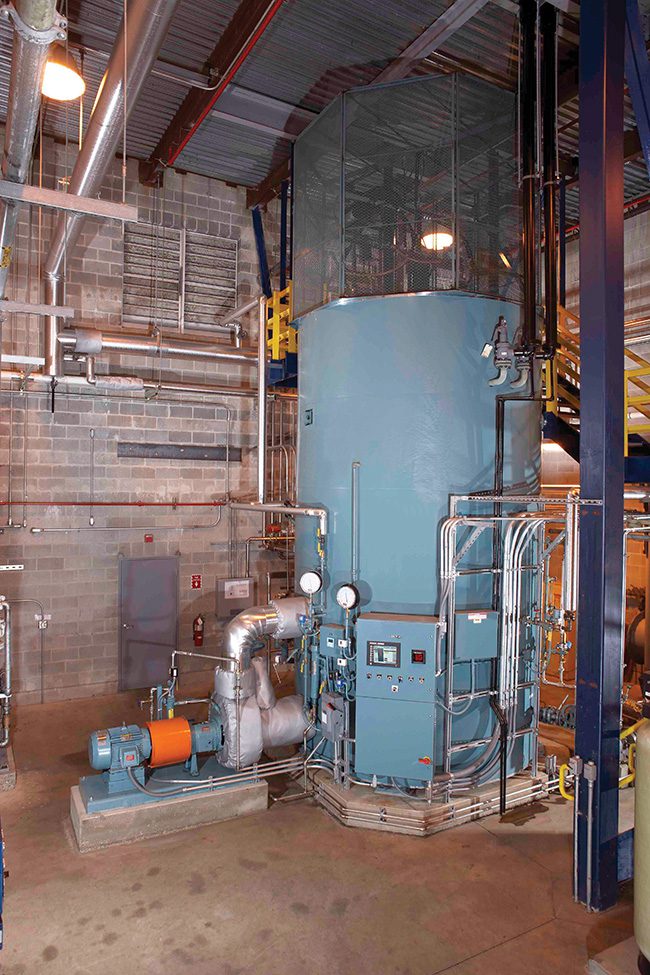
Another plus of the site is that fuel oil can be delivered by ship and unloaded at the Albany plant’s dock. Already on-site were five large, heated oil storage tanks. Two were removed to make room for the new steam turbine building, and two were converted to store demineralized water for plant makeup (Figure 2), giving BEC a demin storage capacity of 2 million gallons—four times the typical capacity of a plant of its size. The final tank, 40 feet high and 200 feet in diameter, provides the plant’s fuel oil storage capacity of 9 million gallons.
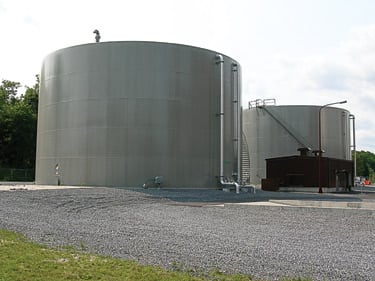
2. Storage liquidity. In the foreground is an oil tank of the old plant that was converted to store demineralized water for the new one. Courtesy: PSEG Power
In October 2002, after doing considerable work on the site, PSEG had to revise the estimated completion date of the repowering project to the second quarter of 2005 for reasons of financial prudence. From that point on, the project, which cost $500 million, went smoothly, thanks to the professionalism and diligence of its many suppliers (see table).

Bethlehem Energy Center’s key equipment and services suppliers. Source: PSEG Power
From efficiency and environmental standpoints, BEC is a tremendous success. The 54% efficient combined-cycle plant uses 36% less fuel per kilowatt-hour than the 36% efficient Albany Generating Station, producing 94% less SO2 and 90% less NOx in the process. Its hybrid (wet/dry) closed-cycle cooling water system (see box) reduces offtake from the Hudson River by nearly 99%. BEC’s construction was supported by the local community and endorsed by a number of health and environmental organizations, including the American Lung Association of New York, the Natural Resources Defense Council, (Hudson) RiverKeeper, and Scenic Hudson.
Distinctions with a difference
Perhaps the most attractive characteristic of BEC’s site is its location. It is not only within NYISO’s footprint (the robust New York City market is just 150 miles downriver) but also near a small load pocket that includes Albany. Significantly, that load pocket requires considerable reactive support during the summer, when everyone uses their air conditioners, and winter, when they run their electric heaters. Providing that support by selling ancillary services to NYISO was an opportunity that made completing BEC even more attractive to PSEG, which—like any utility—is always on the lookout for sources of revenue other than capacity payments. The old plant’s switchyard connections allow the plant to pump reactive power directly into Albany.
Usually, during periods when electricity demand is low but NYISO needs the reactive support, BEC is run in a 1 x 1 or 2 x 1 configuration, rather than in full-capacity 3 x 1 mode. That was the case this past January and February, when the plant was operated in a less-than-maximum-capacity configuration for an average of 10 days.
At those times, the combined-cycle system fires natural gas. Although BEC’s operating permit "grandfathered in" 5,000 fuel-oil operating hours from the old plant, oil is fired only once a week—normally following a shutdown—to keep everything in protocol (seals lubricated, lines packed, etc.). The fuel-oil supply is ready to go at all times. A robust program is in place to ensure that switching to liquid fuel can be done quickly and seamlessly if there’s a natural gas excursion.
Another interesting aspect of BEC has to do with its design. The plant uses vacuum pumps as opposed to steam-jet air injectors, which eliminates dependence on an auxiliary boiler for plant start-up. When starting up a combined-cycle system, unless there’s a cross-tie between main steam and auxiliary steam, it’s impossible to keep steam-jet air injectors in service as the steam turbine ramps up, because there’s not enough extraction steam to keep things going.
To solve the start-up steam problem, PSEG could have installed service ejectors and a hogger but chose not to. Another option was to tie in an existing auxiliary boiler at the old station. But doing so might have caused cross-contamination (especially on the return side), because the old boiler’s piping is entirely carbon-steel.
Going green
The main reason that BEC won the support of local and national environmental groups was that PSEG Power went the extra mile necessary to make the plant a good neighbor. Because the repowering project increased the site’s rated capacity, it triggered a New Source Review (NSR) under the 1977 Clean Air Act Amendments, to be administered by the New York State Department of Environmental Conservation (DEC).
Retiring the Albany Steam Station and replacing it with a clean gas-fired combined-cycle system made complying with the air-quality improvement requirement of the NSR easy. Similarly, BEC’s closed-cycle cooling system—a vast improvement over the Albany plant’s wasteful once-through cooling system—made meeting water-quality improvement mandates child’s play.
Satisfying the New York DEC would take far more than that, however. For example, as a condition of obtaining a permit for the plant, PSEG had to do some significant environmental remediation. The company had to create 1.5 acres of new wetlands for every acre displaced by the new infrastructure of the riverside plant. (Relatively, that wasn’t much of an imposition; the nearby Athens Generating Plant that went on-line in 2004 had to remediate wetlands at a 5:1 ratio.)
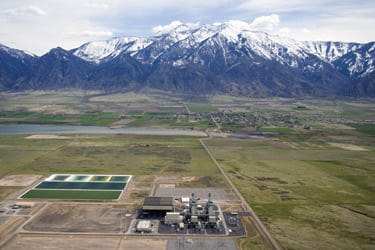
Given the site’s number of overhead power lines and underground gas lines, building the new wetlands was a bit of a tight squeeze. But PSEG turned the trick. It set up an estuary and planted indigenous trees, shrubs, and plants of the right species to maintain botanical diversity (Figure 3). The company even stocked ponds with "mosquito fish" (Gambusia affinis), known for their appetite for mosquito larvae.

3. Quacking the code. To obtain a permit for the repowering project, PSEG had to create one and a half acres of wetlands for every acre taken away by construction of the new plant. Courtesy: PSEG Power
Making BEC aesthetically pleasing was another condition of the permit to repower. To reduce the visual impact of the new plant on the surrounding area—including the river—PSEG sawed off the four stacks of the old plant, which stood 175 feet above the nine-story (162-foot-high) main building. Here, too, the presence of overhead power lines complicated the task. The crane needed for the demolition of the stacks had to be erected in place, rather than wheeled in.
Another aesthetics hoop that PSEG was asked to jump through involved the visible vapor plumes generated by the new plant’s wet/dry cooling towers. The company found that the incidence of "blue plumes" could be reduced by 75% (compared with a wet tower) by installing louvers halfway up the towers (Figure 4). When the dew point hits a certain level, the louvers open automatically, releasing from the side of the tower a considerable volume of air that otherwise would have reached the top. At dew point plus several degrees, a certain amount of steam vented to atmosphere will travel only a short distance before disappearing. The part of the steam that is latent heat remains visible, but not the part that is water vapor.
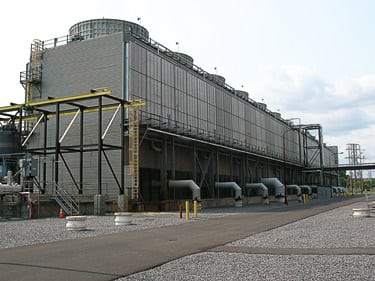
4. Now you see it . . . Triggered by dew point, louvers halfway up the cooling tower bank open automatically to reduce Bethlehem Energy Center’s emissions of "blue plumes." Courtesy: PSEG Power
So far, so good
Since being commissioned last summer, Bethlehem Energy Center has given PSEG Power just what it had in mind when it bought Albany Steam Station in 2000: a 750-MW addition to its 14,000-MW fleet that runs efficiently and cleanly and is well-positioned to make a profit. Between July 18, 2005, and June 30, 2006, the plant operated for 3,733 hours and generated 1,835,062 megawatt-hours.
Just as important, BEC can boast of a perfect safety record. As of this June 30, the plant had accumulated 2,294 days without a lost-time accident. Since commissioning, some 708,850 hours have been worked by plant employees without an OSHA-recordable incident.