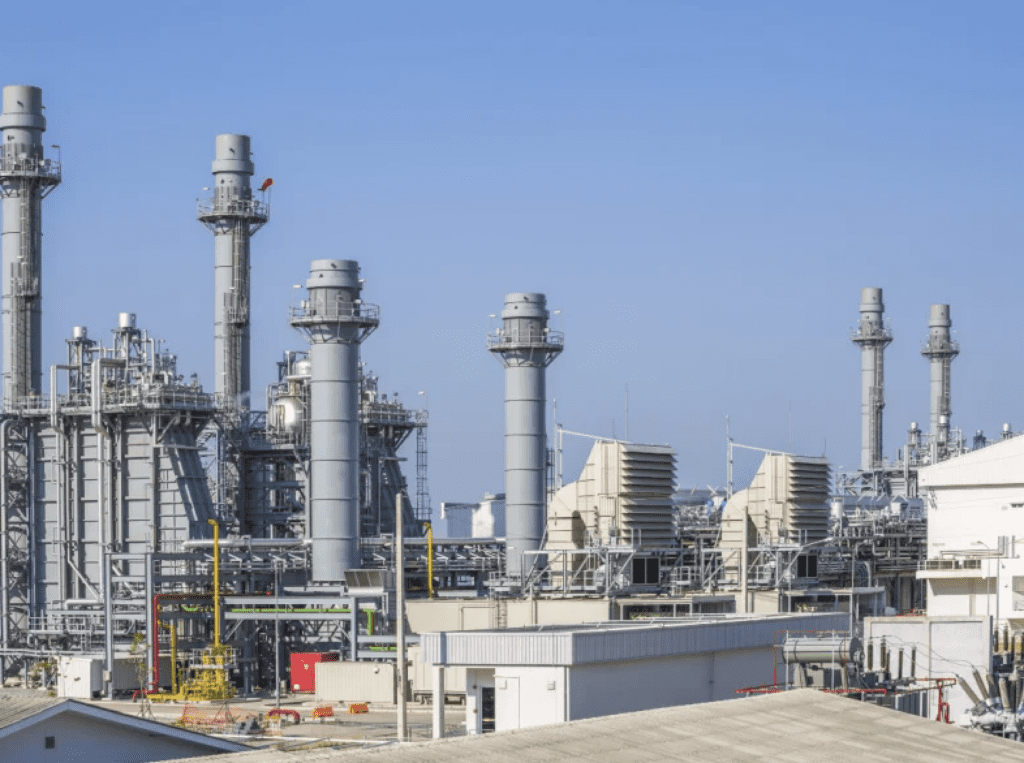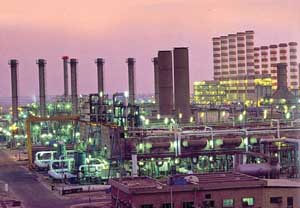
At the Ras Laffan Power Co. facility, the 756-MW net combined-cycle plant and the integrated 40 million gallons per day desalination plant are working in tandem to provide abundant, reliable electricity and desalinated water to residents of the State of Qatar, the most prosperous nation in the Middle East.
The emirate of Qatar is a dynamic symbol of the modern Middle East. In Doha, Qatar’s capital, new skyscrapers and beautiful beaches are juxtaposed with traditional souqs (market places). Large oil and natural gas reserves have made Qatar the second-highest per-capita income country in the world.
With Qatar experiencing explosive growth in recent decades, its demand for both electricity and potable water has greatly increased. To deal with these twin needs, the Ras Laffan Power Co. (RLPC) launched the integrated 756-MW net gas-fired power and desalination plant in Ras Laffan Industrial City, which is located on the coast approximately 50 miles northeast of Doha. The desalination plant produces 40 million gallons per day (mgd) of desalinated water.
RLPC was formed to build the very first independent water and power plant in Qatar, following a 2001 emiri decree. It is a joint venture between AES Corp., Qatar Electricity & Water Co., Qatar Petroleum, and Gulf Investment Corp. The facility started full operation in May 2004 and is operating under a 25-year power and water purchase agreement with Qatar General Electricity and Water Corp. (KAHRAMAA), the sole off-taker and the only entity in Qatar responsible for power and water transmission and distribution. The facility is being operated by AES Ras Laffan Operating Co.
Qatar’s Electric Power Industry
Qatar, a relatively small country in terms of geographical size, has a population of 1,696,563 (as of Qatar’s July 2010 census). The country’s economy is primarily dependent upon oil and natural gas production and refining.
Qatar is utilizing its estimated 8.96 trillion cubic feet of gas reserves to build industrial, chemical, and power plants. The country aims to raise its electric generating capacity to 9,000 MW by 2012 from 4,200 MW as of last May, according to state-controlled Qatar National Bank.
The Gulf Cooperation Council (GCC) countries have established the GCC Interconnection Authority to develop the GCC power grid. This power grid will reduce high long-term investment costs for constructing electrical generation plants by reducing the level of reserves needed in each country. It also will provide wheeling services and enable energy trading. Qatar will be able to export 500 MW of electricity to neighboring states during peak-demand summer months by 2012 over a regional electric grid.
The Facility’s Desalination System
The desalination plant consists of four multi-stage flash evaporator (MSFE) units, according to Shaukat Ali, the facility’s operations and maintenance (O&M) coordinator, and Said Alavi Chemmadan, its operations engineer. Each MSFE unit has 21 stages and is capable of producing 10 mgd of distillate. The plant was built by Fisia Italimpianti, an Italian company (Figure 1).
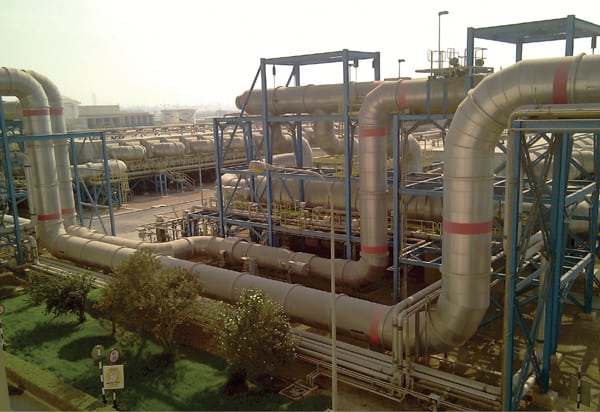 |
| 1. Technology at work for a water-scarce region. The desalination system consists of four multi-stage flash evaporator units. Each unit has 21 stages and is capable of producing 10 million gallons a day of desalinated water. Courtesy: Ras Laffan Power Co. |
The MSFE distillation process distills seawater by flashing a portion of the seawater in a series of spaces called stages, each containing a heat exchanger and a condensate collector. The sequence has a cold end and a hot end, while intermediate stages have intermediate temperatures. The stages have different pressures corresponding to the boiling points of water at the stage temperatures. The desalination train is equipped with brine recirculation pumps, and the evaporators are a cross-tube type manufactured by Belleli Energy.
At the Ras Laffan facility, low-pressure steam is provided by the combined-cycle plant to the desalination plant’s MSFE units and later is returned through the condensate recovery system. In turn, distillate from the desalination plant is provided to the combined-cycle plant, which uses it for its cooling tower makeup and steam cycle.
The desalination plant has been in operation for seven years. During that period, the facility’s net water production has ranged from 52 million cubic meters (m3) in 2006 to 61 million m3 in 2009, as per demand from the KAHRAMAA. During the same period, the plant’s availability ranged from 85% in 2006 to 95.78% in 2009.
Overview of the Combined-Cycle Power Plant
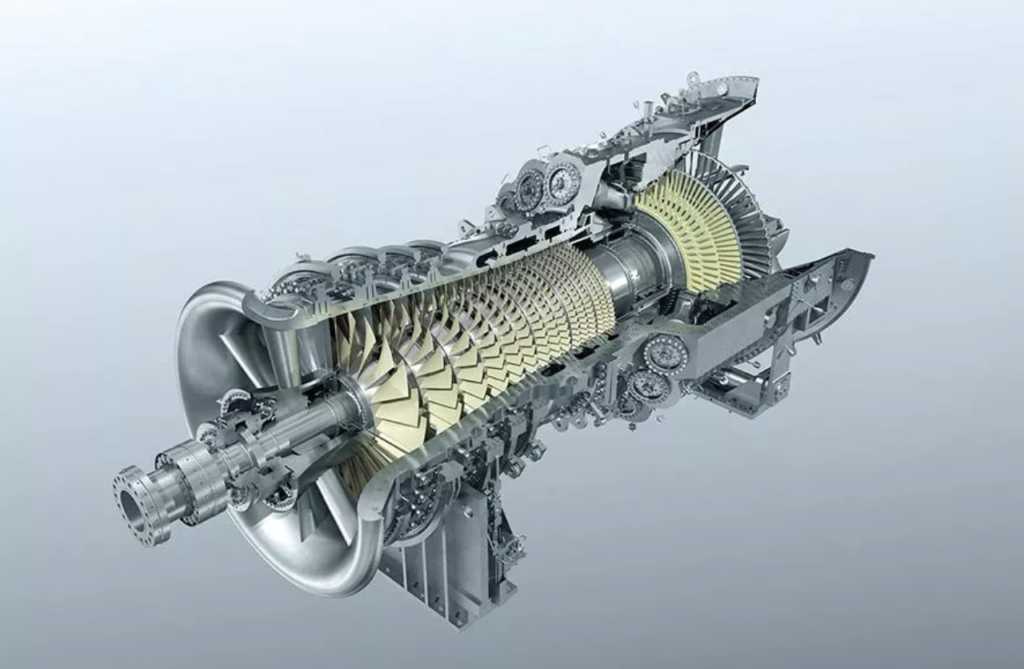
The gas-fired power plant has four 127-MW (ISO conditions) General Electric PG9171E gas turbines. In addition, it has two Franco Tosi CSD33A-50/1 steam turbines, each with a capacity of 200.4 MW.
During the plant’s past four years of operation, its net production of electricity has ranged from 4,512,249.9 MWh in 2006 to 4,198,149.5 MWh in 2009. During that same period, the plant’s availability has ranged from 93.19% in 2006 to 94.02% in 2009.
The main engineering, construction, and procurement contractor for the combined- cycle plant was ENEL Power. For the open-cycle portion of the plant, construction took 16 months; the plant was commissioned at open cycle in April 2003. Installation and commissioning of the steam turbines and desalination plant took an additional 11 months, and their commissioning was in May 2004. Total construction time for the combined-cycle and desalination plants was 27 months.
Because the power plant began operating in 2004, no major modification has been carried out. The equipment and machines are being maintained proactively to ensure the best availability and reliability of power and water supply to the off-taker.
Maintenance Practices
“ ‘Put safety first’ is our first core value, and we practically live it not only at the plant but in our daily life. The safety statistics demonstrate the same,” said James Noronha, the facility’s safety team leader, and Asim Riaz, the facility’s operations manager. “The last lost time accident [LTA] occurred in August 2006, and since then the plant has achieved 6,951,475 man-hours without any LTAs” (through May 2010).
“Great people are an organization’s best assets, and we value our O&M team of 76 members, which is bringing laurels to our company by setting and achieving the par excellence targets in operations and maintenance,” said Venkatachalam Kuppusami, the plant manager, and Zafar Iqbal, the engineering manager. “This small team has reduced the equivalent forced outage factor to 0.75% in 2008, 0.33% in 2009, and 0.21% up until June 2010.”
Ras Laffan personnel focus on predictive maintenance (PdM) rather than preventive maintenance (PM) and breakdown maintenance (BM). PdM is based on condition monitoring, and the staff proactively take advantage of the following techniques:
- Partial discharge monitoring on all generators
- Thermography of all major electrical and mechanical equipment
- Vibration analysis
- Boroscopic inspections
- Ultrasonic leak detection
- Lube oil analysis
- Ultrasonic thickness gauging
“We monitor the ratio of PM:PdM:BM measured in terms of man-hours spent on a monthly basis to refine our maintenance strategy,” said Muhammad Yaser, the condition monitoring and reliability engineer at the facility.
Environmental Initiatives
“Environment, health, and safety [HSE] have always been our top priorities,” said Anindya Sunder Chatterjee, the HSE coordinator. “We achieved ISO 14001 certification in 2006. We are regularly audited for implementation of environmental policies by leading auditors who follow stringent standards.”
To help conserve the environment, Ras Laffan management has reduced water consumption and hazardous chemical usage in the demineralization process by 50% to 60% through optimizing the mixed-bed regeneration process.
The RLPC is also pursuing a Clean Development Mechanism project, which allows countries with emission-related commitments under the Kyoto Protocol to implement an emission-reduction project in developing countries. It will reduce carbon dioxide (CO2) emissions by implementing a new energy efficiency project, which is projected to cut CO2 emissions by 7,030 tons and save approximately 132,915 mmBtu per year of natural gas.
— Angela Neville, JD, is POWER’s senior editor.