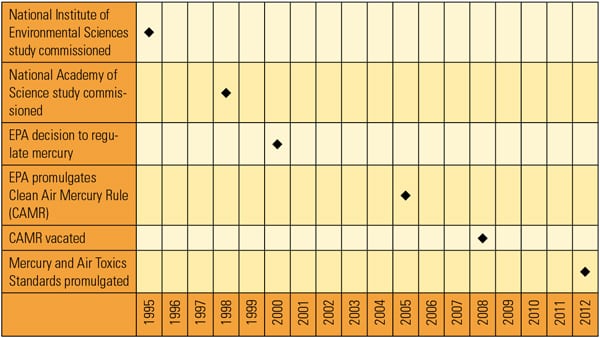
It’s been almost three years since the U.S. Court of Appeals for the D.C. Circuit issued its decision vacating the Environmental Protection Agency’s (EPA) Revision Rule and the Clean Air Mercury Rule. Since then, the utility industry has been in a holding pattern with respect to the control of hazardous air pollutant (HAP) emissions. However, the time draws near for the EPA to issue its new National Emission Standard for Hazardous Air Pollutants (NESHAP) regulating HAP emissions from coal- and oil-fired electric generating units (EGUs). According to a 2009 consent decree, the EPA must publish its proposed Utility NESHAP by March 16, 2011. Emission limits included in the NESHAP must be based on the application of maximum achievable control technology (MACT).
Forecasting What the New Rules Will Cover
Based on our knowledge of the utility industry, our experience with EGUs and air pollution control (APC) systems, and a review of the regulatory history, our predictions are as follows.
First, the Utility NESHAP will include MACT standards for both new and existing coal- and oil-fired EGUs. The EPA could also publish an alternative NESHAP for facilities that are classified as an area, or minor, source of HAP emissions.
Second, the Clean Air Act allows the EPA to divide source categories into subcategories based on differences in class, type, or size. In the past, the agency has established subcategories based on emission characteristics that affect control technology selection and effectiveness. In our opinion, combustion processes, fuel characteristics, and emissions from coal-fired EGUs with dissimilar control technology configurations are different enough to justify subcategorization. We think the EPA will subcategorize coal-fired boilers by fuel for the fuel-related HAPs and that it may further subcategorize boilers by combustion design for non-fuel-related HAPs.
Third, the EPA likely will expand the number of HAPs regulated by the Utility NESHAP to include mercury, non-mercury trace metals, acid gases (hydrochloric acid and hydrogen fluoride), dioxins and furans (D/F), and non-D/F organic compounds. Due to emissions monitoring limitations, it is unlikely that the EPA will require continuous monitoring of the individual non-mercury trace metals and organic HAP compounds. It will probably regulate certain HAP categories using surrogates. The most likely surrogates include filterable particulate matter less than 10 microns (PM10) as a surrogate for the non-mercury trace metals and CO as a surrogate for the non-D/F organics.
Finally, the EPA likely will establish the MACT standards for each regulated HAP, or surrogate, based on a statistical analysis of available emissions data. As part of this rulemaking effort, the EPA initiated an Information Collection Request (ICR) that included a request that several existing EGUs conduct stack testing for a variety of HAP compounds. The EPA will probably develop the EGU MACT standards using an approach similar to the one used in the recently proposed Industrial Boiler NESHAP.
Possible Control Strategies for MACT Compliance
Assuming the Utility NESHAP looks something like what we are predicting, utilities will have to consider the following APC strategies for MACT compliance.
Mercury. Regardless of how the EPA subcategorizes the coal-fired EGUs, it is likely that mercury MACT will reflect an emission rate based on at least 90% reduction from mercury in the fuel. Bituminous-fired units may meet their mercury MACT requirement with flue gas desulfurization (FGD) alone. These units may need to consider an activated carbon injection (ACI) system upstream of the unit’s particulate control system if additional mercury control is needed.
Acid Gases. Acid gas emissions are generally a function of the coal’s chlorine and fluorine content. FGD control systems designed to capture SO2 also effectively capture acid gases. The acid gas MACT standard for bituminous-fired units will likely require FGD control. Subbituminous-fired units tend to generate fewer acid gas emissions; however, based on a review of information available from the EPA’s ICR Part I (Facility Descriptions), more than 12% of the existing subbituminous-fired units are equipped with SO2 controls. Therefore, compliance with the acid gas MACT standard for subbituminous-fired units will likely require some type of SO2 or acid gas control.
Non-mercury Trace Metals. Almost all existing coal-fired boilers are equipped with either an electrostatic precipitator or fabric filter baghouse for PM control. Although the PM MACT standard could be very stringent, we think the MACT standard for existing coal-fired boilers should be achievable with either control system.
Organic HAPs. It is expected that the Utility MACT will have both a D/F emission limit and a non-D/F organic HAP emissions standard. If the EPA includes D/F emission limits in the Utility NESHAP, the challenge may be demonstrating compliance with the emission limit. ACI control systems may provide D/F emissions control, if needed. If the Utility NESHAP regulates non-D/F organic HAPs, CO will be probably be used as a surrogate.
Although stricter MACT emission limits are expected, APC technologies should be available to meet the MACT standards. However, because of the interactions between, and the co-benefits afforded by, conventional APC technologies in the service of controlling HAP emissions, the biggest challenge may be developing compliance strategies that address all HAP standards while avoiding the inclination to focus on a single HAP to the detriment of another.
— Paul S. Farber, PE, DEE (paul.s.farber@sargentlundy.com) is an environmental engineer at Sargent & Lundy LLC in Chicago.