On October 20, 2006, the Federal Energy Regulatory Commission (FERC) issued a Notice of Proposed Rulemaking (NOPR) to facilitate the acceptance of 87 reliability standards submitted by the North American Electric Reliability Council (NERC). That’s both good news and a signal to those of us responsible for reliability. Now that the wheels of federal endorsement and enforcement have begun to turn in earnest, it’s time to begin planning our compliance strategies.
In addition to the 87 standards that FERC proposes to accept, NERC submitted 20 of the "fill-in-the-blank" variety that require regional reliability organizations (RROs) to develop certain procedures and protocols but do not address the specifics of those plans. Critical Infrastructure Protection standards will be dealt with in a separate rule-making.
By now, those charged with complying with reliability standards should be well on their way toward "entity registration" in their regions. Such registrations require submitting the name of a primary contact responsible for internally coordinating a company’s compliance. Most also require designation of an officer of the company who will sign off on the compliance reports periodically sent to the RROs.
Enforcement of the mandatory reliability standards—and penalties for failing to comply with them—won’t begin until this summer. However, FERC has made it clear that in the interim, all responsible entities are expected to meet their requirements as a matter of good utility practice.
In the October NOPR, the commission also made clear that the standards will be applied on a case-by-case basis. For example, there will be no blanket exemptions for small users of the bulk power system who might plead that their actions and degree of compliance affect overall system reliability far less than those of larger users.
NERC will be immediately addressing the revisions and clarifications in the standards listed as high priorities in an attachment to the NOPR. This rule-making is an opportunity for all stakeholders in system reliability to inform FERC of any concerns with standards under consideration. It also is a wake-up call to ensure that internal business and operational practices are shipshape for navigating the twists and turns of mandatory compliance. As with all trips, the better one is prepared, the easier the journey.
—By Jim Stanton, POWER contributing editor and project manager at ICF International. He can be reached at 713-445-2000 or jstanton@icfi.com.
UNDERWATER INSPECTION
To drain or not to drain
A little over a year ago, the operations and engineering staff of FirstEnergy Corp.’s Seneca Station faced a very difficult decision: Should a required inspection of the pumped-storage facility’s upper reservoir be performed underwater or with the reservoir in a dewatered state? In the end, the decision was made to use a remotely operated vehicle (ROV) to do the inspection underwater, eliminating the need to drain the reservoir and shaving days and dollars from the project. The lessons learned during the decision-making process can benefit other hydro plant operators facing the same choice.
The Seneca Station is located at the Kinzua Dam, near Warren, Pa. The dam was originally built by the Army Corps of Engineers to regulate the Allegheny River for flood control. It created the Allegheny Reservoir, a lake that stretches 25 miles upriver. Seneca Station (Figure 1), rated at 435 MW, began commercial operation in 1970.
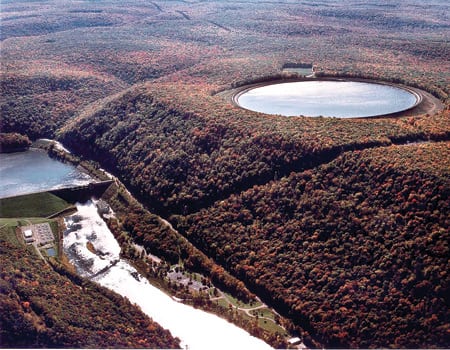
1. Pumped up. The 435-MW Seneca pumped-storage station began commercial operation in 1970. Courtesy: FirstEnergy Corp.
ROV solves several problems
In December 2005, FirstEnergy realized that it needed to perform an annual FERC Part 12 safety inspection of a portion of Seneca Station’s 100-acre upper reservoir—a bowl-shaped structure the size of a NASCAR track that holds about 2.1 billion gallons of water—early in 2006. What made this task challenging (in addition to the Pennsylvania winter) was that the area to be inspected was submerged daily at a depth of up to 50 feet, depending on plant operations. Further complicating matters, material and equipment delivery would be difficult: During the winter, the U.S. Forest Service normally does not plow the 6-mile-long gravel road that provides access to the reservoir because it is used by recreational snowmobiles.
Despite these challenges, and the fact that a "wet" inspection of this size and complexity had never been done before at a FirstEnergy facility, Bill Harker— director of FirstEnergy’s hydro and combustion turbine plants—gave Seneca Station’s inspection team the go-ahead to investigate using an ROV (Figure 2). "Any time you have an opportunity to safely and cost-effectively shorten an outage by four days and still meet all of your inspection objectives, you have to thoroughly investigate the option," said Harker. "Over the past several years, we’ve had success using new techniques during planned maintenance outages of our hydro stations, and we hoped that we could add ROV inspections to the list."

2. The Phantom knows. The remotely operated vehicle used to inspect the upper reservoir of Seneca Station. Courtesy: ASI
How did Harker determine that using an ROV would shorten the Seneca Station outage by four days? In 2004, some repair work had been done on the upper reservoir in a section known as the "Fluent Run Depression," a natural depression capable of holding 40 million gallons of water. As a result, even after the upper reservoir was drained, the Fluent Run Depression still contained a mixture of water and mud that took more than four days to pump out. After the water was removed, the six acres of the Fluent Run Depression were repaired by adding two layers of liner topped with 18 inches of sand and ground asphalt (Figure 3).

3. Multiple layers. Repairs to the Fluent Run Depression required two liners and 18 inches of cover. Courtesy: FirstEnergy Corp.
However, when the upper reservoir was refilled, the initial rush of water washed away some of the sand and ground asphalt. To eliminate further wave damage, "Jersey barriers"—shaped like the state—were installed around the Fluent Run Depression section and the refilling was completed successfully (Figure 4). All instrumentation readings and twice-weekly physical inspections showed that the repairs worked as planned. Even so, the section still needed to be included in the FERC Part 12 safety inspection for 2006.

4. Stay in place. Jersey barriers were added to prevent scouring during refilling of the Fluent Run Depression. Courtesy: FirstEnergy Corp.
No divers allowed
When FirstEnergy managers were deciding whether to inspect the reservoir in a watered or de-watered state, they identified three big benefits of doing the inspection underwater:
- The Fluent Run Depression would not have to be drained, enabling the plant to return to service four days sooner.
- More Jersey barriers would not need to be installed to prevent any damage from the initial fill-in rush of water.
- Using an ROV to perform the inspection would solve a big problem: the water’s murkiness.
The last benefit loomed particularly large. For flexibility’s sake, human divers have long been the first choice for underwater inspections and repair work. But in this case, cost and safety issues dictated against the approach.
For a diver to work without having to enter a decompression chamber upon returning to the surface, the deepest the reservoir could be is 40 feet. To meet this condition over an extended period of time, the plant would have to be kept in reserve shutdown. This option was considered too costly. So, too, was this alternative: conducting the inspection over several days, and only when the upper reservoir water level was low. Needless to say, transporting a decompression chamber to the remote site also was ruled out, for reasons of cost.
Safety was another reason for not using divers; they could be disoriented by the poor visibility caused by the reservoir’s turbidity. Cloudy conditions also might have rendered useless any videotapes recorded underwater, which would compromise inspection performance.
Once it was decided that the ROV approach had merit, a specification was created for vendors to bid on. Clearly laying out the technical and logistical parameters and expectations of the work served as the precursor of a cost-effective inspection solution for FirstEnergy. In effect, the specification eliminated three concerns that typically plague underwater work—visibility, orientation, and equipment malfunctions.
Sonar selected for soundness
To deal with the visibility issue, the specification called for the use of sonar. Although some at the plant originally were concerned that sonar might not be able to detect small voids in structural surfaces, at the end of the day the technique was unanimously accepted for its unquestioned ability to generate profiles of surfaces and repairs and precisely locate the Jersey barriers.
Even if a crystal-clear picture could have been guaranteed by firms bidding for the inspection dive, the one must-have item in the specification was the ability to know where the ROV was in the upper reservoir on a real-time basis. An inability to meet this requirement was cause for one bid to be eliminated.
The winning bidder offered an interesting combination of technologies that allowed the onshore team to watch the underwater video and sonar and simultaneously track the position and orientation of the ROV. Prior to starting the actual inspection, the survey points were downloaded into the inspection firm’s computer along with a digitized map of the repair area. Being able to see not only where the ROV was but also in what direction it was pointed allowed for immediate position corrections and/or hover and hold commands.
Winter complicates the work
The inspection took three days—one day to set up and two days in the water. Although the access road had been cleared of snow earlier in the morning, it took more than an hour to haul the dive boat up to the reservoir, a trip that normally takes 20 minutes (Figure 5). Ice, and stopping to allow logging vehicles to pass, caused considerable delays. Once the crew arrived at the reservoir, they had to shovel snow from the steep access into the water.
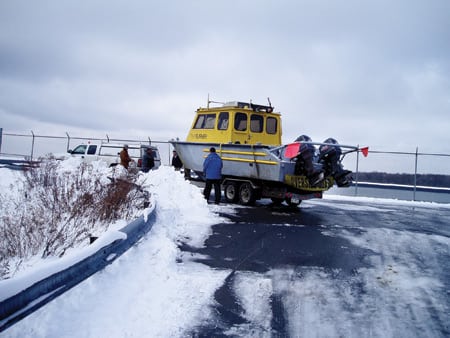
5. Icebreaker. The dive boat with the sonar-equipped ROV had to pass over icy roads to reach the reservoir. Courtesy: FirstEnergy Corp.
It took more than four hours to set up the equipment. The first day ended with the dive boat being in the water for a 90-minute shakedown cruise. With below-freezing temperatures expected that night, the decision was made not to put the ROV in the water to check out its systems. There were just too many seals that could have frozen later if the vehicle had been "put up wet."
On the second day, the access ramp was cleared of the previous night’s 6-inch snowfall and salted before the ROV team arrived. Pre-inspection procedures included a guidance system check that compared the GPS data from the vehicle with survey points on the digitized drawing of the reservoir. Then the ROV was placed in the water and the inspection began. For the first 30 minutes, the vehicle produced a steady stream of video and sonar data. But then the video signal was lost along with control of the port thruster. Some quick troubleshooting diagnosed the problem as an electrical connection that had opened.
After the repair was made, the ROV was put back in the water for more than three hours, with the shore-based team viewing the displays and guiding the boat-based ROV team. Even without the turbulence from the thrusters the viewing clarity for most of the inspection was poor. If not for the sonar data, the inspection would have been unsuccessful. With more subfreezing weather in the forecast, the second day ended with the ROV safely stored inside the Seneca Plant overnight to prevent the seals from freezing.
The third day began—much like the second—with nearly 6 inches of snow on the ground. During an inspection of the equipment, it was clear that the dive boat’s engines were starting to feel the effects of three days of being exposed to near-zero temperatures and heavy snows. For example, the diesel-generator that powered the ROV had trouble starting. However, within two hours the talented ROV team put all of the equipment in working order and completed the inspection, including the six acres of the Fluent Run Depression and the Jersey barriers. Based on past experience, the inspection could not have been completed in two days if a diver had been used. Time and again, the ability to know where the ROV was, even in periods of near-zero visibility, allowed the team to gather large amounts of data in a relatively short period of time.
Buoyed by the success of the ROV, the decision was made to use it for one additional inspection. During the plant’s pumping and generating modes, there is a brief time when there is no water flow between the upper reservoir and the plant. It was decided to move the ROV to the 19-foot-high head conduit and inspect the intake structure. Navigating the ROV between the intake columns was easily accomplished. But the inspection had to be cut short when the plant returned to generation mode. Because the team proved it could be done, ROVs will be used for future high-head conduit inspections.
Lessons learned
Several lessons were learned during this project, but the need for team creativity and communications was the most important. Without a doubt, the well-written specification—informed by past underwater inspections and input from plant, engineering, and regulatory personnel—was the single largest contributor to the success of the project, which came in under budget. The specification was intended to strike a balance between delineating FirstEnergy’s expectations and encouraging bidders to be creative, and it succeeded in that respect as well.
To minimize miscommunication and misunderstanding, FirstEnergy intentionally specified a dive boat large enough to accommodate plant employees, those of its engineering firm, and FERC representatives. The winning bidder also emphasized the value of a close working relationship by proposing that signals from the ROV be sent by radio to an onshore van. The van held other FirstEnergy personnel and a member of the inspection team. Inside it, undistracted by the cold, they watched real-time video and sonar feeds and radioed instructions to the dive boat to change the ROV’s position based on what they saw. All of the feeds were recorded on DVD and given to the team at the end of each day.
Based on a suggestion by the winning bidder, both navigation and profiling sonar were used. The navigation sonar was able to detect anomalies over a large area in advance of the video and proved effective in determining the location of the Jersey barriers. The profiling sonar was used to make dimensional checks of potential cracks and swales in the ballasted repair area (none of which were found). A high-resolution color video camera also played a role in data capture. However, its autofocus function—initially thought to be an attractive feature—hampered viewing because it locked in on suspended solids in the water at the camera lens, as opposed to objects 2 or 3 feet away. The next specification will stipulate the ability to manually override the autofocus feature.
From a business perspective, specifying a minimum number of hours in the water incentivized the inspection firm to arrive with equipment in top operating condition. This part of the specification was backstopped by highlighting the areas that had to be inspected for the project to be considered successful.
In addition to the need for creativity and communication, another lesson learned (actually, reaffirmed) was how tough it is to operate in freezing conditions. Previous cold-weather projects at the upper reservoir had also proved difficult. The single largest problem the project faced was the impact of cold on the dive boat’s engine transmission linkages. Second, perhaps, was the need to manually clear ice and snow from the access ramp prior to starting work every morning. If at all possible, outdoor projects like this should be scheduled for more temperate weather. If not, some type of temporary heated shelter—such as a van—should be considered essential.
—Contributed by FirstEnergy Corp. (www.firstenergycorp.com).
FUEL SWITCHING
Practical aspects of burning landfill gas
Converting an existing steam power plant to burn landfill gas may—in one fell swoop—capture and put to good use the methane generated by an adjacent or nearby landfill and lower the plant’s fuel bill. But there are tradeoffs that need to be fully explored before jumping into a such a project. (See RENEWABLES to learn how AEP extended the life of an aging power plant by repowering it with landfill gas.)
Landfill gas is a renewable fuel with a heating value of 350 to 600 Btu per cubic foot—about one-half that of natural gas. Early repowering projects included installing either reciprocating engines or small gas turbines to burn the landfill gas. That was done more to solve an environmental problem than to capture the power. As it turns out, methane leakage from urban landfills that lack methane collection remediation often is problematic for neighbors of the plant and/or the landfill. At a minimum, the leakage is an irritant; at worst, it is a safety hazard. Collecting the methane through a series of wells, interconnecting piping, and a fan and flare stack was the next step in the evolution of landfill gas projects. The challenge then became operating the wells with a suction pressure equal to the rate of methane generation, which at a landfill decreases slowly over time.
Burning the captured methane productively became the next priority, for obvious economic reasons. Because naturally aspirated reciprocating engines operate at an intake pressure that matches the landfill gas pressure at the discharge of the collection fan, they were a natural choice. Others have tried using combustion turbines to burn landfill gas, but doing so accelerated corrosion of the standard materials used in turbines’ compressors. Using compressors made of exotic alloys solved that problem but ruined project economics.
Larger landfill gas power plants—such as the 48-MW Puente Hills project operated by the Los Angeles County Sanitation District (LACSD)—have succeeded by taking a low-risk approach to reducing methane leakage. The gas collection system at Puente Hills uses more than 1,000 wells, 55 miles of underground trenches, and more than 30 miles of pipes to collect an average of 26,000 cubic ft/min of landfill gas. The fuel is burned by conventional boilers whose steam is collected and sent to a 50-MW steam turbine that has been in service since 1987. The plant’s overall heat rate is about 11,000 Btu/kWh. LACSD also compresses landfill gas for use by the facility’s water trucks and passenger vehicles, saving the equivalent of 1,000 gallons of diesel fuel per day.
The EPA’s Landfill Methane Outreach Program (www.epa.gov/methane) reports that more than 70 steam plants have switched their boiler fuel to landfill gas and enjoy from 10% to 40% fuel savings as their reward. The plants’ fuel demand ranges from 2 to 150 mmBtu/hr.
When taking boiler conversion costs into account, care must be taken to adapt the boiler for the higher fuel flow rate (about twice that of natural gas), variations in the heating value of the landfill gas, and its inherently higher corrosiveness, which can wreak particular havoc at the cold end of the evaporator and air preheater, as well as on the boiler stack. On the positive side of the ledger, the corrosive deposits have proven easy to remove by sootblowing and periodic manual cleaning. Finally, the lower flame temperatures produced when landfill gas burns generate lower levels of NOx emissions than natural gas, but operating at these temperatures may require increasing the surface area of the superheater.
PLANT MANAGEMENT
Time management
Power plant managers and supervisors spend many hours tracking and managing overtime. That’s important, because uncontrolled overtime expenses can quickly consume an O&M budget. But it’s equally important to track and manage idle time.
Overtime—the consequence of underestimating a plant’s workload—has a relatively low ratio of cost (even at time-and-a-half or double-time pay) to productivity. By contrast, because no work is done during idle time, its cost-to-productivity ratio is infinity (the denominator is zero). From this perspective, idle time—which results from overestimating the work load—is the far more important metric. Many utilities and gencos proudly report that their workers put in less than 1% overtime. But few talk about their workers’ idle time, which could constitute as much as 50% of the workday or workweek.
To trim idle time, managers have to do a better job of estimating their plant’s true workload and ensuring that the staffing level matches it. When the managers of one utility (who wish to remain anonymous) recognized their idle-time problem, they sat down with plant operations supervisors and together came up with two conceptual solutions, called "regionalization" and "home alone."
Regionalization. Regionalization seeks to take advantage of a utility’s multiple sites by sharing employees who are geographically proximate—even if they work at different plants. In the utility’s new model, plants that are less than 20 miles apart can pool personnel to smooth out peaks and valleys in workload.
Naturally, the ideal radius depends on individual company needs. A southeastern utility, for example, has created what it calls a "virtual five-unit site" by bringing under one organization all the operations of five plants owned by its corporate parent. Although the five plants are much farther than 20 miles apart, employees routinely leave their normal duties for temporary assignments at sister stations. In this model, each plant assumes responsibility for specific collateral duties—such as radiation protection training—for all five plants.
Representatives of the utility report the program has produced numerous benefits, including reduced rivalry between plants, improved career growth opportunities for employees, and lower O&M expenses. They add that one company employee working at multiple sites can replace two contract employees, on the strength of his or her greater sense of ownership and knowledge of corporate processes.
Home alone. Home alone is the utility’s term for operating a plant without onsite supervision during periods of low workload. An example would be maintaining a cycling plant that has been shut down for the weekend. Traditional utility practice, most consultants agree, often leaves a plant oversupervised. That’s neither good for the O&M budget nor the professional growth of hourly workers.
Reap the rewards
Implementing the regionalization and home-alone strategies enabled the utility to reduce its operations supervisory staff by nearly 50%, largely by offering voluntary early retirement packages. Having addressed supervisory-level staffing, the utility now is beginning to work on hourly level staffing.
More scheduling solutions
Management consultants working in the power industry over the past few years have identified several other scheduling problems common to utilities that can be solved with a little creativity:
- Staffing cycling plants as if they were running baseload. Units that cycle require more sophisticated scheduling, just as manufacturing plants run specific schedules for specific product lines.
- Managing predictable but seasonally variable workloads. Unfortunately, many utilities’ shift schedules do not reflect this variability. An appropriate schedule for a utility might require operators to work 56 hours per week without overtime during the peak season; workers would then be compensated for this imposition with 10 weeks of vacation in the off-peak season. Such schedules are routine in manufacturing industries and, if structured correctly, can even meet labor law and union requirements.
- Casting in stone the schedules for maintenance workers: Monday-to-Friday, eight-hour day shifts. But most maintenance, particularly for cycling plants, occurs at night and on weekends. Accordingly, it makes more sense to deploy the majority of maintenance personnel when the plant is shut down and have only small maintenance crews assigned to day shifts.
—POWER editors