Many simple-cycle gas turbines are running harder than they were ever intended to—yet steam retrofits have never penciled out for most of that fleet. Supercritical CO2 bottoming cycles change the economics, approaching combined-cycle performance without the water, footprint, or multiyear schedule of a heat recovery steam generator.
There are more than 136 GW of simple-cycle gas turbines (SCGTs) operating in the U.S. today. Nearly all of them are burning fuel at efficiencies that would make a combined-cycle plant operator wince—and nearly all of them were deliberately left that way, because the only fix anyone offered was a heat recovery steam generator (HRSG) retrofit that never penciled out.
That math is changing. Gas turbines built for occasional peaking duty are now being dispatched mid-merit, sometimes running above 50% capacity factor on assets originally designed for 15%. Every hour of operation at simple-cycle heat rates is money left on the table—and the interconnection queue means that adding new capacity doesn’t meet the need for speed. The megawatts you need are already in the ground. The question is how much it costs to unlock them, and how fast.
Supercritical CO2 (sCO2) bottoming cycles answer both questions differently than anything the industry has deployed before. Smaller equipment. No water systems. No certified boiler operators. A footprint that fits inside the existing constraints of the exhaust and selective catalytic reduction (SCR) systems. And a deployment timeline measured in months, not the years an HRSG requires. For a fleet that’s operating harder than it was ever meant to, that combination is not a marginal improvement—it’s a different category of solution.
Upgrading the Existing Fleet
According to the U.S. Energy Information Administration, total U.S. SCGT operating capacity reached 136,074 MW as of May 31, 2026, up from 132,274 MW in December 2022, and these figures exclude the rapidly growing behind-the-meter capacity serving data centers. This is a substantial installed base of underutilized thermal assets.
An sCO2 bottoming cycle can lift an SCGT to combined-cycle performance, increasing nameplate output by 30% to 50%, depending on the gas turbine configuration. The economic value of that uplift scales with capacity factor: assets dispatched mid-merit see immediate improvements in heat rate, fuel cost per MWh, and emissions intensity, while assets still in peaking duty gain a larger nameplate to bid into capacity markets and serve load events.

In This Issue
Full issueMost of this fleet was never paired with an HRSG for clear reasons. A steam bottoming cycle imposes:
- ■ Higher capital cost.
- ■ Larger physical footprint.
- ■ Lengthy construction schedules.
- ■ Increased operations and maintenance (O&M) complexity.
- ■ Reduced operational flexibility.
While steam systems add cost and complexity, sCO2 bottoming cycles offer a scalable pathway to unlock significant additional value.
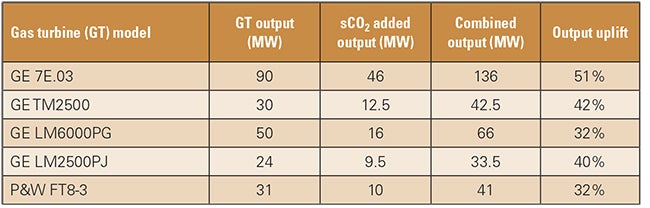
Echogen, using data from Orennia, identified 127,498 MW, almost 95% of the existing SCGT fleet, as potentially eligible for an sCO2 bottoming cycle—a substantial addressable base. Approximately 20% of that capacity comes from the Frame 7E fleet, with the LM6000 family contributing another 11%. Table 1 shows representative output uplift for these and other key turbine models, with combined capacity gains ranging from 32% to more than 50% depending on platform.
 |
|
Table 1. Supercritical CO2 output figures represent Echogen bottoming cycle estimates. Combined totals reflect simple arithmetic sum; site-specific integration may vary. (Used with permission from Orennia.) Courtesy: Echogen |
Current U.S. Market Profile
The 20- to 200-MW SCGT segment is dominated by low-utilization assets: approximately 84% of units and more than 90% of installed capacity operate below 30% capacity factor. This is precisely the segment where an HRSG retrofit has historically failed to clear an investment hurdle—the steam cycle’s capital cost, footprint, and O&M overhead require high run-hours to amortize.
The takeaway for owners and operators: the largest pool of upgradeable U.S. capacity is concentrated exactly where steam doesn’t pencil out, but where a lower-cost, smaller-footprint sCO2 cycle can. As these same assets shift toward mid-merit dispatch, the economic case strengthens further.
The sCO2 Advantage
sCO2 bottoming cycles directly address the constraints that have kept HRSGs off most of this fleet. By eliminating the need for steam generation and substantial water consumption, sCO2 technology provides a compact and cost-effective pathway to recover waste heat. The resulting system requires significantly less space and infrastructure than a traditional combined-cycle plant, enabling retrofit opportunities at sites that were previously uneconomic or physically constrained. This expands the addressable market for waste heat recovery while increasing power output and improving plant efficiency.
Investment Cost and Deployment. sCO2 turbomachinery is roughly an order of magnitude smaller than steam equipment at comparable output, which enables skid-based, modular designs and parallel fabrication. Field installation is correspondingly faster, schedule risk is reduced, and the sCO2 bottoming cycle can deploy on a timeline that is shorter than an equivalent HRSG.
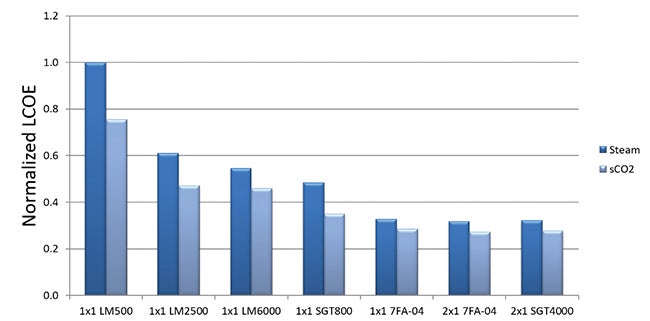
Performance and Operating Cost. Across the 5- to 200-MW+ range, sCO2 systems deliver a 10% to 20% reduction in levelized cost of electricity (LCOE) versus a steam bottoming cycle of comparable output (Figure 1). The advantage is largest at the lower end of the range, where steam-cycle fixed and operating costs dominate.
 |
|
1. Projected levelized cost of electricity (LCOE) for bottoming cycle power generation, assuming 5% discount rate, 30-year plant life, and 85% capacity factor for several sample applications. Courtesy: Echogen |
Operations and Maintenance. An sCO2 system is designed for unmanned, remote operation. It eliminates water-treatment infrastructure, avoids wet-expansion erosion (the working fluid stays single-phase), and requires no winterization—CO2’s freezing point is below −50C. Working-fluid losses are managed with commercial dry gas seals and periodic CO2 makeup.
Steam-based bottoming cycles have significant O&M costs, including certified boiler operators, water treatment infrastructure, blade-erosion management on the wet end of the steam turbine, and winterization at cold sites.
Footprint and Siting. CO2’s high density at supercritical conditions produces compact turbomachinery and smaller piping, especially on the low-pressure side. Eliminating turbine halls, deaerators, and water-treatment systems reduces total site footprint by more than 30% versus an HRSG bottoming cycle. For brownfield retrofits—where space inside the existing fence line is the binding constraint—this could be an essential difference.
Performance and Flexibility. As SCGTs shift from peaking into mid-merit dispatch, their efficiency gap to combined-cycle plants—typically 30% to 50% in heat rate—translates directly into higher fuel cost per MWh. An sCO2 bottoming cycle closes that gap by extracting more electrical output from the same exhaust stream, without adding fuel and without the operational complexity of a steam plant. Single-phase operation and lower thermal mass also enable faster starts and steeper ramps than a comparable steam bottoming cycle—an increasingly relevant capability in grids with high renewable penetration, and a direct fit for data center loads where reliability requirements are non-negotiable and dispatch flexibility on the supply side is what allows critical load to remain uncurtailed.
Key Takeaways
The capacity you need is already on the ground. 136,000 MW of SCGTs are operating in the U.S. today—most of them underutilized, inefficient, and never economically viable to pair with steam. That’s the opportunity.
Steam doesn’t fit this fleet. Higher capital cost, larger footprint, longer construction schedules, and significant O&M overhead mean an HRSG retrofit has never cleared the investment hurdle for the 84% of SCGTs operating below 30% capacity factor.
sCO2 was designed for the assets steam can’t touch. Skid-mounted, modular, remotely operated, and deployable in under two years—sCO2 bottoming cycles deliver 30% to 50% more output from the same turbine, with a 10% to 20% reduction in LCOE versus comparable steam systems.
Speed is the constraint, and sCO2 solves it. In a market where interconnection queues stretch five years and hyperscaler build schedules run 18 months, adding capacity from assets already on the ground—without more fuel, without waiting on the grid—is the fastest path to power.
The Fastest Path to Power
For owners and operators of SCGTs, sCO2 bottoming cycles represent the most practical path to combined-cycle performance—on assets where an HRSG was never economically viable, and on new builds where speed of deployment is the binding constraint. Lower installed cost, smaller footprint, faster schedules, and simpler operations together address the specific reasons most of the existing fleet was never paired with steam.
In a power-constrained market where every additional MW counts, sCO2 offers the lowest-cost added capacity available from assets already on the ground—without burning more fuel, and without waiting on the grid.
—Robert Bernard is Chief Commercial Officer with Echogen.