
This year’s Data Center POWER eXchange (DPX), whose programming POWER’s editors curated, was structured to look beyond the scale of opportunity presented by large-load forecasts and delve into the questions they raise. A key focus: What will it take to deliver power infrastructure and data centers on timelines, terms, and operating conditions that both industries can support?
Held Sept. 30–Oct. 1 at the Omni Shoreham Hotel in Washington, D.C., the event examined the decisions that determine whether large power and data center projects can move forward: which projects are sufficiently mature, what infrastructure they require, who commits the capital, and who bears the risk if demand or delivery schedules change. One theme cut across nearly every discussion: Those decisions cannot be made in isolation. Site selection may advance before grid constraints are fully understood. Financing can depend on power arrangements that themselves require firm customer commitments. Equipment may need to be ordered and capital committed well before permitting and interconnection requirements are settled.
The six questions below offer a snapshot of that broader conversation. POWER’s forthcoming reporting will examine the proposed solutions, their practical limits, and the technical and commercial trade-offs in greater depth.
What Must Follow the Federal Push to Build?
Peter Lake, CEO of infrastructure advisory and project-development firm Cardinal Rose and former senior director of power at the White House’s National Energy Dominance Council, opened the event with a blunt premise: The U.S. cannot lead the artificial intelligence (AI) economy without building the power infrastructure to support it.
“Electricity is the new oil. Data centers are the new factories, and tokens are the new trucks and tanks and tools of prosperity and security,” Lake said. “If the 20th century was the oil century, the 21st century is going to be the digital century.”
Lake, who emphasized that he no longer speaks for the White House or the council, focused on four areas where federal policy has sought to clear barriers: building new generation, accelerating large-load interconnections, increasing the capacity of existing transmission infrastructure, and protecting existing electricity customers as the buildout proceeds.
On generation, Lake argued that developers need long-term price visibility to finance new large-scale power plants and that technology companies driving incremental demand should assume the associated costs. He pointed to efforts in PJM as a potential model built around long-term revenue certainty, new generation, and protections for residential and small-business customers.
On the demand side, Lake urged data center developers to consider flexible interconnection arrangements that could allow facilities to connect more quickly in exchange for reducing their grid withdrawals during system emergencies. The federal approach, he said, deliberately specifies the grid requirement without prescribing how a data center meets it.
“We did not prescribe how the data center should operate,” Lake said. “It was just—we designed it to meet the physical needs of the power grid during grid emergencies.”
A facility could switch to backup generation, pause suitable computing workloads, or shift workloads among a network of data centers. “We want the marketplace to figure that out while addressing the needs of the grid,” Lake said.
Lake also pointed to technologies such as dynamic line ratings as a way to extract more capacity from existing transmission infrastructure. But he stressed that expanding the grid and generation fleet must come alongside protections for customers and tangible benefits for communities.
He highlighted the administration’s Ratepayer Protection Pledge as the framework for that bargain. Lake said the initiative began with commitments from major technology companies and was later expanded to include hyperscalers, utilities, cooperatives, municipal utilities, governors, and regulators. The underlying principles, he said, remained the same: “build bigger, pay above and beyond for transmission and distribution, hire local.”
For Lake, those measures amounted to federal groundwork. The next move belongs to the companies that intend to build and serve the new load. “We have put the pieces in place to open that door, but the industries, the developers, the tech companies, the off-takers have to walk through that door,” Lake said.
Who Bears the Risk Before Infrastructure Is Built?
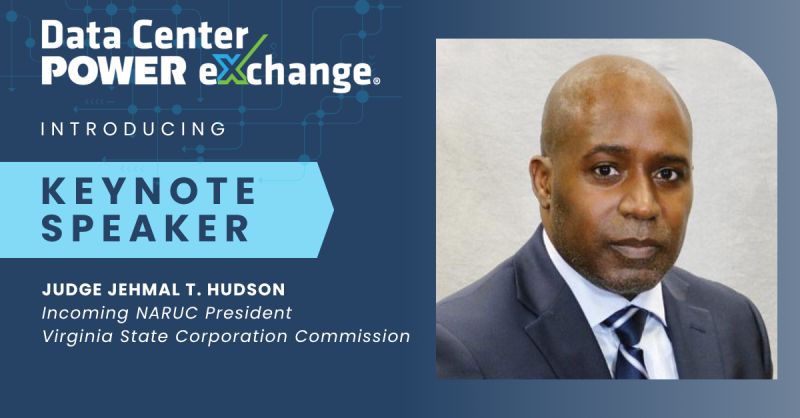
Judge Jehmal T. Hudson, a commissioner at the Virginia State Corporation Commission and incoming president of the National Association of Regulatory Utility Commissioners, approached the large-load challenge from the state regulator’s perspective. He organized it around four questions: Who pays? Who bears the risk? Who decides? And increasingly, when do those decisions need to be made?
At the center of that inquiry is a basic planning problem: determining how much proposed demand will actually materialize.
“The electric system cannot be planned around press releases,” Hudson said. Regulators, he said, increasingly need to look beyond the number of megawatts requested to the certainty behind them: whether a customer controls the site, whether permitting and financing are progressing, when the load will arrive, how quickly it will ramp, and what happens if a project is delayed, downsized, or never built.
The consequences run in both directions, he suggested: Build too slowly and legitimate projects may not receive service when they need it. But build too far ahead of demand and existing customers may be left exposed to underused infrastructure and stranded costs. “The answer is better information and greater certainty,” Hudson said.
The uncertainty is why Hudson argued that regulators should think of large-load tariffs as more than a mechanism for recovering utility costs. “Tariff design is also risk design,” he said. Minimum usage commitments, contract duration, collateral, exit fees, construction contributions, and separate rate classes can all determine who bears the financial consequences before infrastructure is built.
Virginia offers an important example. Dominion serves one of the world’s largest data center markets, putting the state at the forefront of decisions about how to accommodate large-load growth while protecting existing customers. The State Corporation Commission has approved a separate GS-5 rate class for qualifying large-load customers of Dominion Energy Virginia, effective Jan. 1, 2027. Certain customers will be required to pay minimum charges based on 85% of contracted transmission and distribution demand and 60% of contracted generation demand, among other requirements. The commission has also directed Dominion to propose an amended line-extension policy that would require mandatory contributions in aid of construction for defined transmission facilities needed to directly connect new or expanding large loads.
“Physical commitments should increasingly be matched by financial commitments,” Hudson said. If the electric system is being asked to make a substantial investment for a customer, he said, the financial commitment should bear a reasonable relationship to the scale of that system investment.
He also rejected the idea that stronger financial protections necessarily conflict with speed to power. Greater certainty about a customer’s commitment can help utilities and regulators distinguish serious projects from speculative demand and make infrastructure decisions more quickly for projects that are ready to proceed.
Hudson noted that institutions involved in large-load development often make decisions on different timelines. Site selection, economic development incentives, utility planning, and tariff proceedings can advance separately. By the time all of the institutions involved are talking to one another, he said, “important decisions may already have hardened.” Earlier coordination can surface infrastructure needs, system costs, development timelines, and community concerns before choices become difficult to unwind.
For Hudson, ratepayer protection therefore begins before the costs appear in rates. “Ratepayer protection is not simply about allocating costs after they have been incurred,” he said. “It is about allocating risk before the investment decision is made.”
That discipline, Hudson argued, is also central to public confidence. “If the public believes that benefits are private while risks are socialized, confidence in the system will erode,” he said. “Durable growth therefore requires more than infrastructure. It requires public confidence in the decisions that allow that infrastructure to be built.”
What Does Computing Demand Actually Mean for the Grid?
Alexander Hubbard of Lawrence Berkeley National Laboratory approached the data center power question from the chip level up, examining how installed computing equipment, server operation, and the way demand is measured combine to shape electricity use.
Berkeley Lab’s latest reference case projects U.S. data center electricity consumption rising from 192 TWh in 2024 to 649 TWh in 2030, or from 4.7% to 11.8% of total U.S. electricity use. But Hubbard emphasized that the actual level of consumption will depend heavily on how much computing hardware is deployed and how intensively it operates.
Hubbard presented a bottom-up model that begins with the installed equipment base: server shipments, accelerator counts, equipment lifetimes, chip configurations, and rated power. It then applies operating assumptions such as utilization, idle power, and facility overhead, then translates annual electricity consumption into average demand and capacity requirements.
Those operating assumptions can substantially change the result. In one sensitivity case, Berkeley Lab increased assumed idle power from 20% to 30% of rated power and inference-server utilization from 20% to 30%. Electricity consumption increased 21%, or 133 TWh, even though the underlying hardware did not change. “And it’s important to note that that’s on the exact same hardware as in the reference case,” Hubbard said.
Annual electricity consumption, average demand, facility peak load, and requested interconnection capacity are not interchangeable measures. In Berkeley Lab’s 2030 reference case, 649 TWh of annual electricity use translates to about 74 GW of average demand. Using an illustrative 50% average-to-capacity ratio produces about 148 GW of interconnection capacity. Hubbard stressed that “requested interconnection capacity does not equal the facility peak capacity and does not equal the amount of generation” ultimately required.
The same framework also shows where load flexibility can help. If operators can increase utilization of an existing grid connection while managing peaks, more computing activity can fit within the same amount of interconnection capacity. In another Berkeley Lab illustration, average demand rose from roughly 74 GW to 89 GW while modeled capacity remained at 148 GW.
Hubbard’s broader point was that planners need to be precise about which quantity they are discussing. Equipment determines the maximum power that could be drawn. Operations determine how much electricity that equipment actually uses. Requested capacity establishes yet another number.
His closing slide reduced the problem to those three factors: equipment, operation, and demand quantity. “State all three factors, and any demand estimate can be checked,” he concluded.
When Does a Utility Request Become an Infrastructure Commitment?
For R. Matthew Gardner, vice president of Power Generation System Operations at Dominion Energy, the challenge is translating rapid load growth into generation, transmission, substations, and other infrastructure that can take years to plan and build.
“As an energy infrastructure provider, I cannot make plans to serve you what you need today,” Gardner said. “This infrastructure is decades in the making.” He pointed to one 500-kV transmission project that took 11 years to move from concept to service.
That long development cycle is colliding with extraordinary growth in Dominion Energy Virginia’s service territory. PJM and Dominion expect demand there to double from about 25 GW to 50 GW over the next 15 years, Gardner said, and data centers are driving much of that increase.
Dominion expects to provide service for 31 GW of additional data center capacity by the end of 2031. “That’s a capacity number,” Gardner said. “That doesn’t mean that that’s what will necessarily turn a meter.”
The broader development pipeline is larger. Dominion has nearly 54 GW of data center load “under contract in some form or fashion” across a three-contract process consisting of a substation engineering phase, a construction phase, and an electric service agreement phase, Gardner said. The figure represents projects at different stages of development—not 54 GW of load already operating or ready to connect.
The physical scale of individual requests is also changing. Data center interconnection requests in Dominion’s territory increasingly exceed 300 MW, the maximum load the utility serves from a single substation, Gardner said. Larger campuses therefore require multiple substations and infrastructure that develops alongside the customer’s buildout.
Data centers also present a different operating challenge, Gardner said, pointing out that their loads can change much faster than traditional industrial demand and can respond simultaneously to disturbances on the grid. Dominion is conducting more detailed modeling and increasing measurements at points of interconnection to better understand those responses. Gardner said those characteristics are bringing long-range system planning closer to day-to-day grid operations.
Dominion has also changed its commercial arrangements as the scale of the investment has grown. Gardner cited minimum demand charges, deposits, take-or-pay provisions, and contracts extending 14 years beyond the electric service agreement as measures intended to limit the risk that infrastructure built for large loads ultimately falls on other customers.
Serving the projected demand will require substantially more generation. Gardner described an “all of the above” portfolio that includes continued solar additions, offshore wind, battery storage, nuclear, and new natural gas generation. Dominion plans to add about 1 GW of solar annually and is advancing major combined-cycle projects in Cumberland County and at Mount Storm as part of that buildout.
During the fireside discussion that followed the keynotes, Gardner returned to the importance of process and transparency. “There’s a multi-year process in place,” he said. “It’s important that we keep that process consistent and transparent for all customers who want to connect to our system.”
Can AI Help Build the Infrastructure It Requires?
Nelli Babayan, Microsoft’s senior director of AI for U.S. Federal, approached the infrastructure challenge from another direction: how artificial intelligence itself could help accelerate the planning, permitting, engineering, and operation of the infrastructure needed to support growing computing demand.
“AI can help build the infrastructure that it requires,” Babayan said.
Her argument began with siting. Identifying land is only one part of determining whether a data center can actually be built, Babayan said. Power, transmission, water, fiber, environmental requirements, construction sequencing, and community support all have to align before a site is viable.
Microsoft has developed a reference architecture for permitting and licensing processes that uses AI for functions including document intake and routing, information extraction, policy validation, summarization, and regulatory review support, Babayan said. The aim is to make large volumes of technical and regulatory information easier to search, trace, and use throughout the development process.
“The objective is not automation for its own sake. The objective is not to replace regulatory authority or the engineers,” she said. The technology, she added, should help experts work across fragmented information while preserving engineering judgment, human judgment, and regulatory accountability.
Babayan also pointed to AI-assisted scientific discovery as another potential lever. Microsoft has used an agentic AI platform to search for materials that could improve data center cooling, she said. One materials-discovery effort took about 200 hours, compared with a process she said could traditionally take years.
Cooling itself offers another opportunity. Babayan cited Microsoft research that, under the study’s assumptions, found that moving from air cooling to cold plates could reduce energy demand by about 15% and water consumption by roughly 30% to 50%. “The most valuable megawatt may be the one that you are avoiding,” she said.
AI could also support forecasting, planning, and grid analysis on the supply side while improving computing efficiency, cooling, and workload management on the demand side, Babayan said. She cautioned that flexibility still has to support dependable service for business- and mission-critical workloads.
The challenge eventually comes back to investment confidence. Utilities need credible load signals before committing capital to generation and transmission, while hyperscalers need confidence that power will be available on the required schedule and at workable economics before making multibillion-dollar investments, Babayan said.
During the fireside discussion that followed her keynote, Babayan pointed to long-term power purchase agreements as one mechanism Microsoft uses to demonstrate commitment. Such agreements can extend 10 to 15 years, she said, giving counterparties a clearer signal that the demand behind a proposed project is credible.
Community acceptance is also part of the development equation. Babayan said communities are asking increasingly visible questions about electricity costs, water, land use, construction, jobs, and who ultimately pays for supporting infrastructure. Later in the discussion, she said Microsoft seeks to involve communities in decisions surrounding data center development and pointed to investment in jobs, education, and other local benefits.
For Babayan, the opportunity is to apply AI earlier across that entire development process—from permitting and materials discovery to cooling, forecasting, and infrastructure planning. “Power doesn’t have to become the ceiling for AI innovation,” she said. “It can actually become one of the enablers.”
What Does It Take to Manufacture More Power Capacity?
Meeting rising power demand ultimately comes down to whether manufacturers and their suppliers can produce equipment fast enough—and whether developers can assemble the labor, engineering, and other pieces needed to turn that equipment into operating infrastructure.
The constraints extend well beyond generation equipment. During a DPX panel on turbines, transformers, and supply chain timelines, Mike Isaacs, head of supply chain engineering at Hut 8, pointed to labor as an often-overlooked bottleneck. Turbines, transformers, switchgear, circuit breakers, and other substation equipment can carry lead times approaching two or three years, he said, but projects also need enough skilled workers available to install them.
Orestes Macchione, head of sales for High-Voltage Direct Current (HVDC) and Grid Access U.S. at Siemens Energy, described a similar squeeze in transmission equipment. Transformers that once carried lead times of about a year can now take three to five years depending on voltage, he said. Lead times can approach five years for 765-kV equipment. Large developers are also reserving equipment in much greater volumes—sometimes tens or even 100 transformers at a time—absorbing capacity across multiple factories.
Generation manufacturers face many of the same pressures. Scott Young, senior business development manager at Wärtsilä North America, said the company has increased engine manufacturing capacity by 50% over the past four years and plans another 70% expansion over the next three. Even so, production slots remain finite, forcing suppliers to decide which projects are most likely to advance. Site control, realistic commercial operation dates, permitting progress, financing, community engagement, a defined power strategy, and commercial readiness can all influence that assessment. “Credible projects get prioritized, and that credibility starts long before we get to the purchase order,” Young said.
GE Vernova, meanwhile, is undertaking a major production ramp of its own. In a fireside conversation moderated by POWER’s Sonal Patel, Jason Reagan, Gas Value Stream general manager for GE Vernova’s Gas Power business, said the company has committed to an annual gas turbine output rate of 20 GW beginning in the fourth quarter of 2026, increasing to 24 GW by 2028 and 30 GW by 2030. Those figures describe manufacturing output, not schedules for the resulting power plants to enter service.
Reagan described the ramp as a full value-chain effort spanning workforce, factories, and suppliers. GE Vernova is expanding apprenticeship programs and technical training while redesigning factory processes and working more closely inside suppliers’ operations. The company has also extended its planning horizon. Supplier delivery commitments that might previously have been viewed over about 12 months are now being considered 24 to 48 months ahead, allowing GE Vernova and its suppliers to identify capacity, quality, and production constraints years before the equipment is needed.
Forgings and investment castings illustrate the pressure. These critical gas turbine components draw on manufacturing capacity also sought by aerospace and aviation customers, Reagan said. GE Vernova teams are working directly on suppliers’ factory floors to address quality problems, reduce cycle times, and increase output as demand rises across those industries.
Inside GE Vernova’s Greenville, South Carolina, factory, the company is also redesigning how large turbine components move through production. Reagan said one 13,000-pound rotor wheel historically traveled about half a mile through the plant as it passed through machining processes. A new single-piece flow line reduces that travel to about 500 feet.
“So we’ve taken what is a half a mile of travel across a factory down to 500 feet,” Reagan said. The approach reflects a principle he described as “earning the right to automate”: simplify and stabilize the manufacturing process first, then introduce automation and robotics to increase output.
The workforce must evolve alongside those factory changes. Reagan said automation is increasing demand for technicians who can maintain sensors, robotics, encoders, and other equipment. GE Vernova’s maintenance technician program, for example, combines classroom and hands-on training over four years to develop those skills.
The production ramp must also account for equipment already operating. GE Vernova has a global fleet of roughly 7,000 gas turbines that requires service and upgrades even as demand for new units rises, Reagan said. He said the company’s manufacturing lines serve both businesses, allowing factory planning to account for new-unit production and the needs of the existing fleet together.
Across both discussions, the supply chain challenge came down to synchronization. Equipment carrying multiyear lead times, factory expansions, skilled labor, permitting, engineering, and construction all have to arrive in the right sequence. For developers competing for scarce manufacturing capacity, that also means demonstrating early that a project has a realistic path from equipment reservation to operation.
—Sonal Patel is senior editor at POWER magazine (@sonalcpatel, @POWERmagazine).