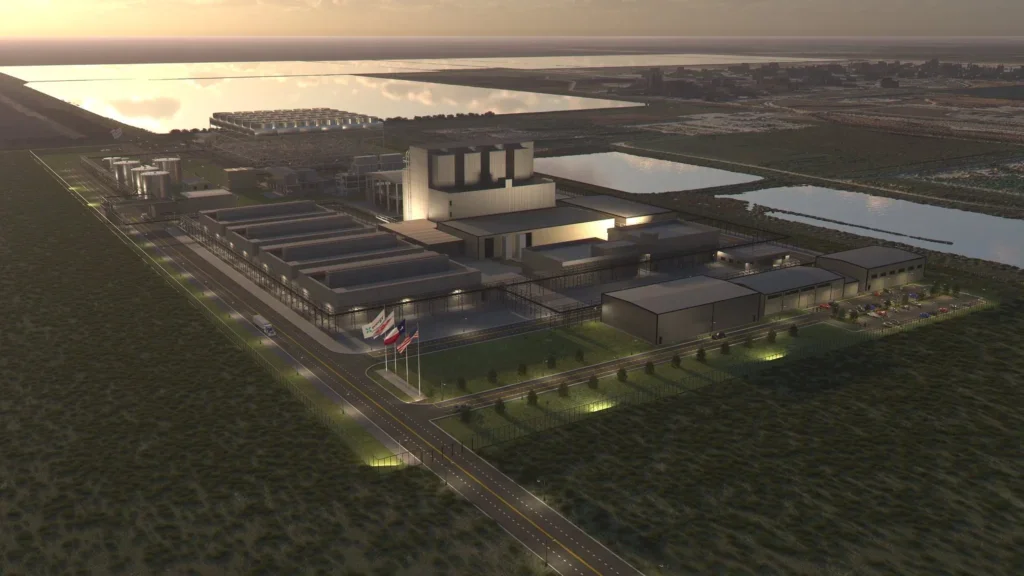
The Nuclear Regulatory Commission (NRC) has completed its environmental assessment (EA) of the proposed 320-MW Long Mott Generating Station at Dow’s Seadrift site in Texas, issuing a Finding of No Significant Impact (FONSI) for the four-reactor X-energy project.
According to X-energy, the NRC completed the environmental review in under a year, marking the first time a U.S. commercial advanced reactor project has completed its National Environmental Policy Act (NEPA) review through the more efficient EA pathway, rather than a full environmental impact statement (EIS), in a Part 50 construction permit proceeding.
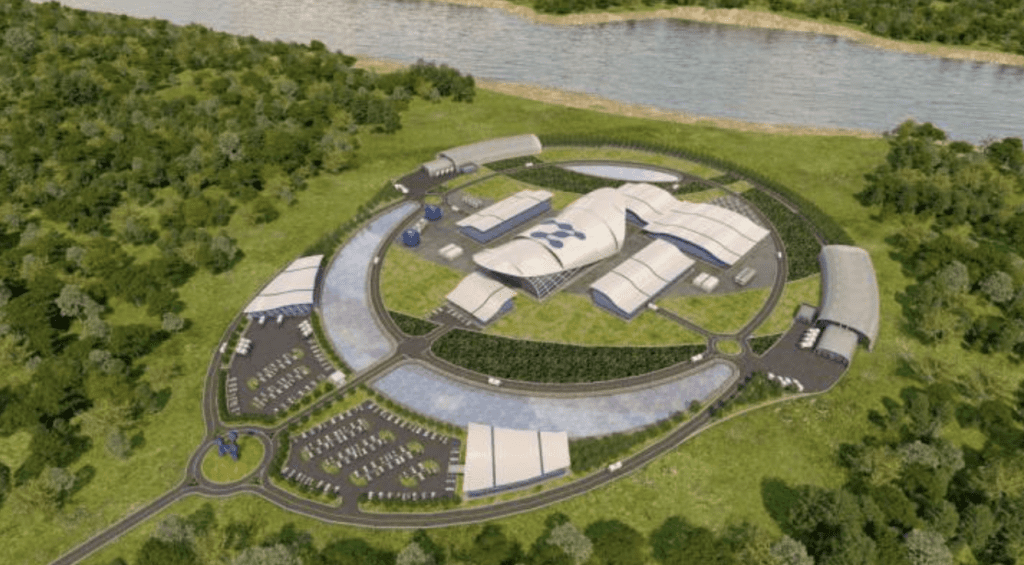
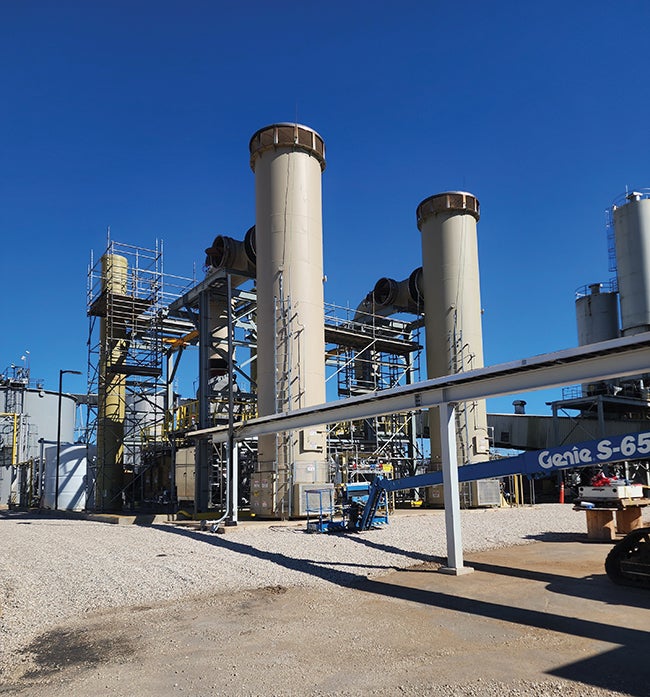
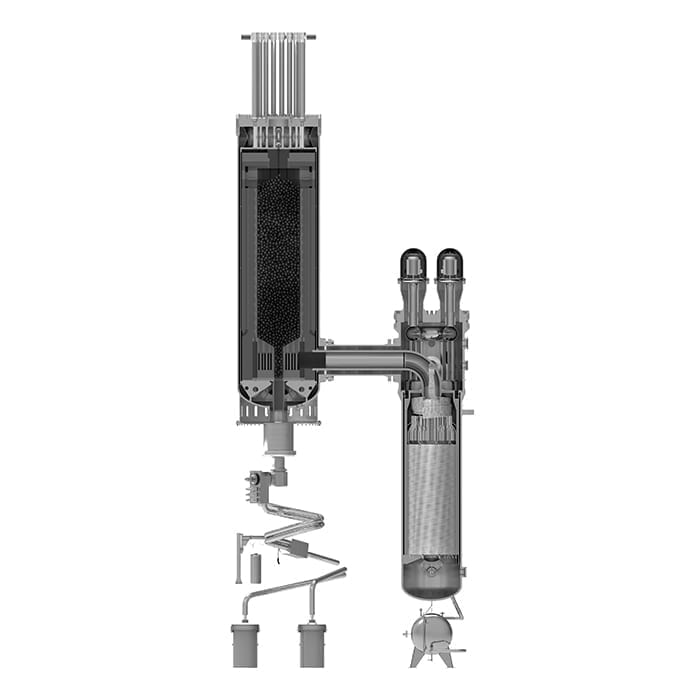
The NRC’s review—completed in under 12 months and ahead of schedule—clears a key prerequisite in the agency’s review of the construction permit application filed by Long Mott Energy LLC, a Dow wholly owned subsidiary, in March 2025. The application covers a four-module, 800-MWth/320-MWe Xe-100 high-temperature gas-cooled reactor facility at Dow Chemical’s UCC Seadrift Operations site on the Texas Gulf Coast.
According to the NRC’s project dashboard, the agency will now work to complete its final safety evaluation by November 2026—within the 18-month timeline required by Executive Order 14300 —after which it could issue a final construction permit decision that will authorize construction of the facility.
X‑energy told POWER that once a construction permit is in hand, the company and Dow plan to move ahead with detailed engineering, procurement, and site preparation activities while developing a separate operating license application, which the NRC must approve before the reactors can load fuel and begin commercial operation. The company said it expects to apply lessons from Long Mott’s environmental and safety reviews to subsequent Xe‑100 projects, including Energy Northwest and Amazon’s Cascade Advanced Energy Facility in Washington State, and in future industrial deployments, to further compress schedules for nth‑of‑a‑kind units.
A Different Kind of Environmental Review
Under the National Environmental Policy Act (NEPA), the standard instrument for a new nuclear plant has historically been a full environmental impact statement (EIS)—a comprehensive review that has taken three to six years in past commercial proceedings. For TerraPower’s Kemmerer Unit 1, which received its construction permit on March 4—the first granted for a commercial reactor in nearly a decade and the first for a non–light-water design in more than 40 years—the NRC completed a full EIS in 18 months, which itself set a notable record.
For Long Mott, the NRC made an early determination to attempt an environmental assessment instead—a more focused instrument that, X-energy explained to POWER, asks whether significant environmental impacts exist, rather than proceeding directly to the broader analysis required for a full EIS. The agency was explicit: if a FONSI could not be reached, it would proceed with a full EIS. X-energy told POWER that while the EA pathway is fully available under NEPA, Long Mott is the first U.S. commercial advanced reactor project to complete NRC environmental review through an EA in a Part 50 construction permit proceeding. The NRC said Long Mott cleared the threshold given the project’s “limited environmental footprint at an existing industrial location.”
Since 2018, X-energy—and later Dow—worked with the NRC through extensive pre-application engagement to define the Xe-100’s environmental and safety profile before the formal Long Mott review began. That early work was integral because the EA pathway depends on whether the NRC can determine, from the record before it, that a proposed action is unlikely to cause significant environmental impacts, the company explained.
In addition, “We intentionally designed the reactor with environmental considerations,” X-energy told POWER, citing air-cooled condensers that limit water use and reduce aquatic impacts. The company also pointed to the Xe-100’s helium coolant, which it says does not become radioactive during operation, and the absence of cooling towers or water intake structures—features that removed major drivers of environmental review scope. Dow and X-energy also built a detailed site record before the EA was finalized, including year-long field surveys, groundwater monitoring, and consultations with federal and state agencies.
The NRC’s Long Mott project page identifies a 1,537-acre project site and shows completed Endangered Species Act consultations with the U.S. Fish and Wildlife Service and National Marine Fisheries Service. X-energy said Dow and X-energy identified sensitive habitats before finalizing the site layout and sited facilities to avoid impacts to protected resources rather than mitigate them after the fact. Ultimately, as the NRC said on Monday, the EA approach allowed for a “more efficient review while maintaining rigorous environmental standards.”
“The milestone demonstrates that we can complete our reviews efficiently, enabling new reactor projects while upholding our responsibility to protect people and the environment,” said NRC Executive Director for Operations Mike King on May 18. “Using an environmental assessment in this case reflects the project’s relatively low potential for environmental impacts and helps provide a more predictable path forward.”
A Replicable Pathway
According to X-energy, the NRC’s historic EA approval “establishes a replicable pathway for increased efficiency in the licensing process, built through years of preparation to demonstrate the strong safety profile of our technology,” said Dragan Popovic, Chief Global Operating Officer at X-energy. “There are no shortcuts in nuclear safety. Every efficiency has to be earned, and it begins with a complete, high-quality application and intrinsically safer technology.”
As X-energy explained to POWER, the company expects later Xe-100 applications to benefit as the design becomes standardized through NRC review: fundamental reactor-design questions could move faster, while site-specific environmental review would remain necessary for each new project. That makes the EA pathway—and the ability to repeat the Long Mott methodology—a potential critical path for nth-of-a-kind deployments. “What this demonstrates is that we have an acceptable pathway—repeatability of how to assess sites, and to demonstrate that our technology has minimal impacts,” it said.
X-energy noted those gains could compound with each successive application. “Just repeating a methodology over and over again—when you do that, you get faster and you get better,” it said. “No corners are going to be cut—[NRC is] going to apply the same approach and check us on all the work, but because they’ve already seen it once, they have confidence in the outcomes.”
The company also cautioned, however, that the EA pathway is not guaranteed. A future site with materially different environmental characteristics could still require a full EIS. Still, “You’re driving efficiency,” X-energy said, “but you’re also earning every last bit of that efficiency.”
Part 50 Is Not the Problem
The Long Mott milestone arrives as a broader debate continues in the advanced nuclear industry about whether the existing Part 50 regulatory framework—originally designed for light-water reactors—is adequate for advanced designs.
“We’re proving that we can use these regulatory processes and get an acceptable outcome in a timely and efficient manner,” X-energy said. “It’s about the experience you bring to the project and the talent you apply to it, and the teams that are built on it that allow companies to succeed. The regulatory process is what it is—and the NRC is willing to work with us on that path now.”
The key is “you have to do the work right, so you have to make the submittals to the NRC, to use pre-application appropriately, and then you have to provide the rationale that lets the NRC make an efficient decision,” it added. “So, there’s a burden on [industry] as well, but the NRC is not the impediment to the success that some have viewed it to be.”
The company also described the Long Mott review as evidence of a more workable dynamic between regulators and applicants.“The NRC has been a great independent but collaborative partner in this journey,” X-energy said. “They saw the work that we did, they appreciated it, and they worked with us on this path to achieve this first-of-a-kind licensing activity.”
Broader Momentum Is Building
The NRC has also been building momentum across its broader advanced reactor docket. The NRC is now operating multiple licensing frameworks in parallel: Part 50—the traditional construction permit and operating license pathway—remains the near-term practical route for Natrium, Long Mott, and TVA’s Clinch River project, while Part 53—a technology-inclusive commercial framework that took effect April 29—opens a medium-term path for advanced and factory-fueled designs, and a newly proposed Part 57 would create a rapid, high-volume licensing track for microreactors.
In February, notably, the agency issued a first-of-its-kind license to TRISO-X, an X-energy subsidiary, authorizing commercial fabrication of HALEU-based TRISO particle fuel at its Oak Ridge, Tennessee facility—the first Category II nuclear fuel fabrication facility ever licensed in the U.S.—completing its review three months ahead of the published schedule.
X-energy said it is now also already working with Cascade Energy Northwest to prepare a construction permit application for the Cascade Advanced Energy Facility in Washington state, where it intends to carry forward the safety and environmental groundwork from Long Mott and apply lessons learned to further compress schedules.
The company has also expanded its commercial pipeline since going public. X-energy priced an upsized IPO on April 23 and on April 30 announced a collaboration with LG&E and KU to explore Xe-100 deployment. In March, the company and Talen Energy said they would evaluate a gigawatt-scale Xe-100 deployment, and X-energy and IHI Corporation partnered to advance U.S.-Japan SMR supply chain development. In December, as POWER reported, X-energy and Doosan Enerbility locked in a 16-unit component reservation to support an 11-GW pipeline.
“Historically, the regulatory process has been a significant risk and concern for the deployment of nuclear,” X-energy told POWER. “I think we’re demonstrating that we can minimize that risk and accelerate projects by having an efficient licensing process. We’ve shown that we can move in the right direction. Now we have to continue to build on that progress.”
—Sonal C. Patel is a senior editor at POWER magazine (@sonalcpatel, @POWERmagazine).