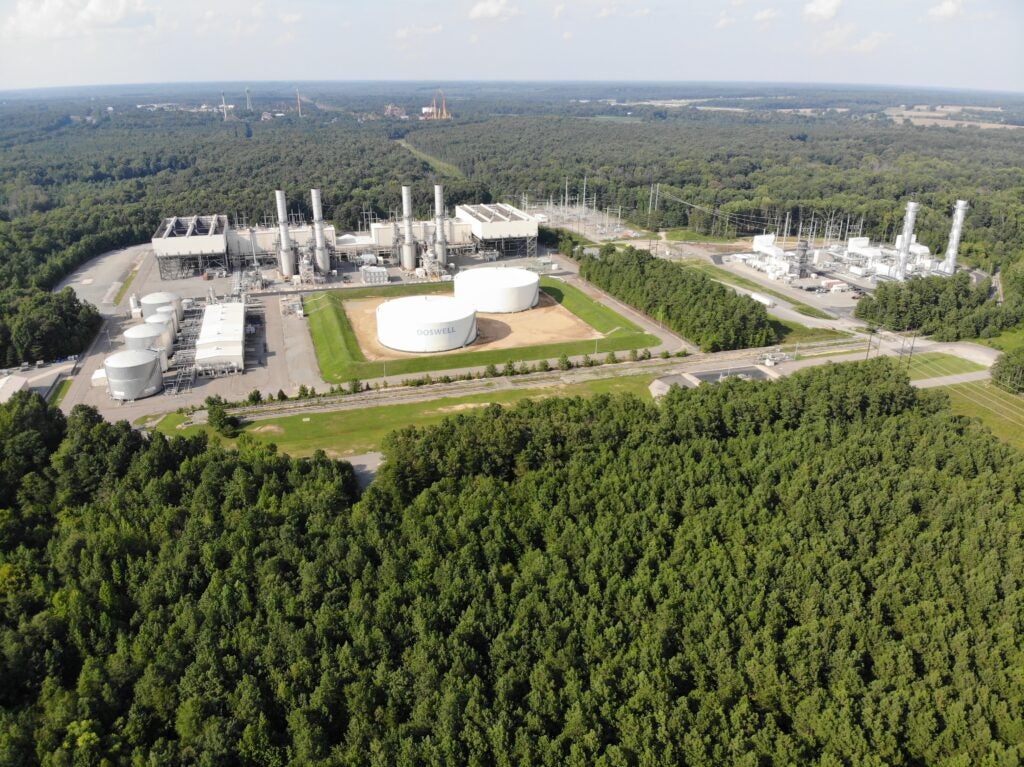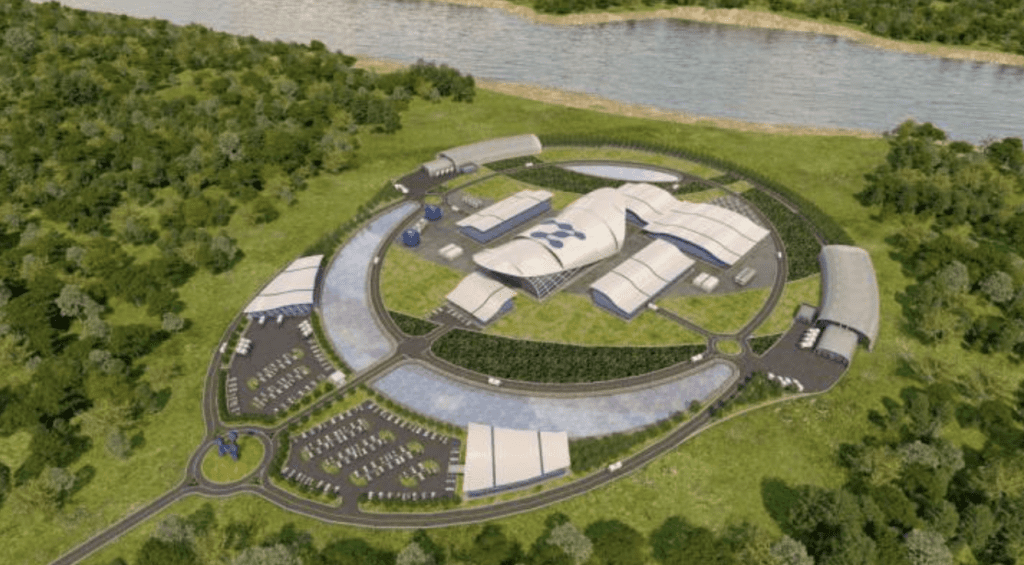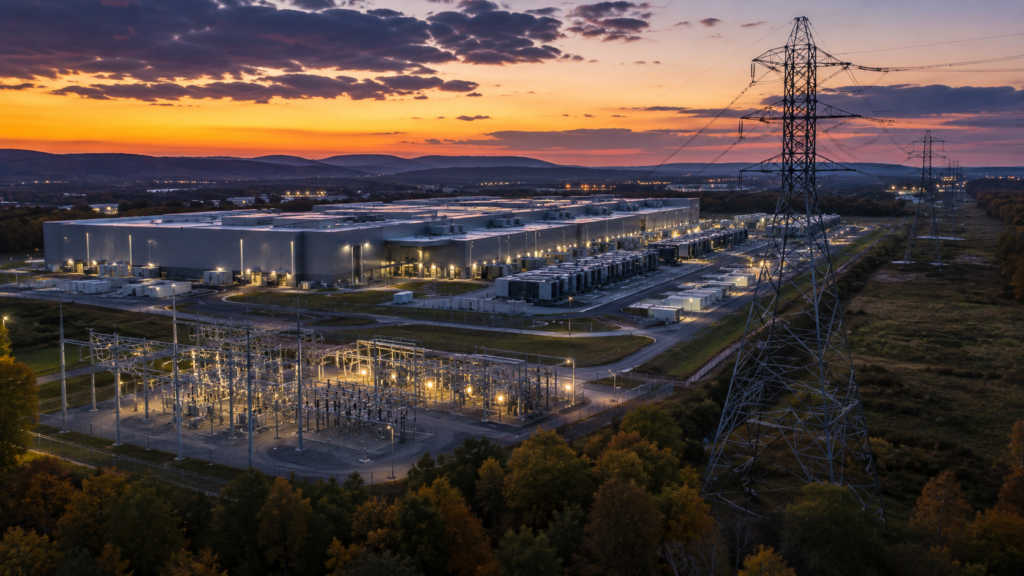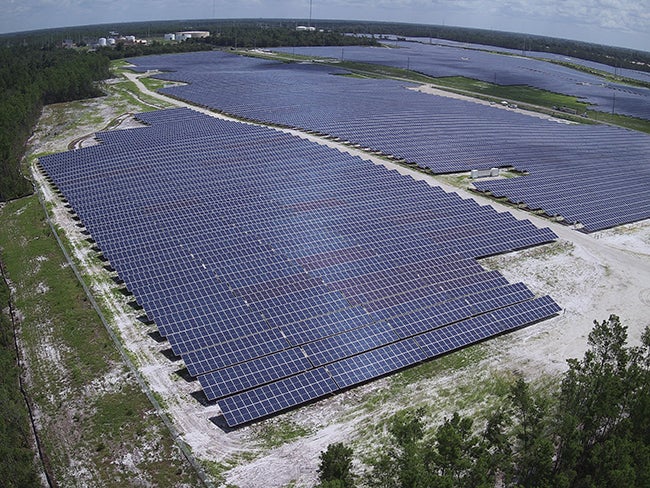
The West Virginia Department of Environmental Protection’s (WVDEP) Division of Air Quality (DAQ) has determined that Purcellville, Virginia-based Fundamental Data satisfied the site-control requirements associated with its August 2025 air quality permit for the Ridgeline Facility—a gas turbine power plant that Fundamental Data is planning as the first phase of a project intended to include roughly 800 MW of gas generation, nearly 1.3 GW of solar, and 14 data center buildings using more than 2 GW of computing load in Tucker County, and a second phase adding 3.1 GW of gas-fired capacity.
The determination, which WVDEP issued on Aug. 13, resolves a specific procedural question raised by community groups. Other questions about the project remain open at the state, federal, and community levels.
While West Virginia DAQ Director Laura M. Crowder on Aug. 15, 2025, issued a construction permit for a combustion turbine power facility on a 291-acre tract near Thomas, West Virginia, community groups, including Appalachian Mountain Advocates, appealed the permit to the West Virginia Air Quality Board (AQB), contesting its authorization as a minor source under 45 CSR 13, the state rule under which a facility that would otherwise trigger federal Clean Air Act major-source review accepts enforceable permit caps that keep its potential emissions below those thresholds.
The AQB ultimately upheld the permit in a Feb. 5, 2026, Final Order. But in July 2026, the same groups raised a separate procedural question about whether Fundamental Data held legal site control—meaning ownership or contractual rights to the land—when the permit was issued in August 2025. While site control is a threshold administrative requirement under Section 8 of the DAQ’s permit application instructions, it had not been part of the AQB appeal.
On July 31, 2026, DAQ Director Crowder opened her own inquiry, giving Fundamental Data until Aug. 7 to respond. After the DAQ received the redacted Purchase and Sale Agreement on Aug. 11, it issued the Aug. 13 determination confirming site control was satisfied.
“Based on this technical and legal correlation, the DAQ has determined that the information provided is sufficient to verify Fundamental Data LLC’s legal site control at the time of permit issuance,” Crowder wrote. “Consequently, the site control requirements stipulated in Section 8 of the permit application instructions are satisfied.”
Multigigawatt Data Center Complexes Testing Past-Era Frameworks
The Ridgeline determination arrives at a crucial opening in the data center/power nexus, as the U.S. power sector begins to confront the practical mechanics of siting hyperscale AI data centers and their dedicated generation at commercial scale. According to ElectricChoice.com, an independent electricity marketplace operated by Eisenbach Consulting that also tracks U.S. data center development and regulation, 61 major U.S. data center projects are announced or under construction, including more than a dozen campuses at or above the gigawatt scale. It has also tallied at least 225 data center moratoriums or restrictions across 30 states.
For now, no universal federal permitting process exists for these projects, and data centers remain subject to state and local siting authority, while particular components of their energy infrastructure may trigger separate federal requirements depending on the technology, location, and project configuration. Requirements can involve the Federal Energy Regulatory Commission, Nuclear Regulatory Commission, Army Corps of Engineers, or state agencies exercising authority delegated under federal environmental statutes.
At the state level, air-quality or construction permits typically address only one phase of a multigigawatt data-center campus—not later-generation phases, electricity supply arrangements, transmission requirements, or the cumulative effects of the full buildout. However, state electricity officials are increasingly identifying that project-by-project structure as a problem in its own right. In a July 2026 framework, the National Council on Electricity Policy—a member-driven body of state utility commissioners, energy officials, consumer advocates, air-quality regulators, and legislators administered by the National Association of Regulatory Utility Commissioners (NARUC)—laid out six areas where state agencies will need to coordinate to respond to load growth: early interagency coordination, shared information portals, state-level load forecasting, interconnection policies for large loads, large-load tariffs, and shared economic-development goals. The framework’s premise is that individual state agencies acting under their own statutes are not, under current arrangements, capable of processing the scale and speed of load additions now arriving in queues. It called on states to move from a “reactive project-by-project process to a proactive, system-level strategy for managing large-load growth.”
NCEP warned that timing has become a critical consideration. Once large-load projects are treated as “done deals,” the framework noted, agencies lose meaningful opportunities to influence their impacts. It urged states to bring utilities, regulators, environmental agencies, economic-development offices, and local governments together before incentives are finalized, sites are locked in, or infrastructure investment is committed. The group also called for common project information, state-level load forecasts, large-load interconnection standards, specialized tariffs, and explicit economic-development criteria so agencies are working from shared data, assumptions, timelines, and risk-allocation principles.
Meanwhile, the structural misalignment also persists at the power system’s technical layer. The Energy Systems Integration Group’s July 2026 report on transmission planning with large loads—prepared by a task force including PJM, MISO, ERCOT, CAISO, SPP, NYISO, ISO-NE, WECC, DOE, and utility, developer, and academic participants—concluded that large loads are exposing three weaknesses in existing transmission planning: siloed planning processes, a mismatch between development and grid timelines, and extraordinary uncertainty over which loads will actually materialize. While data centers can often be developed in roughly two to three years, ESIG noted major transmission infrastructure may require close to a decade to plan, permit, and construct. The mismatch may force utilities and grid planners toward whatever solution can satisfy the immediate request fastest, even when a larger or different investment could provide more durable system capacity.
Given timing constraints, dedicated generation has become attractive to data center developers. But, as ESIG cautioned, self-supply, co-located generation, and flexible service reduce transmission requirements only when their operating limits are defined, visible to system operators, and enforceable. Otherwise, grid planners may still have to plan around the possibility that the load will ultimately require substantial firm service.
Fundamental Data’s Case for a Multi-Fuel Megaproject ‘Platform’
Purcellville, Virginia–based Fundamental Data, a privately held infrastructure company, has proposed Ridgeline with acute awareness of the sector’s current constraints—and an equally acute view of the urgency and scale the AI buildout now demands.
The company has described Ridgeline as “a proposed data and energy infrastructure project in Tucker County, West Virginia, designed to support the digital systems people rely on every day, including artificial intelligence platforms, cloud computing, and enterprise data networks.” As Casey Chapman, a company official, explained to Sen. Sheldon Whitehouse (D-R.I.), Ranking Member of the Senate Committee on Environment and Public Works, in a March 2026 response, the megaproject was never designed as a “modest project.”
“The strategic location provides proximity to the nation’s largest natural gas field, adjacency to one of the most critical transmission nodes on the eastern interconnection, abundant water resources, and a secured land position of significant scale in a jurisdiction that does not impose the local zoning, permitting, and regulatory layers that add cost and time to projects of this type elsewhere in the country. The site was chosen with a long view in mind,” he wrote.
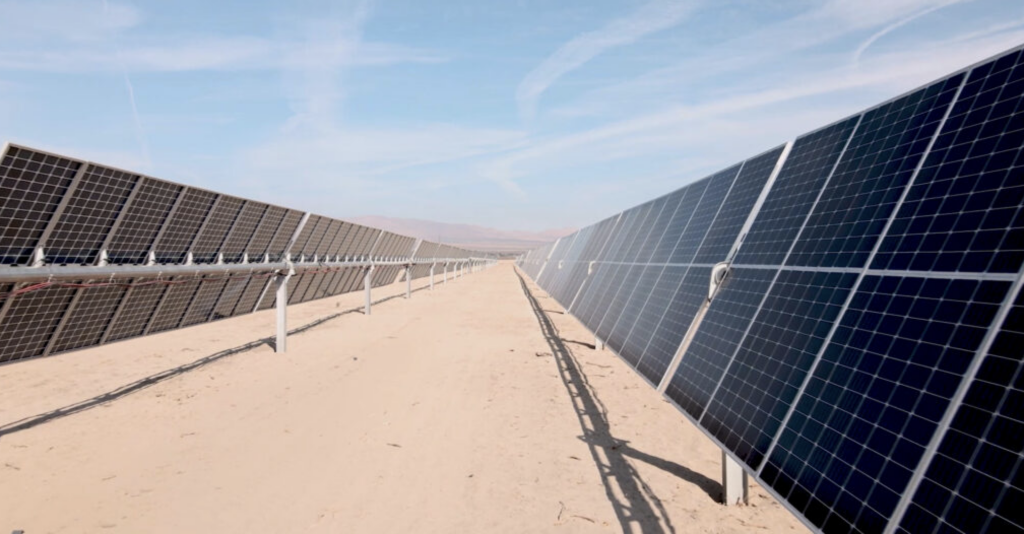
The multi-fuel basis for project development was intentional, Chapman underscored. Ridgeline will include nearly 1.3 GW of solar integrated with the gas turbines—”among the largest solar projects in the United States,” he wrote—configured so that “as solar production increases, gas consumption decreases.” But he argued the scale of AI-driven load makes renewables plus storage insufficient as a substitute for the gas component. “A single 1 GW continuous load requires approximately 4 GW of installed solar capacity to account for a 25% average capacity factor, and roughly 25,000 acres of land,” he said. Scaling that to meet only the 40 GW of projected new AI demand nationally by 2030 would require approximately one million acres—an area larger than Rhode Island—while the entire global annual solar cell manufacturing capacity of 6 GW would meet only about 15% of the projected need. Battery storage carries an equivalent gap, he noted. Carrying a 1-GW load through the 14 to 18 daily hours when solar output is insufficient would require 14 to 18 GWh of storage per gigawatt of continuous load—”more than 10% of the entire deployed battery storage capacity in the U.S. today.”
Nuclear, for now, remains a long-term consideration, he argued. Today, “there is virtually no new nuclear capacity capable of producing energy by 2030” and that “only a handful of projects are on track to deliver power before 2033.” Best-case decision-to-first-power for a new nuclear project, he added, is approximately seven years—”not fast enough to meet the energy demands this country is facing between now and 2030.” Gas may be the only fuel that can meet Ridgeline’s operational timeline at the required scale, while designing the facility to evolve, he added. The facility is designed as “fully hydrogen-compatible,” and subsequent development phases are intended to “incorporate advanced gasification technology and nuclear energy, supported by carbon capture,” he wrote.
As crucially, however, Chapman said the megaproject will build out as a long-horizon infrastructure platform. “We are not building a static asset,” he wrote. “We are building a platform, one whose energy profile is intended to advance as the technology and the economics to support it mature.”
A Permit, an Appeal, and a Site-Control Determination
For now, the Ridgeline Facility’s natural gas generation component holds Construction Permit R13-3713, issued by the WVDEP Division of Air Quality on Aug. 15, 2025—the sole regulatory approval to date underwriting the megaproject. In an Aug. 14 statement responding to the DAQ letter, Chapman said the determination confirms what the company certified in its original permit application. “This is exactly what we said from the beginning: Fundamental Data had legal control of the site when we applied for the permit, and the information we certified to the State was accurate,” he said.
The DAQ reached that conclusion through a GIS and cartographical comparison of property boundaries and coordinates in the redacted July 19, 2024 Purchase and Sale Agreement between seller Western Pocahontas Properties Limited Partnership and Fundamental Data, against those in the permit application. The 291-acre tract described in the agreement, the Division found, “corresponds precisely” with the Facility Location Map and Plot Plans on file.
While community groups—including Tucker United, the West Virginia Highlands Conservancy, and the Sierra Club, represented by Appalachian Mountain Advocates—had asked WVDEP in a July 16 letter to investigate whether Fundamental Data supplied accurate land ownership information in its permit application, the DAQ said in its Aug. 13 determination that it had classified the redacted portions of the Purchase and Sale Agreement—”commercial pricing and transactional terms”—as confidential business information under W.Va. CSR § 45-31, and stated that “no unredacted copy was submitted or is required to be filed in our records.”
Chapman defended the redactions. “Private is not the same thing as secret,” he said. “The economics and negotiated terms of a private land transaction have nothing to do with what comes out of a stack. The public has every right to know what this facility is permitted to emit and what environmental standards it must meet. Those requirements are public.”
Ridgeline is also structured, according to Chapman, so that the project and its users bear its power costs rather than other West Virginia ratepayers. “People should ask who pays. That’s a fair question,” Chapman said. “However Ridgeline ultimately connects to or works with the electric system, our position is straightforward: if our project creates a cost, that cost belongs with us and the people using the power—not a family in Parsons, not a small business in Davis, and not another West Virginia ratepayer.” He added: “We’re not asking West Virginia to bet its money on us. We’re betting on West Virginia.”
Citing a July 1, 2026 letter from the West Virginia Department of Commerce, Fundamental Data has confirmed the company is not seeking financial assistance from the state or from Tucker County. Ridgeline is proceeding, for now, under House Bill 2014, the Power Generation and Consumption Act, which Gov. Patrick Morrisey signed into law on April 30, 2025. The Morrisey administration described the law as creating “a certified microgrid program in West Virginia to expand microgrid development, utilize coal and natural gas resources, and reinvest in West Virginia by creating funds to lower the income tax, provide funding for economic development, and stabilize the electric grid”—legislation the governor’s office said was designed to attract data-center investment and make West Virginia “the most attractive state in the country for data centers.”
Under Permit R13-3713, electricity generated at the plant would primarily serve the co-located data-center campus, and Fundamental Data has said commercial operations are targeted for 2028. More steps remain, including those pertaining to sustained community opposition, independent health-impact modeling, and interconnection terms. Fundamental is determined to “continue working with state regulators and communicating directly with Tucker County residents and local leaders as the Ridgeline project advances.”
“We said we would provide straight answers and work through the regulatory process,” Chapman said last week. “We did exactly that. The State reviewed the documentation, verified the property against the permitted site, and confirmed that the requirement was satisfied. We appreciate the Division’s thorough review and look forward to continuing to move the project forward.”
—Sonal Patel is a POWER senior editor (@sonalcpatel, @POWERmagazine).