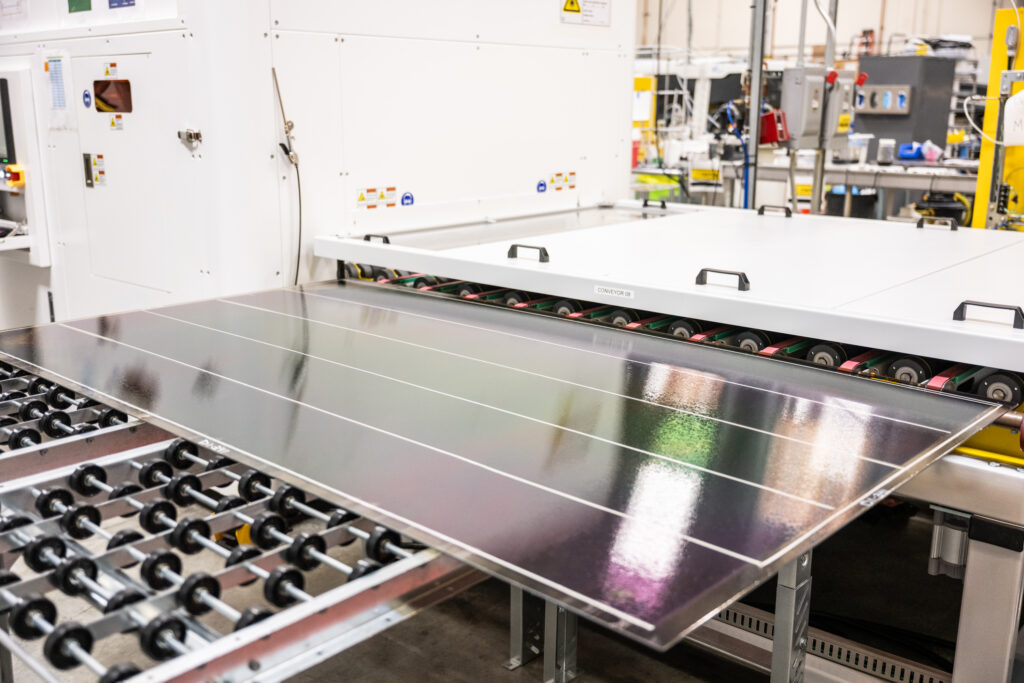

A California-based solar power equipment group said it has signed two separate five-year, 5-GW commercialization partnerships with a pair of India’s leading solar module manufacturers.
Caelux Corp. on July 23 said Rayzon Solar and Navitas Solar will integrate Caelux’s energy-producing solar glass with those companies’ TOPCon solar module technology. The announcements come on the heels of Caelux-Solx five-year, 3-GW partnership announced in April. Caelux on Thursday said the new deals provide a strong market signal for the direction of perovskite technology in the solar energy sector.
“We are pleased to partner with Navitas Solar, a true visionary dedicated to scaling this important energy technology in India, one of the world’s fastest-growing renewable energy markets,” said Scott Graybeal, CEO of Caelux, which is headquartered in Baldwin Park, east of Los Angeles. “By integrating our technology into its module, Navitas Solar is taking the lead in India’s ambitious clean energy goals, both in terms of domestic production and deployment. Together, we aim to deliver advanced solar solutions that support India’s clean energy transition while strengthening its domestic manufacturing capabilities.”
The Caelux-Navitas partnership is designed for delivery of ultra-high efficiency solar modules that combine both perovskite and silicon solar layers. The agreement will couple Caelux’s energy-producing glass tech with Navitas’ N-Type TOPCon solar technology, creating Hybrid Tandem modules with efficiencies of up to 28%.
Aaron Thurlow, chief commercial officer at Caelux, told POWER, “We are honored to partner with these two market-leading India-based solar module manufacturers on multi-gigawatt scale production agreements. Building on our partnership with Solx in the U.S., these deals further strengthen Caelux’s leadership position globally in bringing perovskite technology to market at scale. Just as importantly, these agreements send a powerful market signal that perovskite technology has moved beyond promise to commercial reality.”
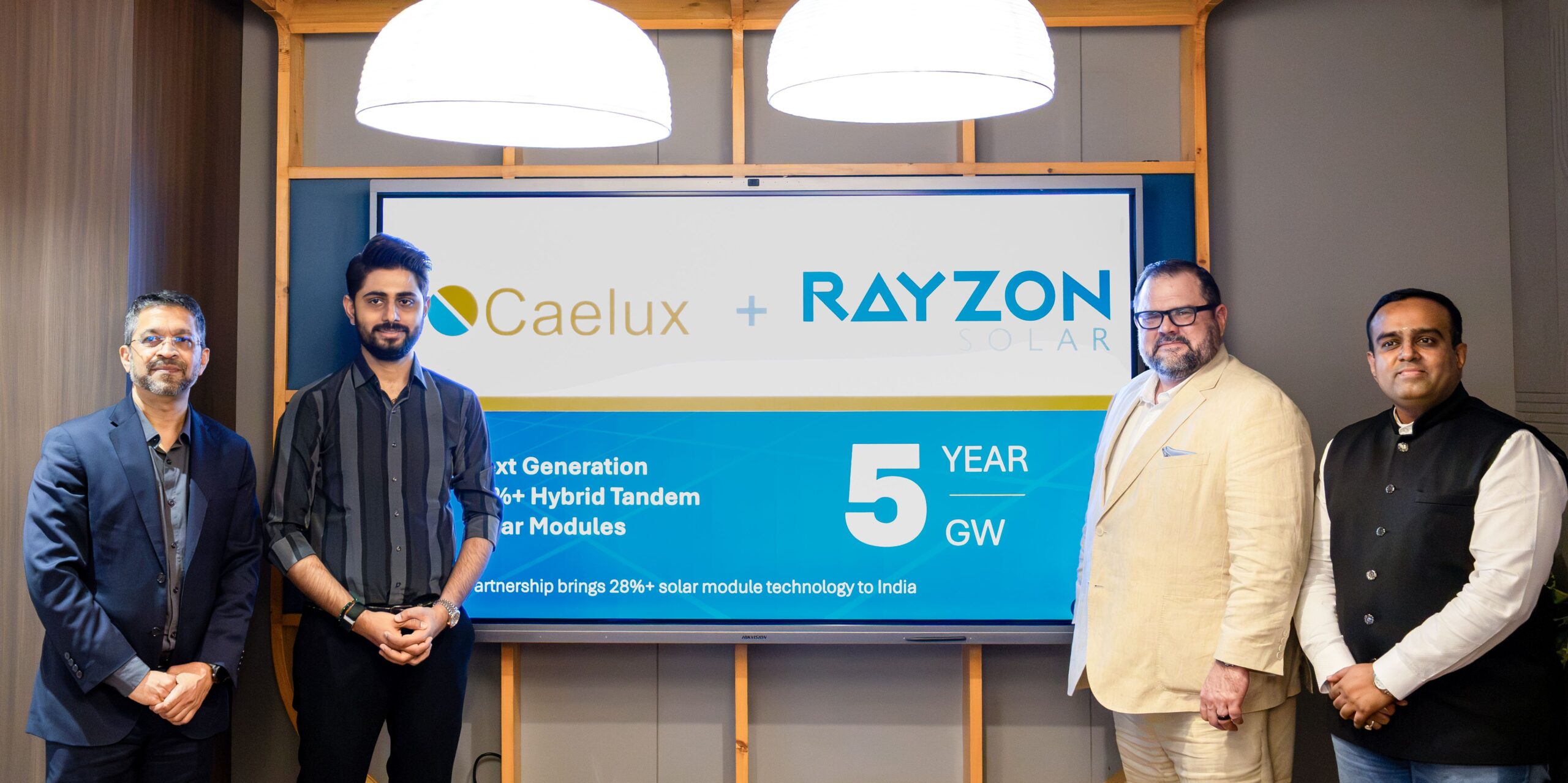
Caelux in the deal with Rayzon Solar will integrate its energy-producing solar glass with Rayzon’s advanced TOPCon modules. The companies said their collaboration will support the “Make in India” vision of the Indian government through local manufacturing, and enable next-generation perovskite-plus-silicon modules with efficiencies of as much as 28%.
India recently reached more than 150 GW of installed solar power making it the third-largest country in terms of deployed solar. Officials have said that to continue this trajectory, and achieve Prime Minister Narendra Modi’s pledge of 500 GW of renewable energy by 2030 (with solar as the primary driver), the country needs to install 350 GW of renewables in less than four years. The technology combination from this deal is expected to significantly improve the power density compared to silicon-only modules. The new module with the companies’ combined technology should accelerate the deployment rate for solar power.
“As India enters the next phase of its renewable energy journey, the focus must extend beyond capacity expansion to manufacturing globally competitive, high-efficiency technologies within the country,” said Ankit Singhania, co-founder and director for Navitas Solar. “Our partnership with Caelux marks an important milestone in that journey. By combining our manufacturing expertise with Caelux’s pioneering perovskite technology, we are creating one of India’s earliest pathways for large-scale production of Hybrid Tandem solar modules. Crucially, this leap in world-class technology and scale will serve as a powerful engine to fuel the Government of India’s ambitious vision of achieving 500 GW of non-fossil fuel power capacity by 2030. This collaboration reinforces our commitment to innovation, market leadership, and self-reliance.”
The companies on Thursday said they want to have commercial production available by 2028.
“Navitas Solar is living proof that India’s energy transition will be won by coupling advanced technology with Indian supply chains, and Indian jobs,” said Vish Iyer, managing director, India & West Asia, for Caelux. “By integrating Caelux’s energy producing glass to create high-efficiency modules, Navitas is helping India leap forward towards its clean energy goals.”
Navitas, founded in 2013, is headquartered in Surat, Gujarat, India. The company specializes in Mono PERC and high-efficiency N-Type TOPCon solar modules.
Bifacial Manufacturing Platform
Rayzon Solar said it will leverage its 11.3-GW large-scale bifacial manufacturing platform as part of the agreement with Caelux. Rayzon Solar will overlay Caelux’s energy-producing glass on its TOPCon technology to produce the highest power density modules available, according to the company.
“We are dedicated to fulfilling India’s vision of establishing world-class, high-quality solar manufacturing at scale,” said Chirag Nakrani, co-founder and managing director, Rayzon Solar Limited. “By partnering with Caelux, we are furthering our technology leadership and strengthening India’s position at the forefront of next-generation solar manufacturing.”
“As India is one of the top solar manufacturing countries in the world, it is a strategic destination for us. This partnership is a critical step in Caelux’s growth trajectory as we look to scale our technology globally,” said Graybeal. “We are honored to partner with Rayzon Solar, an award-winning and globally-respected solar module manufacturer.”
The companies are currently collaborating on early deployments, and commercial volumes are expected to be available by 2028 and eligible for India’s government-tendered utility market.
India is experiencing dramatic growth in both solar deployment and manufacturing due to the Production Linked Incentives Schemes from India’s Ministry of New and Renewable Energy, combined with the Approved List of Models and Manufacturers (ALMM) listing requirements.
“This partnership accelerates our capability to domestically manufacture at the efficiency frontier and at the scale India needs to meet its ambitious clean energy goals of 500 GW by 2030,” said Amit Barve, CEO of Rayzon Solar.
Rayzon Solar said its ALMM-listed manufacturing platform provides the scale needed to commercialize the next-generation modules. The company has facilities in Kim and Kosamba, Surat.
“Having spent my career supporting both downstream project development and solar manufacturing, I am excited about the massive impact that this partnership will have for the Indian solar market,” said Iyer.
Caelux is considered a global leader in perovskite (an advanced crystalline structure that converts sunlight into electricity) solar technology development and manufacturing. The company’s technology transforms the top glass of solar modules into a second power generation layer, increasing energy density by up to 30% and improving LCOEs (levelized cost of electricity) by 20% or more.
—Darrell Proctor is a senior editor for POWER.