
Articles By

-
News
Germany Strikes Deal to Extend Nuclear Plant Life Span
Under a deal made this weekend between energy companies and the government of Chancellor Angela Merkel, the life of Germany’s 17 nuclear power plants, located in five of the country’s 16 federal states, will be extended by up to 15 years. The decision has spurred opposition from the country’s local utilities and renewable industry.
-
News
California Fails to Pass 33%-by-2020 Renewable Mandate
The California Legislature failed last week to pass S.B. 722, a bill that would have required all utilities to obtain at least 33% of their electricity from renewable sources by 2020. The bill passed the Assembly, but the State Senate ran out of time before the legislative session ended on Aug. 31.
-
News
IEA: World’s Generation Increased 230% Since 1973
Electricity generation around the world was 20,181 TWh in 2008 and has soared nearly 230% since 1973, according to the International Energy Agency’s (IEA’s) newly released Key World Energy Statistics. The 2010 edition of the booklet that addresses global energy facts and figures also shows that although the world’s coal/peat shares for power generation increased just 3% during that timeframe, nuclear and gas generation jumped about 10%, while oil generation plunged almost 20%.
-
News
RWE, BASF, and Linde Claim CCS “Breakthrough”
Germany’s largest electricity producer, RWE Power, last week said efforts to test a new technology for separating carbon dioxide from flue gas in a pilot plant at its Niederaussem power station had resulted in a “breakthrough.” The technology, which captures carbon dioxide by means of unnamed chemical solvents, could reduce energy input by 20%, RWE and project partners BASF and the Linde Group claim.
-
News
DOE Grants $575M to 22 Projects for CCS Research and Development
The DOE on Tuesday announced it would grant $575 million in Recovery Act funds to 22 projects in 15 states to accelerate carbon capture and storage (CCS) research and development. The projects are expected to complement industrial demonstration projects already being funded by the Recovery Act, but most have power plant applications.
-
News
Nevada Geothermal’s Blue Mountain Geothermal Project Gets Loan Guarantee
Nevada Geothermal’s 49.5-MW Blue Mountain “Faulkner 1” geothermal project in northwestern Nevada has been awarded a $98.5 million partial loan guarantee by the U.S. Department of Energy (DOE).
-
General
The End of the Climate War
By Kennedy Maize Washington, D.C., Sept. 7, 2010 — The time has come for all of us to abandon the sterile, and now futile, brawl over massive federal legislation to deal with the alleged problem of global warming. For the advocates of measures such as carbon taxes, cap-and-trade (a second-best tax), or Environmental Protection Agency […]
-
General
Election Means Major Energy Policy Changes
By Kennedy Maize Washington, D.C., Sept. 3, 2010 – Look for significant changes in the way Congress addresses energy policy and legislation when the 112th Congress convenes in January 2011. By most expert accounts, Democrats are going to suffer major losses at the polls in November, with many pundits predicting a Republican takeover of the […]
-
Commentary
Energy and Water: A Matter of Interdependence
Water resources represent essential inputs into energy production while, at the same time, energy availability is a key factor in effective water resource use.
-
 Hydro
HydroUK Installs Hub to Test Wave Energy Projects
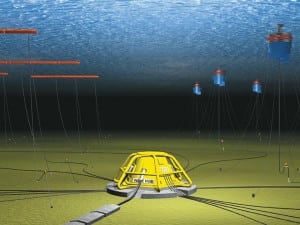
A £42 million marine power infrastructure project that will function as an “electrical socket” in waters 50 meters (m) deep and nearly 16 kilometers (km) off the coast of Cornwall in South West England set sail toward its proposed location this July.
-
 News
NewsUltra-Low-NOx Burner
Hamworthy Peabody Combustion introduced the ECOjet ultra-low-NOx burner. Offering ultra-low burner nitrogen oxide capacities (<30 parts per million) with little or no flue gas recirculation, the burner can be used with a full range of gaseous fuels and with package, industrial, and utility boilers, including single and multi-burner wall-fired, turbo, and other boiler types. Ignition […]
-
Commentary
Why September Marks the New Year
While the New Year officially begins Jan. 1, in my mind, the year really begins the day after Labor Day. That’s when Washington again takes up its never-ending, seldom-succeeding task of pushing the policy boulder up the hill.
-
 Gas
GasThe World’s First Two-Stage Turbocharged Gas Engine
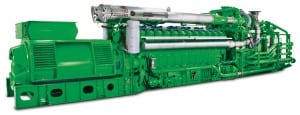
GE launched what it is calling the world’s first two-stage turbocharged gas engine this June.
-
 News
NewsInnovative Fire Extinguisher Mount
Poly Performance’s newly launched Quick Release Fire Extinguisher Mount offers an innovative way to safely mount a fire extinguisher to any flat or round surface. The mount can be secured with either bolts or hose clamps. Configurable for any size fire extinguisher, the mount offers split-second removal to maximize emergency preparedness. Poly Performance manufactures the […]
-
Supply Chains
TREND: Solar Doldrums
While the Obama administration in Washington is lauding solar energy as a major part of an alleged transition to renewable energy, the U.S. companies that make solar modules to turn the energy in sunlight into electric power are hurting. Prices for PV cells are falling, and domestic firms are seeing waves of red ink on their books, falling investor interest, and are responding by moving production offshore.
-
Business
POWER Digest (September 2010)
MHI, Foster Wheeler to Support FEED for UK CCS Project. A consortium of Mitsubishi Heavy Industries (MHI) and Foster Wheeler Energy Ltd. on August 5 announced that it had received an order from E.ON UK to support the front-end engineering design (FEED) for a post-combustion carbon dioxide (CO2) capture plant proposed as part of E.ON’s […]
-
 News
NewsAll-in-One Gas Detection System
Industrial health and safety equipment manufacturer Sensidyne released the SensAlarm Plus, an all-in-one gas detection system for monitoring oxygen, toxic, and combustible gases. The system functions as a single transmitter that offers “Test-on-Demand” and “Predictive Sensor Failure” features, in addition to accepting oxygen, electrochemical, catalytic bead, or infrared sensors. The system provides a large LED […]
-
 O&M
O&MTen Years of Experience with FAC in HRSGs
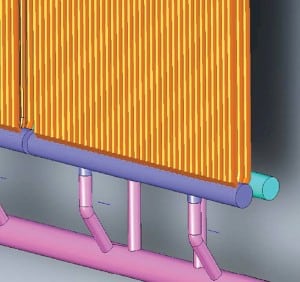
We first reported on combined-cycle plant reliability concerns due to erosive wear and flow accelerated corrosion (FAC) in heat-recovery steam generator (HRSG) pressure parts at the 1999 EPRI Maintenance Conference. More than 10 years later, these damage mechanisms remain significant contributors to forced outages, pressure part repairs, and major component replacement.
-
 Water
WaterMine Drainage: An Alternative Source of Water
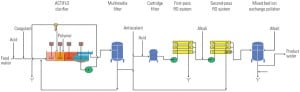
Although mining practices often vary greatly according to the material produced and the value of the deposit, one common denominator is that mining of materials containing sulfide minerals creates acid mine drainage (AMD). AMD is one of the mining industry’s major environmental challenges.
-
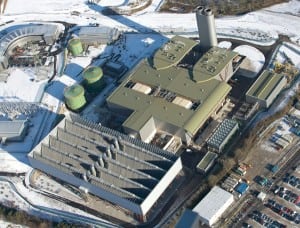 Gas
GasTop Plant: Langage Combined Cycle Power Plant, Plymouth, Devon, UK
The UK grid, focused on adding valuable renewable generation, will rely on natural gas–fired generation for many years to come. One of the most recent additions is the Langage Power Plant, designed for quick response and low load “parking” at night while remaining below air emissions limits. With an extraordinary architectural design that blends into the natural surroundings, Langage is now a local landmark.
-
Solar
What Utility Executives Think About the Smart Grid
This summary of results from a recent Platts/Capgemini survey of North American utility executives looks at what respondents had to say about all things related to the smart grid. Nearly half of respondents’ utilities have a smart grid strategy in place, while the other half said their utility has one in development.
-
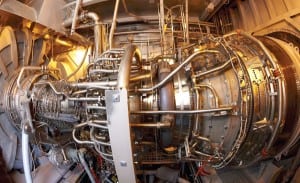 Gas
GasTop Plant: Panoche Energy Center, Firebaugh, California
The Panoche Energy Center is a 400-MW simple-cycle power plant using four of General Electric’s GE LMS100s with fast-start capability. Dispatched by Pacific Gas & Electric to meet regional power and grid stabilization needs, the project entered commercial service two months earlier than planned. Panoche is the largest LMS100 peaking facility in the U.S.
-
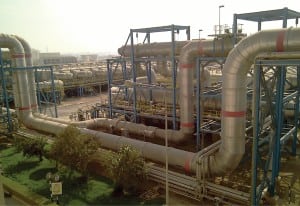 Gas
GasTop Plant: Ras Laffan Power and Water Plant, Ras Laffan Industrial City, Qatar
At the Ras Laffan Power Co. facility, the 756-MW net combined-cycle plant and the integrated 40 million gallons per day desalination plant are working in tandem to provide abundant, reliable electricity and desalinated water to residents of the State of Qatar, the most prosperous nation in the Middle East.
-
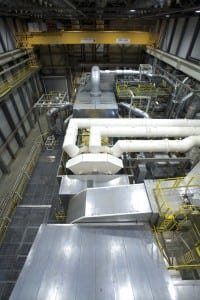 Gas
GasTop Plant: Sloe Centrale Power Plant, Vlissingen-Oost, Zeeland Province, Netherlands
There’s nothing slow about the fast-track operations at the new 870-MW Sloe Centrale Power Plant. The combined-cycle plant is designed for 250 starts per year and is capable of supplying power to the grid within a mere 30 to 40 minutes. In addition to its impressive rapid load response, the gas-fired plant produces low CO2 and NOx emissions by using the latest technology. It also attains an efficiency of 59%.
-
Smart Grid
"Perfect Citizen" Program to Protect the Power Grid
The National Security Agency is launching a program to protect the grid from cyber attack, along with other civilian and military critical infrastructure, while a new Department of Energy report highlights grid vulnerabilities.
-
News
Cap and Trade Is Dead
Cap and trade officially died on July 22 when Senate Majority Leader Harry Reid announced at a news conference that the Democratic Caucus was unable to reach a consensus on any form of energy bill, even a recent short-lived version that proposed reducing carbon emissions from only the utility sector. I predict that carbon cap and trade is now dead for at least a decade, maybe longer.
-
 Gas
GasTop Plant: Timelkam Power Plant Vöcklabruck District, Upper Austria, Austria
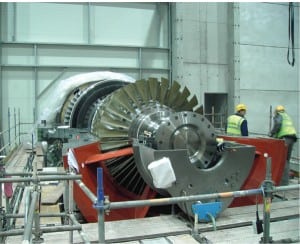
Now that the 412-MW Timelkam Power Plant has replaced a 47-year-old coal-fired power plant located in the Vöcklabruck District, northern Austrians can bid auf wiedersehen (goodbye) to high levels of air pollution. Compared to its predecessor, the new gas-fired combined-cycle plant has dramatically cut CO2 and NOx emissions and produces seven times more energy.
-
 Gas
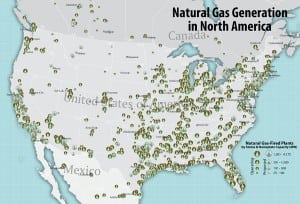
GasIndustry Trends: Map of Natural Gas Generation in North America
Courtesy: Platts Data source: POWERmap All rights reserved. No reproduction allowed.
-
Legal & Regulatory
Will Nuclear 2.0 Be Better, Faster, and Cheaper than Nuclear 1.0?
The nuclear renaissance has been in play for several years yet not a shovel of dirt has been turned. Why should anyone believe that Nuclear 2.0 will be an improvement?
-
Legal & Regulatory
Coal Ash Regulation: Playing the Name Game
What’s in a name? Would coal ash labeled as “special” hazardous waste be as easily recycled as that labeled nonhazardous waste?