
Articles By

-
News
Texas Appeals EPA’s Disapproval of Flexible Permits Program
Texas Attorney General Greg Abbott on Monday legally challenged the U.S. Environmental Protection Agency’s (EPA’s) disapproval of the state’s flexible permits program, a system which allows power plants, factories, refineries, and other industrial plants to exceed emission limits in certain areas as long as they stay within overall limits.
-
News
Hoosier Energy, EPA Settle Alleged NSR Violations
Hoosier Energy, an Indiana-based rural cooperative, on Friday reached an agreement with the U.S. Environmental Protection Agency (EPA) and the Indiana Department of Environmental Management (IDEM) to resolve alleged New Source Review (NSR) violations of the Clean Air Act.
-
News
Tampa Electric to Test Carbon Capture Technologies at Big Bend, Polk Stations
Tampa Electric said on Monday it is participating in two DOE-funded demonstration projects at the company’s Big Bend and Polk Power Stations. The projects are designed to advance carbon dioxide capture technologies and could lead to the development of technologies on a large scale.
-
General
Reid Recognizes the Corpse in the Chamber
By Kennedy Maize Washington, D.C., July 22, 2010 — Is anyone really surprised that Senate majority leader Harry Reid (D-Nevada) has finally declared major energy legislation dead? For weeks, Reid has been singing words from a country classic that I’m sure he knew were false: “Mother’s not dead, she’s only sleeping.” Today, he recognized the […]
-
News
DOE Unable to Gauge Maturity of CCS Technologies, Says GAO Report
The Department of Energy’s (DOE) failure to systematically assess development of carbon capture and storage (CCS) technologies renders it unable to gauge their maturity and to provide resources required to move these technologies toward commercial demonstration, the Government Accountability Office (GAO) found in a report released to the public last week.
-
News
Senators Ready for Carbon Debate
With only about 13 days remaining before the U.S. Senate’s month-long summer recess is scheduled to begin, concerns are mounting about whether it may be too late to delve into an “energy-only bill,” let alone a “utility-only” carbon-curbing bill.
-
News
Terrorists Attack Hydropower Plant in Russia
At least four militants reportedly stormed into a hydropower plant in Russia’s volatile North Caucasus region early this morning, shooting dead two security guards before detonating four bombs in a turbine hall and shutting down the plant.
-
News
IEA: China Has Overtaken U.S., Become World’s Largest Energy User
The International Energy Administration (IEA) alleges, based on preliminary data, that China has overtaken the U.S. to become the world’s largest energy user. But China on Tuesday rejected that report, saying the IEA’s data is unreliable. The IEA said that China consumed 2.252 billion tons of oil equivalent in 2009—4% more than the 2.17 billion […]
-
News
Australian Government Shuts Down UCG Trial on Fears of Water Contamination
A project piloting underground coal gasification (UCG) technology in Australia was last week shut down for tests by the Queensland Government for carcinogenic chemicals in nearby water bores.
-
News
B&W and Bechtel Form Small Modular Reactor Nuclear Plant Alliance
Babcock & Wilcox subsidiary Babcock & Wilcox Nuclear Energy Inc. (B&W NE) and Bechtel Power Corp. today announced they have entered into a formal alliance to design, license, and deploy a Generation III++ small modular nuclear power plant based on B&W mPower small modular reactor (SMR) technology. The new alliance will be known as Generation mPower and could deploy its first units by 2020.
-
News
DOE Files NRC Appeal in Yucca Mountain Fight
The U.S. Department of Energy on Friday filed a 48-page appeal asking the five-member board at the Nuclear Regulatory Commission (NRC) to set aside an application for the Yucca Mountain waste repository project. The agency said that Energy Secretary Steven Chu had the authority to halt the project.
-
News
SDG&E Clears Permitting Hurdles for 120-Mile Calif. Transmission Superhighway
The U.S. Forest Service (USFS) on Tuesday approved a San Diego Gas & Electric (SDG&E) 120-mile transmission line from remote areas in southern California’s Imperial Valley to residences and businesses in the San Diego area.
-
News
Enel Inaugurates World’s First Hydrogen-Fueled Power Plant
Italy’s Enel on Monday inaugurated its hydrogen-fueled combined-cycle power plant at Fusina, near Venice. The €50 million project, the first industrial-scale facility of its kind in the world, uses 1.3 metric tons of hydrogen per hour to generate 60 million kWh a year of electricity as well as heat. It reportedly has an overall efficiency of about 42%.
-
News
Shaw, Toshiba, and Exelon to Pursue Saudi Arabia Nuclear Plants
Shaw Group, Toshiba Corp., and Exelon Corp. unit Exelon Nuclear Partners on Monday announced an agreement to jointly pursue opportunities to design, engineer, build, and operate new nuclear power plants in Saudi Arabia.
-
News
Report: China to Build 10 AP1000 Reactors
China is reportedly looking to build 10 nuclear reactors using AP1000 technology, including the four under construction at Sanmen in coastal Zhejiang province and at Haiyang, Shandong province.
-
News
AREVA, New Brunswick Ink Deal for New Gen III Mid-Size Reactor
AREVA and the Canadian province of New Brunswick last week signed a letter of intent to develop a clean energy park near the Point Lepreau nuclear station. The project would include a midsize third-generation reactor—and it wouldn’t be a prototype, AREVA has reportedly said.
-
News
Study: Regulation, Environment Among Top Concerns for Utility Execs
Utility executives cite regulation, the environment, technology, finance, and end users as the five most critical issues facing the energy industry today, a newly released study by Platts and Capgemini finds.
-
News
GE Announces $200 M Challenge to Accelerate Power Grid Technology
GE on Tuesday invited technologists, entrepreneurs, and start-ups all over the world to enter a $200 million challenge that seeks ideas to create a smarter and cleaner power grid while also accelerating the adoption of more efficient grid technologies.
-
General
Insanity and DOE Winners and Losers
By Kennedy Maize Washington, D.C., July 8, 2010 — It’s become a cliche that government should not try to pick winners and losers in the marketplace. But cliches are useful by the circumstance that they are often correct. So now we come to government loan guarantees, a classic example of government picking winners and losers. […]
-
News
Japanese Firms to Join Forces for Nuclear Exports
Six Japanese companies established a joint venture on Tuesday to propose new nuclear projects abroad. The companies are Tokyo Electric Power Co. (TEPCO), Chubu Electric, Kansai Electric, Toshiba, Hitachi, and Mitsubishi Heavy Industries (MHI).
-
News
Abengoa Gets $1.45B Federal Loan Guarantee for Ariz. CSP Plant
The Department of Energy (DOE) last week offered a $1.45 billion conditional loan guarantee to Spain’s Abengoa to finance the construction and start-up of a concentrating solar power (CSP) generating facility in Solana, Ariz. The facility, which Abengoa claims will be the “largest CSP plant in the world,” will use the first six-hour thermal energy storage system in the U.S.
-
News
Cadmium-Telluride Thin-Film Solar Panel Maker Gets $400M Loan Guarantee
The DOE awarded a $400 million conditional loan guarantee to Abound Solar Manufacturing for the assembly of thin-film, cadmium-telluride solar modules. The project will allow the manufacturing technology to be commercially deployed for the first time ever.
-
News
DOE, DOI to Develop Action Plan for Offshore Wind, Marine Power
The U.S. Department of Energy (DOE) and the Department of the Interior (DOI) signed a Memorandum of Understanding (MOU) last week that will strengthen the working relationship between the two agencies regarding future development of commercial renewable offshore energy projects on the U.S. Outer Continental Shelf.
-
News
DOE Announces $67 Million Investment for Carbon Capture Development
The DOE today announced it would fund 10 projects aimed at developing advanced technologies for capturing carbon dioxide (CO2) from coal combustion. The projects, valued at up to $67 million over three years, focus on reducing the energy and efficiency penalties associated with applying currently available carbon capture and storage (CCS) technologies to existing and new power plants.
-
News
ACEEE Study: Smart Meters Not Enough to Save Energy, Money
A study released last week by the nonprofit American Council for an Energy-Efficient Economy (ACEEE) concludes that smart metering initiatives alone are not enough to save energy.
-
News
EPA Proposes CAIR Replacement Rule
The U.S. Environmental Protection Agency (EPA) proposed regulations on Tuesday to tackle power plant pollution that drifts across the borders of 31 eastern states and the District of Columbia. Replacing the Bush-era Clean Air Interstate Rule (CAIR), the proposed “transport” rule seeks to reduce power plant emissions of sulfur dioxide (SO2) and nitrogen oxides (NOx) to meet state-by-state emission reductions.
-
 Commentary
The Politics and Perils of Pork
An "emergency war supplemental" appropriation bill that Congress was considering at this writing has implications for the power industry: The measure includes $9 billion each for new loan guarantees for nuclear power and renewable energy projects.
-
News
Carbon Controls Fail Business Case Study
Cap-and-trade programs are featured in at least two U.S. legislative proposals to reduce carbon emissions, usually by around 80% by 2050 using a 2005 baseline. The benefits that accrue from the immense investment required to reach these goals are nebulous and don’t occur until decades after the investment. Based on my back-of-the-envelope analysis, the cost-benefit ratio of these proposals does not pass a cursory cost-benefit analysis.
-
 Water
WaterCirculating Fluid Bed Scrubbers Bridge the Gap Between Dry and Wet Scrubbers
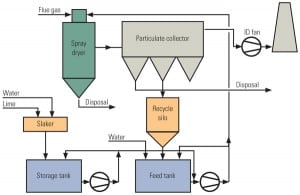
Circulating fluid bed (CFB) dry scrubbing technologies provide distinct advantages over conventional spray dryer absorber scrubbers for removing SO2 from flue gases. The CFB also competes well against wet limestone flue gas desulfurization processes typically favored for large boilers firing high-sulfur coals. With high SO2 removal rates in a dry treatment process, the CFB scrubber appears to be the best of both technologies: a water-stingy scrubber with high SO2 removal rates.
-
 Environmental
Determining AQCS Mercury Removal Co-Benefits
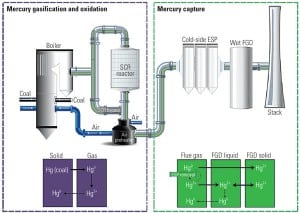
The U.S. Environmental Protection Agency is expected to propose an emissions standard for mercury and other hazardous air pollutants emitted by coal- and oil-fired electric generating units in March of 2011. The anticipated rule would require emission control to meet the various standards using maximum achievable control technology, as determined by the prescriptive requirements of the Clean Air Act. In response to the expected rule-making, utilities will be required to make technology decisions in order to ensure compliance. One cost-effective approach to compliance may be the use of “co-benefits” from air quality control systems (AQCSs) already in service that are designed to remove other pollutants.