The International Hydropower Association (IHA) said global installed hydropower capacity reached 1,469 GW in 2025 after the addition of 28 GW of new capacity during the year, including a record 11.7 GW of pumped storage. Pumped storage capacity surpassed 200 GW globally for the first time, which the agency said reinforces the technology’s “growing importance as the world’s dominant form of large-scale energy storage.”
The IHA in its 2026 World Hydropower Outlook released June 23 highlighted what it called “hydropower’s rapidly evolving role in the global energy transition.” The group said hydropower is increasing in importance as countries “increasingly turn to flexible renewable generation and long-duration energy storage to support energy security, economic resilience and decarbonization.”
Malcolm Turnbull, president of the IHA, said, “As electricity systems become more dependent on variable renewables, and geopolitical tensions make reliance on imports more challenging, countries are increasingly recognizing the importance of flexibility, long-duration storage and resilient domestic generation. Hydropower and pumped storage are uniquely positioned to provide these services at scale.”
Rory Connor, partner and co-head of Power and Renewables for Addleshaw Goddard, a London, UK-headquartered law firm, said, “Hydropower is central to global energy security, stability and the energy transition. IHA’s World Hydropower Outlook is always a seminal report valued by the hydropower and wider energy industry year after year. We are delighted to help IHA launch the World Hydropower Outlook 2026.”
The 2026 World Hydropower Outlook is being discussed during the ongoing London Climate Action Week in the UK, happening now through June 28. The global event is hosted by Addleshaw Goddard in partnership with IHA, the Global Renewables Alliance, and the British Hydropower Association.
The report said that while conventional hydropower remains important for low-carbon electricity generation, the increasing share of solar and wind power on global power grids is driving calls for flexibility, balancing services, and long-duration energy storage. The group said that has led to pumped storage “becoming a strategic priority in major electricity markets worldwide.”
Highlights from the report include:
- Global pumped storage capacity has now surpassed 200 GW, with a further 243 GW currently under construction worldwide.
- Hydropower is moving to the center of energy security strategies worldwide, as governments prioritize system resilience, grid stability, and domestic electricity generation.
- Global hydropower capacity reached 1,469 GW by the end of 2025, remaining the world’s largest source of renewable electricity.
- The total global hydropower development pipeline now stands at 1,127 GW, including 621 GW of pumped storage projects across all stages of development.
- Rising electricity demand from digital infrastructure like data centres, electrification and industrial growth is strengthening demand for firm, renewable power.
Eddie Rich, CEO of IHA, told POWER, “2025 will be remembered as the year the water battery came of age. With global pumped storage capacity now exceeding 200 GW and more projects under construction than ever before, governments are increasingly recognizing that energy security, grid reliability and clean growth depend on long-duration storage. Hydropower provides the flexibility and resilience needed to power economies, integrate renewables and meet rising demand from industries, data centres and electrification.
“This year’s Outlook tells a clear story,” said Rich. “Pumped storage will double globally in [the] next 15 years. But we can and must go further. If the right policy changes are made, it should triple and if governments treat water batteries and chemical batteries equally, the industry will quadruple capacity by 2040.”
China Leads Hydro Additions
The IHA said the China, the global leader in renewable energy, accounted for more than 40% of worldwide hydropower capacity additions last year. The country now has more than 300 GW of hydropower under construction, including 218 GW of pumped storage.
China officially began construction last year of the $170-billion Yarlung Zangbo River Hydropower Project in Tibet, also known as the Motuo (or Medog) Hydropower Station. The project, being designed with five power stations with a total 60 GW of generation capacity, would be the world’s largest hydropower facility. It would be capable of generating about three times as much electricity as the current largest hydro project, the 22.5-GW Three Gorges Dam, according to the Chinese government. The IHA noted that China “is increasingly shifting towards strengthening grid flexibility and hydro-wind-solar integration, elevating hydropower’s strategic role in system reliability and balancing.”
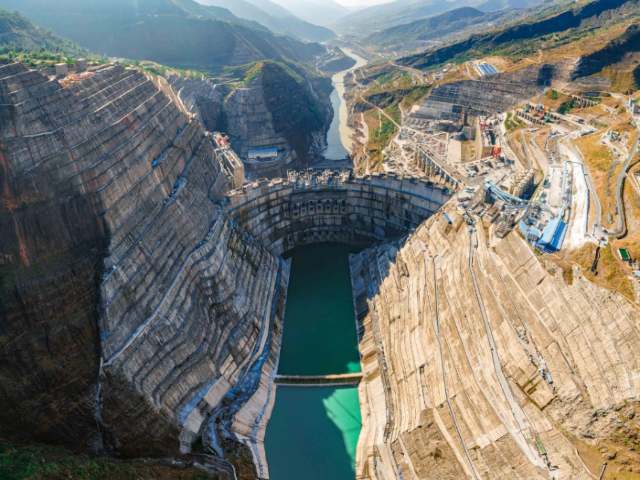
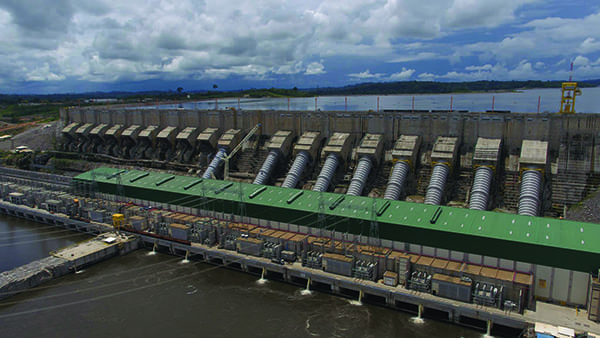
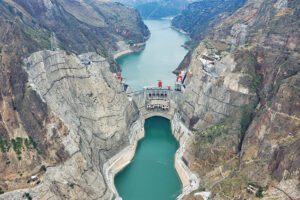
China is home to five of the top nine hydropower plants worldwide as ranked by generation capacity. The list includes the Wudongde Hydropower Station, a 10.2-GW facility that was named POWER’s Plant of the Year in 2022, and the 16-GW Baihetan Hydropower Station (Figure 1), second only to Three Gorges in terms of generation capacity.
Hydropower growth also is occurring across South and Central Asia, with a regional development pipeline of more than 300 GW, according to IHA. India is leading much of the growth in pumped storage, with plans to increase capacity to as much as 100 GW by 2035 from its current 6 to 7 GW of installed capacity. GE Vernova in May of this year announced it had secured an order from Megha Engineering & Infrastructures Limited (MEIL) to deliver nine 150-MW pumped-storage units for the 1.35-GW Upper Sileru hydropower plant, located in the state of Andhra Pradesh in India. The project is expected to be completed by 2030.
The IHA said that governments across Asia also are “strengthening cross-border cooperation on water management and electricity trade as climate pressures intensify.”
Demand for New Capacity in Europe
The IHA in its report said record levels of renewable energy curtailment and wider electricity system stress are accelerating demand for pumped storage and long-duration energy storage across Europe. “Countries including the Netherlands, Germany, Spain, Belgium, Sweden and France recorded more than 500 hours of negative electricity pricing during 2025, highlighting growing flexibility shortages in increasingly renewable-heavy electricity systems,” according to the report. The European Union and other governments are “responding through new market reforms, permitting measures, and revenue stabilization mechanisms designed to unlock major pumped storage investment pipelines,” according to IHA.
Africa continued as a strong region for new conventional hydropower additions for a second straight year, commissioning more than 4 GW in 2025. Major projects have included completion of the 5,150-MW Grand Ethiopian Renaissance Dam, or GERD, in Ethiopia; that facility produced its first power in 2022. Also commissioned in 2025 was Tanzania’s 2,115-MW Julius Nyerere Hydropower Project, that country’s largest power facility. The dam is located on the Rufiji River in the Morogoro region. The IHA noted that both installations “have expanded electricity generation capacity while strengthening regional power systems and energy access.”
The report said conventional hydropower remains important in South America, with a regional development pipeline of about 70 GW. The report said, “Countries across the region are increasingly recognizing hydropower not only as baseload generation but as a strategic flexibility asset capable of balancing rapidly expanding wind and solar fleets. Modernization and digitalization of aging infrastructure are becoming central priorities, with more than half of South America’s hydropower fleet now over 30 years old.”
Major developments in North America and Central America last year include Canada’s commissioning of the 1.1-GW Site C project (also known as the John Horgan Dam) in British Columbia. The U.S., where renewable energy has faced headwinds under the Trump administration and its support for fossil fuels, has still “advanced major permitting reforms and fast-track measures to support hydropower modernization and new electricity infrastructure,” according to IHA, which said more than 60 GW of pumped storage projects are in development across the U.S.
The report also identifies growing demand from data centers and digital infrastructure as a major emerging driver for hydropower globally. Tech giants Google and Microsoft each signed long-term hydropower supply agreements last year in support of powering their digital infrastructure, including data centers.
Barriers to Growth
The IHA’s report notes several barriers that continue to weigh on the hydropower sector. Those include “financing constraints, permitting delays, transmission bottlenecks, climate-related hydrological variability and regulatory uncertainty remain major obstacles to both conventional hydropower and pumped storage development.”
The agency said climate change, which is exacerbating drought conditions, “is also reshaping hydropower planning and operations worldwide.” The report notes that “Severe droughts in parts of South America, South and Central Asia and Europe during 2025 exposed vulnerabilities linked to water availability and aging infrastructure, while extreme weather events highlighted the importance of resilient and flexible electricity systems capable of responding to growing climatic volatility.”
—Darrell Proctor is a senior editor for POWER.