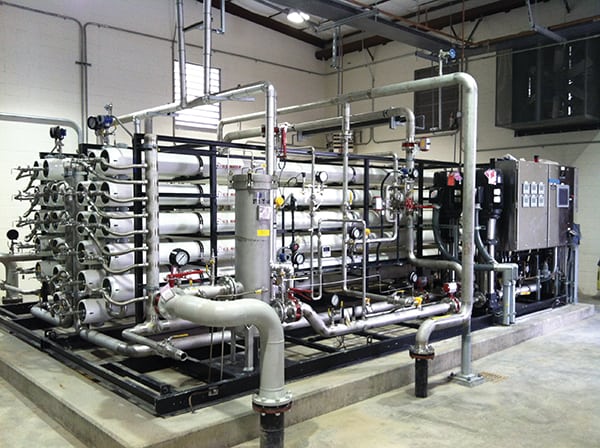
In much of the developing world, two essentials are often in short supply: potable water and reliable electricity. Some countries have invested heavily in desalination and combined cycle technologies to simultaneously solve both problems.
In the U.S., people have come to assume that a cheap and abundant supply of clean, potable water will always be available at the turn of a valve. However, water supplies in some regions have developed serious problems, lately caused by drought. Meanwhile, coastal regions, such as Florida, are stressing underground aquifers to meet water demand while risking contamination from saltwater intrusion. Perhaps it is time to consider a new and virtually limitless source of freshwater—the ocean.
Evaluate the Options
Two primary technologies are available to desalinate seawater. Most desalination plants (86%) in the U.S. are based on membrane technology, called seawater reverse osmosis (SWRO). The second technology approach is thermal distillation, which produces more than 40% of the world’s desalinated water.
SWRO certainly has some capital and deployment time advantages over thermal distillation. SWRO also seems to better fit the compartmentalized nature of U.S. business and government, where, generally speaking, municipalities retain responsibility for providing potable water and investor-owned utilities provide electrical power. Some SWRO projects have been colocated at existing power plants to take advantage of the warmer seawater available from the plant’s cooling water discharge; the warmer ocean water increases the SWRO process efficiency.
Development of desalination in many parts of the developing world has taken a different route. Usually, the markets for electrical power and freshwater supplies are developed simultaneously, often by the country’s sovereign government or by a group of large international businesses based on long-term power and water supply agreements made with the host country. Thermal distillation is normally the technology selected for these very large projects.
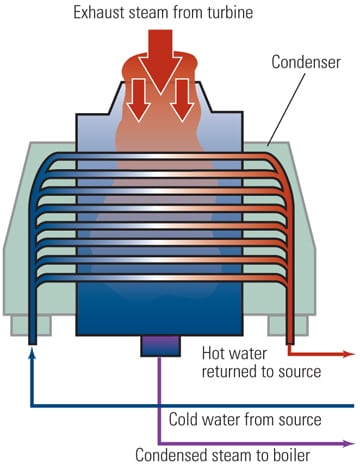
There are synergies that can be exploited when thermal distillation and power generation are developed in concert. Thermal distillation of seawater requires a large supply of cheap energy—and generally large amounts of steam. However, the newest technologies only require very low-pressure, low-grade steam as an energy source. On the other hand, power plants are often challenged to develop the means of disposing of large amounts of low-temperature waste heat produced in the condenser, usually with once-through cooling, cooling towers, or massive air-cooled condensers.
In the U.S., once-through cooling has been the historical cooling method of choice, but pending Clean Water Act Section 316(b) changes (final release is expected in 2013) will eliminate this option for plants constructed in the future.
Option 1: Reverse Osmosis
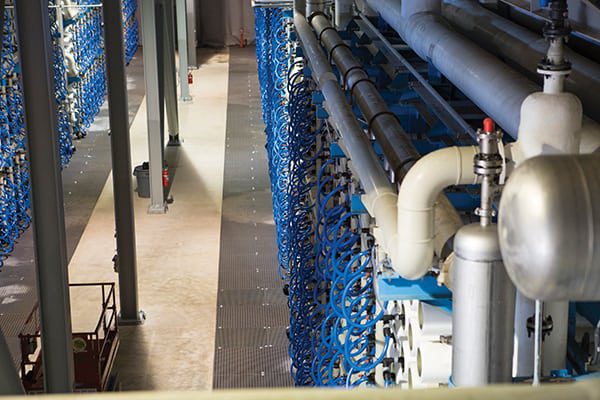
The typical SWRO process consists of pretreatment, reverse osmosis (RO), and post-treatment steps. Pretreatment includes screens and various types of sedimentation and filtration processes, ending with fine (5 micron) filters just upstream of the RO membranes. In some plants, ultra-filtration units have replaced most of the pretreatment. SWRO membranes are sensitive to chemical and microbiological fouling and some elements, thus treatments such as anti-scalant chemicals must be added to the seawater (Figure 1).
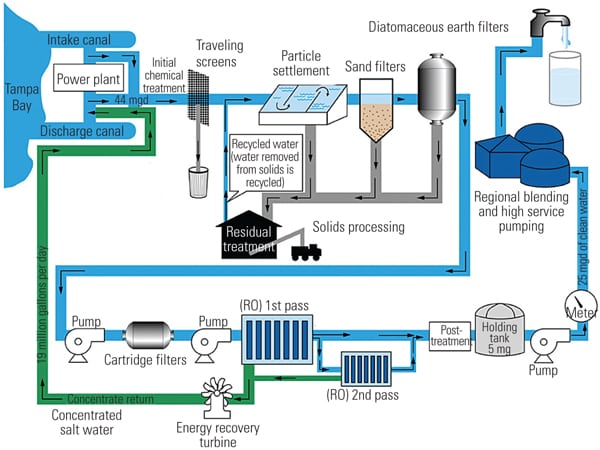 |
| 1. Tampa Bay Water produces 25 million gallons per day of drinking water from seawater. The desalination plant is located next to Tampa Electric’s Big Bend Power Station and “catches” the plant’s warm cooling water discharge for desalination. Starting from the upper left, screens filter out shells, wood, and other debris greater than ¼ inch from ocean cooling water for landfill disposal. The cooling water next is given time for the heavier solids to settle and be removed. The sand filters remove smaller solids from the water, diatomaceous earth filters remove microscopic materials, and cartridge filters protect the reverse osmosis membranes. Next, ocean water, under high pressure, is pumped through reverse osmosis membranes to remove the salt. The concentrated salt water (only 1% to 1.5% more salty) is mixed with ocean water and returned to the discharge canal that leads to the bay. The clean water undergoes several additional treatment steps before arriving at the Regional Blending Station 14 miles away, where the desalinated water is blended with treated surface water and then delivered through the municipal water system to customers. Source: Tampa Bay Water |
SWRO is also power intensive. One study estimated power requirements of SWRO in a range of 9.5 to 26 kWh/kgal of desalinated water or about 9.5 to 26 cents per gallon of water (at a power cost of $0.10/kWh).
Recovery (the permeate produced divided by the feedwater flow rate) is between 35% and 50%, which is lower than the 75% to 85% that is typical of RO processes that are using potable or well sources to produce high-purity water for makeup to the steam cycle.
Handling the reject from the RO process can be an issue. In some U.S. desalination facilities, the brine is injected in very deep wells far below the well water sources. Others discharge the brine back into the ocean
Option 2: Thermal Distillation
Thermal distillation can be in the form of multi-stage flash (MSF) distillation and multiple-effect distillation (MED) units. MSF distillation is the older technology and is more energy intensive because it requires a high-pressure steam source. The Ras Laffan Power and Water Plant, located in Ras Laffan Industrial City, Qatar, is a good example of a combined power and flash distillation project. A POWER Top Plant in 2010, the 800-MW combined cycle plant provides the steam for four, 21-stage flash evaporators, each capable of producing 10 mgd of potable water. The water and steam plants are tightly interconnected. Low-pressure steam is provided by the combined cycle plant to the desalination plant’s MSF units and later is returned through the condensate recovery system. In turn, distillate from the desalination plant is provided to the combined cycle plant, which uses it for its cooling tower makeup and steam cycle (Figure 2).
 |
| 2. Tightly integrated. At the Ras Laffan power and water plant in Qatar, the combined cycle plant provides steam to run the multi-stage flash evaporators that produce freshwater from seawater and the water plant supplies all of the power plant’s water needs. The 800-MW combined cycle plant provides sufficient steam to produce 40 mgd of potable water to the region. Courtesy: Ras Laffan Power Co. |
Multiple-effect distillation has a number of advantages and seems to be tailor-made to be used with a combined cycle power plant. Others have even suggested that MED technology could be used in a hybrid configuration with solar at existing fossil plants. (See “Adding Desalination to Solar Hybrid and Fossil Plants” in the May 2010 issue, available at https://www.powermag.com.)
In an MED unit, a saturated low-pressure steam source (less than 30 psig) runs inside thin tubes while seawater is sprayed on the outside, creating a distillate vapor. This heat transfer occurs in a compartment or “effect.” There are multiple effects in a single distillation unit. The vapor that is generated becomes the heat source for heating the seawater for the next effect. The final effect is under vacuum using the incoming seawater to condense the vapor and make distillate (Figure 3).
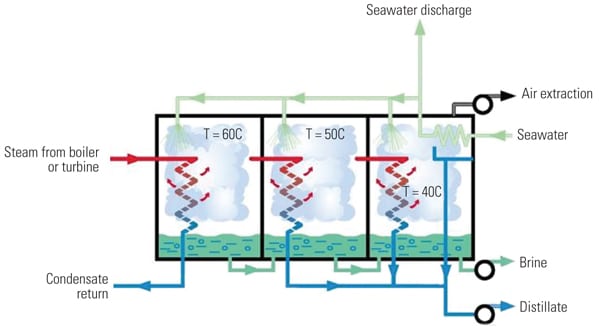 |
| 3. Triple-effect MED. Here’s how the French company SIDEM, a subsidiary of Veolia, which has approximately 80% of the multiple-effect distillation (MED) market share in the Middle East, describes the operation of the typical MED system. The MED evaporator consists of several consecutive cells maintained at a decreasing level of pressure (and temperature) from the first (hot, left) to the last (cold, right). Each cell (also called an effect) contains a horizontal tube bundle. The top of the bundle is sprayed with seawater make-up that flows down from tube to tube by gravity. Heating steam is introduced inside the tubes. Since tubes are cooled externally by make-up flow, steam condenses into distillate (freshwater) inside the tubes. The heat released by the condensation (latent heat) warms up the seawater outside the tubes and partly evaporates it. Due to evaporation, seawater slightly concentrates when flowing down the bundle and produces brine at the bottom of the cell. The vapor raised by seawater evaporation is at a lower temperature than heating steam. However, it can still be used as a heating medium for the next effect, where the process repeats. In the last cell, the produced steam condenses in a conventional shell-and-tubes heat exchanger. This exchanger, called “distillate condenser” or “final condenser,” is cooled by seawater. At the outlet of the final condenser, part of the warmed seawater is used as make-up for the unit, and the other part is rejected to the sea. Brine and distillate are collected from cell to cell until the last one, where each is extracted by centrifugal pumps. The heating steam of the first effect is generally low-pressure condensing steam (as low as 0.3 bar abs). Other heating media (such as hot water) may also be used. Source: SIDEM |
In some cases, MED efficiency is increased further by thermo-compression of the distillate vapor at specific points in the process. Higher-pressure steam is blended with vapor to create more steam at the optimum temperature to heat the seawater without causing scaling.
The brine created by this distillation process is less than 1.5 times the salinity of the incoming water and close to the same temperature as the cooling water outlet temperature for a once-through power plant during the summer months. Depending on the source and salinity of the surrounding water, the brine can be blended with seawater before being discharged or handled in other ways.
Pretreatment of the seawater is generally limited to simple screening and chlorination. Other than the pumps transporting the seawater to the MEDs, there are very few moving parts and very low auxiliary electricity requirements. One study estimated the electrical consumption for MED technology with thermo-compression at 5.7 to 9.5 kWh/kgal—much less than for SWRO.
The thermal efficiency of a unit is described as the gain output ratio (GOR). This is defined as the quantity of distillate produced per unit of steam used. The GOR on a conventional MED unit depends on the number of effects, often three or more. That is, for every 1,000 pounds of low-pressure steam sent to the MED, 3,000 or more pounds of potable water are generated from the seawater. Adding thermo-vapor compression doubles that value.
The Largest Desalination Plant in the World
The Kingdom of Saudi Arabia is a country rich in oil and natural gas but poor in freshwater supplies. Currently, more than 25% of the world’s desalination capacity is located in Saudi Arabia, and more plants are under construction.
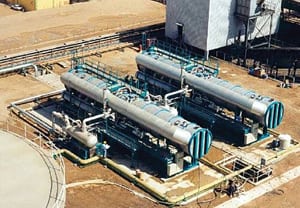
The Marafiq Integrated Water and Power Plant is a combined power and desalination plant located near Jubail on the western shore of the Persian Gulf with a generating capacity of 2,750 MW. At the time it was built, it was the largest desalination plant in the world, producing 178 mgd of freshwater.
The site is divided into four power blocks. Each of the first three power blocks is composed of a 3 x 1 combined cycle plant: three GE 307FA combustion turbines and one backpressure steam turbine. All the steam exhausted from the three backpressure steam turbines goes to the desalination modules. Power block 4 is configured with three combustion turbines and one condensing steam turbine with a seawater-cooled titanium condenser. The fourth power block is used exclusively for power generation. Each gas turbine exhaust feeds a Doosan single-drum heat-recovery steam generator (HRSG) that operates at 1,500 psig (10 MPa). Each HRSG also has a duct burner that is used to increase the steaming capacity of the HRSGs (Figure 4).
 |
| 4. Powering the desert. These are three heat-recovery steam generators of one of the four power blocks at the Marafiq Integrated Water and Power Plant. The four power blocks together are rated at 2,750 MW. Courtesy: David Daniels |
Ocean water desalination is provided by 27 multi-effect desalination modules (MED) with thermo-compressors. These were built by the French company SIDEM, a subsidiary of Veolia. Each of the first three power blocks is able to provide the steam needs of nine MEDs (Figure 5).
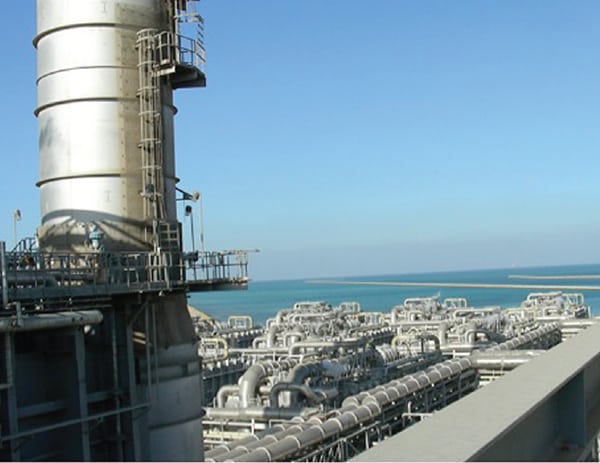 |
| 5. Water is life. This shot shows several of the MED desalination units at the Marafiq Integrated Water and Power Plant. The entire plant can produce 178 mgd of freshwater for the region. Courtesy: David Daniels |
Two types of steam are supplied to the MEDs. Exhaust steam from the noncondensing turbine leaves the turbine at 266F and 25 psig (130C and 0.27 MPa). There is also a turbine extraction point at 446F and 250 psig that provides steam to the MEDs. The low-pressure (LP) and medium-pressure (MP) steam that is sent to the MEDs never comes in close contact with seawater; instead, it heats some of the MED distillate that in turn generates the steam to warm the seawater. These large heat exchangers are called the LP and MP steam transformers.
This degree of separation between the HRSG steam and the desalination units ensures that the risk of seawater contamination of water in the HRSG is very remote—far less than for the conventional seawater-cooled condenser used on power block 4.
The low-pressure steam created in the LP steam transformer is sent through tubes in the MED while seawater is sprayed on the outside of the tubes. Steam generated by the MP steam transformer is blended with distillate vapor in a thermo-compressor to substantially improve the production of each distillation unit.
Distillate is not very tasty. To improve its palatability and reduce its potential for corrosion (distilled water can be very aggressive to brass valves and fixtures and steel piping), its pH is first adjusted with carbon dioxide and then the water is sent through a limestone bed that increases its hardness and improves the taste.
The four power blocks and MSD units were commissioned together between October 2009 and June 2010. Except for outages, the first three power blocks that supply steam to operate the desalination plants are continuously operated. Block 4 operates based on power demands in the Jubail area.
The U.S. Is Slow to Learn
In general, desalination plants and power plants have not been developed in tandem in the U.S. Middle Eastern and other countries are more pragmatic when it comes satisfying water and power needs.
Even though joint development of combined cycle power and desalination has been successfully demonstrated globally many times, it gets little traction in the U.S. However, for those coastal regions with uncertain water supplies, perhaps the construction of new gas-fired combined cycle plants to replace decommissioned coal plants provides the unexpected opportunity to simultaneously solve power and water supply problems.
— David G. Daniels (david_daniels@mmengineering.com) is a principal of M&M Engineering and a contributing editor to POWER.