When it is completed, later this summer, the UK’s Drax Power Station biomass facility will become the largest dedicated cofiring project of its kind in the world. As U.S. coal-fired generators come under increasing pressure to cut emissions and take advantage of incentives to promote power generation from renewables, Drax offers an example of what is possible.
Although there currently is no federal law in the U.S. related to the use of renewables, many states have renewable portfolio standards to drive the use of renewables in power generation. These policies, which may be mandatory or voluntary, require or encourage electricity producers within a given state to generate a specified share of their electricity supply from renewable resources such as wind, solar, or biomass.
In areas that have forest products or agricultural waste, biomass can be the most economical of the various renewable sources. Accordingly, utilities operating within such states are showing tremendous interest in how to take advantage of this renewable resource.
While building dedicated biomass-fired plants is an option, an attractive alternative is cofiring biomass with coal in large coal-fired plants. Cofiring is not only more efficient than burning biomass in small, dedicated plants, it also offers the generator greater fuel flexibility while reducing emissions of SOx, NOx, and other pollutants. (Also see “OPG Charts Move from Coal to Biomass,” April 2010; “Biomass Cofiring: Another Way to Clean Your Coal,” July 2009; and “PSNH’s Northern Wood Power Project Repowers Coal-Fired Plant with New Fluidized-Bed Combustor,” August 2007.)
Burning Biomass with Coal
There are three main methods of introducing biomass into a coal-fired utility boiler. In the co-milling method, biomass can be added to coal before it is milled and then passed through the existing milling system. Using an existing coal-milling system, however, limits the quantity and type of biomass that can be fired. A typical limit is 5% cofiring (by heat input basis) or less.
Alternatively, the biomass can be gasified to produce low-calorific-value gas, which can then be fired in either a boiler or combustion turbine. However, this can be a complex and relatively expensive process when used upstream of an existing conventional utility boiler.
Another method is to use a dedicated cofiring system, where the biomass is processed and milled separately from the coal. This technique offers the best CO2 abatement versus cost ratio of all cofiring solutions. It also increases the proportion of biomass that can be fired to more than 10% by mass. Importantly, the technology also lends itself particularly well to existing coal-fired power plants. As a retrofit project, a relatively quick installation and short tie-in time is possible, often using the existing grid connection as well as road and rail links.
Alstom has been involved with biomass power generation for almost two decades and much longer in the pulp and paper industry in the U.S. However, its first utility-scale cofiring retrofit project was carried out in the Netherlands. In 2004, Alstom successfully designed, installed, and commissioned a dedicated cofiring system on the 640-MWe tangential coal-fired boiler at Essent Energy’s Amer 8 Power Station in the Netherlands. This dedicated biomass-firing system was designed to fire up to 14% biomass on a heat input basis.
In 2006, Alstom designed, installed, and commissioned a dedicated biomass-firing system for two 500-MW coal-fired boilers at Fiddler’s Ferry Power Station in the UK. This was the UK’s first dedicated cofiring project, enabling the cofiring of biomass at up to 20% on a thermal heat input basis. The success of Amer 8, together with its fossil fuel–firing expertise, and success at Fiddler’s Ferry led to Alstom being awarded the contract for the Drax Power Station.
Large-Scale Cofiring
At 4,000 MW, Drax is the UK’s largest coal-fired power station. The plant, which supplies 7% to 8% of the country’s power requirements, consumes about 10 million metric tons (mt) per year of coal, making it a major source of CO2 emissions. As such, Drax is the most important dedicated cofiring project to date in terms of its scale and carbon emissions reduction potential (Figure 1).
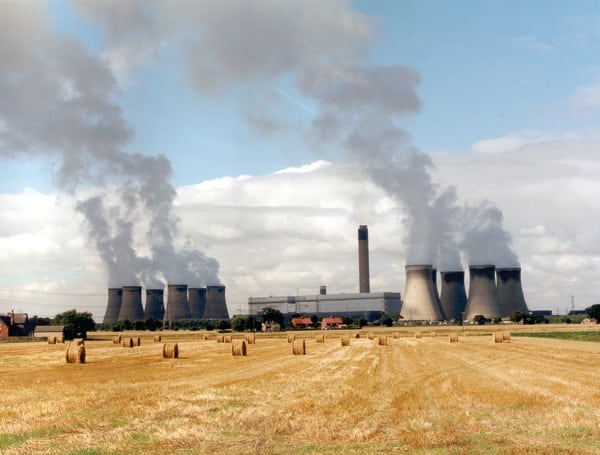 |
| 1. Cofiring central. The 4,000-MW Drax Power Station is the largest coal-fired power plant in the UK. Drax expects to produce up to 10% of its electricity from cofiring biomass once the plant modifications are completed mid-year. Courtesy: Alstom Power |
Drax operates in baseload mode for six months of the year and operates flexibly through the summer months. In winter, about 250,000 mt of coal arrive at the plant each week. With this quantity of coal being consumed, Drax Power Ltd. finds managing the carbon emissions from the plant to be one of its biggest challenges.
Drax Power Station produces around 22 million mt/year of CO2 and emits 815 kg of CO2/MWh compared to an industry average of 950 kg of CO2/MWh. However, the CO2 issue remains important in the European Union.
Drax Power Ltd. set for itself a very aggressive target of producing 12.5% of its output from renewables by mid-2010. This has the potential to save over 2.5 million mt of CO2 each year. Part of these plans is Drax’s approximately £80 million ($150 million) investment to expand its biomass cofiring capability. Once completed, it will be the largest dedicated cofiring project in the world. The plant will burn a variety of biomass, such as peanut husks, straw, wood, and energy crops.
The Master Plan
Drax began preparations for burning biomass in 2003 when it first put biomass through its mills with coal. Then in 2005 it started a cofiring pilot project on one of the plant’s six 660-MW generating units.
The success of this pilot led to a decision to install a dedicated cofiring scheme across all six units. This project, which will take 36 months from design to commissioning, has the capacity to process fuel for 400 MW, meaning that 10% of the plant’s generating capacity will be capable of being fueled by about 1.5 million mt/year of biomass.
Drax Power Ltd. made the decision to build a commercial cofiring project in 2008. The project was split into three separate contracts: the injection system; the rail unloading facility; and the processing works to receive, handle, store, and process various biomass materials. Following a detailed design study, the approximately £50 million ($80 million) contract for the processing works was awarded to Alstom Power in early 2008.
As the world’s largest biomass cofiring scheme, Drax requires (with all six units firing) 500 cubic meters of biomass an hour to be unloaded, processed, stored, milled, transported, and fired. Drax had previously been using the existing coal delivery system and co-milling biomass by using the existing milling system. This approach limited the throughput and the type of biomass fuels that could be fired. Instead, a dedicated fuel-handling and preparation system ensures that the biomass does not affect the existing coal delivery plant.
The project has progressed smoothly to date. The first two units at Drax began part operation in December last year, the second two began operating in early February 2010, and in April 2010 all six units became operational. The entire installation is scheduled to be fully operational by mid-year.
Through plant photos and 3-D renderings, figures 2 through 7 illustrate the biomass process flow from collection through firing.
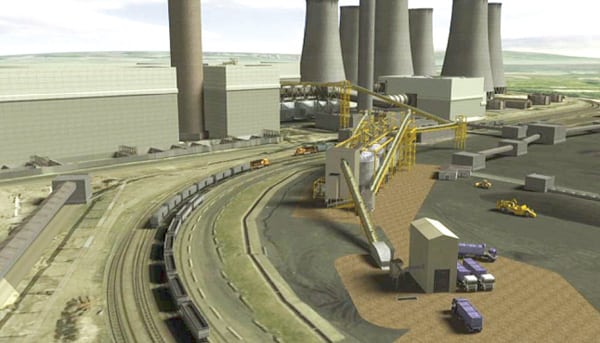 |
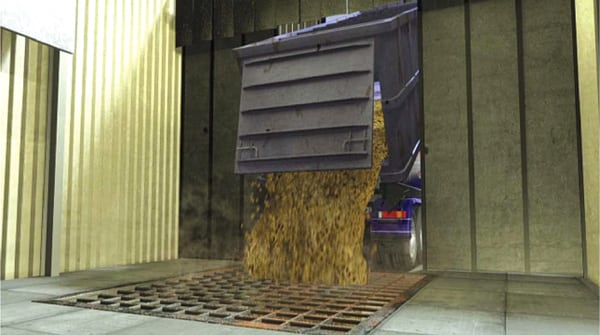
| 2 Receive the fuel. As a retrofit project, there were demanding construction challenges and constraints due to the existing plant’s footprint. These challenges were overcome by installing the road unloading, storage, and process works in a coal stockyard away from the boiler building. The road unloading area receives around 250 mt/h of biomass, which is unloaded by five or six trucks. Courtesy: Alstom Power |
 |
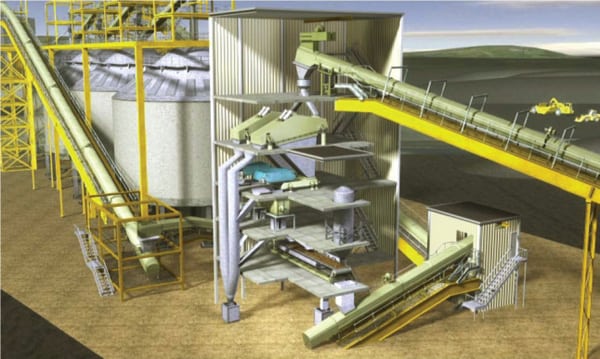
| 3. Unload the fuel. The biomass is transported from the road unloading building via an enclosed conveyor system that uses an air cushion to reduce fuel agitation and contain dust emissions. Courtesy: Alstom Power |
 |
| 4. Process the fuel. The biomass fuel then enters a processing facility, where a series of processes including agitation and magnetic separation are used to separate out any metallic objects or stones from the biomass. At the processing facility, a sample of the biomass is taken for testing using a sampling system. Courtesy: Alstom Power |
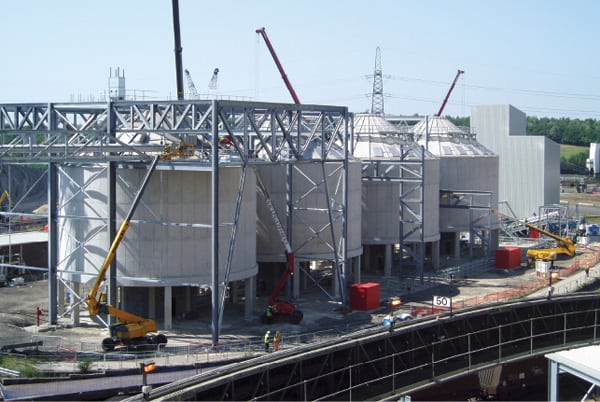 |
| 5. Convey the fuel. The biomass is then transported by conveyor from the process facility to four bulk storage silos, each with a capacity of 3,000 m3. Courtesy: Alstom Power |
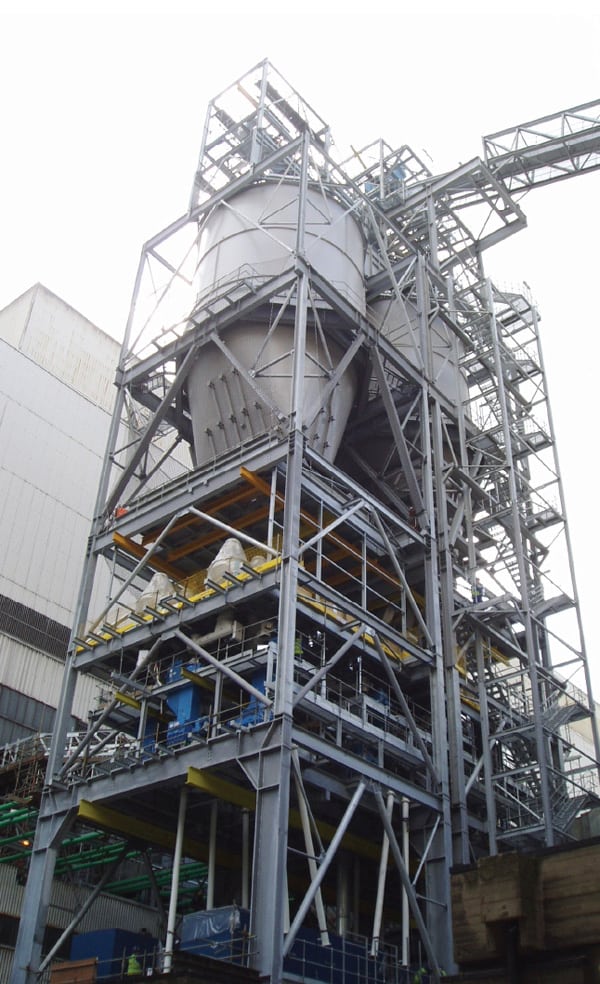 |
| 6. Store the fuel. From the bulk storage silos, the biomass is transported across the power plant to three smaller (day) silos, located just outside of the boiler building. This methodology ensures minimal disruption to the plant’s day-to-day operations. Each of these day silos can store enough fuel for two of the plant’s six units. Courtesy: Alstom Power |
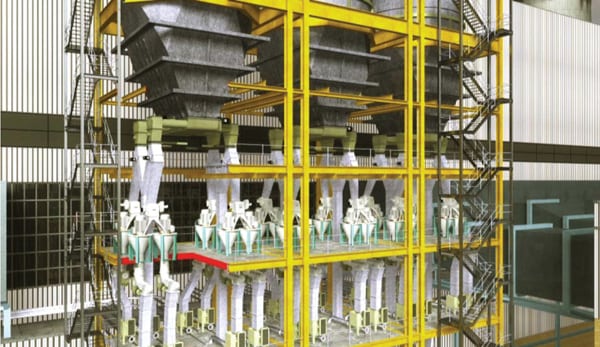 |
| 7. Grind and fire the fuel. The final processing and milling follows when the biomass is fed to a series of hammer mills that grind it into a fine powder. An air knife blower is used to remove any remaining particulates and contaminates. The biomass is then fed into an existing pulverized fuel line, where it is mixed with coal and fed to the burners of each boiler. Due to the wall-fired design of the boilers at Drax, no modifications are needed to the existing burners, which reduced the capital cost of the project. Courtesy: Alstom Power |
U.S. Activity Picks Up
With plants like Drax, Fiddler’s Ferry, and Amer 8 as references, Alstom is well positioned to help move biomass into the mainstream as a fuel source for power generation. Drax also provides a glimpse into the potential for biomass energy to be used in electricity production in the U.S., a market that is still dominated by coal-fired generation. We find many utilities are exploring the cofiring option at their coal-fired plants. One key decision is whether to use engineered or raw fuel, crops, or forest residues.
There are also a number of boiler-specific technical questions to be answered, such as how to maintain boiler efficiency and steam temperatures for optimum performance. Generally, the type of fuel selected will strongly determine the effect on boiler operation, requiring a holistic approach to plant modifications. Once you know the amount and type of biomass fuel available, the costs associated with maintaining boiler performance—and the impact on emissions such as SOx, NOx, CO, CO2, heavy metals, and particulates—can be determined. Other effects on the boiler, such as the potential for slagging and corrosion, must also be considered in any retrofit design.
—Sam Saimbi (sam.saimbi@power.alstom.com) is head of business development, Derby, UK; Doug Hart (doug.hart@power.alstom.com) is manager of engineering, Windsor, U.S., for Alstom Power.