Twice a day, 115 billion tons of saltwater churn in and out of the Bay of Fundy, a funnel-shaped pocket of the Atlantic Ocean wedged between the Canadian provinces of New Brunswick and Nova Scotia. Swelling steadily through the 174-mile journey to the narrow head of the bay at Minas Basin, tidewaters can surge to 53 feet—the highest in the world (Figure 1). More spectacular is the force harbored within these unique waters as a result of a natural anomaly: The sloshing effect created by tidal resonance—a coincidence in the time taken by a large wave to travel the length of the bay and back and the time between the high and low tides—can amplify these tides with enough energy to supply most of Ontario’s electricity needs.

1. World’s highest tides. During a springtime high tide (top), waters at the head of Minas Basin in the southeastern corner of the Bay of Fundy may surge to heights of 53 feet. At low tide in autumn, much of the bay becomes exposed, appearing like a wide channel of braided rivers (bottom). Depth is indicated by dark blue for deep water and purple for shallower water. Source: NASA
Despite the sheer power potential of this region—and others worldwide, such as the Bristol Channel in the UK, an inlet that shares similar geographic characteristics—only one commercial-scale power project has been implemented in the Bay of Fundy: the 18-MW Annapolis Royal Generating Station in Nova Scotia. That plant is the sole operating commercial tidal energy generating station in North America, and one of only three in the world. It shares its barrage technology with the 1966 Rance River plant in France, a larger installation with peak power capacity of 240 MW and annual production of 600 GWh, and Kislaya Guba, a 400-kW project in northwestern Russia. Even the Annapolis station did not begin operation until 1984—and only after several other efforts to construct tidal power plants in the region had failed.
The idea to harvest tidal energy from the Bay of Fundy extends as far back as 1925, when Maine voters approved $100 million to support hydraulic engineer Dexter Cooper’s proposed construction of a power plant to reap power from the tides racing through Passamaquoddy Bay on the Maine coast. Around the same time an official feasibility study was begun for construction of an 800-MW tidal power scheme on the Severn estuary in the Bristol Channel. But while the Severn study concluded that the project was technically feasible, it was thought of as economically unsound.
President Franklin D. Roosevelt thought the Passamaquoddy project would make vital contributions to the nation’s burgeoning power needs and granted it $10 million of federal funding in 1935. Nevertheless, this project, like many others in the long history of marine energy, never materialized.
But now, that’s all about to change.
The marine energy renaissance
Increasing concerns about the environmental, economic, and strategic costs of relying on fossil fuels, coupled with the widespread success of wind and solar power, are giving new life to hopes of capturing energy from the oceans. Oceanic bodies—which collectively cover a little more than 70% of the planet’s surface—may be a potentially significant, currently untapped reservoir of energy.
Decades of research and development have yielded several innovative ways of using oceans to fuel power generation. They include wave energy, ocean current energy, salinity gradient energy, and ocean thermal energy. Recently, with determined governments and companies in tow, several ocean power prototypes have been tested and pilot plants commissioned.
In 2006, for example, following a 22-year-long power-project lull in the Bay of Fundy, the Electric Power Research Institute (EPRI) of Palo Alto undertook a continent-wide study and identified four potential sites for commercial-scale power generation. EPRI’s list included three passages around Deer Island in Passamaquoddy Bay and Nova Scotia’s Minas Passage.
The study’s results immediately prompted Nova Scotia and New Brunswick to begin the site-evaluation process, and three companies secured permits to test their technologies in the Bay of Fundy. Last year, Nova Scotia Power announced that, following the successful installation in the Minas Basin of a tidal demonstration project by OpenHydro, the manufacturer of an open-center stand-alone turbine, the Canadian utility plans to develop large-scale tidal farms in the region.
In addition to being renewable, some types of marine energy, particularly those that derive generation from waves, or from tidal and ocean currents, are predictable (which gives them an edge over wind and solar power). Tides, determined by lunar gravitational pull, can be forecast years in advance, and currents can be mapped by satellite. Doing so could help guard against blackouts.
Offshore or submerged zero-emission turbines would also offer an added aesthetic benefit not enjoyed by offshore wind turbines: invisibility.
Among marine power’s disadvantages are a host of environmental uncertainties and a long list of technical hurdles, from operation to installation. Yet, as the ensuing stream of research and development yields significant results, it can be said with some certainty that the fledgling sector of marine power is about to grow up and take off.
The remainder of this article is a survey of the different concepts currently in use or under development for the extraction and conversion of marine energy to electricity.
Wave power
Created when winds—which result from the planet’s heat differentials—pass on their energy to the oceans, waves are in essence a concentrated form of solar energy. According to an International Energy Agency estimate, wave energy could supply between 10% and 50% of the world’s yearly electricity demand of 15,000 TWh.
Several competing approaches have emerged to convert the kinetic energy of waves into electricity.
Pelamis. The floating snake-like Pelamis has already evolved from prototype to operating unit. Three of these devices collectively generate 2.5 MW at full capacity at the world’s first wave farm in Aquaçadora, northern Portugal. The device relies on vertical wave motion to move articulated joints in the body, which then pump high-pressure oil through generator-driving hydraulic motors. A 250-kW prototype module is 360 feet long and over 10 feet in diameter. Power-holding company Enersis has issued a letter of intent for an additional 20 MW of Pelamis equipment to expand the wave farm project, and plans are under way to use Pelamis technology to power an Orcadian wave farm in Scotland.
Buoy technologies. The buoy concept typically consists of modular buoy-arrays moored several miles offshore in choppy waters.
Finerva Renewables’ AquaBuOY converts the vertical component of waves’ kinetic energy into electricity by directing pressurized seawater through two-stroke hose pumps into a turbine-driven generator. The power is transmitted to shore via an undersea transmission line. Finerva is developing the first phase of a 2-MW commercial power project site using this technology in Fiqueria de Foz in Portugal. Construction of a 100-MW wave energy plant is planned if this project is successful.
Scottish company AWS Ocean Energy has devised an anchored underwater buoy generator system using Archimedes Wave Swing (AWS) technology (Figure 2). The buoys would drive generators as they bob with passing waves, and a pressurized gas cylinder inside the buoy would cause a float to oscillate based on the pressure differential of the water depth above as the wave passes. The AWS buoy was successful in its 2004 pilot test. The company plans to facilitate commercial development and deployment of the technology using a recent £2 million grant from the Scottish government.
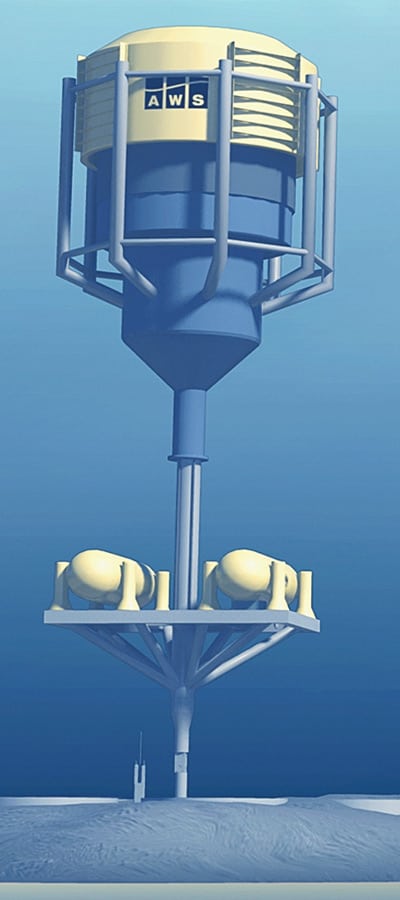
2. One of the buoys. Buoys using Archimedes Wave Swing technology enjoyed a successful pilot test in 2004. The technology recently won a £2 million ($4 million) grant from the Scottish government. Courtesy: AWS Ocean Energy
Ocean Navitas’ technology, known as the Aegir Dynamo, functions by generating electrical current from wave motion in one phase via direct mechanical conversion and the use of a custom buoyancy vessel. Ocean Navitas has tested a 1-MWh buoy in the Orkneys, in Scotland, and plans to place a five-buoy array off the Welsh coast.
Iberdrola Renewables has begun testing an innovative U.S.-manufactured buoy called Power Take Off (PTO), which captures and processes wave energy for storage. The energy is later evacuated under optimum conditions. The company estimates that an array of 10 PTO buoys could produce 1.24 MW.
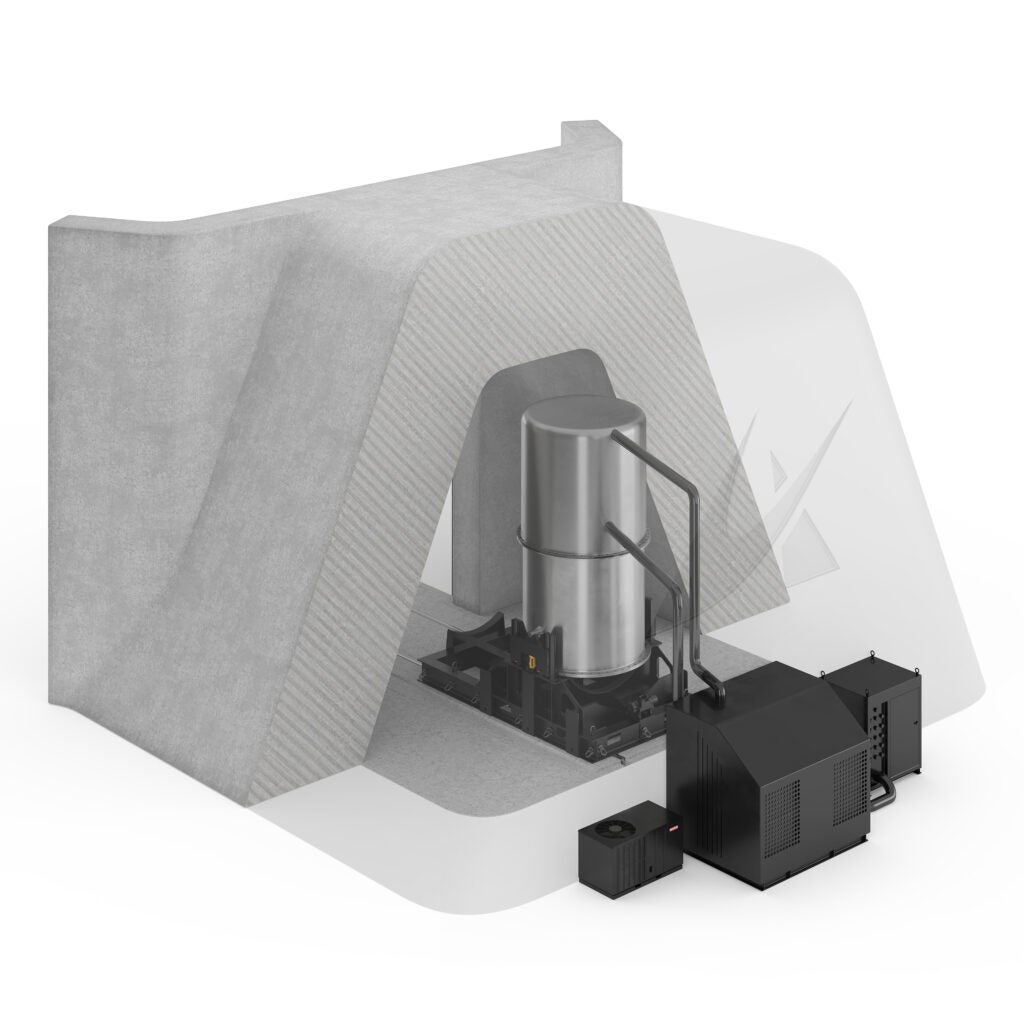
Breakwater and shoreline technologies. Voith Siemens Hydro’s Wavegen technology is integrated into a concrete power station built on a breakwater or coastal protection project. Breakwater turbines, each with an output of between 20 kW and 100 kW, are based on the oscillating water column (OWC) principle. Waves create oscillations on the water’s surface in a partially submerged hollow chamber that’s open at the bottom. The oscillations continuously compress and decompress an air column above the chamber. The difference in pressure converts the rotational energy to electricity via a turbine-driven generator (Figure 3). The world’s first breakwater power station is currently under construction in Mutriku on the Atlantic coast of Spain.
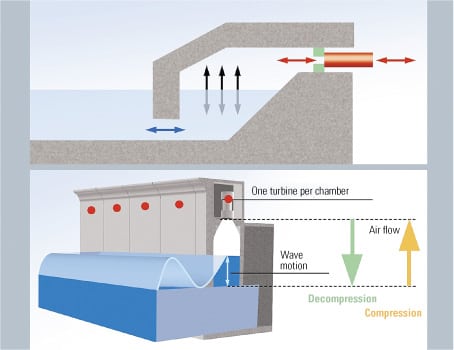
3. A breakwater turbine. Voith Siemens Hydro’s Wavegen technology employs the oscillating water column principle. Courtesy: Voith Siemens Hydro
Wavegen has also developed the Land Installed Marine Powered Energy Transformer (LIMPET), a shoreline energy-converter that uses an OWC to feed a pair of counter-rotating turbines, each driving a 250-kW generator. The current LIMPET model, Limpet-500, installed on a pilot plant on Scotland’s Islay island, is being performance optimized. If the pilot is successful, LIMPET will be used to build a series of commercial power generators.
Floating barge technologies. The Wave Dragon is a large floating barge with dynamic turbines that produces energy much as a low-head hydro power station does. By facing its outstretched collector arms toward oncoming waves, the Wave Dragon can concentrate the wave front toward the ramp at the front of the structure. This increases the wave height at the ramp—which acts like a beach, causing the waves to break over it and into the reservoir behind it (Figure 4). Electricity is generated when water runs through the turbines in the bottom of the structure. A 7-MW Wave Dragon device tested in Pembrokeshire in southwest Wales was commissioned in 2007 (Figure 5) and will be deployed this summer (see sidebar).
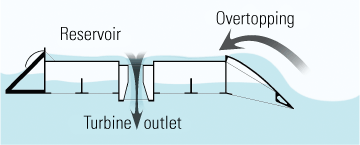
4. Wave Dragon. This floating barge’s design increases the wave height at the ramp, which, like a beach, causes waves to break over it and into the reservoir behind it. Courtesy: Wave Dragon Ltd.
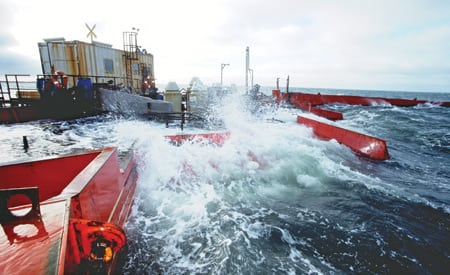
5. Welsh wave power. This Wave Dragon device will generate enough power to supply 2,500 to 3,000 homes. Courtesy: Wave Dragon Ltd.
Moving power from the ocean to land
To support the diverse portfolio of emerging designs for the capture and conversion of wave energy, some companies and government agencies are developing underwater transmission projects to facilitate prototype testing in a wide range of sea and weather conditions.
The $56 million Wave Hub, situated off the coast of Cornwall in South West England, acts like a subsea socket for offshore technologies like Pelamis and buoy wave energy converters, sending electricity 10 miles to the grid via an onshore substation. When it is operational in 2009, the Wave Hub will accommodate up to 30 devices and collect and transmit enough power to meet South West England’s target of generating 15% of its electricity from renewable sources (Figure 6).
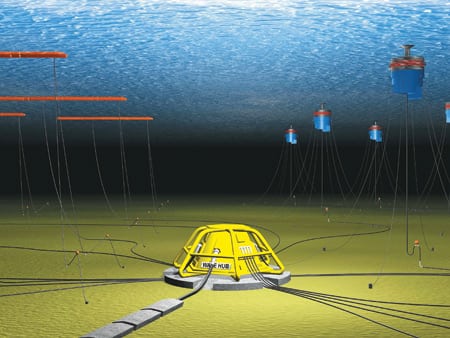
6. Taming the tentacles. The Wave Hub is designed to simplify the connection of multiple marine power–generating devices to land-based electricity grids. Courtesy: Wave Hub
Tidal power
The most significant difference between wave and tidal energy is that waves occur only in water closest to the surface, whereas the entire water body moves from surface to seabed in a tide. In tides, moreover, energy is due to a net movement of water—unlike waves, where the water acts as a carrier for energy. Unlike wave energy, therefore, tidal energy is location-specific.
Although only a few regions in the world harbor ideal conditions for tidal power, a range of diverse devices have been designed and are ready for testing and deployment. The UK, notably, has surged to the forefront of the tidal power race, propelled by a recent Sustainable Development Commission (SDE) report estimate that, considering how geographically well-suited the islands are to the technology, tidal energy has the potential to generate about 10% of the UK’s power.
Barrage systems. The concept of building dams composed of gated sluices and low-head hydro turbines across channels to harness water-level differentials has been proven productive by long-standing installations like the Annapolis station in the Bay of Fundy and La Rance, in France. Costs and environmental issues aside, researchers at Utrecht University in the Netherlands have deemed the concept feasible and have proposed that a dam constructed across the 20-mile Bab al Manab strait of the Red Sea could generate as much energy as 50 GW (see "Dam the Red Sea?" in POWER, January 2008, Global Monitor).
And now, more than 80 years after the first feasibility study, the UK government has renewed its interest in constructing a 10-mile-long barrage across the Severn tidal estuary running between the English and Welsh coasts, prompted by an SDE finding that a location-specific hydroelectric barrier on the estuary could generate 8.6 GW—meeting 5% of Britain’s power needs. Britain has allocated £14 million ($28 million) for the feasibility study, which is expected to culminate in early 2010.
Meanwhile, to reap energy from the Bay of Fundy, Canadian company Blue Energy International is advancing technologies used in tidal dam power with a “tidal fence” concept—a horizontal array of stand-alone vertical-axis turbines. This configuration, which can capture energy from both directions of a tide, has so far seen six prototypes and is currently being assessed by the National Research Council of Canada.
Tidal stream turbines. Making a marked departure from the traditional barrage system, tidal stream turbines are massive stand-alone turbines that work much like wind turbines—but with a much higher energy density, because saltwater is 850 times denser than air.
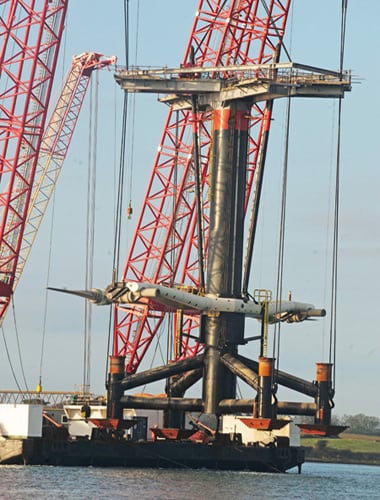
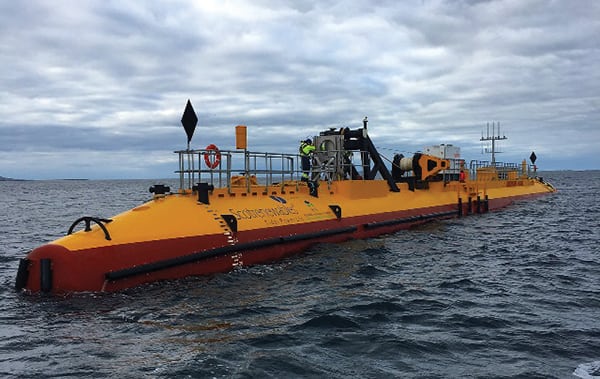
7. First commercial-scale tidal energy turbine. SeaGen’s 52-foot-diameter twin rotors will operate for up to 18 to 20 hours per day off the coast of Northern Ireland, producing up to 1.2 MW. Courtesy: Marine Current Turbines Ltd.
In April 2008 the first commercial-scale tidal turbine from Bristol-based company Marine Current Turbines, a 122-foot long inverted windmill dubbed the SeaGen, was installed in Strangford Laugh, a shallow inlet in Northern Ireland where tides gush in at speeds of up to 9 mph (Figure 7). Energy produced by the 1.2-MW device will be purchased by ESB Independent Energy, a retail subsidiary of Ireland’s national electricity company—and one of the first utilities to provide tidal energy to its customers.
Deep-sea tidal farms. British tidal company Lunar Energy plans to construct two deep-sea tidal farms. One would consist of eight underwater turbines on the sea bottom in Pembrokeshire, South Wales; the other would be a colossal 300-turbine field in the Wando Hoenggan Water Way off the South Korean coast. The latter project, a collaboration with Korean Midland Power Co., is a $1 billion scheme that extracts power from fast-moving deep-sea tidal streams. Lunar Energy will utilize 60-foot-tall Rotech Tidal Turbines, each with a 2,500-ton frame containing a pump, generator, motor, and electronics (Figure 8). The project entails a full resource research and feasibility study, and if successful, it will be operational by 2015.
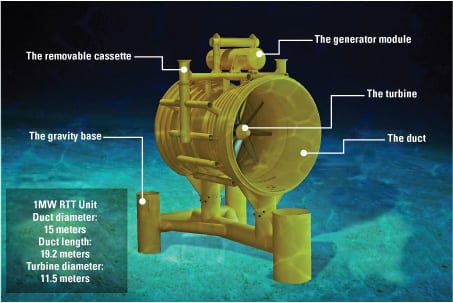
8. Harnessing tidal power. Each 60-foot tall Rotech Tidal Turbine consists of a 2,500-ton frame containing a pump, generator, motor, and electronics. Courtesy: Lunar Energy
Ocean current energy
Oceanic bodies are constantly in motion, propelled by a variety of factors, including winds, water temperature, salinity levels, and the Coriolis force. Surface currents—which constitute about 10% of all the water in the oceans—are restricted to the upper 1,300 feet of the oceans and predominantly derive their energy from the wind and the sun.
According to the U.S. Minerals Management Service, the world’s oceans harbor about 5,000 GW of power, with densities of up to 1.5 kW/f2. By some estimates, this means that capturing just 0.1% of the available energy from the Gulf Stream—which has 21,000 times more energy than Niagara Falls and a flow 50 times that of the world’s freshwater rivers collectively—could generate enough power to supply Florida with 35% of its electrical needs.
Compared with other ocean energy technologies, the harnessing of ocean current power is still in its infancy. A handful of prototypes and demonstration units have been developed, including Hammerfest Strøm’s submerged wind-like turbines that capture energy with hydrodynamic, rather than aerodynamic, lift or drag. However, developers of this technology continue to grapple with a long list of potential problems, from complex and costly maintenance to the potential disruption of delicate marine ecosystems.
Open-center turbine. The stand-alone open-center turbine that features a fixed outer disk and a rotating inner disk is thought to suit both tidal stream and ocean current applications. Gulfstream Energy Inc.’s device is designed to be anchored to the seafloor, 200 feet below the surface. Installed 5 miles offshore in Florida’s Gulfstream, where the current flows at an average sustained speed of 3 knots, the turbine could produce an estimated 2.5 MW of power.
OpenHydro’s open-center turbine, on the other hand, has been applied to the extraction of tidal stream energy with such promising results that the company will engage in a demonstration project in the Bay of Fundy. The device has a self-contained rotor fitted with a solid-state permanent magnet generator, all encapsulated within an outer rim (Figure 9).
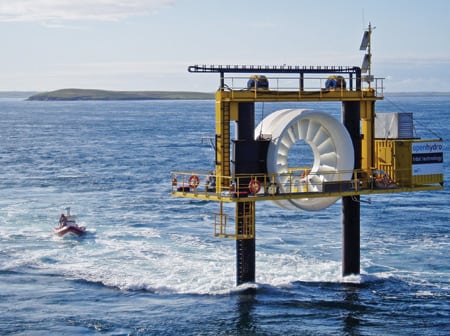
9. Goes with the flow. OpenHydro’s open-center turbine extracts tidal stream energy and will be used in a demonstration project in the Bay of Fundy. Courtesy: OpenHydro
Salinity gradient energy
It has been estimated that 2.6 TW may be derived from exploiting the salinity gradient—or salt differential—between the world’s seawater and freshwater. The process, called pressure-retarded osmosis (PRO), basically involves pumping seawater at 60% to 85% of the osmotic pressure against one side of semipermeable membranes whose other side is exposed to freshwater.
When freshwater, compelled by osmosis, flows across the membranes, it dilutes the saltwater and increases its volume—and consequently, the pressure within the saltwater chamber. A generator-driving turbine is spun as the pressure is compensated. (For details of the PRO process see "Osmotic power from the ocean" in POWER, November/December 2006.) PRO can be thought of as the reverse osmosis process (used for desalination and water treatment) running backward and producing power from the flow of freshwater.
A decade of collaborative research and development by the Norwegian University of Science and Technology and Statkraft, a Norwegian power company, has yielded promising results, including the development of a high-performance membrane. In 2007, Statkraft initiated construction on the world’s first osmotic plant prototype. The plant, at Tofte on the Oslo fjord, scheduled for completion by the end of 2008, will produce between 2 kW and 4 kW of power.
Ocean thermal gradient energy
Tides and currents aren’t the only potential energy source we can harness from the oceans. Oceans also absorb and store tremendous amounts of solar energy. According to the National Renewable Energy Laboratory, 23 million square miles of tropical seas absorb an amount of solar radiation equal in heat content to about 250 billion barrels of oil—a tenth of which could supply 20 times the power needs of the entire U.S. on any given day. The technology for converting this solar radiation into electrical power is ocean thermal energy conversion (OTEC), which exploits the ocean’s thermal gradients—temperature differences of 36 degrees F or more between warm surface water and cold deep seawater—to drive a power-producing cycle.
Besides sourcing a clean, renewable reserve of energy, OTEC has the potential to provide many useful by-products such as freshwater, hydrogen via electrolytic processing of freshwater, and lithium and uranium, which may be extracted from deep seawater. Despite these potential payoffs, OTEC development has been gradual, primarily because of competitive operation costs. The technology was first proposed as far back as 1881 by a French physicist, and several prototypes have been tested intermittently since the first experimental 22-kW low-pressure turbine was deployed in 1930.
Closed-cycle OTEC. In the closed-cycle version of OTEC, warm seawater from the ocean’s surface vaporizes a working fluid with a low boiling point, such as ammonia, which then flows through an evaporator. The vapor expands and turns a generator-driving turbine. The vapor is then condensed using cold seawater pumped from deep within the ocean. The working fluid is continuously recycled within this closed system.
Open-cycle OTEC. In the open-cycle variant of this technology, warm seawater becomes the working fluid and is flash-evaporated in a vacuum chamber, producing pressurized steam. The steam then expands through a low-pressure turbine. Cold seawater condenses the steam, and, if it remains separated, could supply desalinized water as a by-product.
Hybrid-cycle OTEC. A hybrid-cycle OTEC employs features of both the closed and open cycles (Figure 10). Warm seawater is flash-evaporated, the steam is used to vaporize the working fluid, and that fluid drives a turbine. Finally, steam condenses and provides desalinized water.
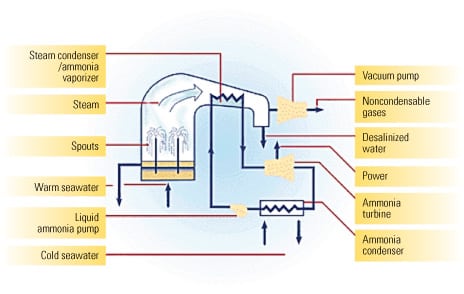
10. Hybrid model. Ocean thermal energy conversion (OTEC) takes advantage of ocean temperature gradients to generate power. In the hybrid OTEC process, warm seawater is flash-evaporated, the steam is used to vaporize the working fluid, and that fluid drives a turbine. Source: National Renewable Energy Laboratory
Although components to test the technology are widely available, no commercial-scale plants—or even pilot plants connected to a grid—exist. The most ambitious prototype to date was an Indian research vessel that carried a 1-MW OTEC plant in 2002. That effort, a collaboration with the Japanese company Xenesys Inc. and Saga University in Japan, was unsuccessful due to a failure of the deep sea cold water pipe.
Xenesys is determined to power on, however. It opened a research and development center dedicated to OTEC last November to meet what it sees as increased demand as a result of renewed interest. According to its web site, the Indian government plans to construct 1,000 OTEC power plants, each 50,000 kW, throughout the country. And the island nation of Palau is planning to launch a 3,000-kW OTEC plant; it hopes to make a complete switch from diesel oil for power generation to OTEC in the next 10 years. Xenesys said that it has been receiving offers for research support and technical collaboration from more than 50 countries, including South Korea, the Philippines, Indonesia, Sri Lanka, Maldives, Cook Islands, and the United States.
Companies like U.S.-based Sea Solar Power Inc. (SSP) have also continued to test and develop key elements of the hybrid Rankine cycle OTEC plant. SSP President James H. Anderson Jr. penned articles for POWER as far back as 1965 with his father, J. Hilbert Anderson, regarding the feasibility and economic viability of power harvested from the ocean’s thermal gradient. The younger Anderson asserts that the technology continues to have tremendous potential—that the only setback it may experience is a lack of interest from the government.
The Andersons had estimated in 1965 that it would cost $5.54 million to set up a floating 20-MW “sea thermal” plant, including the installation of major equipment and auxiliaries plus the cost of services such as engineering and supervision. Today, a small but commercial-sized floating OTEC plant of 20 MW—which could be built in as little as 39 months—could cost from $120 million to $190 million.
Energy islands
Architects Dominic Michaelis and his son Alex recently proposed in an entry to the Virgin Earth Challenge (a competition for solutions to combat global warming) that a series of floating sea-faring platforms could be effectively outfitted to reap many forms of renewable energy. Each “energy island” would be fitted with wave energy devices, wind turbines, and solar panels; each could also harbor a small OTEC plant. With the right conditions, according to the Michaelises, one platform could generate as much as 250 MW of energy.
A decade ago, this idea would have been considered fanciful. Now, considering the advantages such a construct could provide in support of developing renewables, the concept is being taken more seriously.
Last year, Dutch electric company KEMA and civil engineering firm Bureau Lievense announced they have been investigating the technical feasibility and economic viability of an artificial “Energy Island” for storing large-scale energy off the Dutch coast (Figure 11). The 6.2-mile by 3.7-mile island would incorporate a fall lake, or a pumped energy storage (PES) facility.
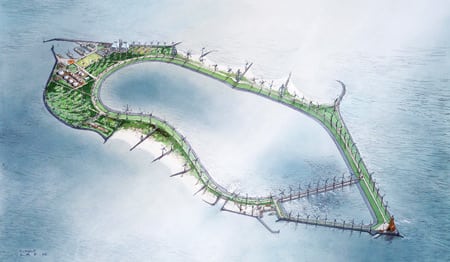
11. Watery “energy island.” One scheme for “offshoring” energy storage uses an unusual type of pumped energy storage that depends on a dike-enclosed lake—which is filled with water 105 feet to 130 feet below sea level. Courtesy: KEMA
The method reverses the principle on which a conventional PES facility works. When power supply exceeds demand, seawater is pumped out of the dike-enclosed lake—which is filled with water 105 feet to 130 feet below sea level—and back into the surrounding sea; when demand exceeds supply, seawater flows back in, driving a generator. The 24 square-mile island would potentially store a capacity of 20 GWh, enough to supply an average of 1,500 MW to the onshore grid for at least 12 hours. Several construction companies have expressed interest in building or designing the island, a project that would cost about $4.9 billion and take six years to complete.
Development incentives
Given that marine energy resources have the potential to generate 4,000 TW, as estimated by the British government-funded research group Carbon Trust, it is no surprise that venture capitalists and power companies are flooding the sector with ready money. In spite of the fact that marine-generated electricity currently costs 10 times as much as electricity produced by traditional sources, and undeterred by the abundant risks faced by marine energy firms, private investment will continue to increase. According to one projection, marine energy will constitute up to 20% of Europe’s total renewable resources by 2020—compared with the 40% projected for wind power.
Governments, too, are lending their support to this new wave of power generation. The UK government and other public-sector organizations have invested around £15 million ($29 million) in the creation of the European Marine Energy Center, the research facility committed to help emerging technologies evolve from prototype to the commercial marketplace. And the EU is backing the Wave Energy Centre in Portugal, a facility to provide strategic and technical support to companies in this field.
Comparatively, U.S. support is lagging. Despite increased interest in this emerging sector, the Federal Energy Regulatory Commission has only issued one license, awarded to Finerva Renewables’ Makah Bay wave pilot project in Washington State. So far this year, four preliminary licenses have been issued, including two to Pacific Gas & Electric Co. wave projects off the coast of California.
Last year, though approved by the U.S. House Science Committee, a marine renewable energy and development bill (H.R. 2313) that would have appropriated $250 million from 2008 to 2012 was seemingly abandoned before the House vote. And, echoing the fate of marine energy research and development projects born in the Carter and Reagan eras that lost their funding in the 1980s, the DOE’s Energy Efficiency and Renewable Energy 2009 budget for its Water Power Program proposes only $3 million—a 70% decrease from the $9.9 million Congress appropriated for 2008.
Marine energy’s future
If marine energy is to thrive, the monster hurdle that developers must overcome is the cost factor. Following an 18-month initiative, Carbon Trust found in a detailed study of the cost-competitiveness and potential growth of wave and tidal stream energy that marine energy will remain more expensive than other forms of generation until the sector sees the installation of hundreds of megawatts of capacity. Four routes may potentially reduce costs: concept design developments; detailed design optimizations; economies of scale; and lessons learned from production, construction, installation, operation, and maintenance.
Additionally, future growth of wave energy will be affected by a range of factors, among them: strategic and security-of-supply considerations, the availability of financing for technology and project development, technology and risks, electricity networks, and environmental and regulatory factors.